
One missed date. That is all it takes to wipe out years of research, thousands of dollars in prosecution costs, and a client’s entire patent right. This is not a theoretical risk; it happens to real firms every year, and it is exactly why so many patent attorneys, paralegals, and IP managers ask the same question: what is double-docketing in patent law?
In simple terms, double-docketing in patent law is the deliberate practice of recording every critical deadline in two independent tracking systems instead of one. Rather than trusting a single database, a single calendar, or a single person’s memory, firms build in a second, separate layer of verification. If the first system fails, misses a date, or contains a data-entry error, the second system catches it before the consequences become irreversible.

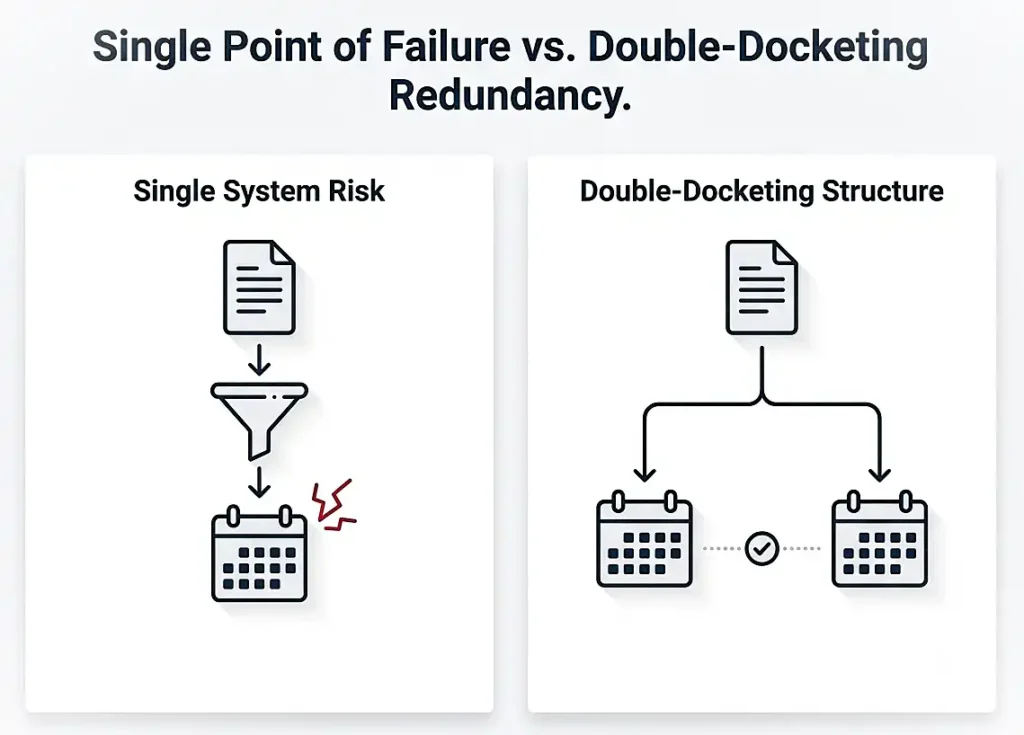
For anyone working in intellectual property, docketing is not administrative busywork tucked away in the back office. It is the operational backbone of the entire practice. Every patent application, every office action response, every national phase entry, and every maintenance fee lives and dies by a date on a calendar. When that date is missed, there is often no second chance. Double-docketing exists precisely to remove that single point of failure.
In this comprehensive guide, we will explore what double-docketing actually means, why it has become a standard risk-management practice across the IP industry, how to implement it correctly from day one, the mistakes that quietly undermine even well-intentioned systems, and how firms of every size, from solo practitioners to large intellectual property departments, can build a docketing infrastructure that genuinely protects clients.
Double-Docketing in Patent Law
What is Double-Docketing in Patent Law?
Double-docketing in patent law refers to the redundant, independent tracking of statutory and office-imposed deadlines across two separate systems, calendars, or reviewers. Instead of relying on a single docketing database maintained by one person, firms maintain a secondary, independent check, often through a different software platform, a manual calendar, or a second docketing professional, to confirm that the dates in both systems match.
At its core, double-docketing answers one uncomfortable but necessary question: what happens if the primary system is wrong? Rather than hoping that scenario never occurs, well-run firms design their entire deadline management process around the assumption that errors will eventually happen, and they build a structure that catches those errors before they become client-facing disasters.
Quick Definition
Double-docketing is a risk-management practice in patent and trademark prosecution where every critical deadline is independently entered and cross-checked in two separate tracking systems, in order to prevent missed filings caused by human or software error.
Why the Term “Double” Matters
The word “double” is doing important work here. It does not mean simply reviewing the same entry twice, and it does not mean having one person glance over another person’s shoulder. True double-docketing requires two genuinely independent processes: two separate data entries, ideally made by two different people, and ideally recorded in two different systems. Consequently, if one entry contains a typo, a miscalculated deadline, or a missed notification, the second, independently created entry has a real chance of catching that error.
Why Double-Docketing Matters in Patent Prosecution
Patent deadlines are unforgiving in a way that few other areas of law can match. Missing a response date to a USPTO office action, a national phase entry deadline, or a maintenance fee due date can result in the permanent, irreversible abandonment of a patent application. There is often no equitable relief, no extension, and no second attempt.
Consequently, double-docketing matters because it directly protects three interconnected things that every IP practice depends on:
- Client assets – A missed deadline can mean the total, permanent loss of patent rights that took years and significant financial investment to develop.
- Firm reputation – Docketing errors are among the leading causes of legal malpractice claims in intellectual property practice, and reputational damage often outlasts any financial settlement.
- Malpractice insurance standing – Many insurers now specifically ask about redundant docketing protocols during underwriting, and firms without them may face higher premiums or reduced coverage.
Claim
Exposure
Damage
Premium Increase
Furthermore, as patent portfolios grow more complex, with PCT filings, multiple national phase entries across different jurisdictions, and layered office action deadlines stacking on top of each other, a single point of failure becomes an increasingly dangerous bet. A firm managing ten patents can survive a minor docketing hiccup. A firm managing a thousand-patent portfolio cannot.
This is exactly why more firms, regardless of size, are formalizing double-docketing as a standard operating procedure rather than treating it as an occasional or optional safeguard reserved only for high-value clients.
How Double-Docketing Works: Step-by-Step
Implementing double-docketing is not technically complicated, but it does require genuine discipline, clear ownership, and consistent execution. Here is how most well-run firms structure the process from start to finish.
- Primary entry. A docketing professional enters the deadline into the main IP management software immediately after receiving an office action, notice, or filing confirmation. This entry should happen the same day the document is received, not days later.
- Independent secondary entry. A second person, or in some cases a separate automated system, enters the same deadline independently, without simply copying the first entry. This independence is the entire point of the exercise.
- Cross-verification. Both entries are compared on a scheduled basis, commonly weekly, to catch any discrepancies between the two records.
- Discrepancy resolution. Any mismatch triggers an immediate review against the original USPTO or client correspondence to determine which entry, if either, is correct.
- Escalation protocol. If a deadline falls within a critical window, for example thirty days or fewer, both systems automatically flag it for direct attorney sign-off before any action is finalized.
- Audit trail documentation. Every verification step, discrepancy, and resolution is logged, creating a defensible record that protects the firm if a dispute or malpractice inquiry ever arises.
Additionally, many firms rotate which staff member handles the secondary entry on a monthly or quarterly basis. This rotation reduces the chance that the same blind spot, misunderstanding, or shortcut appears consistently in both systems, since a fresh set of eyes is more likely to catch an error that a familiar routine might miss.
A Practical Example
Imagine a firm receives a non-final office action with a three-month statutory response deadline. Under a single-docketing system, one paralegal calculates the date, enters it into the software, and moves on. If that calculation is off by even a few days, due to a miscounted month or an overlooked extension rule, nothing catches the error until it is potentially too late.
Under double-docketing, a second paralegal, working independently and without seeing the first entry, calculates the same deadline separately. When the two entries are compared during the weekly cross-check, any discrepancy is immediately visible, giving the team time to resolve it correctly, well before the actual due date arrives.
Single Docketing vs. Double-Docketing: A Comparison
| Feature | Single Docketing | Double-Docketing |
|---|---|---|
| Number of tracking systems | One | Two, independently maintained |
| Error detection method | Relies on one reviewer | Cross-checked by a second, independent entry |
| Risk of missed deadline | Higher | Significantly reduced |
| Staffing requirement | Lower | Higher, but scalable through outsourcing |
| Malpractice insurance appeal | Standard | Often preferred or specifically required |
| Audit trail strength | Limited | Strong, with documented cross-verification |
| Best suited for | Very small, low-volume solo practices | Firms managing active, growing, or international portfolios |
Which Docketing Model Fits Your Firm?
Practice
Portfolio
International
As the table above shows, double-docketing does require more resources upfront, primarily in the form of staff time or outsourced support. However, most firms find that the incremental cost of a second verification layer is genuinely minor compared to the financial and reputational cost of even a single missed deadline. In many cases, one avoided abandonment pays for years of the additional docketing overhead.
The Types of Deadlines Most Commonly Double-Docketed
Not every date on a patent portfolio calendar carries the same level of risk, but experienced docketing teams tend to prioritize double-checking the following categories:
- Office action response deadlines, including both non-final and final office actions, since these carry strict statutory response windows.
- National phase entry deadlines under the PCT system, which are notoriously strict and generally non-extendable once missed.
- Maintenance fee and annuity payment deadlines, particularly for portfolios spanning multiple countries with different fee schedules.
- Priority claim deadlines, including the twelve-month window for claiming priority from an earlier filed application.
- Terminal disclaimer and information disclosure statement (IDS) deadlines, which are easy to overlook but can still affect the enforceability of a granted patent.
- Appeal and petition deadlines, which often carry shorter windows and higher stakes than routine prosecution deadlines.
Firms that double-docket only the “obvious” high-stakes dates, while treating administrative deadlines as lower priority, often discover too late that even seemingly minor filings can carry serious downstream consequences.
Common Mistakes Firms Make With Double-Docketing
Even well-intentioned firms frequently undermine their own double-docketing systems without realizing it. Some of the most frequent mistakes include the following.
- Copy-pasting instead of independent entry. If the second entry is simply copied from the first, any original calculation error carries over completely unchecked, defeating the entire purpose of redundancy.
- Using the same software for both systems. A platform-wide bug, outage, or synchronization failure can compromise both entries simultaneously, which is precisely the scenario double-docketing is meant to prevent.
- Skipping cross-verification during busy periods. Deadlines often slip precisely when workload spikes, which is unfortunately exactly when verification matters most.
- No clear escalation owner. Without a specifically named person responsible for resolving flagged discrepancies, issues can sit unresolved until it is too late to fix them safely.
- Treating double-docketing as optional for “minor” deadlines. Even administrative deadlines, such as certain IDS filings, can carry serious consequences if missed. For related guidance on this specific issue, see our article on why accurate IDS reference management matters in patent prosecution.
- Failing to update both systems after an amendment. When a deadline is extended, amended, or otherwise changed, teams sometimes update only one of the two systems, quietly recreating the single point of failure the process was designed to eliminate.
- Relying entirely on automated calendar sync without human review. Software integrations are useful, but they are not infallible, and a purely automated double-docketing process without periodic human verification can still miss context-specific nuances.
Expert Tips for Building a Reliable Double-Docketing System
Based on years of hands-on docketing experience across patent and trademark portfolios, here are practical, field-tested tips that make double-docketing genuinely effective rather than a box-checking exercise performed for appearances.
Platforms
Ownership
Alerts
Review
Trail
Redundancy
- Use two different software platforms where possible. Relying on the same underlying system for both entries defeats much of the redundancy that double-docketing is supposed to provide.
- Assign clear, individual ownership. One docketing professional should own the primary entry, and a different, specifically designated person should independently own the secondary check.
- Automate reminders at multiple intervals, such as sixty, thirty, and fourteen days before a deadline, rather than relying on a single alert that can be easily missed or dismissed.
- Review docketing accuracy on a quarterly basis, not only when a problem happens to surface on its own.
- Train staff thoroughly on statutory deadline calculation, using authoritative references such as the Manual of Patent Examining Procedure (MPEP), since docketing software is only as accurate as the dates that are entered into it.
- Document every discrepancy resolution to create a defensible audit trail that protects the firm if a dispute or malpractice inquiry ever arises later.
- Build in redundancy for staff absences. A double-docketing system that depends on two specific individuals, both of whom might be unavailable at the same time, is not truly redundant.
- Periodically test the system deliberately. Some firms run internal audits where a known deadline is intentionally checked to confirm both systems would have caught a discrepancy if one existed.
Firms managing high-volume trademark portfolios face very similar deadline-management challenges. Our guide on how to prevent missed deadlines in trademark docketing covers additional strategies that pair naturally with double-docketing.
Double-Docketing and Outsourced IP Management
Many small and mid-sized firms find that maintaining two fully independent, internally staffed docketing systems is simply not realistic given their current headcount and budget. This is exactly where outsourced docketing support becomes genuinely valuable. A dedicated external docketing partner can serve as the secondary, independent verification layer, without requiring the firm to hire, train, and retain additional in-house staff for a function that, while critical, does not need to be performed entirely internally.
This hybrid approach is particularly useful for firms currently weighing their internal capacity against growth in their patent portfolio. If you are unsure whether to build this function entirely internally, our comparison of hiring an in-house versus a virtual patent paralegal walks through the relevant trade-offs in detail. Similarly, for firms specifically evaluating vendors for this purpose, our breakdown of the best patent docketing services for small firms is a useful next resource to review.
What to Look for in an Outsourced Docketing Partner
When evaluating whether an outsourced provider can genuinely serve as your secondary docketing layer, consider the following criteria:
- Independent software infrastructure, separate from your firm’s primary docketing platform.
- Documented cross-verification procedures, not just data entry services.
- Clear escalation protocols for time-sensitive deadlines.
- Experience with your specific practice areas, whether that is domestic prosecution, PCT filings, or trademark portfolios.
- Transparent audit trail reporting that your firm can access and review at any time.
Choosing a partner without these features may create the appearance of redundancy without the actual risk protection double-docketing is meant to provide.
Double-Docketing Across the Broader IP Lifecycle
Double-docketing does not operate in isolation. It fits within a firm’s broader intellectual property management strategy, alongside consistent office action tracking, PCT deadline monitoring, and accurate disclosure practices. For a comprehensive view of how these individual pieces connect into a complete system, see our complete guide to intellectual property management.
Firms handling international filings should also pay especially close attention to national phase entry deadlines set under the PCT system, which are a frequent source of double-docketing failures given their strict, generally non-extendable nature. Because these deadlines often fall thirty months from the earliest priority date, and because different jurisdictions calculate that window slightly differently, they represent exactly the kind of high-stakes, easy-to-miscalculate date that double-docketing was designed to protect.
Finally, because office action response deadlines are among the highest-stakes dates a docketing system tracks, it is worth reviewing our detailed guide on what happens if you miss the six-month USPTO office action response window, which explains the specific consequences firms face when this particular deadline slips through the cracks.
First-Hand Perspective: What Effective Docketing Actually Looks Like Day to Day
Firms that have implemented double-docketing successfully often describe it less as a single policy and more as a daily habit woven into the rhythm of the practice. Every incoming USPTO notice, whether it arrives by mail, email, or through the USPTO’s official patent electronic filing system, triggers the same repeatable sequence: log it, calculate the deadline, enter it independently in both systems, and confirm receipt with the responsible attorney.
Over time, this consistency becomes the real safeguard, arguably even more than the redundancy itself. A docketing team that treats every notice with the same disciplined process, regardless of how routine or urgent it appears, is far less likely to let an unusual or unexpected deadline slip through simply because it did not look like the others.
A Repeatable Daily Discipline
Experienced docketing professionals also emphasize the value of context. Two independent entries are useful, but they are most effective when the people making them understand why a particular deadline matters, what happens if it is missed, and how it fits into the broader prosecution strategy for that specific application. Purely mechanical data entry, disconnected from that understanding, is more prone to the exact kind of blind-spot errors that double-docketing exists to catch.
How AI and Modern Docketing Software Support Double-Docketing
Modern IP management platforms increasingly offer built-in tools that support, though do not replace, a genuine double-docketing process. These include automated deadline calculation based on filing dates, integration with USPTO and WIPO databases for real-time status updates, and configurable multi-stage alert systems.
However, it is worth noting that automation alone does not constitute double-docketing. If a single software platform calculates a deadline once and simply displays it in two different views or dashboards, that is not independent verification; it is the same calculation displayed twice. True double-docketing still requires a genuinely separate calculation or entry process, whether performed by a second person, a second independent software instance, or both. Firms should be cautious about vendors that market single-system redundancy as equivalent to double-docketing, since the underlying risk of a shared point of failure remains unchanged.
Double-Docketing by Firm Size: A Practical Roadmap
Not every firm needs to implement double-docketing the same way. The right structure depends heavily on portfolio size, staffing, and budget. Below is a practical roadmap for how firms at different stages typically approach this challenge.
Solo Practitioners and Very Small Firms
Solo practitioners rarely have the staff to run two fully internal, independent docketing teams. Instead, most rely on a combination of:
- A primary docketing software subscription for day-to-day tracking.
- A separate, low-cost outsourced docketing review service that independently verifies key deadlines on a monthly or quarterly basis.
- A personal backup calendar for the highest-risk dates, such as statutory bar dates and office action responses.
This lightweight structure still provides meaningful redundancy without requiring additional hires.
Small to Mid-Sized Firms
Firms in this range typically have at least one dedicated docketing professional, but adding a second full-time internal role purely for verification is often not cost-effective. Consequently, many firms in this category pair their internal docketing staff with an outsourced partner who independently tracks the same portfolio. This structure delivers genuine redundancy while keeping fixed overhead manageable.
Larger Firms and In-House IP Departments
Larger practices, and corporate IP departments managing extensive portfolios, generally build fully internal double-docketing teams, often supported by two separate enterprise-grade docketing platforms. In these environments, double-docketing is frequently paired with formal quality assurance audits, dedicated escalation teams, and quarterly compliance reviews to satisfy both malpractice insurers and internal governance requirements.
Regardless of firm size, the underlying principle remains constant: redundancy should scale with portfolio complexity, not simply with firm revenue. A five-attorney firm managing an unusually large or international portfolio may need more robust double-docketing infrastructure than a much larger firm with a smaller, domestic-only caseload.
The Cost of Getting Docketing Wrong
It is worth pausing on what is actually at stake when a docketing system fails, because the consequences extend well beyond a single missed date.
- Loss of patent rights. In many cases, a missed statutory deadline results in permanent abandonment, with limited or no path to revival.
- Client relationship damage. Even where revival is technically possible, the added cost, delay, and loss of confidence can permanently damage the attorney-client relationship.
- Malpractice exposure. Docketing failures are a well-documented, recurring source of legal malpractice claims specifically within intellectual property practice.
- Increased insurance costs. Firms with a history of docketing errors often face higher malpractice insurance premiums going forward.
- Reputational harm. In a field built heavily on referrals and long-term client relationships, a single high-profile missed deadline can quietly undermine years of reputation building.
Viewed against these risks, the modest additional cost of maintaining a genuine double-docketing system is, for most firms, a clearly worthwhile investment rather than an unnecessary expense.
Frequently Asked Questions
What is double-docketing in patent law, in one sentence? Double-docketing in patent law is the practice of independently recording and cross-checking every critical deadline in two separate tracking systems, in order to prevent missed filings.
Is double-docketing required by the USPTO? No. The USPTO does not mandate double-docketing as a formal requirement. However, it is widely considered a best practice across the industry, and many malpractice insurers favor or specifically require it as part of a firm’s risk-management protocol.
How is double-docketing different from a simple reminder system? A standard reminder system typically relies on a single set of entered dates, with alerts generated from that one source. Double-docketing specifically requires two independent entries, created separately, along with a structured verification process to catch discrepancies between them.
Can small firms realistically implement double-docketing? Yes. Small firms often pair an internal docketing system with an outsourced docketing partner, achieving genuine redundancy without needing to double their internal headcount.
What deadlines should always be double-docketed? At a minimum, firms should double-docket office action response deadlines, national phase entry dates, maintenance fee due dates, priority claim deadlines, and any statutory bar dates.
How often should double-docketed entries be cross-checked? Most firms perform cross-verification on a weekly basis, with additional checks triggered automatically whenever a deadline falls within thirty days.
Does double-docketing eliminate all risk of a missed deadline? No system eliminates risk entirely, but double-docketing significantly reduces it by ensuring that a single error, whether human or software-related, does not go unnoticed until it is too late to correct.
Who typically performs the secondary docketing entry? This varies by firm size. In larger practices, a dedicated second docketing professional handles it. In smaller practices, this role is often filled by an outsourced docketing partner working from an independent system.
Conclusion
So, what is double-docketing in patent law, and why should it matter to your firm specifically? It is a deliberate, structured safeguard that protects clients’ patent rights by ensuring no single error, software glitch, or overlooked entry can result in a missed, irreversible deadline. As portfolios grow more complex and international filings increase in volume, relying on a single docketing system is an increasingly risky bet that fewer firms can afford to make.
Whether you build this capability internally or partner with an experienced docketing team, the underlying goal remains the same: genuine redundancy that catches mistakes before they become irreversible client losses. If your firm is ready to strengthen its docketing infrastructure and reduce the risk of a missed deadline,

