
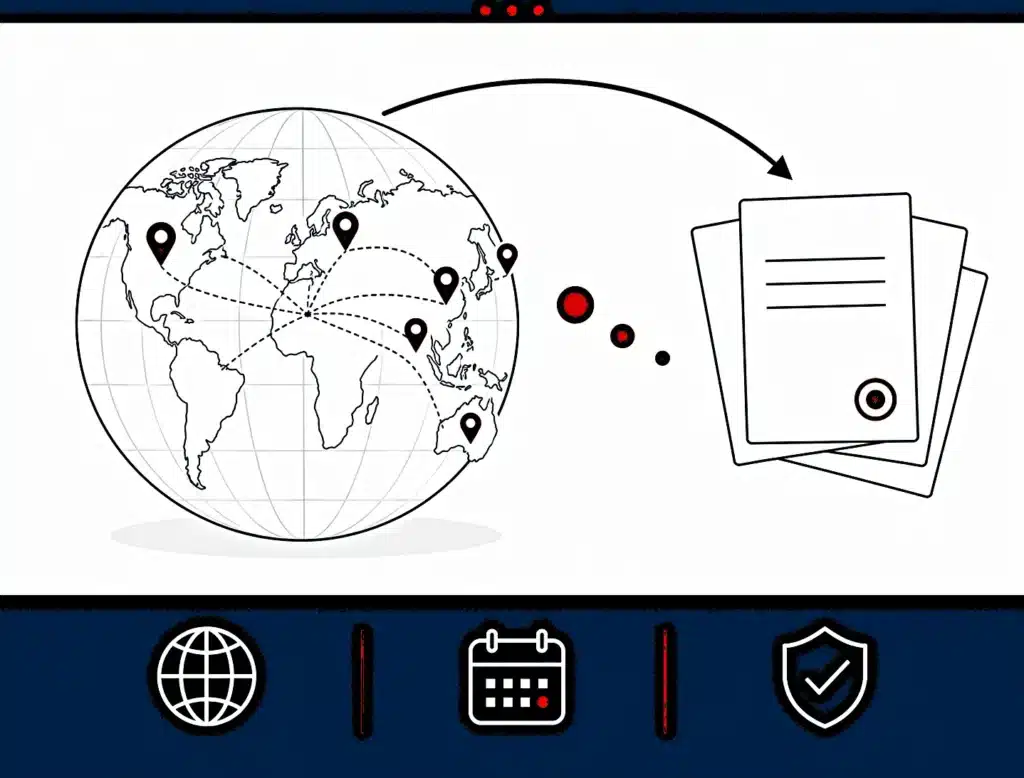
If you have ever wondered how the PCT patent process works, you are far from alone. For inventors and businesses seeking international patent protection, understanding the Patent Cooperation Treaty (PCT) system is one of the most critical steps in building a global IP strategy. The PCT patent process works as a unified international filing mechanism that lets applicants pursue patent protection in over 150 countries through a single application. Rather than filing separately in every country from day one, you file once, buy valuable time, and then decide which national markets to enter.

This article walks you through every phase of the PCT process in plain language: from the initial international filing and the formal search report, to the optional examination phase and the all-important national phase entry. Whether you are filing your first PCT application or advising clients through prosecution, this guide gives you the practical, process-driven knowledge to navigate the system with confidence.
What is the PCT System? A Quick Definition
The Patent Cooperation Treaty (PCT) is an international treaty administered by the World Intellectual Property Organization (WIPO). It was established in 1970 and entered into force in 1978. Today, more than 150 member states participate, making it one of the most widely used pathways for international patent protection.
The PCT does not grant international patents. No such thing exists. Instead, it streamlines and consolidates the early stages of the filing process before applicants must commit to expensive national or regional filings. Think of the PCT as a 30-month holding period during which you gather market intelligence, assess commercial viability, and secure funding before committing to country-by-country prosecution.
Quick Answer: What does the PCT system do?
- It allows a single international application to be filed in one language, at one office, for one fee set.
- It provides a standardized international search and, optionally, a preliminary examination.
- It preserves your right to enter the national phase in any member country for up to 30 months from your priority date.
- It gives inventors and businesses time to evaluate their invention’s commercial potential before incurring the full cost of national filings.
How Does the PCT Patent Process Work? A Phase-by-Phase Overview
The PCT patent process works in two main phases: the international phase and the national/regional phase. Understanding each phase, its timeline, and its key actions is essential to managing your application effectively.
Phase 1: The International Phase
The international phase runs from the filing date through to national phase entry (typically at 30 months from the priority date). It consists of four key stages.
Stage 1: Filing the International Application
You begin by filing your PCT application with a Receiving Office (RO). Common Receiving Offices for U.S. applicants include the USPTO as a PCT Receiving Office and WIPO’s own International Bureau directly.
The international application must include:
- A request form (PCT/RO/101)
- A description of the invention
- One or more claims
- An abstract
- Drawings, if applicable
- A reference to the priority application (if claiming priority under the Paris Convention)
The filing date of the PCT application becomes your international filing date. If you are claiming priority from an earlier national or regional application, your priority date is that earlier date, and you must file the PCT application within 12 months of it.
Key practical tip: The language you file in determines which International Searching Authority (ISA) is available to you. U.S. applicants filing in English can choose the USPTO, the European Patent Office (EPO), or other authorized ISAs.
Micro-Entity: 80% reduction on WIPO fee
Stage 2: The International Search
After filing, your application is sent to the International Searching Authority (ISA) you selected. The ISA conducts a thorough prior art search and issues two crucial documents:
- International Search Report (ISR): A list of prior art documents considered relevant to your claims.
- Written Opinion of the ISA (WO-ISA): The examiner’s preliminary, non-binding opinion on whether your invention appears to meet the patentability criteria of novelty, inventive step, and industrial applicability.
The ISR and Written Opinion are typically issued within 9 months of the international filing date (or 16 months from the priority date, whichever is later).
Why this matters: The ISR is published alongside your application and is visible to national offices. A positive Written Opinion strengthens your position; a negative one signals claim issues you should address before national phase entry.
| ISA Document | What It Contains | Timeline |
|---|---|---|
| International Search Report (ISR) | List of relevant prior art | 9 months from filing or 16 months from priority |
| Written Opinion of the ISA | Non-binding patentability assessment | Issued with ISR |
| International Preliminary Report on Patentability (Chapter I) | Final Chapter I report if no demand filed | 28 months from priority |
Stage 3: International Publication
At 18 months from your earliest priority date, WIPO publishes your international application in its entirety, including the ISR. This publication is available in WIPO’s Patentscope database and gives the public – and potential competitors – visibility into your invention.
Important: If you filed without claiming priority from an earlier application, publication happens 18 months from your international filing date. Publication cannot be avoided in most circumstances, so plan your commercialization and licensing strategy accordingly.
Stage 4 (Optional): International Preliminary Examination (Chapter II)
If you want a second, more thorough non-binding assessment of patentability before committing to national phase costs, you can file a Demand for International Preliminary Examination (IPEA) under PCT Chapter II.
To benefit from the extended deadline, you must file the Demand before:
- 3 months from the date the ISR and Written Opinion were established, or
- 22 months from the priority date, whichever is later.
The IPEA then issues the International Preliminary Report on Patentability (IPRP) – Chapter II. This report is more detailed than the Chapter I report and allows you to make amendments to claims and description before the examiner reaches a final opinion.
When to use Chapter II:
- Your Written Opinion raised serious novelty or inventive step objections.
- You want to amend your claims based on the ISR results and receive formal feedback.
- You need a stronger patentability foundation before expensive national filings.
- You are entering jurisdictions that heavily rely on the IPRP in their national phase.
Phase 2: The National / Regional Phase
At 30 months from the priority date, your PCT application transitions into the national or regional phase. This is when the PCT system hands you off to the individual patent offices of each country where you want protection.
What happens at national phase entry:
- You submit a formal national phase entry request to each selected national or regional office (e.g., EPO for Europe, JPO for Japan, CNIPA for China, IPOS for Singapore).
- You pay national filing fees and, where required, translation fees.
- Each national office then examines your application under its own laws and procedures.
- The national examination may rely heavily on the ISR and IPRP but is not bound by them.
Key national phase deadlines:
| Country / Region | National Phase Deadline |
|---|---|
| United States (USPTO) | 30 months from priority date |
| European Patent Office (EPO) | 31 months from priority date |
| Japan (JPO) | 30 months from priority date |
| China (CNIPA) | 30 months from priority date |
| India (IPO) | 31 months from priority date |
| Canada (CIPO) | 30 months from priority date |
| Australia (IP Australia) | 31 months from priority date |
Note: Some countries offer extensions or different rules in specific circumstances. Always verify current deadlines with the relevant office or your IP counsel.
PCT Timeline at a Glance
The following timeline summarizes every critical milestone in the PCT patent process:
| Milestone | Timing |
|---|---|
| Priority application filed | Month 0 |
| PCT application filed | Within 12 months of priority |
| International Search Report (ISR) issued | 9 months from PCT filing / 16 months from priority |
| Application published by WIPO | 18 months from priority |
| Demand for Chapter II (if desired) | By 22 months from priority |
| IPRP Chapter II issued | 28 months from priority |
| National / regional phase entry | 30–31 months from priority (varies by country) |
Who Can File a PCT Application?
To file a PCT application, at least one applicant must be a national or resident of a PCT member state. In practice, this covers most inventors, startups, and corporations operating in major commercial markets.
Eligible applicants include:
- Individual inventors (sole or joint)
- Companies and corporations
- Universities and research institutions
- Government agencies and public bodies
If you are a U.S. applicant, you file your PCT application through the USPTO as your Receiving Office. For Canadian applicants, the Canadian Intellectual Property Office (CIPO) serves this role. Learn more about this specific pathway in our detailed guide on PCT Filing Through USPTO and CIPO: Complete US and Canadian Applicants Guide.
PCT Costs: What You Should Budget For
The PCT process involves fees at multiple stages. While costs vary by ISA selection, applicant size (micro-entity, small entity, or large entity), and the number of countries targeted in the national phase, the typical international phase involves:
International Phase Fees (approximate, USD, large entity via USPTO RO):
| Fee Type | Approximate Amount |
|---|---|
| International filing fee (WIPO) | $1,381 |
| Search fee (USPTO as ISA) | $2,180 |
| Transmittal fee (USPTO RO) | $240 |
| Total International Phase (approximate) | $3,800 – $4,500+ |
Small entities qualify for a 60% reduction on the WIPO international filing fee; micro-entities qualify for a 80% reduction.
National phase fees are separate and vary significantly by country. Filing in 5 to 10 countries during the national phase can cost between $20,000 and $60,000 or more in total, including translation and attorney fees.
PCT vs. Direct National Filing: Which Route is Better?
A common question among applicants is whether to use the PCT route or file directly in each country via the Paris Convention route. Neither approach is universally superior; the right choice depends on your timeline, budget, commercial strategy, and the countries you are targeting.
| Factor | 🌐 PCT Route | 🏳️ Direct National Filing |
|---|---|---|
| 🕒 Timeline Flexibility | ‘Up to 30 months’ to decide | Must commit within 12 months |
| 💲 Upfront Cost | One international fee set | Multiple country fees upfront |
| 🔍 Prior Art Clarity | Unified ISR search report | Each office searches separately |
| 🎯 Best For | 3+ countries; early-stage | 1-2 countries; clear strategy |
| 🔤 Translation Costs | ‘Deferred’ to national phase | Required at filing in most countries |
| ⚙️ Complexity | Moderate; centralized management | Simple for few; complex for many |
For most inventors and businesses seeking protection in three or more countries, the PCT route offers a compelling combination of cost deferral and strategic flexibility.
Common PCT Filing Mistakes to Avoid
Even experienced practitioners encounter pitfalls in the PCT process. Awareness of these mistakes helps you avoid costly errors.
1. Missing the 12-month PCT filing deadline If you have filed a provisional or national application, you must file the PCT application within 12 months of that priority date. Missing this deadline means losing your priority claim – a potentially fatal error.
2. Selecting the wrong Receiving Office Your choice of Receiving Office affects which ISAs are available and which languages are accepted. Always verify compatibility before filing.
3. Failing to respond to the Written Opinion The Written Opinion is non-binding, but ignoring a negative opinion means entering the national phase with known weaknesses in your claims. Address objections proactively.
4. Overlooking national phase deadlines The 30-month national phase deadline is firm in most countries. Missing it can result in the permanent loss of patent rights in that jurisdiction. Use a robust docketing system to track every deadline. Our team at Teak IP’s Docketing and IP Management service is specifically designed to protect against missed deadlines.
5. Filing incomplete or inconsistent application documents Errors in the priority claim, applicant information, or claims can delay processing and require costly corrections. Always perform a thorough pre-filing review.
6. Ignoring sequence listing requirements for biotech applications If your invention involves nucleotide or amino acid sequences, a proper sequence listing in the required format is mandatory. For support, explore Teak IP’s Sequence Listing Services.
7. Underestimating translation requirements Several major jurisdictions, including Japan, South Korea, China, and Germany, require certified translations at national phase entry. Budget for this well in advance.
Expert Tips for Navigating the PCT Process Successfully
Drawing on years of experience supporting patent practitioners through international prosecution, here are the expert insights that consistently make a difference:
Conduct a thorough prior art search before you file. A pre-filing search aligned with the ISA’s methodology helps you anticipate the ISR results and draft stronger claims. You can also review comparable patents in WIPO’s Patentscope database as a starting point.
Draft claims strategically from the outset. PCT claims need to be broad enough to survive multiple national phase examinations under different legal standards. Work with experienced patent counsel who understands how to structure independent and dependent claims for an international audience.
Use the Written Opinion as a strategic tool. Treat the first Written Opinion not as a rejection but as a roadmap. If the examiner identifies prior art that closely reads on your claims, use the Article 34 amendment opportunity to distinguish your invention before entering the national phase. Our article on Advanced PCT Rules, Special Cases, and Technical Details covers amendment strategy in depth.
Align your national phase entry with commercial milestones. Enter the national phase in the countries where you have actual or anticipated commercial activity. Entering 30 countries speculatively is expensive and often unnecessary. Align IP investment with business priorities.
Leverage provisional applications strategically. A U.S. provisional application gives you an early priority date for relatively low cost. You then have 12 months to refine the invention, conduct market research, and prepare a strong non-provisional PCT application. However, be aware of common misconceptions about PCT provisional applications: our dedicated guide on PCT Provisional Applications and Alternative Filing Strategies explains exactly how this works and what mistakes to avoid.
Partner with a specialized PCT support service. Managing the PCT process in-house is resource-intensive. Many law firms and corporate IP departments partner with PCT application specialists to handle document preparation, deadline tracking, and filing coordination. Teak IP’s dedicated PCT Application Services team provides exactly this kind of expert, U.S. attorney-led support.
The PCT and the European Patent Office: A Powerful Combination
One of the most strategically important pathways under the PCT system is the route to a European patent via the EPO. Rather than filing separately in each European country, you can enter the national phase through the EPO and, upon grant, validate the patent in individual European member states.
This EPO route significantly reduces prosecution costs for applicants targeting multiple European markets. It also benefits from the EPO’s renowned examination quality and a well-developed body of appeal decisions.
For a deep dive into how this combined strategy works, read our comprehensive guide on PCT and European Patent Applications: EPO Route.
PCT Patent Drawings: What You Need to Know
Clear, compliant patent drawings are often the difference between a smooth prosecution process and costly objections. Under PCT Rule 11 and the associated Annexes, patent drawings in international applications must meet specific formal requirements:
- Drawings must be on sheets sized A4 or US letter.
- Lines must be uniform, sufficiently dense, and dark.
- Numbering must be consistent with the description.
- No shading is permitted in certain ISA jurisdictions unless specifically allowed.
Non-compliant drawings can result in formality objections from the Receiving Office or the ISA, delaying your international filing date. Teak IP’s Patent Drawing Services team prepares drawings to meet both USPTO and PCT international standards, ensuring you avoid formality objections from the start.
How Teak IP Supports the PCT Patent Process
At Teak IP, we work alongside patent attorneys and IP departments to provide specialized paralegal and technical support across every stage of the PCT process. Our U.S. attorney-led team combines the efficiency of our India-based operations with the responsiveness and expertise of our U.S. professionals.
The Our PCT-related services include:
- PCT application preparation and filing support
- International application document review and formality checks
- PCT deadline docketing and monitoring
- National phase entry coordination and checklists
- Patent drawing preparation to PCT standards
- Sequence listing preparation for biotech PCT applications
- IDS preparation for U.S. national phase entries (learn more: IDS Preparation and Filing Services)
Our flexible, a la carte model means you pay only for the specific services your practice needs, with no minimum commitments.
Frequently Asked Questions (FAQ)
1. How does the PCT patent process work in simple terms?
The PCT patent process works by letting you file a single international patent application that preserves your right to seek patent protection in over 150 countries. You file once, receive a search report and a patentability opinion, and then have up to 30 months from your priority date to decide which countries to enter. Each country then examines your application under its own national laws.
2. Does a PCT application grant an international patent?
No. The PCT system does not grant patents. It is a procedural gateway that simplifies and delays the cost of filing in multiple countries. Actual patent rights are granted by individual national or regional offices during the national phase.
3. What is the difference between PCT Chapter I and Chapter II?
Chapter I refers to the standard international phase, which produces the International Search Report and the Written Opinion of the ISA. Chapter II is an optional additional stage where you can request International Preliminary Examination, allowing you to amend your claims and receive a more detailed patentability assessment before national phase entry.
4. How long does the PCT patent process take?
The international phase of the PCT patent process takes approximately 30 months from the priority date. After national phase entry, prosecution timelines vary significantly by country, ranging from 2 to 5 years or more for grant.
5. How much does the PCT patent process cost?
International phase fees typically range from $3,800 to $4,500 or more for large entities filing through the USPTO, depending on ISA selection. National phase costs depend on the number of countries selected and local attorney fees, often totaling $20,000 to $60,000 or more across multiple jurisdictions.
6. Can I still file in a country that is not a PCT member?
Yes. Countries that are not PCT members cannot be reached through the PCT system. You would need to file directly in those countries under the Paris Convention or via a separate bilateral agreement. Argentina and several other countries have specific filing requirements outside the PCT framework.
7. What happens if I miss the national phase entry deadline?
Missing the national phase entry deadline in most PCT member states results in the permanent loss of patent rights in that country. Some jurisdictions allow restoration of rights under limited circumstances and upon payment of fees, but this is not guaranteed. Robust deadline monitoring is essential to prevent this outcome.
8. Does the PCT patent process work the same way for all types of inventions?
Broadly, yes. The PCT process applies to utility inventions across all technology fields. However, certain special categories, such as utility models, design patents, and plant patents, have jurisdiction-specific rules that may require separate filings. For guidance on these edge cases, see our article on PCT for Utility Models and Special Patent Types.
9. Where can I read the official PCT rules and regulations?
The authoritative source for PCT rules is the WIPO PCT Resources page, which includes the PCT Applicant’s Guide, fee schedules, and links to all Receiving Offices and ISAs. The USPTO PCT Information Center also provides country-specific guidance for U.S. applicants.
Conclusion
Understanding how the PCT patent process works is foundational for any inventor, startup, or corporation building a meaningful international IP portfolio. By filing a single international application, obtaining a unified search report, and leveraging the full 30-month window before national phase entry, the PCT system gives you time, information, and strategic flexibility that direct national filing simply cannot match.
The key to using the PCT process effectively is preparation: file strong, well-drafted claims; respond proactively to the Written Opinion; align your national phase entries with your actual commercial strategy; and manage your deadlines with absolute precision.
If you are ready to file a PCT application or need expert support at any stage of the PCT patent process, Teak IP is here to help. Our U.S. attorney-led team brings deep expertise in PCT application preparation, deadline docketing, patent drawings, and national phase coordination. Contact us today to discuss how we can support your international patent strategy.

