
Advanced PCT Rules form the foundation of one of the most sophisticated and widely utilized systems for filing international patent applications: the Patent Cooperation Treaty (PCT). For patent practitioners, IP professionals, and inventors seeking to protect their intellectual property across multiple jurisdictions, understanding the advanced concepts within the PCT framework is essential. This comprehensive guide explores PCT Rule 92bis, the nuances of PCT patent pending status, the critical phases of PCT international applications, and the technical requirements that govern the filing process. Whether you’re navigating the complexities of a PCT stage patent or managing a PCT request through various examination stages, this resource provides the detailed technical knowledge needed for successful international patent protection.
For patent practitioners and inventors seeking streamlined international protection, our PCT application filing services ensure that every advanced PCT requirement – from Rule 92bis compliance to examination stage management – is handled with precision.

1. Understanding Advanced PCT Rules: PCT Rule 92bis
PCT Rule 92bis stands as one of the most critical regulatory provisions within the Patent Cooperation Treaty framework. This rule specifically addresses the ability of applicants to modify or refine their PCT request under defined circumstances. Understanding PCT Rule 92bis is fundamental for anyone managing an international patent application published under the patent cooperation treaty.
What is PCT Rule 92bis?
PCT Rule 92bis permits applicants to correct errors in their original PCT patent pending filing or make necessary modifications to the request, provided specific procedural requirements are met. This rule is codified within the Regulations under the Patent Cooperation Treaty and serves to prevent applicants from losing patent rights due to technical oversights or administrative mistakes.
Key Definition: PCT Rule 92bis allows the correction of errors in the PCT request, including errors in the names of applicants or inventors, addresses, priority claims, and other bibliographic data-but only within strict time limits and subject to specific conditions.
Scope of PCT Rule 92bis Corrections
The types of corrections permissible under PCT Rule 92bis include:
- Bibliographic Information Corrections: Errors in applicant names, inventor names, addresses, and country designations can be corrected under this rule. For instance, if an applicant’s surname is misspelled in the original PCT international application, Rule 92bis provides a mechanism for correction.
- Priority Claim Corrections: Errors relating to earlier priority applications-such as incorrect filing dates or application numbers—can be addressed through Rule 92bis procedures.
- Entitlement Corrections: In some cases, errors affecting entitlement to priority rights can be corrected, allowing applicants to maintain the benefit of their priority claims in a PCT stage patent application.
- Procedural Information: Corrections to phone numbers, email addresses, and other contact information submitted in the PCT request are also permissible.
Critical Limitation: Rule 92bis does NOT permit changes to the technical content of the application, including amendments to the claims, abstract, drawings, or specification. Such modifications must follow the procedures outlined under Article 19 or Article 34 of the Patent Cooperation Treaty.
Time Limits under Advanced PCT Rules (Rule 92bis)
The procedural timeline is stringent when correcting errors through PCT Rule 92bis:
Filing Procedures for Advanced PCT Rules Corrections
Applicants seeking to make corrections under PCT Rule 92bis must follow this procedural framework:
- Identify the Error: The applicant must clearly identify which element of the PCT request contains an error and specify the correction needed.
- Submit Corrected RO101 Form: The corrected Request Form (RO/101) must be submitted to the Receiving Office, clearly indicating which fields have been modified.
- Payment Considerations: Rule 92bis corrections are typically made without additional fees if they are administrative corrections to the request itself. However, corrections involving re-designation of states or other substantive changes may trigger additional fees.
- Timing Documentation: The applicant must ensure that the corrected request is received within the applicable deadline, with evidence of timely submission.
Practice Tip: When managing a PCT request that contains errors, applicants should act promptly. Filing a Rule 92bis correction well in advance of publication deadlines ensures that the correction will be recognized in the international application published under the patent cooperation treaty pct system, protecting the integrity of the filing.
2. Advanced PCT Rules in the PCT Request Form
At the heart of every PCT request lies the Request Form (RO/101), a detailed document that captures all essential information about the international application published under the pct. This form is the foundation upon which the entire PCT international application rests, and its accurate completion is paramount.
Key Components of the PCT Request Form
The PCT Request Form contains multiple sections, each addressing specific elements crucial to the PCT patent pending filing:
Section 1: Applicant Information
The applicant section establishes the identity of the person or entity seeking patent protection. This section includes:
- Name and Address: The legal name and mailing address of the applicant, formatted according to WIPO guidelines
- National Designation: The applicant’s country of residence or incorporation
- Applicant Category: Classification as an individual, company, public body, or other entity type
- Multiple Applicants: If multiple entities jointly own the invention, each must be listed with their respective information
Important: Errors in applicant information are among the most common sources of PCT patent pending complications. An incorrect applicant name can invalidate priority claims and complicate national phase prosecution.
Section 2: Inventor Information
The inventor designation is critical in jurisdictions that recognize inventor-specific rights. The PCT request must clearly identify:
- Full names and addresses of all inventors, whether they are the applicants or third parties
- The percentage of inventorship for each inventor (in some jurisdictions)
- Whether the inventor is identical to the applicant
Section 3: Priority Claims
Priority claims in the PCT request establish the effective filing date of the international patent application and are crucial for determining novelty.
- Priority Date: The filing date of the earlier application (typically a national patent application)
- Application Number: The official application number of the priority application
- Country of Filing: The jurisdiction in which the earlier application was filed
- Priority Period: The 12-month (for invention patents) or 6-month (for design patents) period within which the PCT international application must be filed to claim priority
Key Concept: A PCT stage patent application that properly claims priority to an earlier filing date enjoys significant competitive advantages, as the priority date-not the PCT filing date-determines what prior art is relevant to patentability.
Section 4: Designation of States
The designation section specifies which countries the applicant seeks patent protection through the international application published under the patent cooperation treaty system.
- Regional Designations: Applicants can designate the European Patent Office (EPO), African Regional Intellectual Property Organization (ARIPO), or other regional offices
- National Designations: Individual countries can be designated for national phase prosecution
- PCT Member States: The PCT has over 150 member states, each available for designation
- PCT International Selection Option (IP5): Modern PCT request filings may include designation of all PCT member states automatically
Section 5: Title and Technical Field
The PCT request requires:
- Title of Invention: A concise, descriptive title that clearly identifies the subject matter
- Technical Field Classification: International Patent Classification (IPC) codes assigned to the invention
- Cooperative Patent Classification (CPC): Additional classification codes used in conjunction with IPC
Section 6: Declaration of Inventorship
In the PCT patent pending stage, applicants must declare inventorship, which serves multiple purposes:
- Establishing who is entitled to the patent rights
- Creating evidence of inventorship for potential disputes
- Complying with national requirements in jurisdictions where the PCT international application eventually enters national phase
Declaration Requirement: The declaration of inventorship must be submitted with or shortly after the PCT request. Some offices allow it to be submitted during the international phase, while others require it at national phase entry for PCT stage patent applications.
Common Errors under Advanced PCT Rules
Practitioners frequently encounter these errors when preparing PCT international application filings:
- Incorrect Applicant Names: Misspellings, incorrect legal entity names, or missing name elements that prevent PCT rule 92bis corrections
- Missing Inventor Information: Particularly problematic in countries that recognize inventor-specific rights
- Priority Claim Errors: Incorrect application numbers or dates that cannot be corrected under PCT rule 92bis without complex procedures
- Incomplete Address Information: Missing street addresses or postal codes that complicate official correspondence regarding the PCT patent pending application
3. Publication of International Applications
The publication of an international application published under the patent cooperation treaty represents a critical milestone in the PCT stage patent progression. This public disclosure marks the transition from the confidential filing phase to a stage where the invention becomes part of the public domain.
Publication Timeline and Requirements under Advanced PCT Rules
Understanding the publication timeline is essential for applicants managing PCT patent pending status:
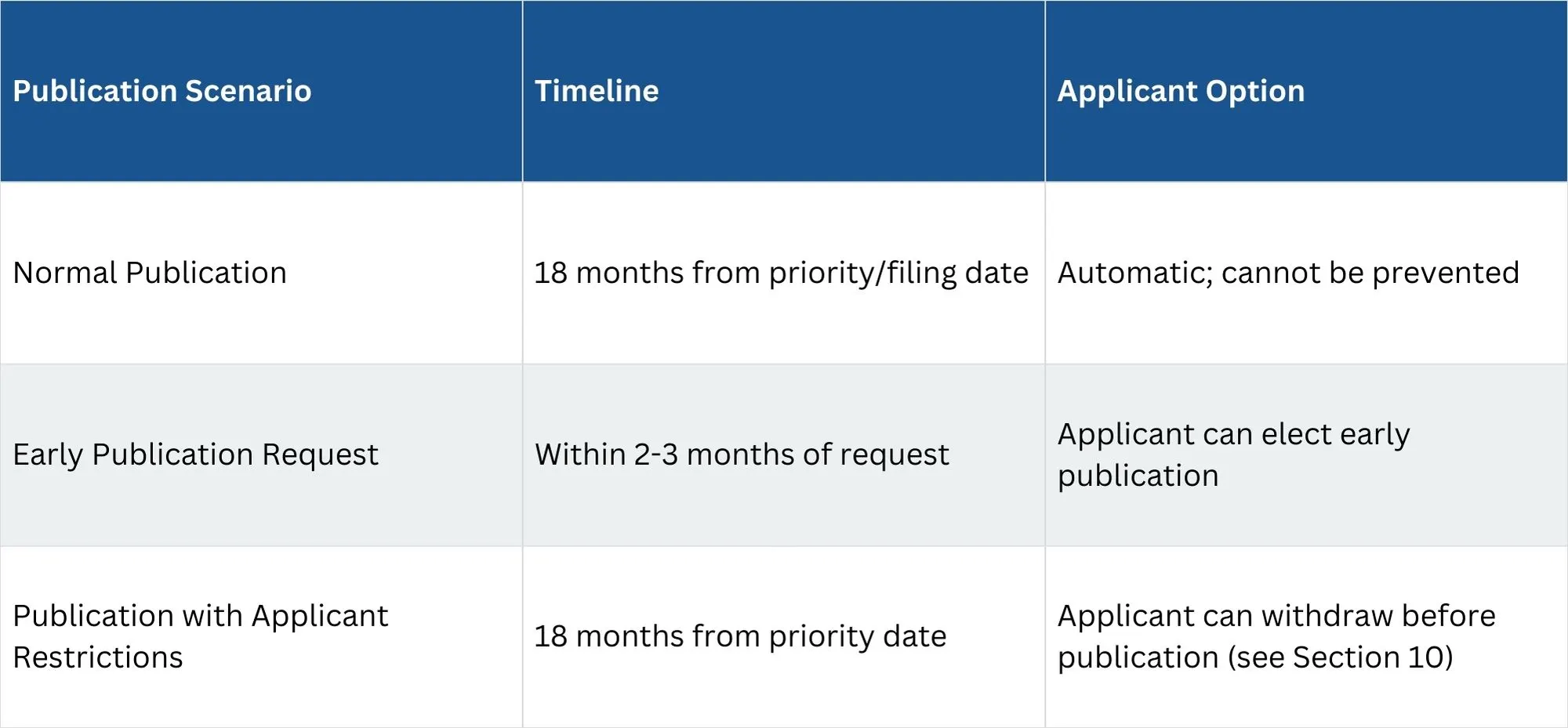
- Standard Publication Date: The international application published under the pct is normally published 18 months after the priority date (or filing date if no priority is claimed)
- Early Publication Option: Applicants can request early publication before the 18-month deadline, particularly if they wish to begin enforcement activities or establish public record earlier
- Deferred Publication: Under certain circumstances, publication can be deferred, though this is limited to specific scenarios
Contents of the Published International Application
When an international application published under the patent cooperation treaty pct is released, the publication includes:
- Complete Bibliographic Data: All information from the original PCT request, including applicant, inventor, priority claims, and designations
- International Search Report (ISR): The examiner’s assessment of the novelty and inventiveness of the claims
- Written Opinion: Detailed analysis of claim patentability based on prior art
- Technical Content: Complete specification, claims, abstract, and drawings as filed (or as amended under Article 19 if applicable)
- International Patent Classification (IPC): Technical field classifications assigned during search
Publication Rights and Third-Party Access
Once an international application published under the pct is released, third parties gain certain rights:
- Public Access Rights: The published PCT patent pending application becomes part of the searchable patent literature, available to other researchers, competitors, and the public
- Citation Rights: Published PCT stage patent applications can be cited as prior art against subsequent patent applications filed after the publication date
- Provisional Patent Rights: In jurisdictions that recognize provisional rights, an applicant of a PCT request may claim limited damages if infringement occurs after publication but before grant, even if the claims are later amended
Strategic Consideration: Publication of a PCT international application is essentially irreversible and has significant commercial implications. Companies should carefully consider their disclosure strategies, particularly for inventions where trade secret protection might be preferable to patent protection.
The International Patent Bibliography
The published international application published under the patent cooperation treaty includes a comprehensive patent bibliography that documents:
- Prior art documents cited by the International Searching Authority
- The relevance of each cited document to specific claims
- The examiner’s analysis of how prior art affects patentability
Also, Read: ePCT Filing Guide using Online PCT Application System
4. PCT-Pending Status: What It Means (Advanced PCT Rules)
The status of “PCT patent pending” is perhaps one of the most misunderstood concepts in patent law. This designation carries significant legal, commercial, and operational implications for applicants.
Definition of PCT Patent Pending
PCT patent pending refers to the period during which an international patent application published under the patent cooperation treaty remains under examination before any national or regional patent office, but has not yet resulted in a granted patent. This status typically spans from the initial PCT request filing through the international examination phases and into national phase prosecution.
Technical Definition: A “PCT patent pending” application is one for which the PCT stage patent has been initiated but no final determination of patentability has been made in any designated jurisdiction. The application is actively being prosecuted or awaiting prosecution decisions.
Duration of PCT Patent Pending Status
The timeline for PCT patent pending status varies significantly depending on multiple factors:
- International Phase Duration: Typically 30-34 months from the priority date, during which the PCT request undergoes international search and preliminary examination
- National Phase Duration: Varies by jurisdiction, typically 1-5 years depending on examination backlogs and applicant responses
- Total Duration: From filing through grant (if successful) typically ranges from 4-8 years, though this can extend significantly if applicants file continuation applications or face substantial office action rejections
During this entire period, the application maintains PCT patent pending status, and the applicant can use this designation in marketing materials and on products.
Legal Rights During PCT Patent Pending Status
Applicants with a PCT patent pending application have limited legal rights compared to patent holders, but these rights are not insignificant:
Provisional Patent Rights
In many jurisdictions, a PCT stage patent applicant can claim provisional patent rights against infringers if certain conditions are met:
- Publication Requirement: The international application published under the pct must be publicly available (which occurs 18 months after priority or filing)
- Translation Requirement: In jurisdictions where the PCT international application was filed in a non-official language, a translation must be provided to third parties
- Damages Limitations: Provisional rights typically allow recovery only of damages incurred after notice of the PCT patent pending application, and only if claims are substantially similar to those ultimately granted
- Notice Requirement: The applicant must provide actual notice of the PCT stage patent to the infringer, typically by sending a copy of the published application
Critical Limitation: Provisional patent rights during PCT patent pending status are not equivalent to patent enforcement rights. An infringer cannot be sued until a patent actually issues, though good faith notice may allow recovery of damages once the patent grants.
Marking Rights During PCT Patent Pending Status
Many jurisdictions permit applicants to mark products with a “PCT patent pending” notice during the PCT stage patent phase:
- Marking Convention: Use of “Patent Pending,” “Pat. Pend.,” “Pending Patent,” or similar notices is standard practice
- Marketing Advantage: The PCT patent pending marking can deter competitors and signals to customers that intellectual property protection is being pursued
- Legal Notice: Proper marking during PCT patent pending status may allow applicants to seek damages against infringers who had actual notice of the application
Confidentiality and Disclosure During PCT Patent Pending Status
The PCT patent pending status has important confidentiality implications:
- Pre-Publication Confidentiality: Before the 18-month publication date, the PCT request and its contents remain confidential, known only to the applicant, their representatives, and WIPO officials
- Post-Publication Disclosure: Once the international application published under the patent cooperation treaty is released, all details become public knowledge
- Commercial Implications: The PCT stage patent applicant loses trade secret protection for disclosed technical information once publication occurs
Impact on Business Operations
The PCT patent pending status significantly affects how companies can operate:
- Licensing Strategy: Companies cannot grant exclusive patent licenses based on PCT stage patent applications, though non-exclusive arrangement are sometimes used in practice
- Investment and Valuation: The PCT patent pending status affects the company valuation; prospective investors recognize that PCT patent pending applications carry significant uncertainty regarding ultimate patentability
- Competitive Intelligence: The international application published under the pct provides competitors with detailed technical information that could inform their own development efforts
5. Advanced PCT Rules in International Search and Preliminary Examination
The International Search phase represents the first comprehensive technical examination of a PCT request, while the International Preliminary Examination phase provides a second-level analysis of patentability. Both phases are integral to the PCT stage patent progression.
The International Search Phase
The International Searching Authority (ISA) is responsible for conducting a thorough examination of the PCT international application to identify prior art and assess patentability.
Search Scope and Methodology
The International Search is comprehensive and addresses:
- Prior Art Identification: The ISA searches databases of patents, published patent applications, scientific literature, and other technical disclosures to identify documents relevant to the invention
- Novelty Assessment: The search determines whether the invention presents features not disclosed in any single prior art document
- Claim Analysis: The ISA analyzes each claim to identify its essential features and scope
- Multiple Classification: The invention is classified using International Patent Classification (IPC) and Cooperative Patent Classification (CPC) systems to ensure comprehensive searching
International Search Report (ISR)
The output of the search phase is the International Search Report, which is integral to the international application published under the pct:
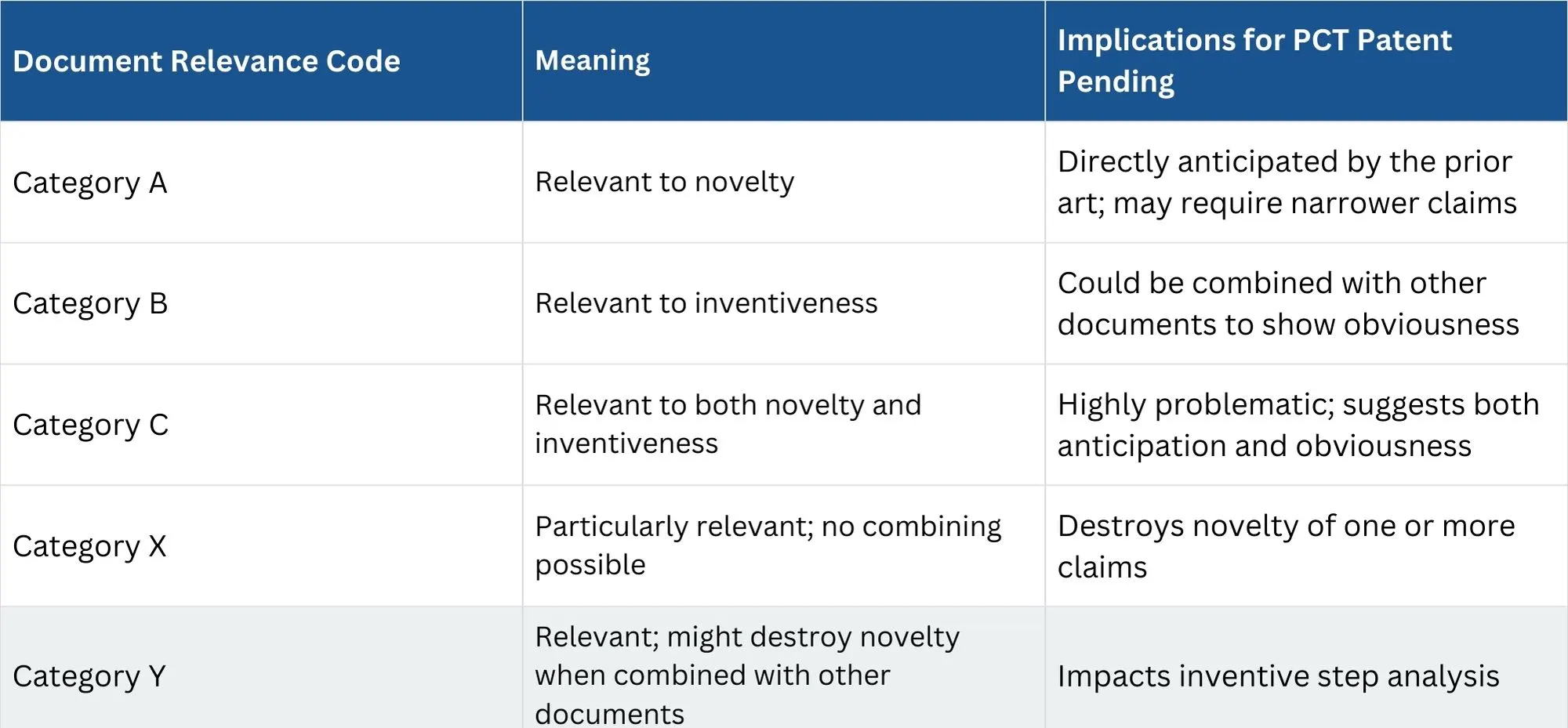
- Format and Content: The ISR lists all prior art documents identified by the ISA, with each document assigned a relevance code indicating its significance
- Relevance Codes: Documents are marked as either (a) particularly relevant to novelty, (b) particularly relevant to inventiveness, or (c) particularly relevant to both
- Claim-by-Claim Analysis: The ISR cross-references which documents are relevant to each claim
- Written Opinion: Accompanying the ISR is a detailed written opinion providing the ISA examiner’s preliminary assessment of patentability
International Preliminary Examination Phase
Following the international search, applicants of a PCT request have the option (in most jurisdictions) to request an International Preliminary Examination (IPE). This phase provides additional analysis before entering national phase prosecution of the PCT stage patent.
Optional Nature: The International Preliminary Examination is optional in the PCT patent pending process. Applicants can choose to proceed directly to the national phase without requesting IPE. However, this examination provides valuable feedback before the critical decision of entering multiple national jurisdictions.
International Preliminary Examination Report (IPER)
The IPER builds upon the ISR and provides a more definitive opinion regarding patentability:
- Patentability Determinations: The IPER gives the IPEA’s initial decision on whether the PCT request meets novelty, inventiveness, and industrial applicability criteria.
- Detailed Analysis: More thorough analysis than the initial written opinion, considering applicant responses and amendments under Article 19
- Non-Binding Nature: IPER opinions are not binding on national patent offices; they serve as guidance for the PCT stage patent applicant in deciding how to proceed
Applicant Response Options During International Search
Upon receiving the International Search Report and Written Opinion, applicants can take several actions to strengthen their PCT patent pending application:
- File Amendments Under Article 19: Applicants can amend their PCT request to narrow claims, remove obvious elements, or clarify disclosure to overcome search findings
- Submit Written Comments: Applicants can submit a detailed response explaining why the claims are patentable despite the cited prior art
- Request Further Action: In some cases, applicants can request that the ISA conduct additional searches on specific aspects of the invention
- Request International Preliminary Examination: If the initial search results are unfavorable, requesting IPE provides another opportunity to persuade an examiner before national phase entry
Designated International Searching Authorities
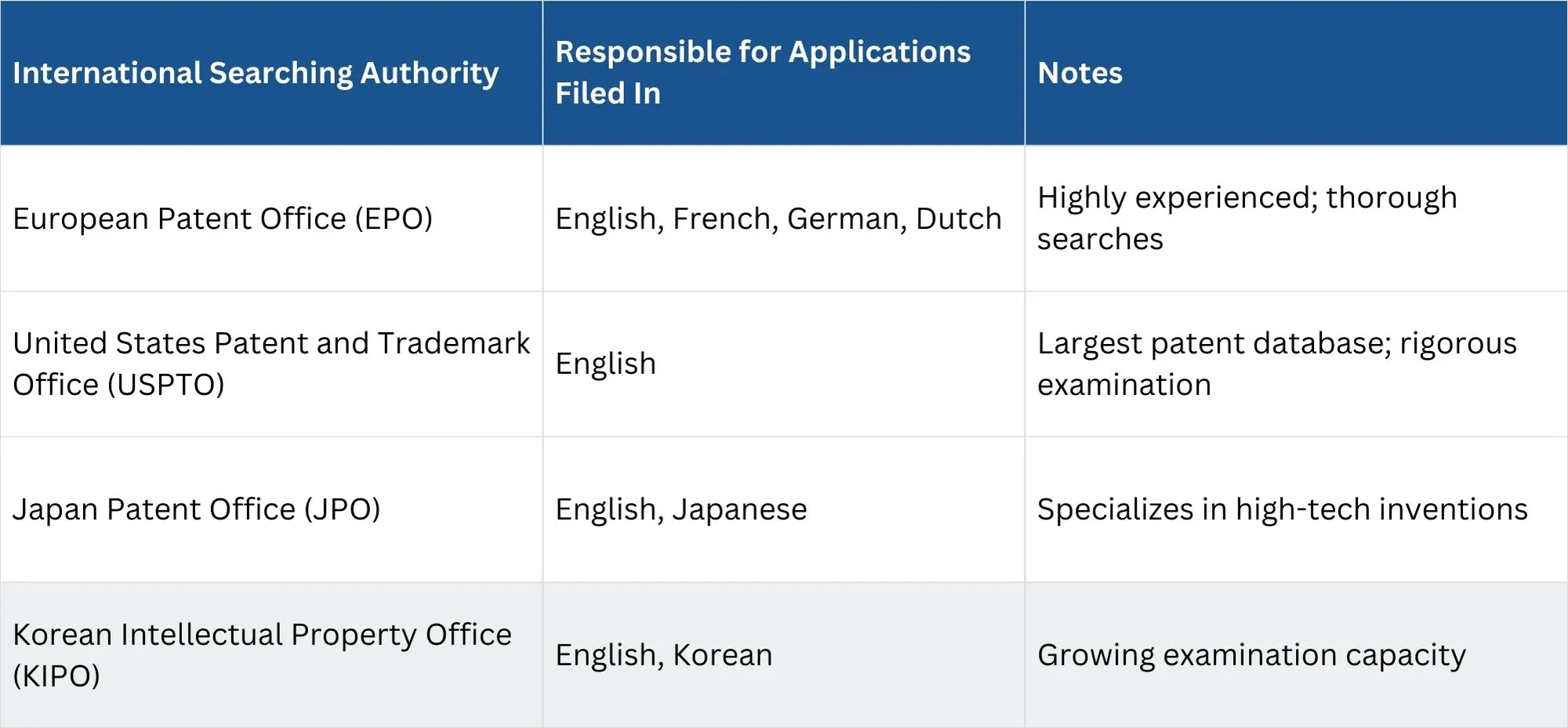
Depending on the language of filing for the PCT request, different ISAs conduct the international search:
Also, Read: PCT National Phase Deadlines: Complete Timeline Guide
6. Advanced PCT Rules: Amendments Under Article 19 and 34
The ability to amend a PCT request at different stages of the PCT stage patent prosecution is crucial for applicants seeking to overcome examination findings and strengthen their claims. Article 19 and Article 34 amendments provide two distinct procedural pathways.
Article 19 Amendments
Under Article 19, applicants can adjust their claims during the international phase of the PCT, from the publication of the international application until the point of entering the national phase.
Article 19 Scope and Timing
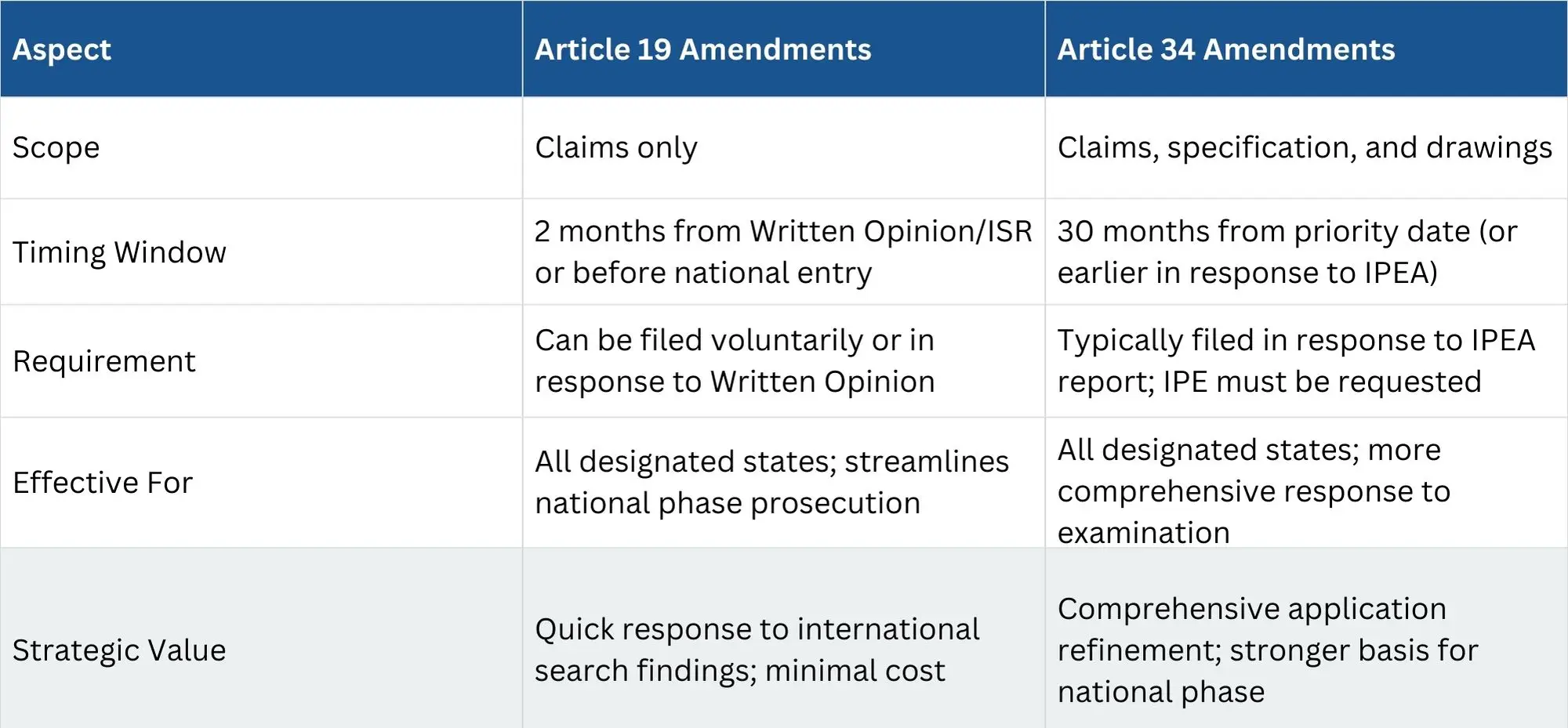
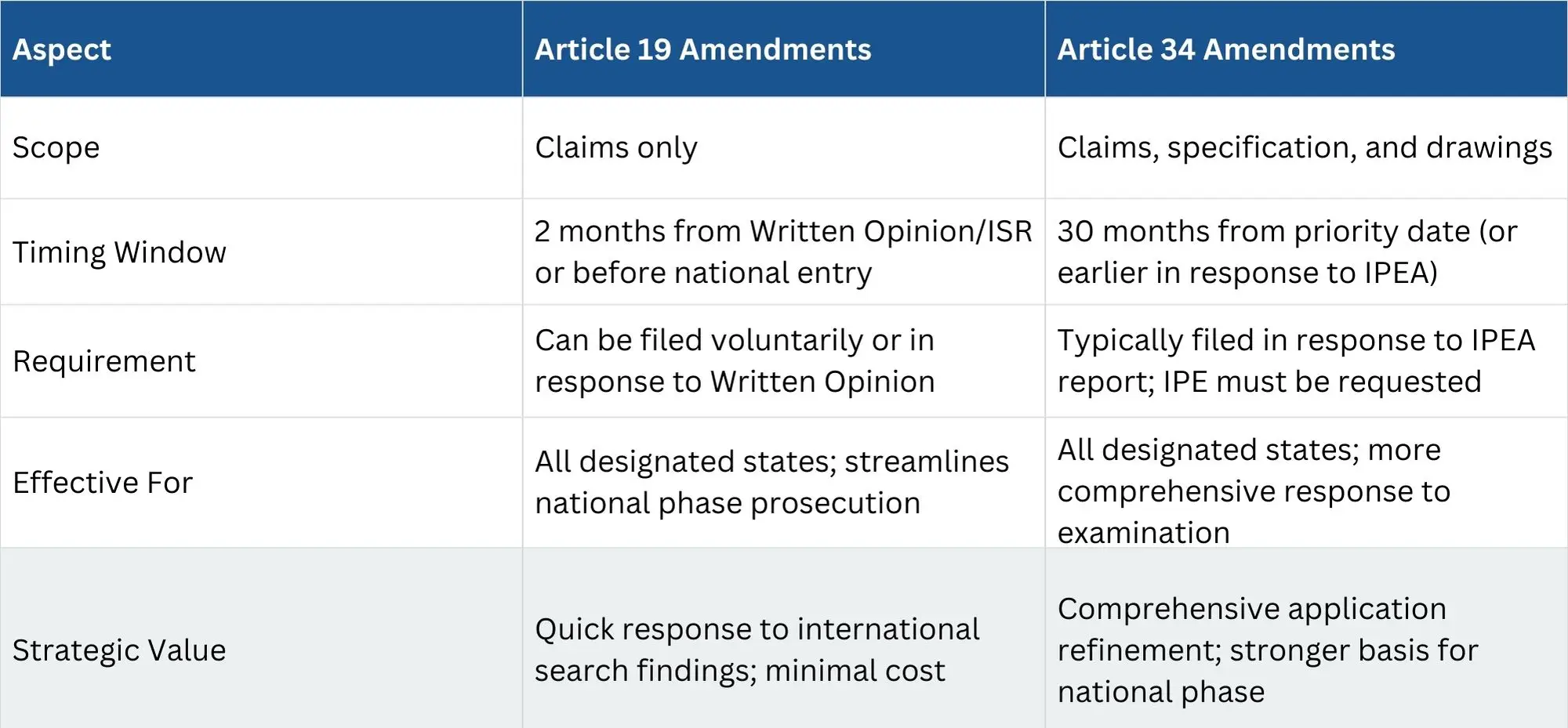
- Available Amendment: Under Article 19, applicants can amend only the claims of the PCT request, not the specification or drawings
- Timing Window: Article 19 amendments must be filed within a specific deadline:
- If the applicant receives a Written Opinion before the ISR, the deadline is 2 months from the ISR date or before national entry (whichever is earlier)
- If the applicant receives the Written Opinion with the ISR, the deadline is 2 months from that date or before national entry (whichever is earlier)
- Relationship to IPE: If the applicant has requested International Preliminary Examination, Article 19 amendments can also be filed as part of that request and examination
Strategic Use of Article 19 Amendments
Article 19 amendments are crucial tools for strengthening a PCT patent pending application:
- Claim Narrowing: If the ISR identifies prior art that anticipates or makes obvious the original claims, narrow amendments can carve out patentable subject matter
- Claim Refinement: Amendments can clarify ambiguous language or better delineate the invention’s scope
- Dependent Claim Strategies: Applicants often add new dependent claims with alternative limitations that may avoid identified prior art
- Prevention of Defects: If the Written Opinion identifies formal defects (e.g., unclear antecedent basis), Article 19 amendments correct these issues before national phase
Practical Advantage: Article 19 amendments can be filed and considered before the IPEA and national examiners review the application. This gives applicants an early opportunity to overcome search findings without waiting for formal office action rejections in each national jurisdiction.
Limitations of Article 19 Amendments
Article 19 amendments have important restrictions:
- Claims Only: The specification and drawings cannot be amended under Article 19; any amendments to these documents must occur in the national phase
- No New Matter: Amendments cannot introduce new technical content not originally disclosed in the specification (subject to reasonable interpretation)
- Time Constraint: The narrow window (typically 2 months) for filing Article 19 amendments can be challenging if applicants need time to develop response strategies
Article 34 Amendments
Under Article 34, applicants may modify the PCT request while undergoing the International Preliminary Examination, which provides more extensive rights than Article 19.
Article 34 Scope and Procedures
- Broader Amendment Rights: Under Article 34, applicants can amend not only the claims but also the specification and drawings of the PCT international application
- Timing: Article 34 amendments must be filed:
- In response to the IPEA’s preliminary examination report, or
- Within 30 months from the priority date (or filing date if no priority is claimed) for PCT stage patent applications
- Multiple Amendments: Applicants can file multiple rounds of amendments in response to successive IPEA reports
Practical Advantages of Article 34 Amendments
The broader scope of Article 34 amendments makes them particularly valuable:
- Specification Clarification: The PCT request specification can be amended to better support claims or clarify technical disclosures
- Drawing Modifications: Drawings can be amended to better illustrate the invention
- Multiple Responses: Unlike Article 19, applicants can respond to IPEA reports multiple times, allowing iterative refinement of the PCT stage patent application
- National Phase Coordination: Article 34 amendments can be coordinated with national phase entry strategies to ensure consistency across jurisdictions
Comparison: Article 19 vs. Article 34 Amendments
Intersection with National Phase Amendments
It is crucial to understand how Article 19 and 34 amendments interact with subsequent national phase prosecution of the PCT stage patent:
- Consistency Requirement: National examiners will review any Article 19 or 34 amendments and may reference them in office actions
- Base for Comparison: The amendments form a record of what changes were made before national phase entry, which can be referenced in later disagreements regarding claim scope
- Global Strategy: Applicants should carefully consider how international phase amendments will affect prosecution in different national jurisdictions with varying examination standards
Also, Read: National Phase Entry Patent Filing Process, Deadline and Strategy
7. Priority Claims in PCT Applications (Advanced PCT Rules)
Priority claims in a PCT request are foundational to international patent prosecution. Understanding priority mechanics is essential for applicants seeking to establish the effective filing date of their international application published under the patent cooperation treaty.
The Priority Right and the 12-Month Priority Period
The Paris Convention for the Protection of Industrial Property established the fundamental priority principle: an applicant who files a patent application in one member country can claim the benefit of that earlier filing date when filing in other member countries within a specified period.
- 12-Month Period: For patent applications (utility patents), applicants have 12 months from the priority date to file a PCT request claiming priority to the earlier application
- 6-Month Period: For design patents and trademarks, the priority period is 6 months
- Effective Date: The priority date (not the PCT filing date) determines what prior art is relevant to patentability in most jurisdictions
Critical Concept: When an applicant files a PCT international application claiming priority to an earlier patent application, the PCT filing receives the earlier filing date for purposes of patentability determination. This is extraordinarily advantageous and is a primary reason applicants use the priority system.
Types of Priority Claims
The PCT request can claim various types of priority:
National Priority
National priority is the most common form:
- Earlier National Application: The priority application is a national patent application filed in a single country
- Example: An inventor files a patent application with the USPTO on January 15, 2023, then files a PCT request on December 14, 2023, claiming priority to the January 2023 USPTO filing
- Effect: The PCT stage patent application is treated as if it were filed on January 15, 2023, for patentability purposes
Regional Priority
Regional applications, such as those filed with the European Patent Office or African Regional Intellectual Property Organization, can serve as priority documents:
- EPO Applications: European patent applications can establish priority for a subsequent PCT request
- ARIPO Applications: African regional applications can similarly establish priority
Earlier PCT Application
In limited circumstances, an earlier PCT international application can establish priority for a later PCT request:
- Rare Scenario: An applicant may file an initial PCT request, then file a second PCT international application claiming priority to the first to add new designations or otherwise modify the protection strategy
- Strategic Use: This approach allows applicants to “refresh” their PCT filing with a new PCT application while retaining the original priority date
Multiple Priority Claims
A single PCT request can claim priority to multiple earlier applications if the invention is supported by those earlier applications:
- Partial Priorities: Different claims in the PCT international application might claim priority to different earlier applications if those applications each disclosed portions of the invention
- Common Priority: Most frequently, all claims claim priority to the same earliest application
Priority Documentation and Verification
When filing a PCT request claiming priority, applicants must provide certain documentation:
- Certified Copy Requirement: The receiving office may require a certified copy of the priority application from the earlier office
- Timing of Submission: The priority document can be submitted with the PCT request or within 16 months of the priority date
- WIPO eService Submission: Modern practice allows priority documents to be submitted through WIPO’s digital systems
Priority Claim Errors and Corrections under Advanced PCT Rules
Errors in priority claims are among the most problematic issues in PCT patent pending applications. Depending on the type of error, different correction procedures apply:
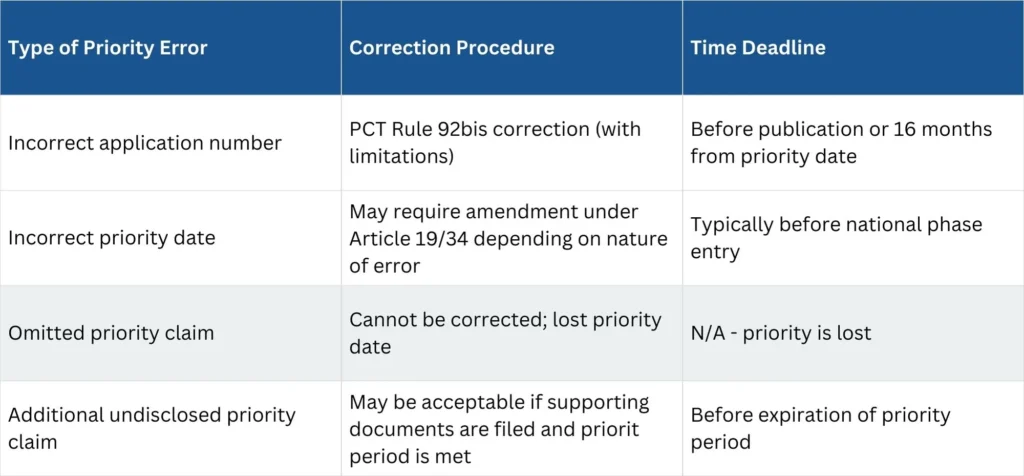
Critical Warning: An omitted priority claim cannot be corrected under PCT rule 92bis or any other procedure. Once the PCT is filed without claiming priority to an earlier application, the applicant has lost the benefit of that earlier filing date forever. This is why careful attention to priority documentation is essential.
Strategic Use of Priority Claims
Experienced practitioners use priority claims strategically:
- Provisional Applications as Priority: U.S. provisional applications often serve as priority documents for subsequent PCT requests, allowing applicants to claim a priority date while allowing additional development time
- Divisional Applications: In some jurisdictions, applicants can file divisional applications (applications derived from an earlier application) and claim priority to the parent, which can be beneficial for managing PCT stage patent strategy
- Sequential Filing Strategy: Applicants sometimes file multiple priority applications to establish multiple earlier filing dates, each supporting different aspects of their inventive concept
Also, Read: PCT Filing Costs and Fees: Complete Breakdown
8. Sequence Listings and Biological Material
For PCT request applications involving biotechnology, genetic engineering, or other fields requiring disclosure of nucleotide or amino acid sequences, specific technical requirements apply to the international application published under the patent cooperation treaty.
Sequence Listing Requirements
When a PCT international application discloses sequences of DNA, RNA, or proteins, applicants must comply with specific formatting and submission requirements:
- Format Requirement: Sequence listings must be prepared according to WIPO Standard ST.25 or ST.26, which specify exact formatting for sequence data
- Submission Format: Sequences must be submitted in a machine-readable format (typically XML or other specified electronic format) as part of the PCT request filing package
- Incorporation by Reference: The sequence listing is incorporated by reference into the specification and forms part of the PCT stage patent application disclosure
WIPO Standard ST.25 vs. ST.26 in Context of Advanced PCT Rules
Two standards govern sequence submission in a PCT request:
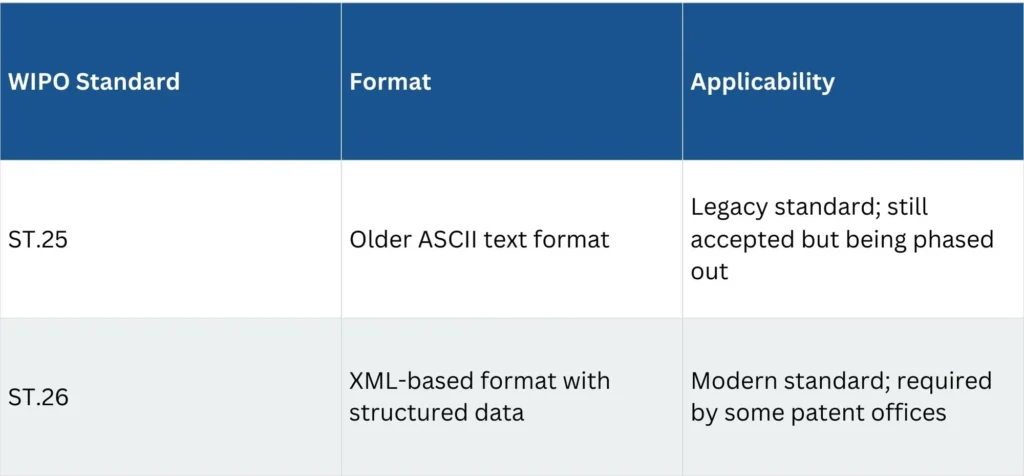
Practice Note: Modern PCT applications increasingly require submission in ST.26 format. Applicants should verify the specific requirements of their designated patent offices regarding acceptable sequence listing formats.
Content of Sequence Listings
A complete sequence listing in a PCT international application includes:
- Sequence Identification: Each sequence is assigned a unique identifier number (SEQ ID NO) for reference within the specification
- Sequence Type: Specification of whether the sequence is DNA, RNA, or amino acid
- Sequence Length: The number of nucleotides or amino acids in the sequence
- Actual Sequence: The complete nucleotide or amino acid sequence in standard notation
- Related Sequences: Information about homology, modifications, or relationships to other sequences
Biological Material Deposits
When a PCT request involves biological material (such as microorganisms, cell lines, or plant varieties) that cannot be adequately described in the specification, applicants must comply with deposit requirements:
Deposit Requirements Under the Budapest Treaty
The Budapest Treaty on the International Recognition of the Deposit of Microorganisms establishes international procedures for biological material deposits:
- Designated Depositories: Biological material must be deposited with a designated international depositary authority (IDA), such as the American Type Culture Collection (ATCC) or European Collection of Authenticated Cell Cultures (ECACC)
- Deposit Certificate: The applicant must obtain a deposit certificate from the IDA and submit it with the PCT request
- Availability Requirement: The deposited material must be made available for inspection by competent authorities during PCT stage patent examination
Reference in the Specification
The PCT international application specification must include:
- Deposit Details: The name and address of the depository, the accession number, and the date of deposit
- Availability Statement: A statement that the deposited material will be made available upon request during the examination period
- Description: Complete description of the characteristics and properties of the biological material
Biotechnology Practice: For PCT patent pending applications in biotechnology, early coordination with international depositaries is essential. Deposits should be made well before filing to allow sufficient time to obtain certificates and verify deposit information.
Also, Read: Comprehensive PCT Guide: Mastering International Patent Applications
9. PCT for Software and Business Method Inventions
Patent protection for software and business methods through the PCT request process presents unique challenges and opportunities. The patentability of these inventions varies significantly across different jurisdictions represented in a PCT stage patent application.
Software Patent Patentability in the PCT Context
Software-related inventions disclosed in a PCT international application must satisfy patentability criteria that are applied differently across jurisdictions:
United States Patent Law (USPTO Standards)
Under U.S. patent law, software inventions are patentable if they:
- Produce Technical Effect: The software must produce a concrete, non-abstract technical effect, such as improved computer performance or enhanced functionality of hardware
- Overcome the Alice/Mayo Test: The invention must fall outside the “abstract idea” exception to patentability established in Alice Corp. v. CLS Bank and Mayo v. Prometheus Labs.
- Include Specific Implementation Details: The PCT request should include specific details about the algorithms, data structures, and hardware interactions
Abstract Idea Exception: Under U.S. law, purely abstract algorithms or mathematical concepts are not patentable. However, software that applies such algorithms to achieve practical results is patentable. The distinction is critical for PCT stage patent prosecution in the United States.
European Patent Office Standards
The EPO applies different standards for software patents in PCT stage patent applications:
- Technical Character Requirement: The invention must have a “technical character” and solve a technical problem using technical means
- Computer-Implemented Inventions: Software patents are acceptable if they involve a technical effect beyond the normal operation of a computer
- Business Methods: Pure business methods are generally not patentable at the EPO, but software that implements business methods with technical contribution is acceptable
Drafting Software Patents for PCT Applications
To maximize patentability of software inventions across jurisdictions in a PCT request, applicants should:
- Emphasize Technical Effects: Clearly describe how the software produces improved computer performance, reduced processing time, enhanced security, or other technical benefits
- Describe Specific Implementation: Include detailed descriptions of algorithms, data structures, system architectures, and hardware interactions
- Link to Hardware: If possible, describe how the software interacts with specific hardware components or systems
- Include Independent Claims with Multiple Limitations: Independent claims should include multiple technical features that work together to achieve the technical effect
- Provide Concrete Examples: Include specific examples of how the software solves technical problems in real-world scenarios
Business Method Patents in the PCT Context
Business method patents face particular challenges across different jurisdictions within a PCT patent pending prosecution:
United States Position on Business Methods
U.S. patent law initially permitted broad business method patents, but standards have tightened:
- Post-Alice Scrutiny: Business methods must now produce a technological benefit beyond the abstract concept of the business idea itself
- Technical Solutions Required: Patentable business method inventions typically combine technical components that solve technical problems
- Examples: A business method implemented using specific computer systems with improved efficiency might be patentable, but the same method performed manually would not be
European Patent Office Position on Business Methods
The EPO is generally more restrictive regarding business method patents:
- Non-Patentable Methods: Pure business methods, including methods of doing business or organizing commercial transactions, are explicitly excluded from patentability
- Exception for Technical Implementation: Business methods implemented with technical means that produce a technical effect may be patentable
- Distinction from Software Patents: Business methods require stronger technical contribution than software patents to be patentable at the EPO
Prosecution Strategy for Software and Business Method Patents
Given the varying standards across jurisdictions, PCT stage patent applicants should consider:
- Dual Claim Sets: Including both method claims and system/apparatus claims (e.g., “a computer system comprising…”) to appeal to different examination standards
- Multiple Dependent Claims: Including numerous dependent claims with varying levels of technical specificity to overcome rejections in different jurisdictions
- International Preliminary Examination: Requesting IPE can help identify jurisdiction-specific patentability issues before national phase entry
- Jurisdiction-Specific National Phase Strategies: Once entering the national phase, applicants can tailor prosecution in each jurisdiction to its specific standards
10. Withdrawal and Restriction Procedures
Despite the advantages of maintaining a PCT patent pending application through examination, circumstances sometimes arise where applicants wish to withdraw or restrict their international patent application published under the patent cooperation treaty. Understanding withdrawal and restriction procedures is important for managing PCT stage patent strategy.
Withdrawal of the International Application
The PCT framework permits applicants to withdraw a PCT request at various stages, each with different consequences and timing constraints.
Pre-Publication Withdrawal
Withdrawal before the international application published under the pct is released to the public is often the most advantageous:
- Complete Confidentiality: A PCT patent pending application withdrawn before publication remains confidential, with limited disclosure even to patent offices
- Trade Secret Protection: The technical content remains undisclosed, preserving trade secret status if the invention is ultimately protected through non-patent means
- No Public Record: The PCT international application leaves no public record, allowing the applicant to maintain competitive advantage
- Timing: Pre-publication withdrawal must occur before 18 months from the priority date (or filing date)
Strategic Consideration: Pre-publication withdrawal is often used when business circumstances change (e.g., the technology is abandoned, an acquisition occurs, or a decision is made to rely on trade secrets) or when examination findings suggest patentability challenges. The confidentiality advantage makes pre-publication withdrawal attractive in many scenarios.
Withdrawal After Publication
Withdrawal after the international application published under the patent cooperation treaty pct is released has different implications:
- Published Information Remains Public: Once published, the technical content is permanently in the public domain and remains available to third parties
- No Trade Secret Protection: The invention cannot be protected as a trade secret after publication of the PCT stage patent application
- Withdrawal Still Available: Applicants can withdraw at any time, even after publication, though the information is already disclosed
- National Phase Withdrawal: Withdrawal after publication is often used to prevent incurring national phase prosecution costs when patentability appears unlikely
Formal Withdrawal Procedures
To formally withdraw a PCT request, applicants must:
- Submit Written Notice: A withdrawal notice must be submitted to the Receiving Office in writing
- Applicant Authority: The withdrawal must be authorized by the applicant or their patent agent
- National Phase Withdrawal: If the PCT stage patent has already entered national phase in specific jurisdictions, withdrawal must be submitted to those national offices as well
- Effective Date: The withdrawal typically becomes effective upon receipt by the relevant office
Restriction and Election of Species/Countries
Rather than complete withdrawal, applicants sometimes restrict their PCT international application to specific jurisdictions or claim sets.
Restriction of Designation to Certain States
If a PCT request initially designates multiple countries but applicants later determine that protection in certain jurisdictions is not cost-effective, they can restrict the application:
- Withdrawn Designations: Applicants can request withdrawal of specific country designations, eliminating PCT patent pending status in those jurisdictions
- Cost Savings: Withdrawing designations eliminates subsequent prosecution costs in those countries
- Timing: Country designations can be withdrawn before or shortly after national phase entry deadlines
- PCT Rule 90bis Procedure: Most modern PCT applications automatically designate all PCT member states, but applicants can use specific procedures to withdraw selected designations
Species Restriction and Claim Amendments
In some fields (particularly botany and microbiology), applicants may have filed applications covering multiple related species or varieties:
- Inventive Entity: If the PCT request covers multiple botanical or biological species, examiners may require applicants to restrict claims to a single species
- Applicant Election: The applicant can elect which species to claim in the primary PCT stage patent application and defer others to divisional applications
- National Phase Strategies: Restriction may be addressed differently in each national jurisdiction, requiring careful coordination
Partial Withdrawal from International Preliminary Examination
If an applicant has requested International Preliminary Examination but later withdraws that request:
- Return to Basic Phase: The PCT request reverts to the basic international phase, and no International Preliminary Examination Report is issued
- Cost Implications: Withdrawing the IPE request eliminates further examination costs but also eliminates the opportunity to obtain a detailed preliminary opinion
- Timing: IPE withdrawal must occur within specific deadlines (typically before the IPEA issues its report)
Survival of Priority Rights After Withdrawal
An important consideration when withdrawing a PCT patent pending application:
- Priority Claims Preserved: If a PCT request is withdrawn, the priority rights are NOT lost if the applicant files another application claiming priority within the 12-month priority period
- Alternative Strategies: Applicants can withdraw a PCT international application and simultaneously file a new national or PCT application claiming the same priority, effectively “restarting” the process
- Amended Content: The new application can include amendments or improvements to the disclosure without losing the original priority date
Strategic Flexibility: Withdrawal of a PCT stage patent application does not necessarily end the applicant’s patent protection strategy. Applicants retain flexibility to file new applications, pursue divisional applications, or employ alternative protection strategies while preserving priority rights.
Also, Read: Why Choose PCT Filing? 5 Key Reasons
Conclusion (Advanced PCT Rules)
Advanced PCT Rules form the basis of effective patent protection through the Patent Cooperation Treaty, requiring deep understanding of procedural rules, technical requirements, and strategic considerations. From the critical procedural rules governing PCT Rule 92bis corrections under advanced PCT rules through the complexities of PCT patent pending status, each element of the international application published under the Patent Cooperation Treaty framework requires careful attention.
Applicants pursuing PCT stage patent protection benefit from comprehensive knowledge of PCT request preparation under advanced PCT rules, the PCT international application examination process, and the technical requirements that govern international patent treaty compliance. Whether addressing the International Search phase, responding to examination reports, making strategic amendments under Article 19 or 34 in accordance with advanced PCT rules, or managing priority claims, practitioners must master the technical details and procedural requirements outlined in this guide.
The intersection of advanced PCT rules and PCT IP fundamentals with jurisdiction-specific standards creates both challenges and opportunities for sophisticated patent prosecution. By understanding these advanced topics thoroughly, applicants can maximize their patent protection strategy, navigate examination more efficiently, and ultimately achieve their intellectual property protection goals across the international marketplace.
Whether your PCT international application involves emerging technologies like software and business methods, biotechnology with sequence listings and biological deposits, or traditional mechanical innovations, the frameworks and procedures detailed in this comprehensive guide provide the technical foundation under advanced PCT rules needed for successful international patent prosecution.
Start your PCT patent filing journey today with careful planning, professional guidance, and a clear understanding of your commercial objectives.
Our Services: Discover PCT Application Services.

