
2. When Does National Phase Begin? Critical Deadlines
In this section, we will discuss about when the national phase begins and what the critical deadlines are that every PCT applicant must know. Missing these deadlines can permanently affect our patent rights, so understanding them clearly is very important for every applicant. This is very important question. The national phase patent entry window is strictly regulated. Missing deadlines can result in loss of priority and abandonment of your patent rights.
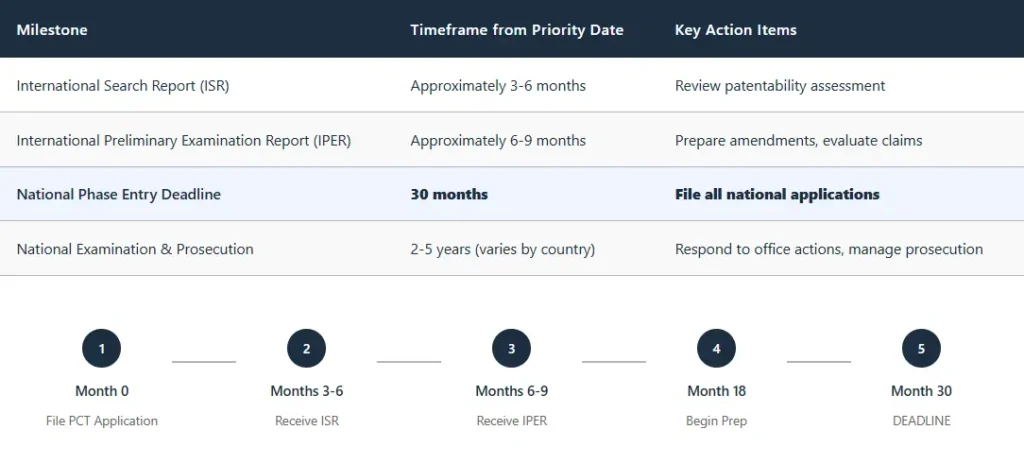
The 30-Month Rule: (National Phase Entry Patent Filing Process)
In this part, we will discuss about the 30-month rule which is the standard deadline for entering the national phase across most countries. This deadline is calculated from the priority date of our original patent application and applies to the majority of PCT member countries worldwide.
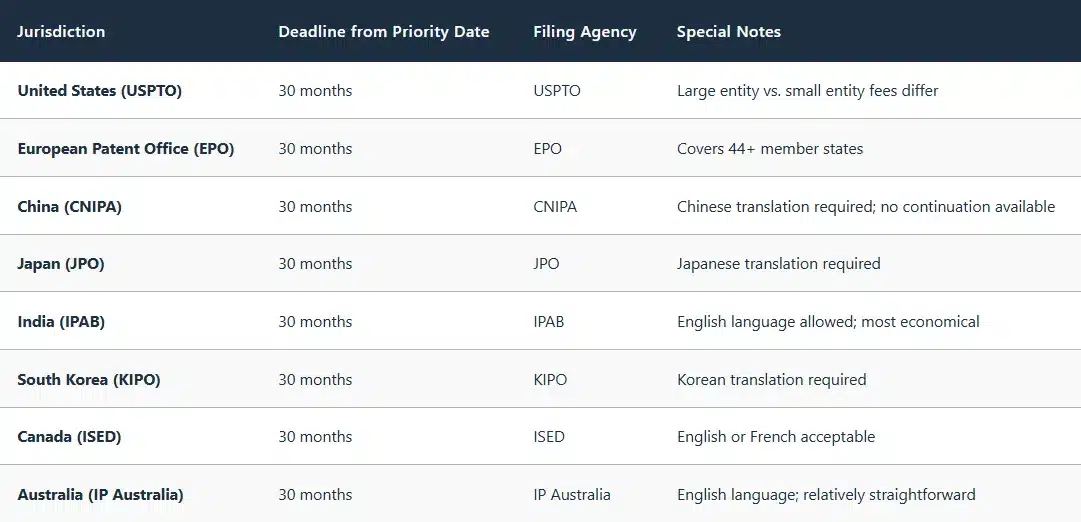
- International Deadline: The standard deadline to enter the national phase across most countries is 30 months from the priority date (the filing date of your initial patent application)
- Priority Date Definition: This is typically the date you filed your first provisional or non-provisional patent application
- Global Applicability: This 30-month deadline applies to most PCT member countries
Extended Timelines for Regional Offices:
For some regional offices, there is an extended timeline.
- European Patent Office (EPO): Also operates on a 30-month timeline for national phase patent applications
- Individual Country Variations: Some jurisdictions may have slightly different deadlines:
- Japan: 30 months from priority date
- China: 30 months from priority date
- India: 30 months from priority date
- Australia: 30 months from priority date
Timeline Overview:
| Milestone | Timeframe from Priority Date |
|---|---|
| International Search Report | Approximately 3-6 months |
| International Preliminary Examination Report | Approximately 6-9 months |
| National Phase Entry Deadline | 30 months |
| National Examination & Prosecution | 2-5 years (varies by country) |
Strategic Timing Considerations:
Considering 30 months or 31 months timeline is very important to remember. The national phase of PCT application typically requires action by month 30, but applicants should plan submissions 2-3 months in advance to account for translation times, agent coordination, and administrative processing.
Also, Read: Comprehensive PCT Guide: Mastering International Patent Applications
3. Strategic Considerations for National Phase Entry Patent Filing Process
In this section, we will discuss about the strategic considerations that are important for a successful national phase entry patent filing process. Good planning during the international phase is what makes the national phase go smoothly and cost-effectively for every applicant.
Pre-National Phase Strategy: (National Phase Entry Patent Filing Process)
In this part, we will discuss about the pre-national phase strategy that we should develop before we start entering the national phase. This includes reviewing the international examination reports, doing a cost-benefit analysis, and planning any claim amendments we may need to make.
Market Analysis and Portfolio Planning
- Evaluate the International Preliminary Examination Report (IPER) and International Search Report (ISR) to assess patentability prospects
- Consider the examiner’s objections and whether your invention is likely to receive patent protection
- Assess commercial potential in target markets before committing to expensive national filings
Cost-Benefit Analysis
- National phase filings are significantly more expensive than maintaining the international phase
- Translation costs, professional fees, and national filing charges accumulate quickly
- Strategic markets require strong commercial potential to justify expense
Amendment Strategy
- Use IPER feedback to strengthen your claims and overcome potential rejections
- Refine specifications to address examiner concerns before national phase entry
- Consider divisional applications if examining early amendments might weaken protection
Country Selection Rationale:
In this part, we will discuss about the rationale we should use when deciding which countries to include in our PCT national phase. Factors like market size, competitive landscape, manufacturing locations, technology trends, and enforcement environment all play an important role in this decision.
When determining which countries for PCT application national phase, consider:
- Market Size: Focus on jurisdictions with significant market potential for your invention
- Competitive Landscape: File in regions where competitors are active or where market entry is planned
- Manufacturing Locations: Protect countries where products will be manufactured or imported
- Technology Sector Trends: Some countries offer stronger patent protection for specific technology areas
- Enforcement Environment: Select jurisdictions with reliable patent enforcement mechanisms
Timing Within the National Phase:
In this part, we will discuss about the different timing options available to applicants within the national phase entry window. We will look at the advantages and risks of early entry, strategic mid-range entry, and late entry when approaching the 30-month deadline.
- Early Entry (Months 1-10): Demonstrates commitment to protection; allows faster prosecution in some jurisdictions
- Strategic Entry (Months 18-24): Permits observation of market developments and competitive activity
- Late Entry (Months 25-30): Risky but permits maximum information gathering; leaves minimal buffer time
Also, Read: ePCT Filing Guide using Online PCT Application System Guide
4. Country Selection: Where Should You File? (National Phase Entry Patent Filing Process)
In this section, we will discuss about the country selection process and where we should file our national phase patent applications. This is one of the most important decisions in the national phase entry process because it directly shapes our global IP protection strategy. Country selection is an important decision to take in the National Phase Entry Patent Filing Process. The decision of where to enter national phase at specific patent offices fundamentally shapes your global IP protection strategy.
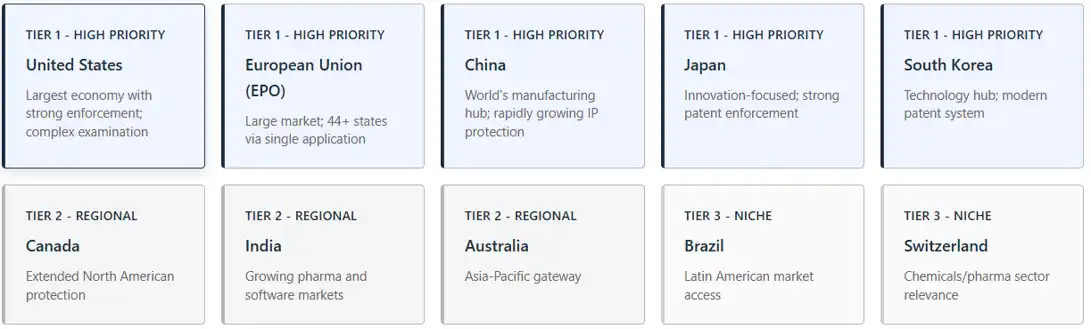
Tier 1 Markets (High Priority):
Typical Selections:
- United States: Largest economy with strong enforcement; complex examination
- European Union: Large market; EPO provides regional coverage via single application
- China: World’s manufacturing hub; rapidly growing IP protection
- Japan: Innovation-focused; strong patent enforcement
- South Korea: Technology hub; modern patent system
Tier 2 Markets (Regional Coverage):
- Canada: Extended North American protection
- India: Growing pharmaceutical and software markets
- Australia: Asia-Pacific gateway
- Brazil: Latin American market access
Tier 3 Markets (Niche Protection):
- Countries with specific industry relevance (e.g., Switzerland for chemicals/pharma)
- Emerging markets with growth potential in your sector
- Countries where specific competitors operate
EPO vs. Individual National Filings:
A national phase application in the EPO covers 44+ member states through a single filing:
- Cost Efficiency: Lower cost than filing individually in multiple European countries
- Maintenance Simplicity: Single annuity payment vs. multiple country fees
- Prosecution Timing: Unified examination process
- Flexibility: Can designate only needed countries at national phase
Also, Read: PCT Filing Costs and Fees: Complete Breakdown
5. Required Documents and Translations (National Phase Entry Patent Filing Process)
In this section, we will discuss about the required documents and translations that are needed for the national phase entry patent filing process. Preparing proper documentation on time is one of the most fundamental requirements for a successful national phase entry in any country.
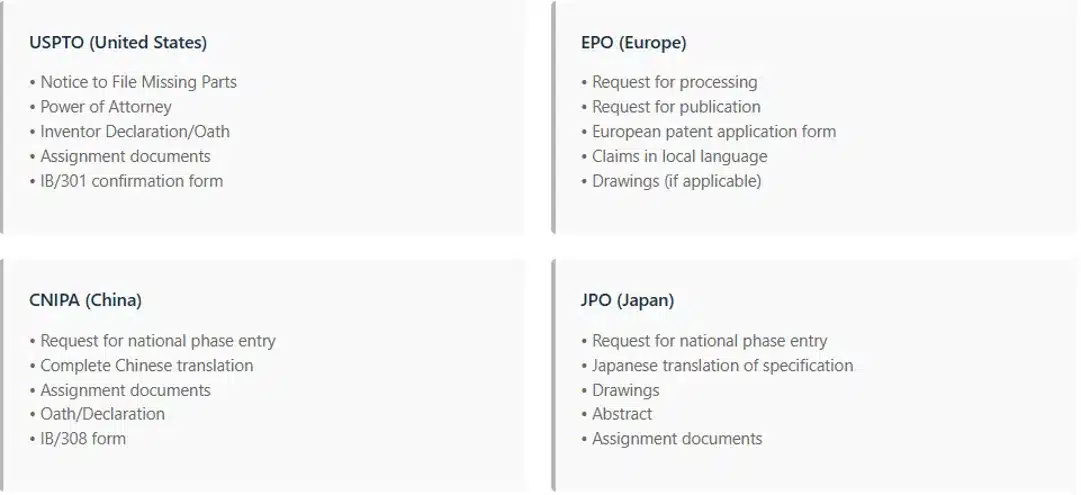
Essential Documents for National Phase Entry:
In this part, we will discuss about the essential documents that are required for national phase entry in key jurisdictions like the USPTO, EPO, CNIPA in China, and the Japan Patent Office. Each country has its own specific document requirements that we must carefully prepare and submit.
USPTO/US National Phase:
- Notice to File Missing Parts (if applicable)
- Power of Attorney
- Declaration/Oath by inventor
- Assignment documents (if ownership changed)
- IB/301 form (PCT filing confirmation)
EPO National Phase Entry:
- Request for processing
- Request for publication (if not automatic)
- European patent application form
- Claims in local language
- Drawings (if any)
China National Intellectual Property Administration (CNIPA):
- Request for national phase entry
- Complete Chinese translation
- Assignment documents
- Oath/Declaration
- IB/308 form
Japan Patent Office (JPO):
- Request for national phase entry
- Japanese translation of specification
- Drawings
- Abstract
- Assignment documents
Translation Requirements:
In this part, we will discuss about the translation requirements that applicants must meet when filing national phase patent applications in non-English speaking countries. The full specification, claims, drawings, and abstract must all be accurately translated by qualified technical patent translators.
Critical Translations Needed:
- Full Specification: Complete translation including claims, drawings, and abstract
- Claim Set: Particularly important; must accurately reflect original claims
- Technical Drawings: May require annotation in local language
- Non-English Originals: Required for all non-English language filings
Quality Assurance:
- Translations must be completed by qualified technical translators
- Patent translation differs from general translation; technical accuracy is essential
- Back-translation verification often recommended for critical sections
- Certified translations required by many patent offices
Timing for Document Preparation:
In this part, we will discuss about the recommended timing for preparing all documents required for national phase entry. We should begin translation work six to eight months before the deadline and allow at least four to six weeks for the translation of any substantial application.
- Begin translation work 6-8 months before national phase deadline
- Allow 4-6 weeks for translation of substantial applications
- Reserve additional time for review, revision, and certification
- Budget for expedited translation if approaching deadlines
Also Read: PCT Provisional Applications and Alternative Filing Strategies
6. Working with Local Patent Agents
In this section, we will discuss about working with local patent agents and why they are so important in the national phase entry process. Local agents provide the jurisdiction-specific expertise that is absolutely necessary to navigate each country’s unique patent office rules and requirements.
Why Local Agents Are Essential:
Regulatory Compliance
- Each patent office has unique procedural rules
- Local agents understand office practice and preferences
- They interpret examination reports in the original language
- They manage responses to office actions within local procedural requirements
Strategic Guidance
- Assess patentability prospects specific to local patent law
- Develop claims tailored to examination standards in each jurisdiction
- Navigate examination timelines and prosecution strategies
- Advise on cost management and portfolio optimization
Communication and Administration
- Direct relationship with local patent office
- Timely filing of responses and amendments
- Management of procedural deadlines
- Coordination with international filing agents
Agent Selection Criteria:
- Technical Expertise: Deep knowledge of your technology area
- Office Relationships: Strong connections with local patent examiners
- Communication: English proficiency for international coordination
- Fees: Transparent, reasonable fee structures
- References: Strong track record with similar applications
Coordination with International Counsel:
- Single Point of Contact: Designate one international agent to coordinate all national agents
- Unified Strategy: Ensure consistent claim interpretation across jurisdictions
- Amendment Coordination: Synchronize substantive amendments where possible
- Cost Tracking: Monitor cumulative expenses across all countries
Also, Read: PCT Countries and International Coverage
7. National Phase vs. Regional Phase (EPO)
In this section, we will discuss about the difference between the national phase and the regional phase through the European Patent Office. Understanding this difference is crucial for building an effective and cost-efficient European patent protection strategy as part of our PCT application.
The European Patent Office Regional Phase:
Regional Phase Filing:
- EPO Designation: When filing a PCT application, applicants designate the EPO as a regional patent office
- Single Application: One application covers designated European member states
- Examination Timeline: Typically 3-5 years for substantive examination
- Grants: EPO grant results in validated national patents in designated countries
Advantages of EPO Regional Phase:
- Cost-efficient single examination covering 44+ countries
- Unified prosecution strategy
- Single annuity payment (rather than multiple country fees)
- Professional EPO examination standards
- Flexibility to designate only needed countries during national phase
Transition to National Phase Within European Countries:
After EPO grant, applicants may file additional national phase patent applications:
Post-Grant National Phase:
- Some countries offer 3-6 months post-EPO grant for supplementary national applications
- Useful for:
- Seeking additional protection through national law variations
- Filing divisional applications in specific countries
- Refining claims through national prosecution
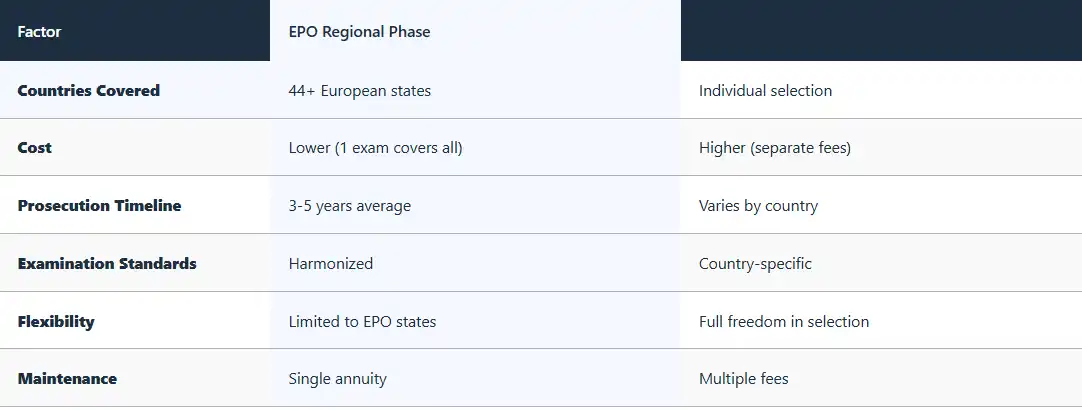
Strategic Comparison:
| Factor | EPO Regional Phase | Direct National Filings |
|---|---|---|
| Countries Covered | 44+ European states | Individual selection |
| Cost | Lower (1 exam covers all) | Higher (separate fees) |
| Prosecution Timeline | 3-5 years average | Varies by country |
| Examination Standards | Harmonized | Country-specific |
| Flexibility | Limited to EPO states | Full freedom in selection |
| Maintenance | Single annuity | Multiple fees |
8. Cost Management During National Phase Entry Patent Filing Process
It is important consider, as govt. official fees and professional service fees are significant for each country. The national phase filing stage involves substantial expense. Strategic cost management optimizes portfolio value. In this section, we will discuss about the cost management considerations during the national phase entry patent filing process. The national phase involves significant expenses and careful cost planning is very important to make sure we get the best value from our patent investments.
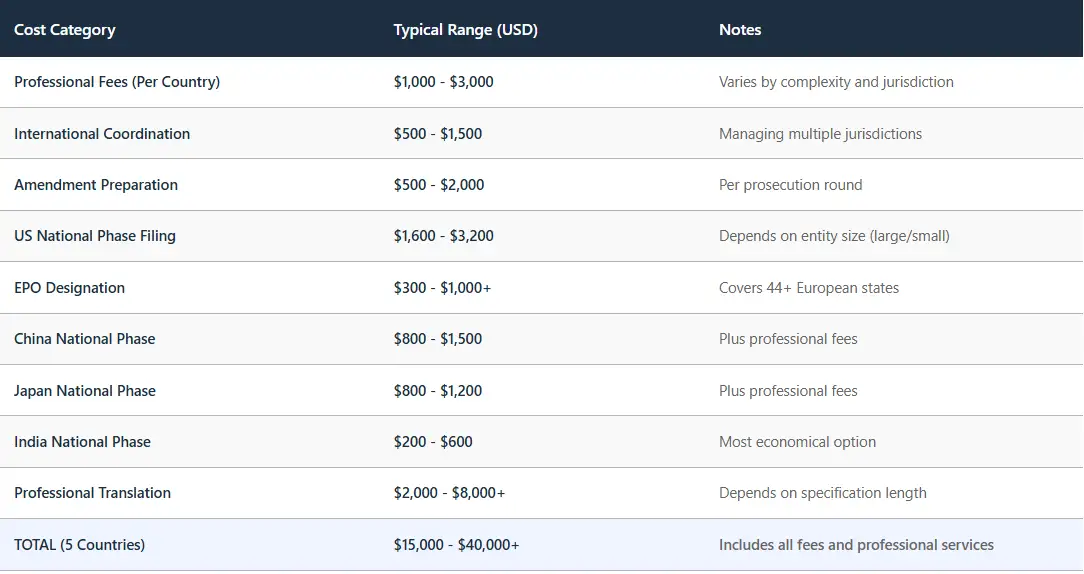
Typical Cost Breakdown in the National Phase Entry Patent Filing Process
In this part, we will discuss about the typical cost breakdown that applicants face during the national phase entry process. This includes professional fees, official government filing fees, and translation costs for key jurisdictions like the US, EPO, China, Japan, and India.
Professional Fees:
- Local patent agent fees: $1,000-$3,000 per country (varies by complexity)
- International coordination: $500-$1,500
- Amendment preparation: $500-$2,000 per round
Official Fees:
- US National Phase: $1,600-$3,200 (depending on entity size)
- EPO Designation: €300-€1,000+
- China National Phase: $800-$1,500
- Japan National Phase: $800-$1,200
- India National Phase: $200-$600
Translation Costs:
- Professional translation: $2,000-$8,000+ (depending on specification length)
- Certification and notarization: $200-$500
Total National Phase Entry (5 Countries): $15,000-$40,000+
Cost-Saving Strategies:
Cost-Saving Strategies: In this part, we will discuss about the practical cost-saving strategies that can help us reduce our national phase entry expenses without losing important patent protection. These strategies include portfolio prioritization, using EPO regional filings, optimizing translations, and negotiating better agent fee arrangements.
Portfolio Prioritization
- File only in countries where commercial potential justifies expense
- Abandon countries with limited market opportunity
- Leverage market research to eliminate marginal territories
Prosecution Management
- Use IPER feedback to draft narrowed claims that reduce examination objections
- Minimize amendment rounds through comprehensive initial filings
- Consider continuation/divisional strategies to spread costs over time
Translation Optimization
- Use machine translation + human editing (rather than full translation)
- Share translation components across similar jurisdictions
- Negotiate volume discounts with translation providers
Agent Fee Negotiation
- Shop multiple agents in key jurisdictions
- Negotiate flat fees vs. hourly rates
- Bundle multiple application handling for volume discounts
Regional vs. National Filings
- Use EPO regional phase instead of individual European national filings (cost savings: 50-70%)
- Consider OAPI (African Intellectual Property Organization) for African coverage
- Evaluate regional alternatives that reduce total filing costs
9. Common Mistakes to Avoid in National Phase Entry Patent Filing Process
In this section, we will discuss about the common mistakes that applicants must avoid during the national phase entry patent filing process. Being aware of these mistakes in advance helps us protect our patent rights and avoid costly errors that can permanently damage our patent portfolio.
Critical Timing Errors:
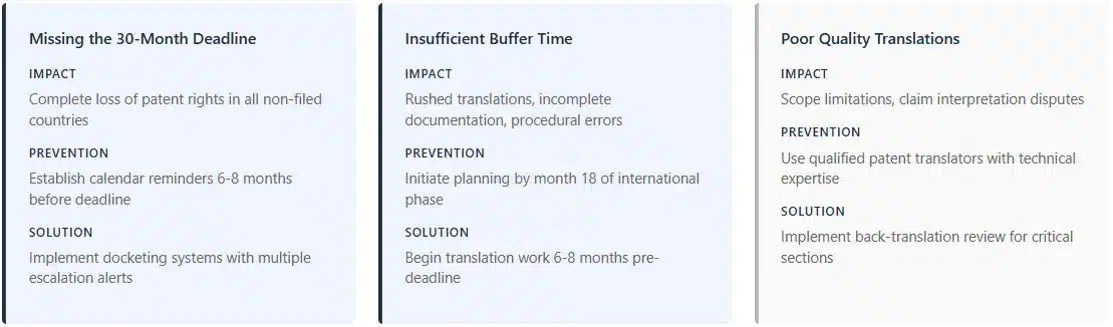
In this part, we will discuss about the critical timing errors that can occur during the national phase entry process. Missing the 30-month deadline or not leaving enough buffer time for translations and document preparation are the most serious timing mistakes any PCT applicant can make.
Missing the 30-Month Deadline
- Impact: Complete loss of patent rights in all non-filed countries
- Prevention: Establish calendar reminders 6-8 months before deadline
- Solution: Implement docketing systems with multiple escalation alerts
- Recovery: File requests for reinstatement in some jurisdictions (limited availability)
Insufficient Buffer Time
- Impact: Rushed translations, incomplete documentation, procedural errors
- Prevention: Initiate national phase planning by month 18 of international phase
- Solution: Begin translation work 6-8 months pre-deadline
Document and Translation Errors:
In this part, we will discuss about the document and translation errors that commonly happen during national phase filing. Poor quality translations, missing required documents, and inconsistent claim amendments across different countries are all errors that can create serious problems during prosecution and enforcement.
Poor Quality Translations
- Impact: Scope limitations, claim interpretation disputes, enforcement challenges
- Prevention: Use qualified patent translators with technical expertise
- Solution: Implement back-translation review for critical sections
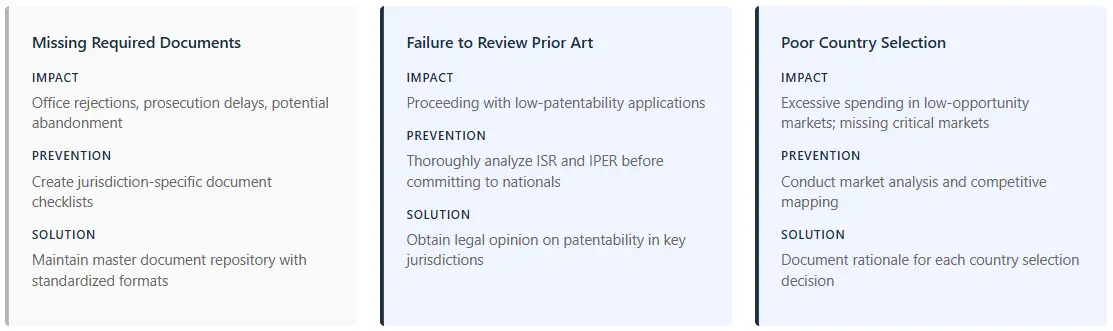
Missing Required Documents
- Impact: Office rejections, prosecution delays, potential abandonment
- Prevention: Create jurisdiction-specific document checklists
- Solution: Maintain master document repository with standardized formats
Inconsistent Claim Amendments
- Impact: Scope divergence across jurisdictions, enforcement complexity
- Prevention: Coordinate amendments with international counsel before filing
- Solution: Maintain amendment tracking spreadsheet for all countries
Strategic Oversights:
In this part, we will discuss about the strategic oversights that many applicants make during the national phase entry process. These include failing to review prior art reports, making poor country selection decisions, having inadequate communication between agents, and not budgeting for ongoing patent maintenance fees.
Failure to Conduct Prior Art Review
- Impact: Proceeding with low-patentability applications
- Prevention: Thoroughly analyze ISR and IPER before committing to nationals
- Solution: Obtain legal opinion on patentability in key jurisdictions
Poor Country Selection
- Impact: Excessive spending in low-opportunity markets; missing critical markets
- Prevention: Conduct market analysis and competitive mapping before selection
- Solution: Document rationale for each country selection decision
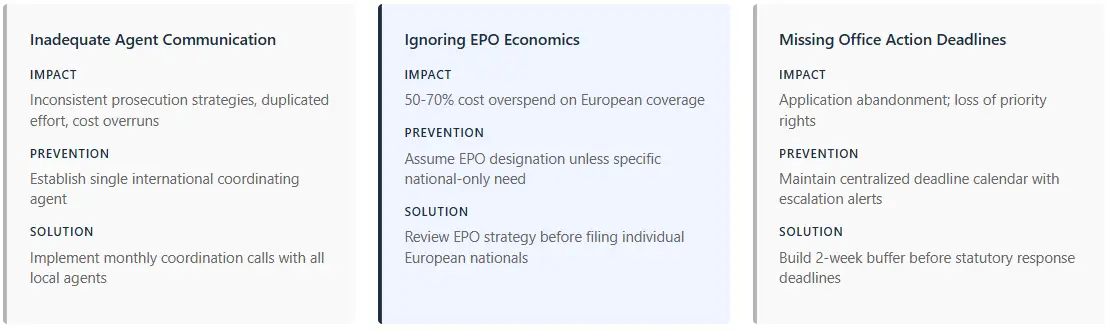
Inadequate Communication Between Agents
- Impact: Inconsistent prosecution strategies, duplicated effort, cost overruns
- Prevention: Establish single international coordinating agent
- Solution: Implement monthly coordination calls with all local agents
Ignoring EPO vs. National Filing Economics
- Impact: 50-70% cost overspend on European coverage
- Prevention: Assume EPO designation unless specific national-only need exists
- Solution: Review EPO strategy before filing individual European nationals
Failure to Budget for Maintenance
- Impact: Patent lapses due to unpaid annuities
- Prevention: Include maintenance cost projections in national phase decision
- Solution: Establish annuity payment system with 3-month advance reminders
Procedural Pitfalls:
In this part, we will discuss about the procedural pitfalls that can occur during national phase entry if we are not careful. Improper power of attorney documentation, incorrect fee calculations, and missed office action response deadlines are common procedural errors that can cause application abandonment.
Improper Power of Attorney Documentation
- Impact: Inability to conduct prosecution; lack of legal authority
- Prevention: Use jurisdiction-specific POA forms
- Solution: Have POA reviewed by local counsel before filing
Incorrect Fee Calculations or Underpayment
- Impact: Application rejection; delayed processing
- Prevention: Verify current fee schedules directly from patent offices
- Solution: Build 10% fee buffer into cost estimates
Missed Office Action Deadlines
- Impact: Application abandonment; loss of priority
- Prevention: Maintain centralized deadline calendar with escalation alerts
- Solution: Build in 2-week buffer before statutory response deadlines
Aslo, Read: PCT National Phase Deadlines: Complete Timeline Guide
Strategic Roadmap for National Phase Entry
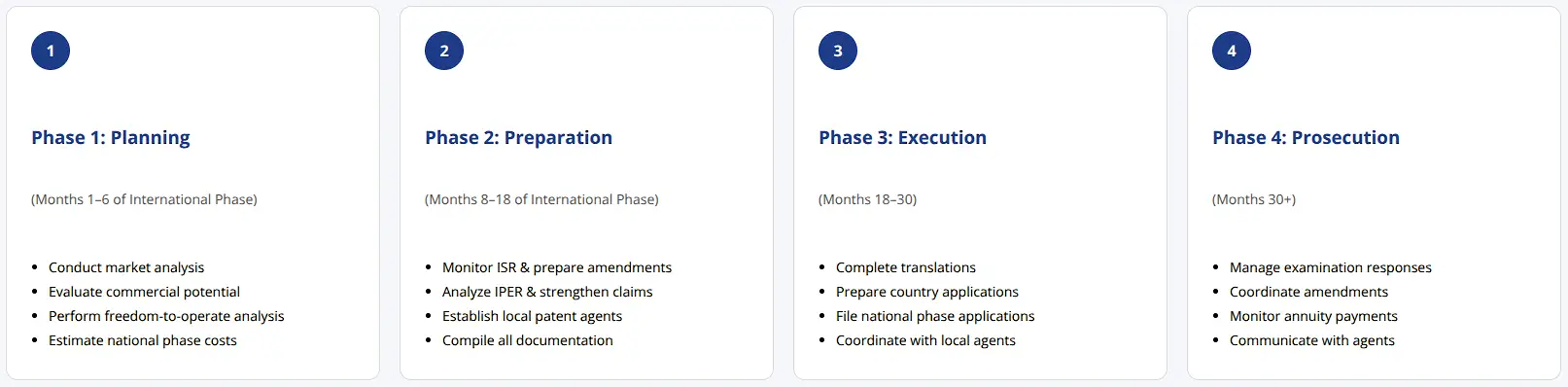
In this section, we will discuss about the strategic roadmap that every applicant should follow for a successful national phase entry. This roadmap is divided into four clear phases that guide us from early planning all the way through post-entry prosecution in each designated country.
1st Phase: Planning (Months 1-6 of International Phase)
- Conduct market analysis and identify target territories
- Evaluate commercial potential and competitive landscape
- Perform freedom-to-operate analysis
- Estimate national phase costs and develop budget
2nd Phase: Preparation (Months 8-18 of International Phase)
- Monitor ISR and prepare initial amendments
- Analyze IPER and identify strengthened claims
- Establish relationships with local patent agents in target countries
- Prepare and review translation plan
- Compile all required documentation
3rd Phase: Execution (Months 18-30)
- Complete and review all translations
- Prepare country-specific applications
- File national phase applications (months 25-28, allowing 2-month buffer)
- Coordinate with local agents on priority jurisdictions
- Begin prosecution planning with local counsel
4th Phase: Prosecution (Months 30+)
- Manage examination responses in each jurisdiction
- Coordinate amendments across countries
- Monitor annuity payment schedules
- Maintain communication with local agents
Conclusion
In this conclusion part, we will summarize the key points from the national phase entry patent filing process guide. Understanding critical deadlines, selecting countries wisely, preparing proper documentation, working with local agents, and avoiding common mistakes are all essential for maximizing the value of our PCT investment. The national phase of a PCT application determines whether your international patent filing translates into enforceable patent protection in your target markets. Timing and crucial documentation both important in the National Phase Entry Patent Filing Process. Understanding critical deadlines, procedural requirements, and strategic considerations enables effective portfolio management. By selecting target countries strategically, preparing thorough documentation, working with qualified local agents, and avoiding common pitfalls, applicants maximize the value of their national phase patent investments.
The 30-month window from your priority date requires disciplined planning and execution. Start your national phase strategy early, maintain clear communication with local counsel, and remain focused on commercial and technical objectives driving your patent protection decisions.
Success in national phase entry requires treating each jurisdiction as a distinct legal proceeding while maintaining strategic coherence across your global patent portfolio.
Start your PCT patent filing journey today with careful planning, professional guidance, and a clear understanding of your commercial objectives. Visit our website for PCT Application Services.
Also, Read: Why Choose PCT Filing? 5 Key Reasons

