
If you manage a docket with thousands of patent matters spread across a dozen jurisdictions, you already know that docketing is not a back-office chore. It is the operational backbone that keeps every deadline, every renewal, and every client relationship intact. Choosing among the best patent docketing services for mid-size and large firms is therefore not a simple vendor swap; it is a decision that touches software integrations, staffing models, data security, and the reputational risk of a single missed date.

This guide breaks down exactly what mid-size and large IP firms should look for, which evaluation criteria actually matter at scale, and how to avoid the costly mistakes that trip up firms during a docketing transition. Whether you are replacing an underperforming vendor or building an outsourced docketing function for the first time, this article will help you evaluate options with the rigor an enterprise portfolio demands.
What Makes Docketing Different at Scale for Large IP Firms
Docketing a portfolio of 50 patents looks nothing like docketing a portfolio of 5,000. As matter volume grows, so does the complexity of every downstream process: rule-based deadline calculation, cross-jurisdictional renewal tracking, conflict checks, and reporting to multiple internal stakeholders. A firm managing thousands of active matters cannot rely on manual spreadsheets or a single docketing clerk; it needs a system, and often a partner, engineered for volume.
Large firms also tend to serve corporate clients with their own IP management systems, which means the docketing provider must integrate cleanly rather than operate as an isolated silo. In short, the best patent docketing services for large firms are judged less on basic date-calculation accuracy (which should be a given) and more on how well they scale, integrate, and report across an entire enterprise operation.
Why a Small-Firm Docketing Playbook Falls Short
A solo practitioner or small firm can often get by with a lean docketing setup and a single point of contact. Our related guide, What Are the Best Patent Docketing Services for Small Firms?, covers that scenario in detail. Large firms, however, face different pressure points:
- Higher matter volume means a single docketing error has a larger blast radius.
- Multiple practice groups and offices require role-based access and permissioning.
- Corporate clients often mandate specific docketing software or reporting formats.
- Global filing strategies demand deep familiarity with dozens of national and regional patent offices.
- Redundancy and business continuity planning become non-negotiable, not optional.
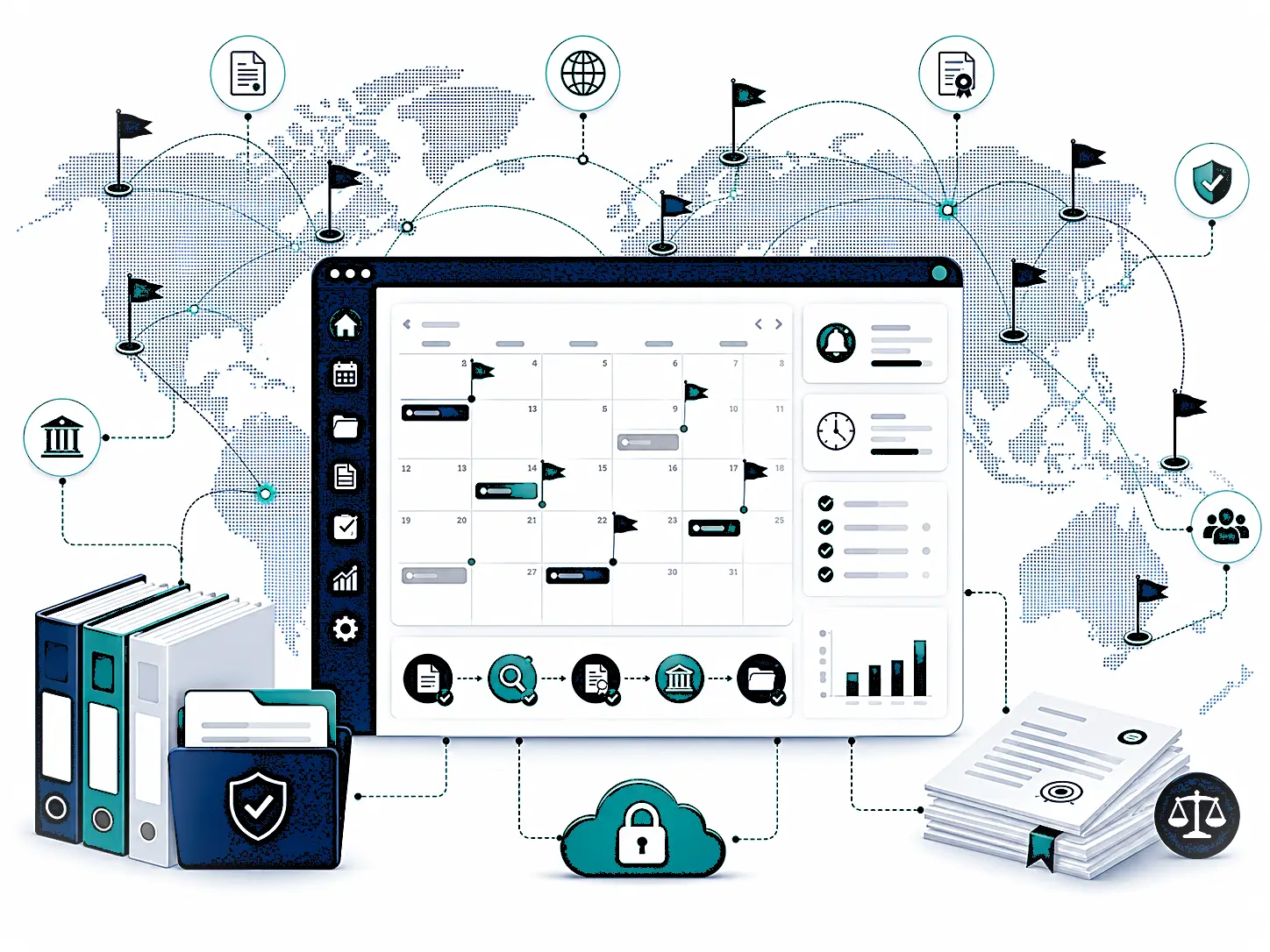
Because the underlying evaluation criteria diverge so sharply from what a small firm needs, mid-size and large firms should treat vendor selection as a distinct exercise, not a scaled-up version of a small-firm checklist.
Core Criteria for Evaluating the Best Patent Docketing Services for Large Firms
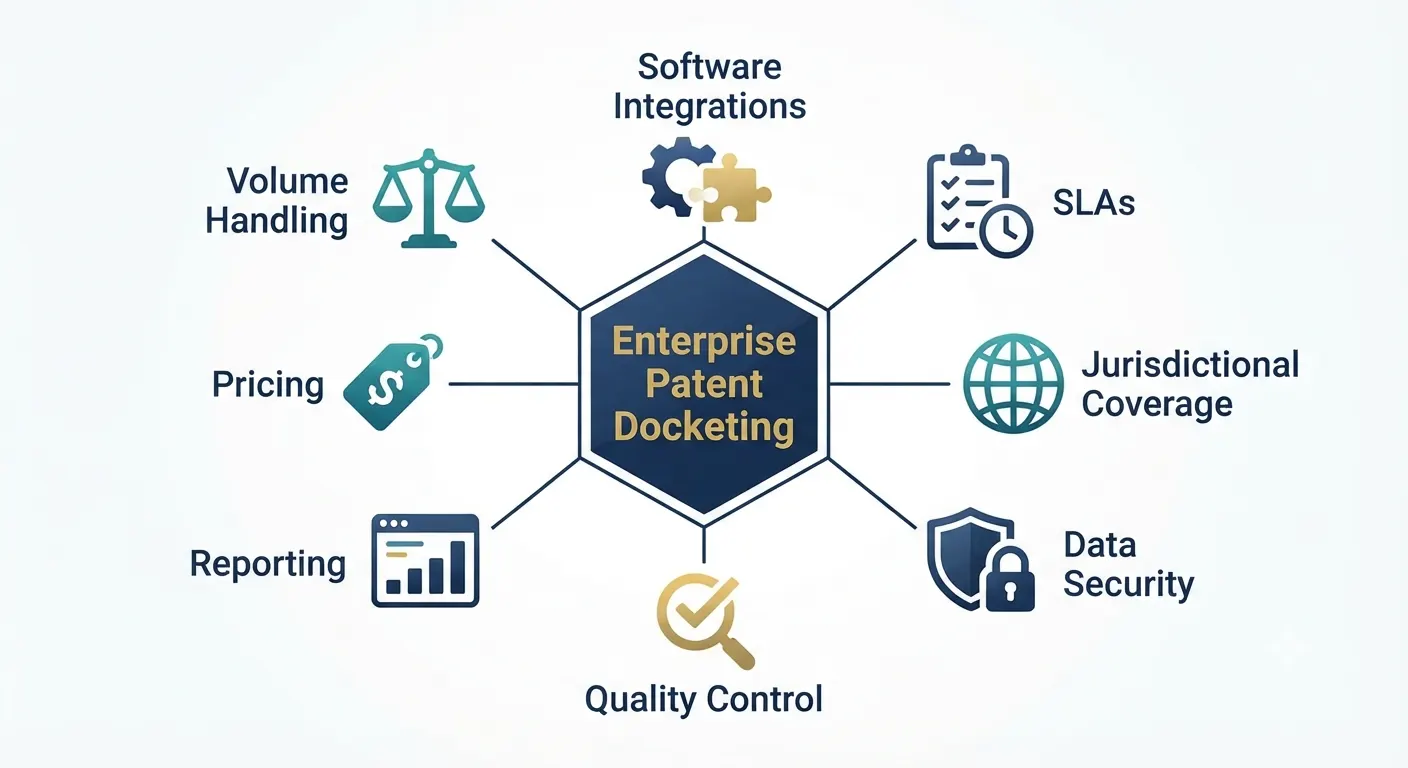
When comparing the best patent docketing services for large firms, evaluation should center on eight areas: volume handling, software integrations, SLAs, jurisdictional coverage, data security, quality control, reporting, and pricing. Each is examined below.
1. Volume Handling and Portfolio Scalability
A provider that manages 500 matters comfortably may struggle at 5,000. Ask prospective vendors how many active matters their largest current client manages, and request references from firms of a similar size to yours. Additionally, inquire about:
- Staffing ratios (how many docketing professionals per 1,000 matters).
- Surge capacity for docket migrations, mergers, or sudden portfolio growth.
- Historical uptime and error rates at scale, not just in a small pilot program.
2. Docketing Software Integrations
Enterprise firms typically run on established IP management platforms such as Anaqua, CPI (Computer Patent Annuities), Foundation IP, Patricia, or similar enterprise-grade systems. A docketing partner must be fluent in your existing software stack, or capable of migrating your data without introducing gaps. Before signing, confirm:
- Which platforms the vendor has direct, hands-on experience with.
- Whether they can work inside your existing system or require you to adopt theirs.
- How they handle data migration, historical matter import, and system-to-system syncing.
For a deeper look at how IP management platforms tie into broader portfolio strategy, see our Intellectual Property Management: Complete and Comprehensive Guide.
3. SLAs and Accountability
Service Level Agreements separate a professional docketing partner from a loosely managed vendor relationship. At the enterprise level, SLAs should specify measurable, auditable commitments, including:
- Turnaround time for docketing new matters and updates.
- Error correction timelines.
- Escalation paths when deadlines are at risk.
- Financial or service remedies if SLAs are missed.
Firms that skip formal SLAs often discover, only after a missed deadline, that there was no contractual accountability in place. That is a preventable and expensive mistake.
4. Multi-Jurisdictional and Global Deadline Coverage
Large IP firms frequently manage portfolios spanning the United States, Europe, and Asia, along with PCT national phase entries. According to the World Intellectual Property Organization, PCT applications must enter the national phase in each target country, and every jurisdiction carries its own deadline rules, extension procedures, and fee structures. Your docketing partner needs demonstrated expertise in:
- USPTO rules and the America Invents Act deadline framework.
- European Patent Office and Unified Patent Court timelines.
- National phase entry deadlines across major filing jurisdictions.
- Currency, translation, and local agent coordination requirements.
Our related article on How Does the PCT Patent Process Work? offers additional background on why multi-jurisdictional docketing accuracy is so demanding.
5. Data Security and Compliance
Patent portfolios contain sensitive, often pre-publication, information. Consequently, data security cannot be an afterthought. Ask vendors about:
- SOC 2 or equivalent security certifications.
- Encryption standards for data at rest and in transit.
- Access controls, audit logs, and employee background check policies.
- Business continuity and disaster recovery plans.
6. Quality Control and Redundancy
Because a single missed date can jeopardize patent rights, redundancy matters enormously. Look for providers that use a multi-layered review process rather than a single-person check. Our guide on double-docketing explains how independent, secondary docketing review helps catch errors before they become a malpractice exposure.
7. Reporting, Analytics, and Dashboards
Enterprise clients, general counsel, and managing partners all want visibility into portfolio health without digging through raw docket data. The best patent docketing services for large firms typically provide:
- Real-time dashboards showing upcoming deadlines by practice group, client, or jurisdiction.
- Custom reporting for budget forecasting and renewal fee planning.
- Exportable data for board-level or client-facing reporting.
8. Pricing Models for Enterprise Docketing
Large firms should scrutinize pricing structures carefully, since flat per-matter fees can become disproportionately expensive at high volume. Common enterprise pricing approaches include:
- Tiered volume pricing that decreases per-matter cost as portfolio size grows.
- À la carte pricing, where firms pay only for the specific services used.
- Hybrid retainer models combining a base fee with variable, usage-based charges.
In-House vs. Outsourced vs. Hybrid Docketing Models
Before selecting a specific vendor, large firms need to decide on a delivery model. The table below compares the three primary approaches.
In-House
Best For
Firms with very large, stable dockets and dedicated budget for full-time staff.
Key Advantage
Direct oversight and institutional knowledge.
Key Risk
High fixed cost; single points of failure during turnover.
Outsourced
Best For
Firms wanting predictable costs and scalable capacity without hiring overhead.
Key Advantage
Access to specialized expertise and built-in redundancy.
Key Risk
Requires strong vendor vetting and clear SLAs.
Hybrid
Best For
Firms managing fluctuating volume or expanding into new jurisdictions.
Key Advantage
Flexibility to scale up or down without permanent headcount changes.
Key Risk
Needs clearly defined handoff points to avoid duplicated or missed work.
Most mid-size and large firms today are gravitating toward the hybrid model, retaining strategic oversight in-house while outsourcing high-volume, rules-based docketing tasks to a specialized partner. This approach also complements broader paralegal staffing strategy; see our related piece on Is It Better to Hire an In-House or Virtual Patent Paralegal? for a closer look at that staffing decision.
Step-by-Step: How to Evaluate and Select a Docketing Vendor
Selecting among the best patent docketing services for large firms works best as a structured process rather than an ad hoc comparison. Follow these steps:
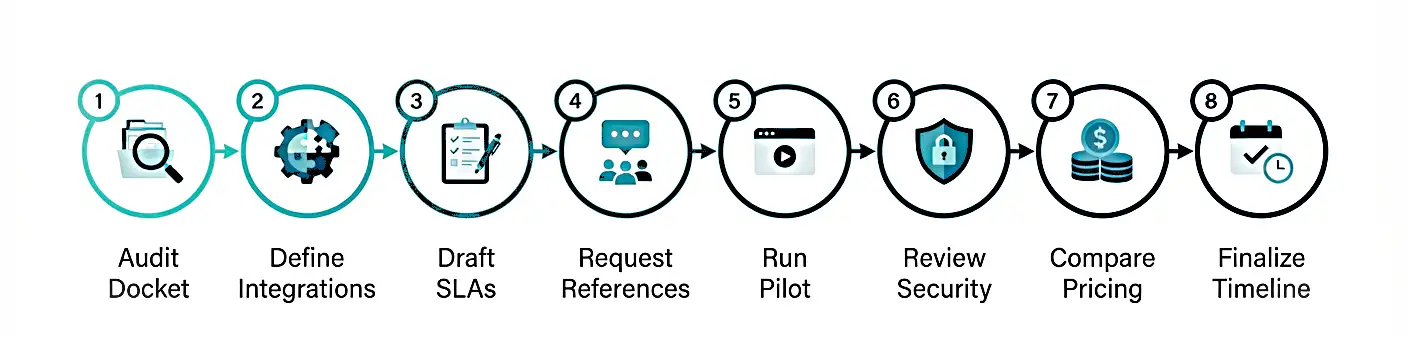
Step 1: Audit your current docket
Quantify matter volume, jurisdictional spread, and current error or missed-deadline history.
Step 2: Define your must-have integrations
List the software platforms, client portals, and internal systems that any vendor must support.
Step 3: Draft SLA requirements
Decide on acceptable turnaround times, escalation procedures, and remedies before requesting proposals.
Step 4: Request enterprise references
Speak directly with firms of comparable size, not just smaller reference clients.
Step 5: Run a pilot migration
Test the vendor on a subset of matters before a full portfolio transition.
Step 6: Review security documentation
Confirm certifications and data handling policies in writing.
Step 7: Compare pricing at your actual volume
Ask for quotes based on your real matter count, not a generic rate card.
Step 8: Finalize a transition timeline.
Build in overlap between your outgoing and incoming docketing processes to avoid coverage gaps.
Common Mistakes Large Firms Make When Choosing Docketing Services
Even sophisticated firms fall into predictable traps during vendor selection. Watch out for these missteps:
Mistake #1 Underestimating integration complexity
Assuming any vendor can “figure out” your software stack after signing often leads to costly delays.
Mistake #2 Skipping formal SLAs
Verbal assurances are not enforceable; without documented SLAs, accountability disappears.
Mistake #3 Ignoring redundancy in quality control
A vendor relying on a single reviewer per matter introduces unnecessary risk.
Mistake #4 Choosing based on price alone
The cheapest option frequently lacks the staffing depth or redundancy that high-volume dockets require.
Mistake #5 Failing to plan the transition period
Migrating thousands of matters without a defined overlap window increases the risk of dropped deadlines.
Mistake #6 Overlooking global jurisdiction expertise
A vendor strong in domestic USPTO docketing may lack the depth needed for complex PCT and national phase portfolios.
Expert Tips for a Smooth Docketing Transition
- Stagger the migration by practice group rather than moving the entire portfolio at once, so any issues surface on a smaller, manageable scale first.
- Run parallel docketing systems for at least one full deadline cycle to confirm accuracy before decommissioning the old system.
- Assign an internal transition owner who is accountable for the migration timeline and vendor communication.
- Document your current docketing rules thoroughly, including any firm-specific practices, before handing off historical data.
- Schedule a formal 90-day review with your new vendor to catch and correct any early-stage issues before they compound.
Key Features Checklist: Best Patent Docketing Services for Large Firms
Use this quick-reference checklist when comparing proposals from prospective vendors.
| Feature | Why It Matters | Must-Have for Large Firms? |
|---|---|---|
| Volume-tested track record | Confirms the vendor can handle enterprise-scale dockets | Yes |
| Native software integrations | Avoids costly custom builds or manual data re-entry | Yes |
| Documented SLAs | Provides contractual accountability | Yes |
| Multi-jurisdictional expertise | Supports global filing strategies | Yes |
| SOC 2 or equivalent security | Protects sensitive, pre-publication IP data | Yes |
| Multi-layered quality control | Reduces the risk of missed or duplicate deadlines | Yes |
| Custom reporting and dashboards | Supports client and internal stakeholder visibility | Yes |
| Flexible, à la carte pricing | Prevents overpaying for unused services | Recommended |
| U.S.-based attorney oversight | Adds strategic and legal accountability to the process | Recommended |
Why Teak IP is Built for Mid-Size and Large IP Firms
Teak IP was built around the operational realities that enterprise IP departments and large patent firms face every day: high matter volume, multiple software platforms, and zero tolerance for missed deadlines. Our docketing and IP management services are supported by U.S. attorney oversight, a multi-layered quality control system, and a combined U.S. and India team structure that delivers both cost efficiency and around-the-clock coverage.
Rather than locking clients into rigid retainer packages, Teak IP uses an à la carte pricing model, so mid-size and large firms pay only for the specific services their portfolio requires, whether that is full docketing management, IDS preparation, or paralegal support. For a broader view of how our team supports complex disclosure obligations alongside docketing, see How IDS Management Can Protect Your Patent from Invalidity Challenges and Why Accurate IDS Reference Management Matters in Patent Prosecution.
Firms evaluating the USPTO’s own guidance on patent application deadlines will find that Teak IP’s docketing rules and reminders are built to track those requirements precisely, alongside equivalent rules for international jurisdictions.
Frequently Asked Questions
What are the best patent docketing services for large firms?
The best patent docketing services for large firms are those that combine proven volume handling, deep software integrations, documented SLAs, multi-jurisdictional expertise, and strong data security. No single feature determines quality; firms should evaluate vendors holistically across all of these dimensions.
How is docketing different for large firms compared to small firms?
Large firms manage far higher matter volume, more complex software integrations, and broader jurisdictional coverage. As a result, they need vendors with proven enterprise-scale experience, formal SLAs, and redundancy in quality control, rather than the more limited setup that suffices for a small practice.
Should a large firm outsource docketing entirely or keep it in-house?
Many large firms choose a hybrid approach, retaining strategic oversight internally while outsourcing high-volume, rules-based docketing work to a specialized partner. This balances cost efficiency with flexibility as portfolio size fluctuates.
What software do the best patent docketing services for large firms typically support?
Leading docketing providers generally support established enterprise IP management platforms such as Anaqua, CPI, Foundation IP, and Patricia, along with the ability to migrate historical data without gaps.
How much do enterprise patent docketing services cost?
Pricing varies based on matter volume, jurisdictional complexity, and service scope. Enterprise firms typically benefit from tiered or à la carte pricing models rather than flat per-matter fees, since flat pricing can become disproportionately expensive at scale.
What is the biggest risk when switching docketing vendors?
The biggest risk is a coverage gap during the transition period. Firms should run parallel systems, stagger migrations by practice group, and clearly document handoff responsibilities to avoid missed deadlines mid-transition.
Conclusion
Selecting among the best patent docketing services for large firms is a strategic decision, not a routine vendor purchase. Mid-size and large IP firms need to weigh volume-handling capacity, software integrations, SLAs, global jurisdictional expertise, security, and pricing flexibility together, not in isolation. Firms that skip formal evaluation criteria, rush transitions, or choose on price alone tend to pay for it later in missed deadlines or costly rework.

If your firm is ready to evaluate its current docketing setup against enterprise-grade standards, Teak IP offers a Docketing Capability Assessment to help you identify gaps and opportunities before they become costly problems. Request your free Docketing Capability Assessment today and see how a U.S. attorney-led, multi-layered docketing team can support your firm’s growth.
Docketing & IP Management Services for Law Firms and Corporate IP Teams

