

What is a Legal Docketing Workflow?
In the world of intellectual property law, missing a single deadline can be catastrophic. A patent application abandoned due to a missed response deadline, a trademark lost to an overlooked renewal date, or an IP portfolio weakened by poor records management – these are not hypothetical risks. They are real consequences of an inadequate legal docketing workflow.
A legal docketing workflow is the structured, step-by-step system that IP law firms, corporate legal departments, and patent agencies use to track, manage, and act on every critical date, filing requirement, deadline, and procedural milestone associated with intellectual property assets.
Unlike general legal calendaring, IP docketing is uniquely complex. It involves multi-jurisdictional filings, international treaties like the Patent Cooperation Treaty (PCT) and the Madrid Protocol, government office actions, annuity payments, maintenance fees, and inter partes proceedings – all happening simultaneously across dozens or even hundreds of matters.
| Why This Framework Matters for Your Practice IP law operates on hard deadlines with virtually no margin for error Missing a USPTO or EPO deadline can result in permanent loss of patent rights Trademark non-renewal can mean losing a brand built over years A well-designed docketing workflow is your firm’s first line of defense A Step‑by‑Step Framework covers Patents, Trademarks, and broad IP docketing best practices |
Core Components of an IP Docketing Workflow
Before diving into the step-by-step process, it’s essential to understand the foundational components that every legal docketing workflow must include, especially when handling IP matters.
The Five Pillars of Effective IP Docketing
1: Intake & Matter Opening
- Capturing all relevant client, inventor, and matter details at the point of engagement
- Assigning matter numbers, client codes, and docket identifiers immediately
- Documenting the filing basis, jurisdiction(s), and applicable treaty frameworks
- Recording priority dates, provisional filing dates, and parent application information
- Setting up the initial deadline cascade from the first key date
2: Deadline Calculation & Calendar Management
- Calculating all statutory deadlines from triggering events (filing dates, office action dates, registration dates)
- Building in buffer deadlines (typically 30, 14, and 7 days ahead of the hard deadline)
- Differentiating between hard deadlines (statutory) and soft deadlines (internal targets)
- Accounting for weekends, federal holidays, USPTO office closures, and jurisdiction-specific rules
- Maintaining a master docket calendar alongside individual attorney views
3: Document Management & Correspondence Tracking
- Capturing and filing all USPTO/EPO/WIPO correspondence immediately upon receipt
- Linking every document to its corresponding matter record and docket entry
- Tracking outgoing correspondence and confirming receipt/acknowledgment
- Maintaining a secure, searchable, and audit-ready document repository
4: Workflow Routing & Task Assignment
- Routing incoming office actions and correspondence to the appropriate attorney or agent
- Assigning docketing tasks with clear ownership, due dates, and completion criteria
- Establishing escalation protocols for items approaching their deadlines
- Creating approval workflows for client authorizations and instructions
5: Reporting, Audit & Quality Control
- Running regular docket reports for attorneys, clients, and management
- Conducting periodic docket audits to catch missed or miscalculated deadlines
- Tracking docketing errors and near-misses for continuous improvement
- Maintaining compliance records for malpractice insurance and bar requirements
Patent Docketing Workflow – Step by Step
Patent docketing is among the most deadline-intensive areas of IP law. From provisional applications to PCT filings to national phase entries and beyond, each stage has strict statutory deadlines governed by the USPTO, EPO, WIPO, and applicable national patent offices. For practices that want this workflow executed by specialists, our patent docketing services cover every stage from provisional intake through national phase entry and annuity tracking.
Patent Legal Docketing Workflow
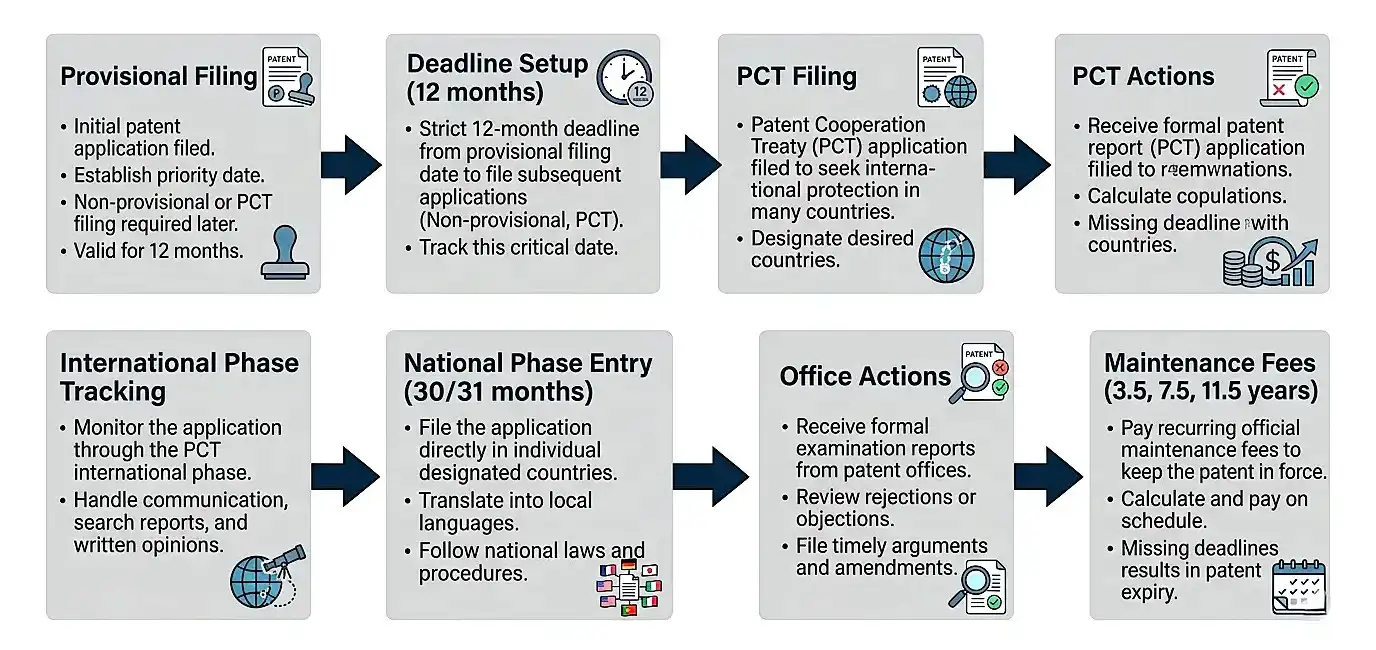
U.S. Provisional Patent Application Docketing
1: Provisional Application Intake
- Receive client instruction or attorney instruction to file provisional application
- Open new matter in docketing system with client code, matter number, and invention title
- Record inventor names, assignee/applicant details, and filing jurisdiction (USPTO)
- Set provisional filing date as T=0 (the anchor date for all subsequent deadlines)
- Generate the critical 12-month deadline for the non-provisional filing (T+12 months)
- Set internal reminders at T+9 months, T+10 months, T+11 months, and T+11.5 months
| Critical Patent Deadlines to Docket Immediately 12 months from provisional filing: Non-provisional or PCT application must be filed30 months from earliest priority date: PCT national phase entry (most countries)3 months from PCT International Filing Date: Demand for Chapter II examination3 months from office action date: USPTO response deadline (extendable with fees)6 months maximum extension for USPTO office action responsesIssue fee payment: 3 months from Notice of AllowanceMaintenance fees: 3.5 years, 7.5 years, and 11.5 years from grant |
PCT (Patent Cooperation Treaty) Application Docketing
PCT applications add an additional layer of complexity because they create international filing rights in 150+ member countries through a single application, but each national phase entry must be individually tracked.
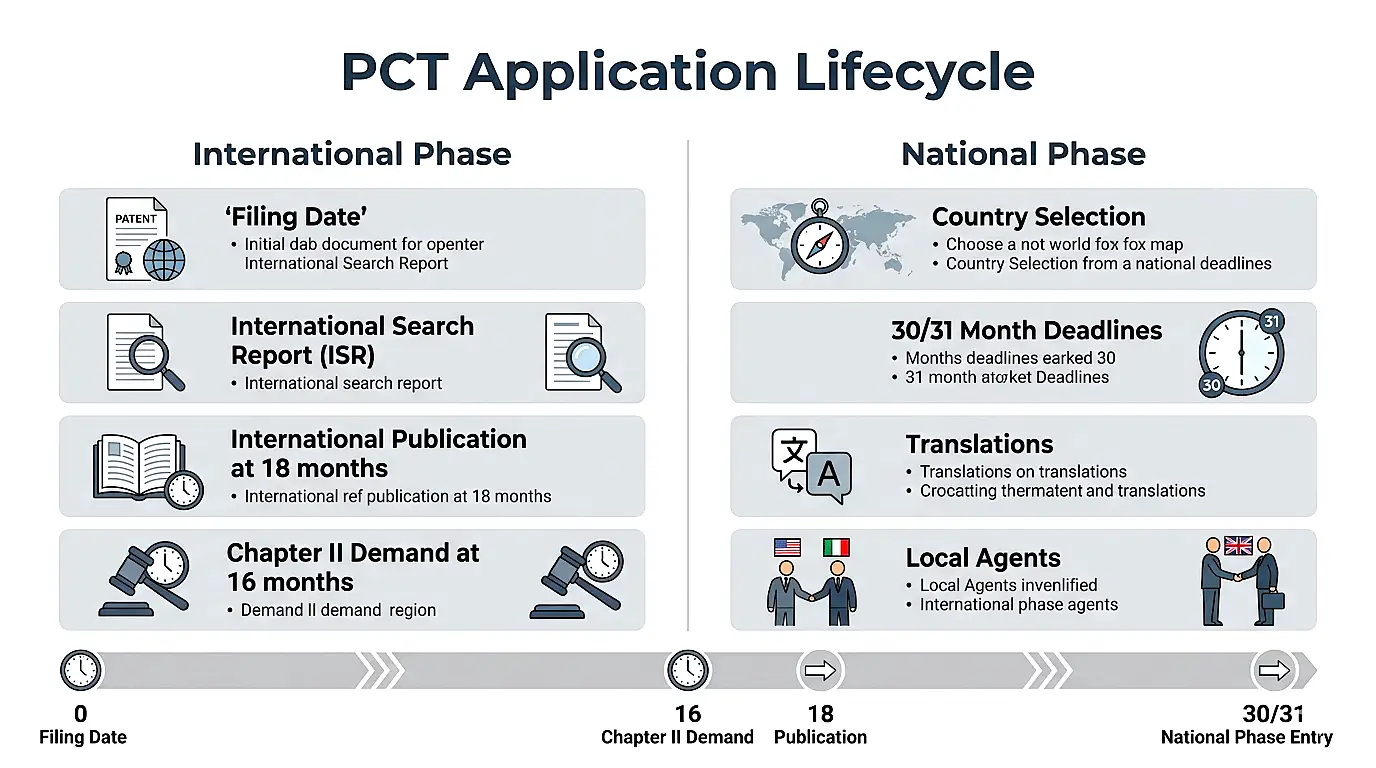
1st Phase International Filing Stage
- Monitor for any International Preliminary Examination Report (IPER) deadlines
- Record PCT filing date (this becomes the international filing date)
- Note the receiving office (RO) and international searching authority (ISA) selected
- Docket the 16-month deadline from priority date for demand filing (Chapter II)
- Calendar the international publication date (18 months from earliest priority date)
- Track the ISR (International Search Report) and Written Opinion expected timing
2nd Phase: National Phase Entry Tracking
- Calendar translation requirements and associated deadlines per jurisdiction
- Identify all target countries for national phase entry
- Create individual docket entries for each jurisdiction with country-specific deadlines
- 30-month deadline: Most countries (from earliest priority date)
- 31-month deadline: Japan, Canada, and several other jurisdictions
- 20-month deadline for some countries if no Chapter II demand was filed
- Assign local associate firms in each jurisdiction and track their acknowledgments
| ⚠ Critical Warning: PCT National Phase Deadlines Failure to enter national phase by the statutory deadline results in irreversible loss of patent rights in that jurisdictionAlways verify country-specific deadlines — they can differ significantly from the standard 30-month ruleEPO national phase entry has specific requirements including filing fees and European search feesSome countries (e.g., India) have additional formality requirements that must be tracked separatelyNever rely solely on docketing software — always have attorney secondary verification for national phase deadlines |
USPTO Office Action Docketing (Legal Docketing Workflow)
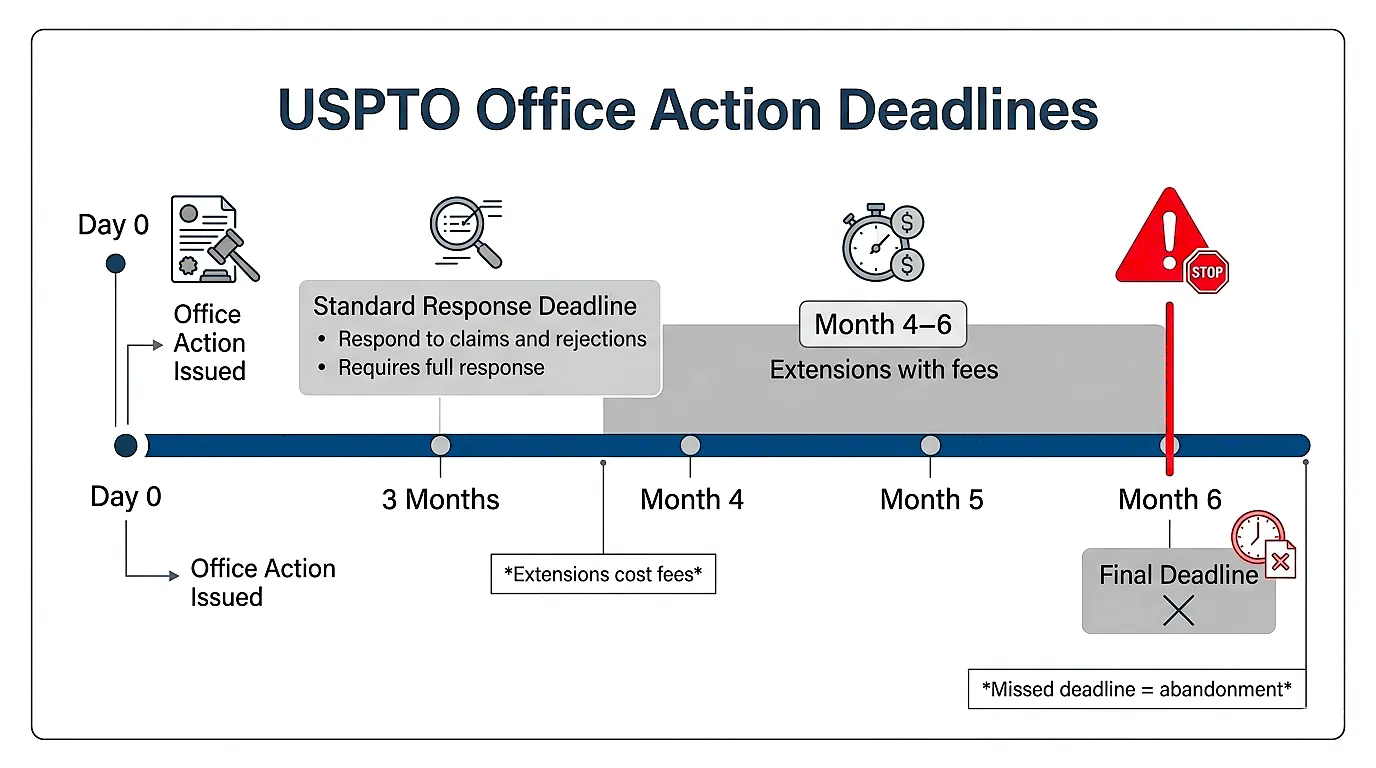
1st Step: Office Action Receipt & Intake
- Immediately upon receipt of Office Action (OA), log it in the docketing system with the exact mail date
- Identify the type of OA: Non-Final, Final, Restriction/Election, Notice of Allowance, or other
- Calculate the 3-month shortened statutory period (SSP) for response
- Calculate extension of time fees for months 4, 5, and 6 (if needed)
- Set hard deadline (month 6 from OA mail date – this is absolute and non-extendable)
- Route OA to the responsible attorney with all deadline information within 24 hours
- Send acknowledgment notification to the client per engagement terms
2nd Step: Response Tracking & Follow-Up
- Track attorney’s response drafting timeline against the SSP and client instruction
- Send internal reminders at 30 days, 14 days, and 7 days before the hard deadline
- Track any Requests for Continued Examination (RCE) if filed after Final OA
- Record extension of time requests and associated fees paid to USPTO
- Confirm e-filing or paper filing receipt and obtain USPTO filing receipt
- Update docket entry to close OA and open next action upon receipt of USPTO response
Patent Maintenance Fee Docketing
Post-grant, patents require periodic maintenance fees to remain in force. Missing these can result in abandonment of the patent, with limited revival options.
| Maintenance Fee | Due Date | Grace Period | Surcharge If Late |
| 1st Maintenance Fee | 3.5 years from grant | 6 months (with surcharge) | Yes — substantial |
| 2nd Maintenance Fee | 7.5 years from grant | 6 months (with surcharge) | Yes — substantial |
| 3rd Maintenance Fee | 11.5 years from grant | 6 months (with surcharge) | Yes — substantial |
- Docket all three maintenance fee deadlines at the time of patent grant
- Set internal reminders 12 months, 6 months, 3 months, and 1 month before each due date
- Confirm client instructions on payment before each deadline
- Track payment confirmations and USPTO receipts in the docket record
- Monitor for any foreign maintenance / annuity fees in parallel if the patent family extends internationally
Trademark Docketing Workflow – Step by Step
Trademark docketing spans the entire lifecycle of a mark – from initial application through registration, post-registration maintenance, renewal, and enforcement monitoring. Each stage has distinct USPTO deadlines and documentary requirements. IP teams managing complex brand portfolios can streamline every step in this workflow by engaging our trademark docketing services to handle application tracking, SOU management, renewal cycles, and Madrid Protocol obligations.
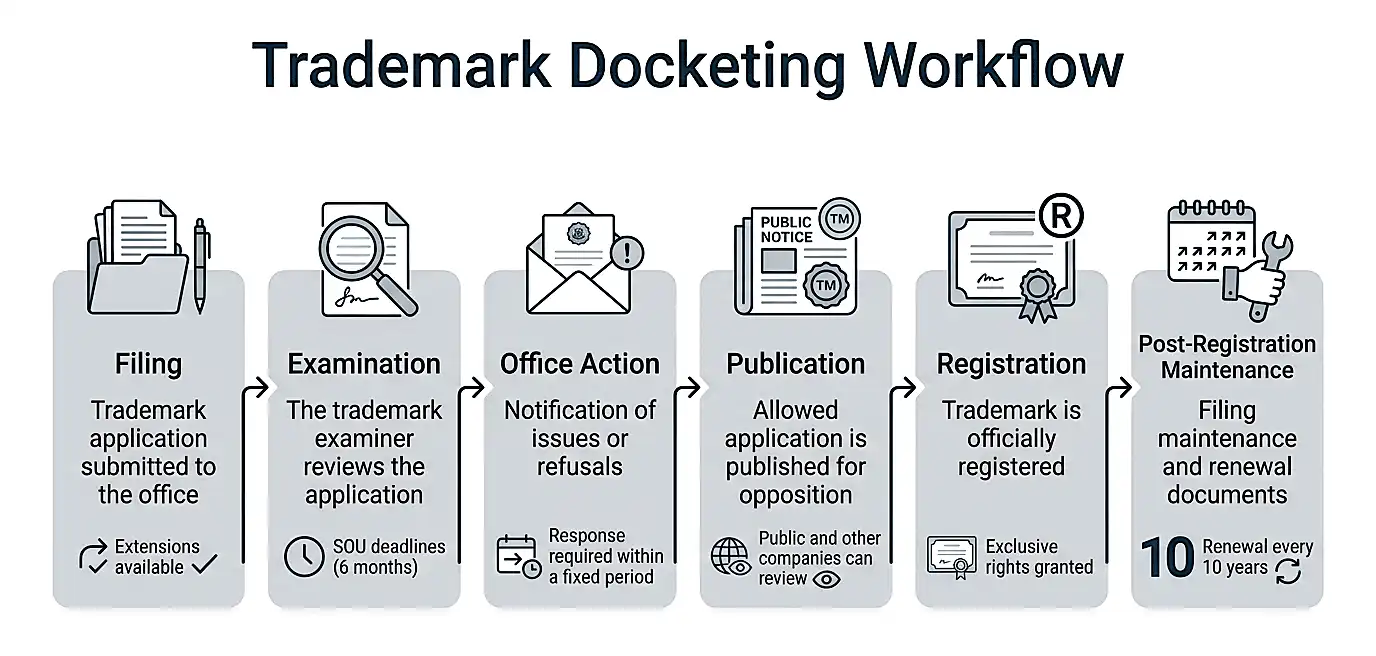
Trademark Application Filing Workflow
1st Step: Pre-Filing Intake & Clearance
- Record client name, mark (wordmark, design mark, or composite), and goods/services in the docketing system
- Document the filing basis: use in commerce (1(a)), intent-to-use (1(b)), foreign registration (44(e)), or foreign application (44(d))
- Log any claimed priority date if filing under Paris Convention within 6 months of foreign filing
- Assign trademark attorney and paralegal with docketing responsibilities
- Calendar expected USPTO examination timeline (typically 8–12 months from filing)
2nd Step: Post-Filing Docketing
- Record USPTO application serial number upon filing confirmation
- File the filing receipt and confirmation in the matter record
- Calendar the 6-month window if claiming Paris Convention priority from a foreign application
- For ITU applications: Calendar the 6-month Statement of Use (SOU) deadline from Notice of Allowance (NOA)
- Calendar up to five 6-month extensions of time to file SOU (maximum 36 months from NOA)
Trademark Office Action Docketing (Legal Docketing Workflow)
USPTO examining attorneys may issue Office Actions requiring the applicant to address legal or procedural deficiencies. These have strict deadlines.
Key Trademark Office Action Deadlines
- Response deadline: 3 months from the date the OA issues (shortened statutory period as of October 2022)
- Extensions available: Two 3-month extensions for a total of 9 months from OA issue date
- Failure to respond: Results in abandonment of the trademark application
- Non-Final OA: Applicant can respond to the merits and/or amend the application
- Final OA: Applicant must comply, file a Request for Reconsideration, or appeal to TTAB
Docketing Steps for Trademark Office Actions
- Upon receipt of OA, immediately log in docketing system with OA date and type
- Calculate 3-month response deadline from OA issue date (not receipt date)
- Calculate maximum extension deadline (9 months from OA issue date)
- Route OA to responsible attorney within 24 hours with all deadline information
- Send client notification per engagement letter terms
- Set internal reminders at 30, 14, and 7 days before the 3-month deadline
- Track response filing and confirm USPTO acknowledgment
- Docket next action based on USPTO response (registration, further OA, or abandonment)
Post-Registration Trademark Docketing
Registration is not the end of the trademark docketing workflow – it is merely a transition into the critical post-registration maintenance and renewal phase.
8 Declaration of Use (Continued Use)
- Due between years 5 and 6 from the registration date (grace period of 6 months with surcharge)
- Certifies that the mark is still in use in commerce for the goods/services listed
- Failure to file results in cancellation of the trademark registration
- For marks registered after November 16, 1989: Combined Section 8 & 15 filing is common
- Docket this deadline immediately upon receipt of registration certificate
- Set internal reminders at 18 months, 12 months, 6 months, and 2 months before the Year 5 deadline
Renewal (10-Year Renewal)
- Due every 10 years from the registration date (first renewal between years 9 and 10)
- Combined Section 8 & 9 filings accepted – most practitioners file them together
- Grace period: 6 months after the renewal deadline with a surcharge
- Failure to renew results in cancellation and potential loss of the registered mark
- Docket the 10-year, 20-year, and 30-year renewal deadlines at the time of registration
- Many docketing systems can auto-calculate these, but manual verification is essential
| Trademark Milestone | Deadline | Key Notes |
| Section 8 Declaration | Years 5–6 from registration | 6-month grace period available |
| Section 15 Incontestability | Any time after 5 years continuous use | Optional but strategically important |
| First Renewal (Sec. 8 & 9) | Years 9–10 from registration | Must include specimen of use |
| Subsequent Renewals | Every 10 years thereafter | Combined Sec. 8 & 9 filings |
| ITU Statement of Use | 6 months from NOA | Up to 5 extensions available |
| Paris Priority Claim | 6 months from foreign filing | Strict — no extension |
Also, Read: Intellectual Property Docketing: A Complete Guide
Legal Docketing Workflow Best Practices
Even the best docketing software is only as effective as the workflow and practices that surround it. The following best practices are drawn from industry experience in high-volume IP docketing environments.
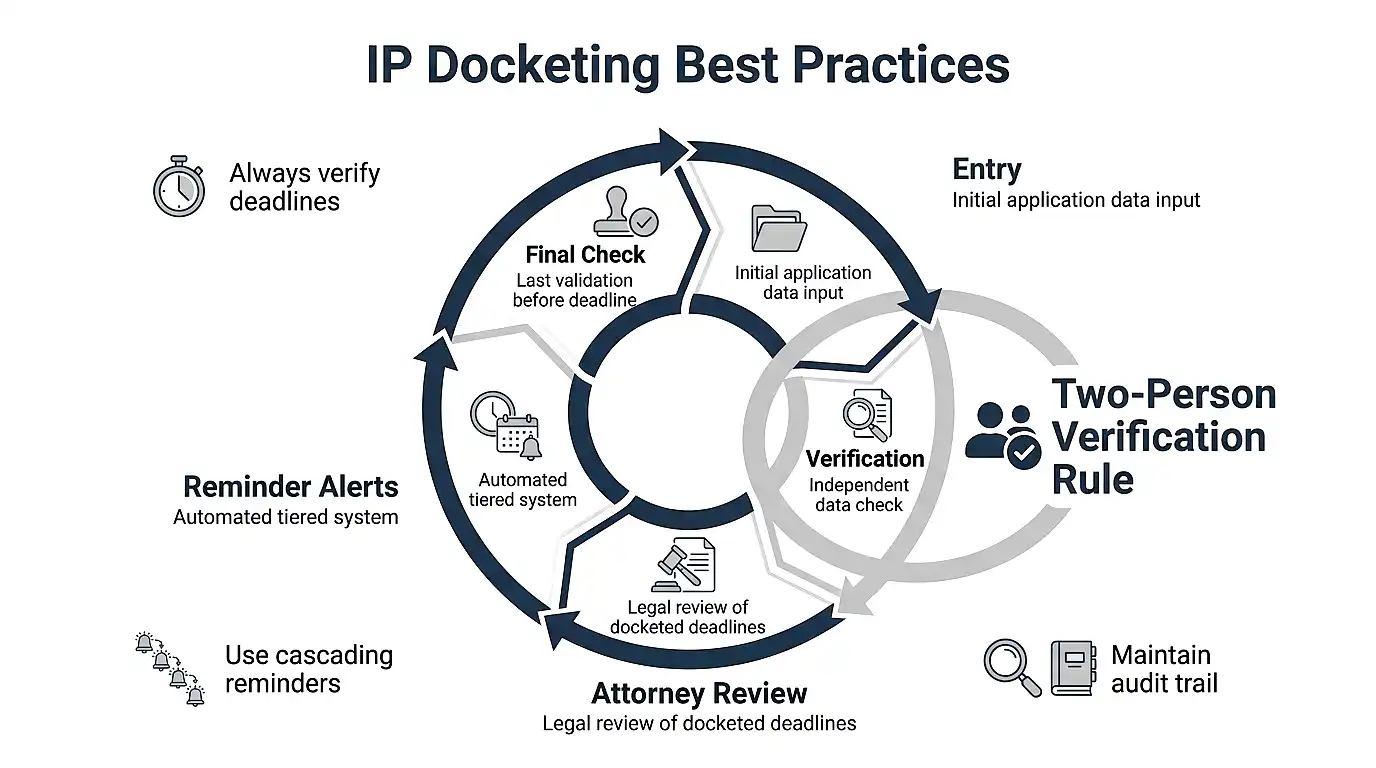
The Double-Check Rule: Two Sets of Eyes on Every Deadline
In a mature legal docketing workflow, no critical deadline should rely on a single person or a single system entry. The double-check rule means:
- Every deadline calculated by one team member is verified by a second team member
- Docketing software calculations are cross-referenced against the relevant statute or rule
- Attorney review and sign-off on the docket sheet before any matter is marked as calendar-ready
- Automated reminders serve as supplemental alerts, not primary deadline management
Triggering Event Documentation
Every deadline in an IP docketing workflow is triggered by a specific event: a filing date, an office action mail date, a registration date, or a grant date. The triggering event must be documented with the original source document — not reconstructed from memory.
- Attach the original USPTO Notice of Allowance when docketing the issue fee deadline
- Retain the office action front page showing the mail date when calculating response deadlines
- Log the PCT filing receipt from the receiving office when docketing national phase entry dates
- Document the registration certificate date when setting post-registration maintenance deadlines
Cascading Deadline Management
IP docketing is not about managing one deadline at a time — it is about managing cascading chains of deadlines that flow from a single originating event. A well-structured workflow maps these cascades from day one.
| 💡 Pro Tip: Cascade Mapping for PCT Applications At the time of PCT filing, immediately docket: International filing date, 12-month priority deadline, 18-month publication date, 30-month national phase deadlines for ALL target countries, Chapter II demand deadline (16 months from priority), and any country-specific variationsThis upstream thinking prevents scrambling when national phase deadlines approach years laterCascade maps should be reviewed and updated whenever client instructions change |
Abandonment Prevention Protocol
Docket abandonment – matters going dead due to missed deadlines – is one of the most serious risks in IP practice. A robust abandonment prevention protocol includes:
- A morning docket report sent to all attorneys showing items due in the next 30 days
- An escalation protocol triggered 14 days before any hard deadline if no attorney action has been recorded
- A secondary escalation to firm management or practice group leader at 7 days
- A physical verification call or email to the responsible attorney at 3 days
- Documented confirmation that every deadline has been acted upon or consciously abandoned per client instructions
Intake-to-Docket Time Standards
One of the most common workflow failures in IP docketing is delay between receiving a document and entering it into the docketing system. Best practice standards include:
- Same-day docketing for all incoming USPTO/EPO/national office correspondence
- 24-hour maximum turnaround for office actions, notices of allowance, and registration certificates
- 48-hour maximum for new matter intake from client engagement through initial docket setup
- Immediate (real-time) update of docket records upon filing any response or fee payment
Also, Read: Comprehensive Guide to Patent Docketing Systems
IP Docketing Software & Technology
Modern legal docketing workflows are heavily technology-dependent. The right docketing platform can dramatically reduce errors, improve efficiency, and provide the audit trail necessary to defend against malpractice claims.
Leading IP Docketing Software Platforms
| Platform | Key Features | Best Suited For |
| Anaqua | Full IP lifecycle, annuity mgmt, reporting dashboards | Large corporations, global firms |
| Dennemeyer DIAMS | International annuity focus, multi-jurisdiction | IP boutiques, mid-size firms |
| CPA Global (Clarivate) | Automated annuity payments, IP analytics | Enterprise patent portfolios |
| Foundation IP | Attorney-centric, customizable workflows | Law firms of all sizes |
| Inprotech | Patents and trademarks, USPTO integration | Mid-to-large IP firms |
| Compu-Mark | Trademark-focused, watching services | Trademark-heavy practices |
| Docket-It | Affordable, USPTO-synced deadlines | Small firms and solo practitioners |
Essential Software Features to Evaluate
- USPTO, EPO, and WIPO API integrations for automated docket updates
- Configurable reminder and escalation rule engines
- Matter-level document management with full correspondence history
- Multi-user access controls with role-based permissions (attorney, paralegal, docketing specialist)
- Audit logs with time-stamped records of all docket changes
- Reporting and analytics dashboards for portfolio overview
- Client portal integration for direct client access to their matter status
- Mobile access for attorneys managing dockets remotely
USPTO Patent Center & Trademark Status and Document Retrieval (TSDR)
In addition to commercial docketing platforms, IP practitioners should integrate free USPTO tools into their workflows:
- Patent Center: Real-time access to patent application status, image file wrapper, and prosecution history
- TSDR (Trademark Status): Real-time trademark application and registration status, all office actions, and filing history
- PAIR (Private/Public): Still accessible for older patent matters, though Patent Center is replacing it
- TTABVUE: Trademark Trial and Appeal Board proceedings database
- Global Dossier: View related applications across USPTO, EPO, and JPO in one interface
Also, Read: What is a Docketing System? Complete A to Z Guide
Building the Right IP Docketing Team
The most sophisticated docketing workflow will fail without the right people executing it. IP docketing requires a specialized skill set that combines legal knowledge, procedural accuracy, and systematic attention to detail.
Key Roles in an IP Docketing Workflow
Docketing Specialist / IP Docketing Paralegal
- Primary responsibility for entering and maintaining all docket records
- Calculates deadlines from source documents using official rules and statutes
- Generates and distributes docket reports to attorneys and management
- Conducts regular docket audits and reconciliation against USPTO/EPO records
- Should have formal training in IP docketing (NALS, NAIPLA certifications preferred)
IP Paralegal / Patent Agent
- First-line review of incoming office actions and official correspondence
- Prepares initial deadline analysis for attorney review
- Assists in drafting responses to minor procedural office actions
- Maintains client communication files and correspondence logs
Supervising Attorney / Docket Oversight Partner
- Ultimate professional responsibility for all docket accuracy
- Reviews and approves docket audit reports
- Establishes firm docketing policies and procedures
- Signs off on all outgoing responses and fee payments
- Escalation point for abandonment-risk situations
IT/Systems Administrator
- Manages docketing software installation, updates, and integrations
- Maintains data backup and disaster recovery protocols for docket database
- Configures user access rights and security settings
- Manages USPTO/EPO API connections and data synchronization
Staffing Models for IP Docketing
Depending on the size and structure of your IP practice, different staffing models may be appropriate:
- In-House Docketing Team: Best for large firms and corporate IP departments with high-volume, ongoing docketing needs. Provides maximum control and direct oversight.
- Outsourced IP Docketing Services: Ideal for small to mid-size firms that need expert docketing without the overhead of full-time staff. Teak IP Services specializes in this model, offering dedicated docketing professionals at a fraction of in-house staffing costs.
- Hybrid Model: Combining a small internal docketing team with an outsourced partner for overflow, specialized jurisdictions, or annuity management. Provides flexibility and redundancy.
- Attorney-Managed Docketing: Only appropriate for solo practitioners with very small portfolios. High risk without specialized support.
Also, Read: Effective Trademark Portfolio Management: Key Components, Challenges & Practices
Common IP Docketing Errors & How to Avoid Them
Understanding where docketing workflows fail is as important as knowing how to build them. The following are the most common – and most dangerous – docketing errors in IP practice.
The Most Frequently Missed Deadlines
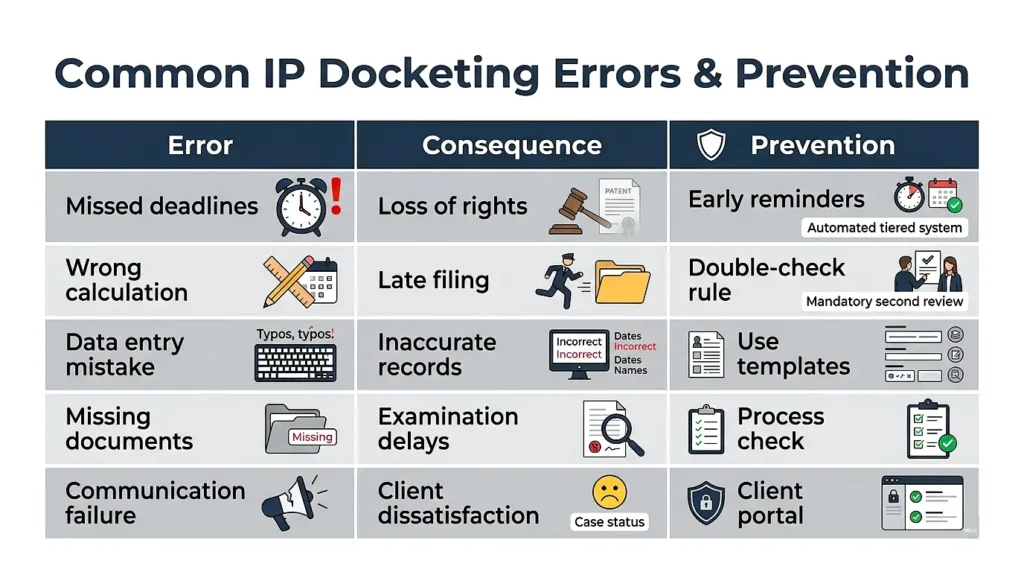
Systemic Workflow Failures to Avoid
- Single point of failure: Relying on one docketing professional with no backup or cross-training creates catastrophic risk when that person is absent.
- Delayed intake: Every day of delay between receiving a document and docketing it increases risk. Intake must be same-day.
- Relying solely on automated reminders: Software reminders can fail, be dismissed, or be misconfigured. Human review of the docket is non-negotiable.
- Failure to confirm client instructions: Proceeding with or abandoning an application without documented client authorization exposes the firm to liability.
- No audit trail: Inability to prove when a deadline was docketed, who verified it, and when it was acted upon is a malpractice defense nightmare.
Also, Read: Outsource Patent Docketing: Key Reasons to Consider
International IP Docketing Considerations
For IP firms managing global patent and trademark portfolios, international docketing adds an entirely new dimension of complexity. Different countries have different deadline rules, fee structures, and procedural requirements that must be individually tracked.
European Patent Office (EPO) Docketing
- European patent applications can enter the EPO directly (Euro-direct) or via PCT
- European search report and extended European search report deadlines must be tracked
- Reply to Examination Report: 4 months from communication date
- Validation deadlines: Each EP member state requires separate validation for national enforcement
- Annual renewal fees: Due for each year the application is pending and post-grant
- Opposition period: 9 months from grant date – docket for defensive monitoring purposes
- EPO deadlines are calculated from the date of notification, not the issuance date – this is a critical difference from USPTO
Trademark International Registration (Madrid Protocol)
- International registrations are managed through WIPO’s Madrid System
- Based on a home country (basic) registration or application – track the home mark’s status
- 5-year dependency period: IR is dependent on the basic mark for 5 years from registration
- Refusals from designated countries: Typically 12-month or 18-month period to respond
- 10-year renewable term from the international registration date
- Individual country maintenance requirements may still apply in addition to WIPO renewal
Managing Foreign Associate Networks
- Establish a vetted network of foreign associates in each jurisdiction where clients file
- Create standardized instruction templates for national phase entries, oppositions, and renewals
- Track acknowledgment of instructions within 24–48 hours of sending
- Require confirmation of filing with official receipts from each associate
- Maintain backup associates in high-volume jurisdictions
- Reconcile foreign associate invoices against docket records to confirm actions taken
Also, Read: Trademark IP Management Best Practices for Multi-Jurisdiction Brand Protection
Outsourcing Your IP Docketing Workflow
For many IP law firms and corporate legal departments, maintaining an in-house IP docketing team is neither practical nor cost-effective – especially during periods of portfolio growth, staff transitions, or budget constraints. Outsourcing the legal docketing workflow to a specialized IP services provider like Teak IP Services offers a strategic alternative.
Benefits of Outsourcing IP Docketing to Teak IP Services
Cost Efficiency
- Eliminate the cost of full-time salaries, benefits, training, and software licensing for an in-house team
- Pay only for the docketing support you need, scalable up or down as your portfolio changes
- Reduce overhead associated with recruiting, onboarding, and retaining specialist docketing staff
Expert Knowledge & Accuracy
- Access dedicated IP docketing professionals with deep knowledge of USPTO, EPO, WIPO, and national office procedures
- Benefit from teams that specialize exclusively in IP docketing – not generalist paralegals handling multiple functions
- Leverage best-practice workflows refined across hundreds of matters and multiple jurisdictions
Risk Reduction & Reliability
- Eliminate single points of failure with team-based docketing and built-in redundancy
- Consistent quality control processes including double-check verification on all critical deadlines
- Business continuity – no disruption to docketing during staff vacations, illness, or turnover
- Regular docket audit reports for full visibility and attorney oversight
Technology & Integration
- Teak IP’s docketing specialists are trained in leading platforms including Anaqua, Foundation IP, and others
- Seamless integration with your existing practice management and billing systems
- USPTO, TSDR, and EPO portal access for real-time status verification
What Teak IP Services Docketing Covers
| Teak IP Services: IP Docketing Service Portfolio U.S. patent prosecution docketing (provisional, non-provisional, continuations, divisions, CIPs)PCT docketing – international phase and national phase entry tracking for 50+ countries U.S. trademark docketing – application through post-registration maintenance International trademark docketing – Madrid Protocol and direct national filings Post-grant proceedings – IPR, PGR, CBM, ex part re examination docketing Patent annuity and maintenance fee tracking and payment coordination Docket audits and portfolio clean-up for acquired or migrated IP matters Custom docket reporting for attorney, client, and management distribution |
Also, Read: Outsource Trademark Docketing: Strong Reasons to Consider
Legal Docketing Workflow Checklist
Use this comprehensive checklist to audit and improve your firm’s existing IP docketing workflow, or to build a new one from scratch.
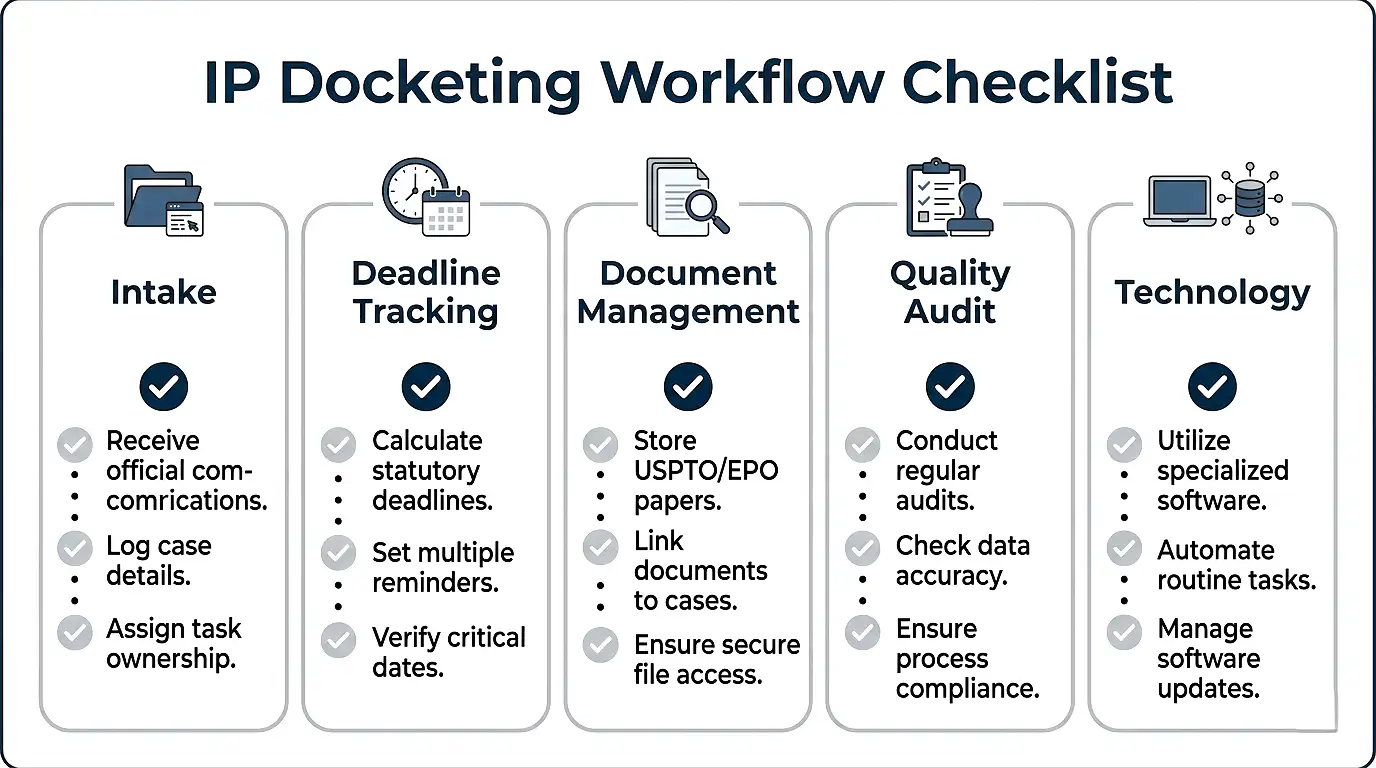
Intake & Matter Opening Checklist
- Initial deadline cascade calculated and entered from triggering event
- New matter opened in docketing system within 48 hours of engagement
- Client code, matter number, attorney assignment, and paralegal assignment recorded
- All inventors, applicants, and assignees documented with correct spelling and entity type
- Filing basis, jurisdiction, and applicable international treaty identified and noted
- Priority date(s) and all claiming applications/registrations linked in the system
Ongoing Docketing Operations Checklist
- Docket entry closed only after receipt of official confirmation from the relevant office
- All incoming USPTO/EPO/WIPO correspondence docketed same day of receipt
- Office action deadlines calculated from official mail date (not receipt date)
- Secondary verification of all office action deadlines by a second team member
- Attorney routing notifications sent within 24 hours of any incoming office action
- Client notifications sent per engagement letter terms
- All outgoing filings and responses recorded in docket with filing confirmation number
Quality Control & Audit Checklist
- Backup docketing professional identified and cross-trained for all critical matters
- Weekly docket report reviewed by supervising attorney or docket manager
- Monthly docket audit conducted to cross-reference system records with USPTO/TSDR/EPO
- Quarterly review of docketing procedures and error log for continuous improvement
- Annual comprehensive docket audit for all active matters
- All docketing errors documented and root cause analysis completed
Technology & Systems Checklist
- Software version and rule updates reviewed with each USPTO/EPO rule change
- Docketing software configured with all applicable deadline rules for each jurisdiction
- Automated reminder rules set for all standard deadlines (30/14/7 day cascade minimum)
- USPTO, TSDR, and EPO portal integrations verified and active
- Data backup for docket database completed and tested regularly
- User access rights reviewed and updated upon any staff change
Your Legal Docketing Workflow Is a Strategic Asset
A well-designed legal docketing workflow is not just a back-office administrative function – it is a strategic asset for any IP practice. It protects your clients’ most valuable intangible property. It protects your firm from malpractice risk. And it enables you to manage growing IP portfolios with confidence, efficiency, and accuracy.
Whether you are a solo IP attorney managing a few dozen matters or a global IP firm handling thousands of patent and trademark files across multiple jurisdictions, the principles in this A Step‑by‑Step Framework apply equally. The details scale; the fundamentals do not.
The question is not whether you need a robust IP docketing workflow. The question is whether you have the right people, processes, and technology in place to execute it. If the answer is no – or even maybe – Teak IP Services is here to help.
Our Services: Explore IP Docketing Services

