
Intellectual Property Docketing: Managing intellectual property assets isn’t just about filing applications – it’s about never missing a deadline. One missed renewal or a late response to an office action can mean the permanent loss of a patent, trademark, or copyright that took years and thousands of dollars to secure.
This is where intellectual property docketing becomes the backbone of every successful IP practice.
Whether you’re an in-house IP counsel, a law firm paralegal, or a growing startup protecting your innovations, understanding IP docketing is non-negotiable.

Whether you’re building a docketing system from scratch or looking to strengthen an existing one, our IP docketing services provide the expertise, processes, and technology support to ensure no critical deadline is ever missed.
This guide walks you through everything: what intellectual property docketing is, why it matters, how docketing systems work, and best practices to build a bulletproof IP docket.
What is Intellectual Property Docketing?
Intellectual property docketing is the systematic process of recording, tracking, and managing all critical dates, deadlines, and actions related to IP assets – including patents, trademarks, copyrights, and trade secrets.
A “docket” in IP law refers to a calendar or database that captures every important event tied to an IP portfolio: filing dates, examination deadlines, annuity payments, office action responses, renewal dates, and more.
In simple terms: IP docketing ensures that no deadline slips through the cracks – ever.
Why Intellectual Property Docketing is Critical
Intellectual property rights are time-sensitive by nature. Governments impose strict statutory deadlines. Miss them, and your IP rights can be abandoned, invalidated, or forfeited – with little to no ability to recover.
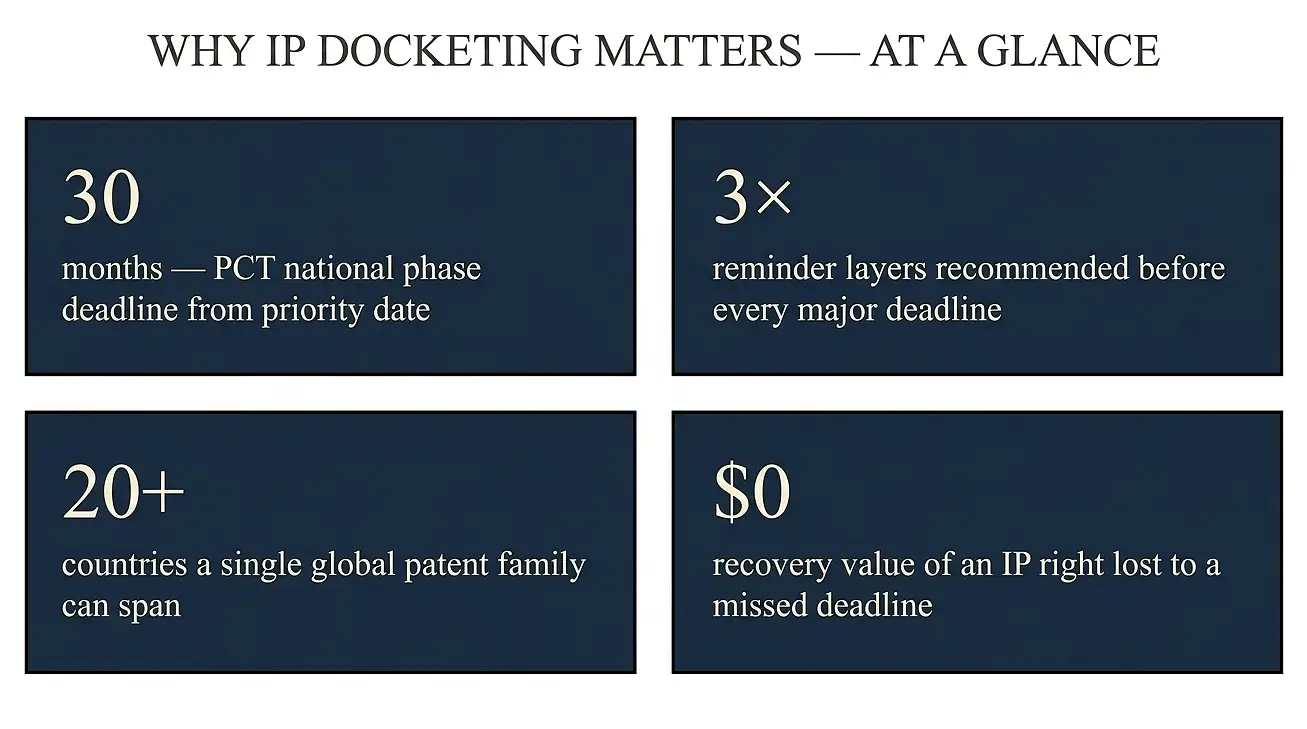
Key reasons IP docketing is essential:
- Statutory deadlines are absolute – Patent offices worldwide set hard cutoffs for responses, annuities, and renewals with very limited grace periods.
- Portfolio size demands structure – Companies with even 50–100 active IP assets cannot rely on memory or spreadsheets alone.
- Multi-jurisdictional complexity – A global patent family may span 20+ countries, each with different local rules, currencies, and timelines.
- Malpractice risk – For law firms, missing a client’s IP deadline is a serious legal liability.
- Business continuity – IP assets underpin product launches, licensing deals, M&A transactions, and investor confidence.
Types of IP Assets Covered by Docketing
A robust intellectual property docketing system covers all forms of IP:
1. Patents
- Provisional and non-provisional applications
- PCT (Patent Cooperation Treaty) applications
- National phase entries
- Office action deadlines
- Annuity/maintenance fee payments
- Grant and issuance dates
- Post-grant proceedings (IPR, PGR, reexamination)
2. Trademarks
- Application filing dates
- Office action response deadlines
- Publication for opposition periods
- Renewal and Section 8/15 filing deadlines
- Madrid Protocol designations
- Watch notices and opposition windows
3. Copyrights
- Registration filing dates
- Renewal deadlines (for older works)
- Licensing agreement milestones
4. Trade Secrets
- Internal audit dates
- NDAs and confidentiality agreement renewals
- Employee/contractor agreement review dates
5. Domain Names & Design Rights
- Domain renewal dates
- Industrial design renewal deadlines
Core Components of an Intellectual Property Docketing System
An effective intellectual property docketing setup – whether software-based or manual – must include these foundational elements:
Matter/Case Management
Each IP matter (patent application, trademark filing, etc.) should have a unique identifier with a complete profile including:
- Filing date, jurisdiction, and applicant details
- Current status (pending, granted, abandoned, etc.)
- All associated deadlines with calculated due dates
- Links to official documents, correspondence, and prosecution history
Deadline Calculation Engine
IP deadlines are calculated from trigger events (e.g., filing date, office action date). A good docketing system:
- Automatically calculates deadlines based on jurisdiction-specific rules
- Flags weekends and official holidays
- Applies grace periods where applicable
- Updates cascading deadlines when a trigger date changes
Reminder & Alert System
- Multi-level reminders (e.g., 90 days, 60 days, 30 days, 7 days before a deadline)
- Email or dashboard alerts assigned to responsible attorneys, paralegals, or agents
- Escalation protocols if a deadline is not acknowledged
Audit Trail & Reporting
- Full history of all actions taken and by whom
- Status reports for clients, management, or audits
- Portfolio-level dashboards showing upcoming deadlines by date, country, or asset type
Integration with Annuity Services
- Connection to annuity/renewal payment services (e.g., CPA Global, Dennemeyer, NovumIP)
- Confirmation tracking for payments made
- Invoice reconciliation
The Intellectual Property Docketing Workflow: Step by Step
Understanding the end-to-end workflow helps firms build consistent, repeatable processes.
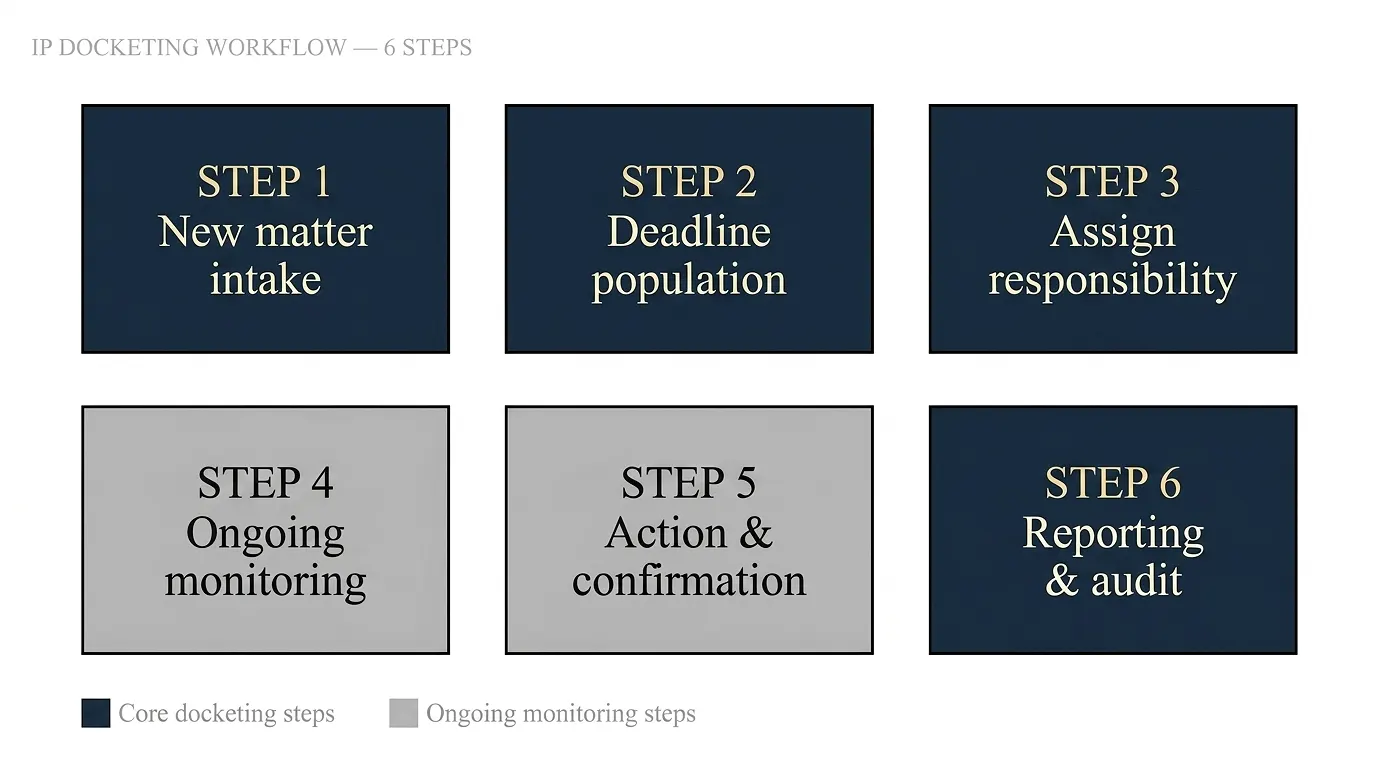
1st Step: New Matter Intake
- Receive the new IP matter (new filing, assignment, or takeover)
- Assign a docket number and create the matter record
- Enter all known dates: priority date, filing date, international filing date (for PCT), etc.
2nd Step: Deadline Population
- System (or docketing specialist) calculates all upcoming deadlines based on jurisdiction rules
- Deadlines are entered or auto-generated: office action response, national phase entry, annuity dates, renewal dates
3rd Step: Assignment of Responsibility
- Each deadline is assigned to a responsible attorney, paralegal, or agent
- Secondary responsible party assigned as backup
4th Step: Ongoing Monitoring
- Daily or weekly docket review meetings
- Alerts sent to responsible parties at pre-set intervals
- All incoming correspondence from IP offices is processed and new deadlines are docketed immediately
5th Step: Action & Confirmation
- Responsible party completes the required action (files response, pays annuity, etc.)
- Docket is updated with confirmation: filing receipt number, payment confirmation, etc.
- Status updated to reflect the new stage
6th Step: Reporting & Audit
- Regular portfolio status reports generated for clients or management
- Annual or semi-annual docket audits to verify accuracy
- Abandoned or lapsed cases are flagged and documented
Also, Read: Comprehensive Guide to Patent Docketing Systems
Common Intellectual Property Docketing Deadlines You Must Track
Here are the most critical deadlines in intellectual property docketing:
| Deadline Type | Typical Timeframe | Consequence if Missed |
|---|---|---|
| PCT National Phase Entry | 30 months from priority date | Application abandoned |
| US Patent Maintenance Fee | 3.5, 7.5, 11.5 years from grant | Patent expires |
| Response to Office Action (USPTO) | 3 months (extendable to 6) | Application abandoned |
| Trademark Renewal (US) | Every 10 years | Registration cancelled |
| Section 8 Declaration (US TM) | Between years 5–6 and 9–10 | Registration cancelled |
| Opposition Period (US TM) | 30 days from publication | Third-party rights may be lost |
| European Patent Annuities | Annually from filing date | Patent lapses |
| Paris Convention Priority | 12 months (patents), 6 months (designs/TMs) | Priority claim lost |
Intellectual Property Docketing Best Practices
Experienced IP professionals follow these best practices to build a docketing process that is reliable, scalable, and auditable.
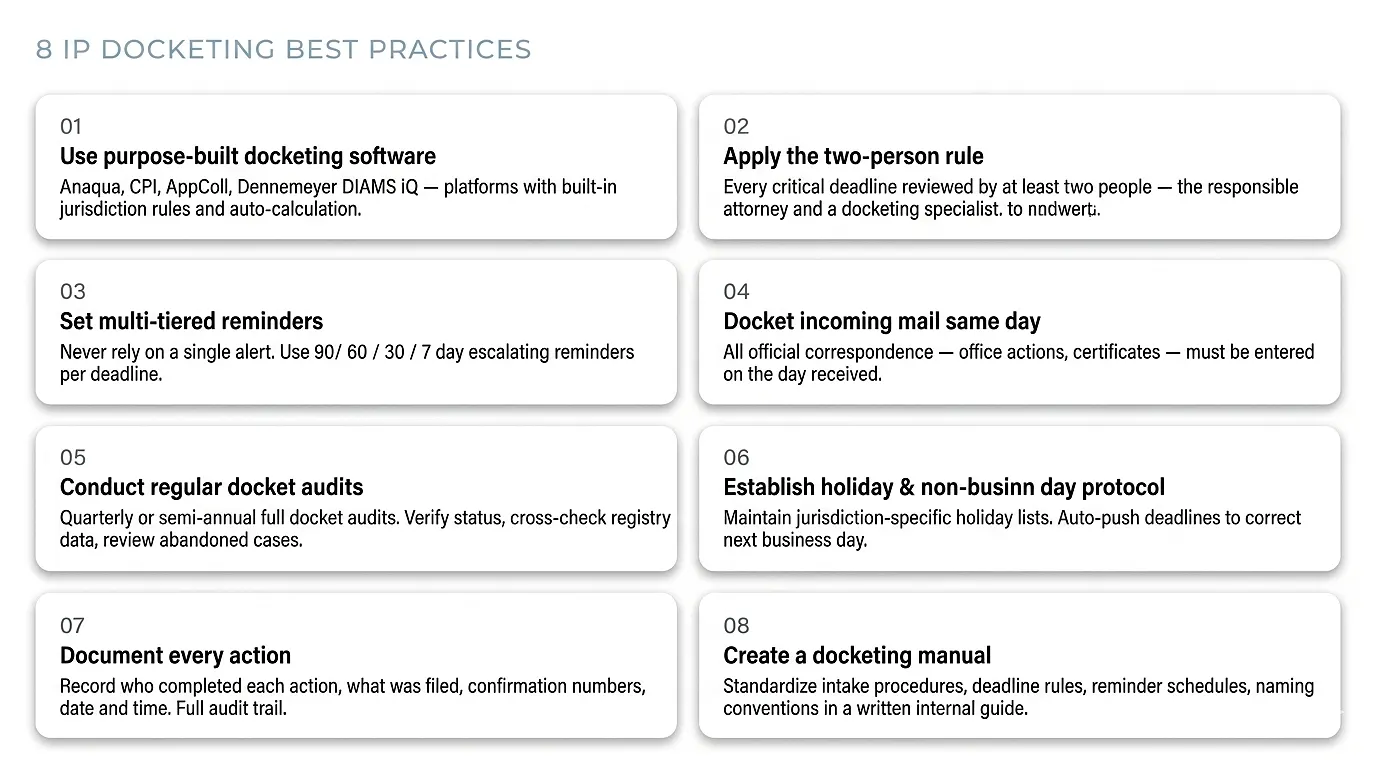
1. Use Purpose-Built IP Docketing Software
Spreadsheets are a liability. Invest in dedicated intellectual property docketing software such as:
- Anaqua
- CPI (Computer Packages Inc.)
- AppColl
- Dennemeyer DIAMS iQ
- Delegate (Questel)
- Foundation IP
These platforms include jurisdiction-specific rule sets, auto-calculation of deadlines, and built-in reminder workflows.
2. Apply the “Two-Person Rule”
Every critical deadline should be reviewed and confirmed by at least two people – the responsible attorney or agent, and a docketing specialist or paralegal. This redundancy catches human error.
3. Set Multi-Tiered Reminders
Never rely on a single reminder. A best-practice reminder schedule looks like:
- Day 1: Deadline entered, first reminder set
- 90 days before: Alert to primary responsible party
- 60 days before: Alert to primary + secondary responsible party
- 30 days before: Escalation alert to team lead or supervisor
- 14 days before: Red-alert status; senior review required
- 7 days before: Final escalation to firm management
4. Docket Incoming Mail and Office Actions Same Day
Every piece of official correspondence – office actions, examination reports, registration certificates – must be docketed on the day it is received. Delays in docketing can cascade into missed deadlines.
5. Conduct Regular Docket Audits
Schedule quarterly or semi-annual full docket audits:
- Verify all open matters have accurate status
- Cross-check official registry data with your docket records
- Review abandoned/lapsed cases to confirm intentional abandonment
- Identify any orphan matters with no assigned responsible party
6. Establish a Holiday and Non-Business Day Protocol
Each jurisdiction observes different public holidays. Your docketing system or specialist must:
- Maintain an updated list of holidays by jurisdiction
- Automatically push deadlines that fall on non-business days to the next working day
- Apply the correct rule (the last business day before, or the next business day after)
7. Document Everything
Every action taken on a docket matter must be recorded:
- Who completed the action
- What was done (and what was filed/paid)
- Confirmation numbers, receipt numbers, or payment references
- Date and time of completion
This creates an audit trail that protects your firm in malpractice disputes and client audits.
8. Create a Docketing Manual
Standardize your docketing procedures in a written internal manual that covers:
- Intake procedures for new matters
- Jurisdiction-specific deadline rules
- Reminder schedules and escalation protocols
- Naming conventions and file organization
- Procedures for handling abandoned or transferred matters
Also, Read: What is a Docketing System? Complete A to Z Guide
Building Your Intellectual Property Docketing Team
For law firms and large IP departments, docketing should be a dedicated function – not an afterthought.
Roles in a docketing team:
- Docketing Manager/Director – Oversees the docket system, sets policies, manages the team, and handles escalated issues
- Docketing Specialist/Paralegal – Enters deadlines, processes incoming mail, generates reports, conducts audits
- Responsible Attorney/Agent – Owns each IP matter; receives alerts and confirms actions
- Secondary Contact – Backup to the primary responsible party for each matter
For smaller firms or solo practitioners, an outsourced IP docketing service (like Teak IP Services) provides professional-grade docketing expertise without the overhead of a full in-house team.
Also, Read: Effective Trademark Portfolio Management: Key Components, Challenges & Practices
Outsourced Intellectual Property Docketing: When to Consider It
Many firms and corporate IP departments are turning to outsourced intellectual property docketing services for good reason.
Signs you should consider outsourced IP docketing:
- Your docketing volume is too high for in-house staff to manage reliably
- You’re expanding into new jurisdictions with unfamiliar deadline rules
- Your current docketing process relies on spreadsheets or email reminders
- You’ve had close calls or near-misses with IP deadlines
- You want to reduce overhead costs while maintaining quality
Benefits of outsourced IP docketing:
- Access to trained, experienced IP docketing professionals
- Dedicated oversight of your portfolio without hiring full-time staff
- Use of industry-standard docketing software included in the service
- Scalable – grows with your portfolio without adding headcount
- Reduces malpractice risk with documented, auditable processes
Also, Read: Outsource Patent Docketing: Key Reasons to Consider
Common Mistakes in Intellectual Property Docketing (And How to Avoid Them)
Even experienced teams make errors. Being aware of common pitfalls helps you prevent them.
| Mistake | Risk | Prevention |
|---|---|---|
| Relying on a single person for docketing | No backup if the person is unavailable | Always assign a secondary responsible party |
| Using spreadsheets for large portfolios | Manual errors, version conflicts | Upgrade to dedicated docketing software |
| Docketing incoming mail with delay | Deadlines triggered by receipt date are miscalculated | Same-day docketing policy for all official mail |
| Not updating deadlines when trigger events change | Cascading deadline errors | Recalculate all related deadlines when any key date changes |
| Skipping docket audits | Outdated or inaccurate records | Schedule mandatory audits at least annually |
| Ignoring foreign associate updates | International deadlines missed | Require foreign associates to report actions within 24–48 hours |
Intellectual Property Docketing in a Multi-Jurisdictional Context
Global IP portfolios add significant complexity to docketing. Here’s what to keep in mind:
- Different deadline rules per country: The USPTO, EPO, WIPO, and national offices each have unique timelines, fee structures, and grace period rules.
- Foreign associate coordination: You depend on local agents in each country. Build clear communication protocols requiring timely reporting of all official actions.
- Currency and fee tracking: Annuity fees vary by country and change over time. Your system must track amounts, currencies, and payment confirmations.
- Translation and certification requirements: Some deadlines are linked to document submissions that require translation or notarization – allow lead time.
- Time zone awareness: Filing deadlines are typically based on the receiving office’s local time. Midnight deadlines in different time zones require careful coordination.
Also, Read: Trademark IP Management Best Practices for Multi-Jurisdiction Brand Protection
Key Metrics to Monitor in Your IP Docket
Track these KPIs to evaluate the health of your docketing operations:
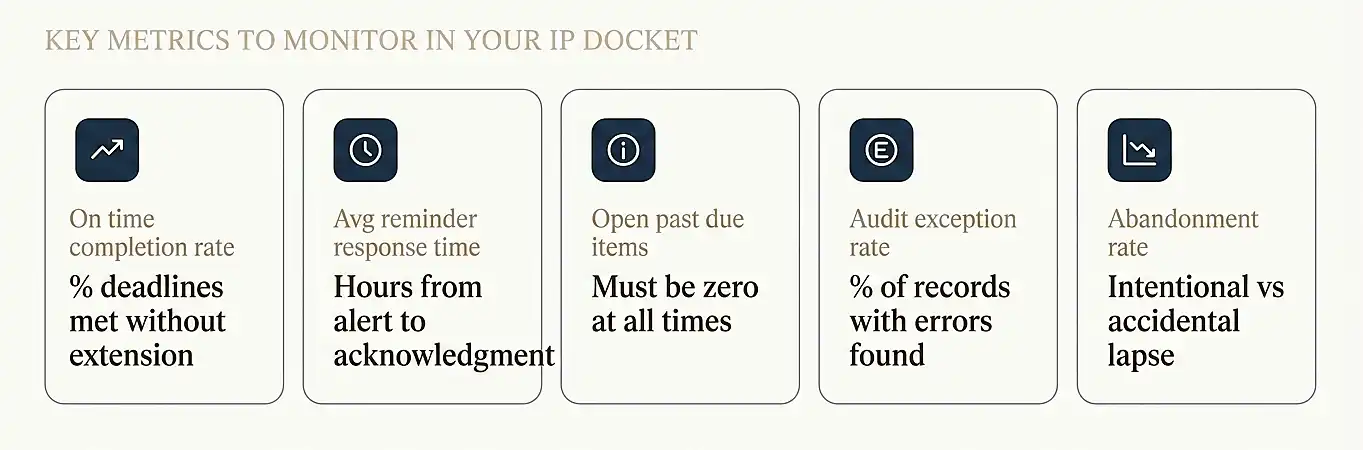
- On-time completion rate – % of deadlines met without extension
- Average reminder response time – How quickly are responsible parties acknowledging alerts?
- Open past-due items – Any item past due without action is a critical flag
- Audit exception rate – % of records with errors found during audits
- Abandonment rate – Are cases being abandoned intentionally (client instruction) or accidentally?
Also, Read: Outsource Trademark Docketing: Strong Reasons to Consider
Conclusion: Make Intellectual Property Docketing a Core Competency
Intellectual property docketing is not an administrative afterthought – it is a mission-critical function that directly determines whether your IP assets remain protected. A single missed deadline can undo years of investment in innovation, brand building, and legal protection.
By investing in the right tools, trained professionals, documented procedures, and a culture of deadline accountability, you transform your IP portfolio management from a liability into a competitive strength.
Whether you’re building an in-house docketing team or looking for a trusted partner to manage your IP deadlines, the fundamentals remain the same: track everything, remind early, confirm always, and audit regularly.
How Teak IP Services Can Help
At Teak IP Services, we provide expert intellectual property docketing and IP management support tailored to law firms, corporate IP departments, and growing businesses. Our trained docketing specialists ensure that your portfolio is managed with precision – so you never miss a deadline that matters.
📌 Our IP Docketing Services Include:
- Full docket setup and matter intake
- Ongoing deadline monitoring and reminder management
- Multi-jurisdictional portfolio tracking
- Docket audits and accuracy reviews
- Integration with your existing docketing software
- Foreign associate coordination support
👉 Contact Teak IP Services today to learn how we can strengthen your IP docketing operations.
Our Services: Learn More About IP docketing services

