
Receiving an office action response from the USPTO (United States Patent and Trademark Office) can feel alarming – especially if it’s your first time navigating the patent or trademark application process. But here’s the good news: an office action is not a rejection. It’s an official communication, and in most cases, you have a full opportunity to respond, clarify, and ultimately secure your intellectual property rights.

In this comprehensive guide, Teak IP Services walks you through everything you need to know about office action responses – what they mean, how to address them, what deadlines apply, and how to avoid the mistakes that could cost you your application. For applicants who need structured, expert support in crafting their reply, our office action response and shell preparation services cover everything from initial shell preparation through final submission to the USPTO.
1. What is an Office Action?
Key Definition
An office action is an official written communication issued by a USPTO examining attorney or patent examiner, notifying an applicant of issues, objections, or refusals related to their patent or trademark application.
Think of it as the examiner’s formal feedback on your application. It may raise questions about the uniqueness of your invention, the distinctiveness of your trademark, conflicts with existing registrations, or procedural deficiencies in your filing.
An office action does not mean your application has been denied. It means the examiner needs more information, clarification, or amendment before the application can move forward.
Key takeaway: Receiving an office action is a normal – and common – part of the patent and trademark process. Approximately 80–90% of all USPTO trademark applications receive at least one office action before registration.
Also, Read: Office Action Response Trademark: How to Handle USPTO Refusals and Keep Your Mark Alive
2. Types of Office Actions
Not all office actions are created equal. Understanding the type you’ve received is the critical first step in crafting an effective response.
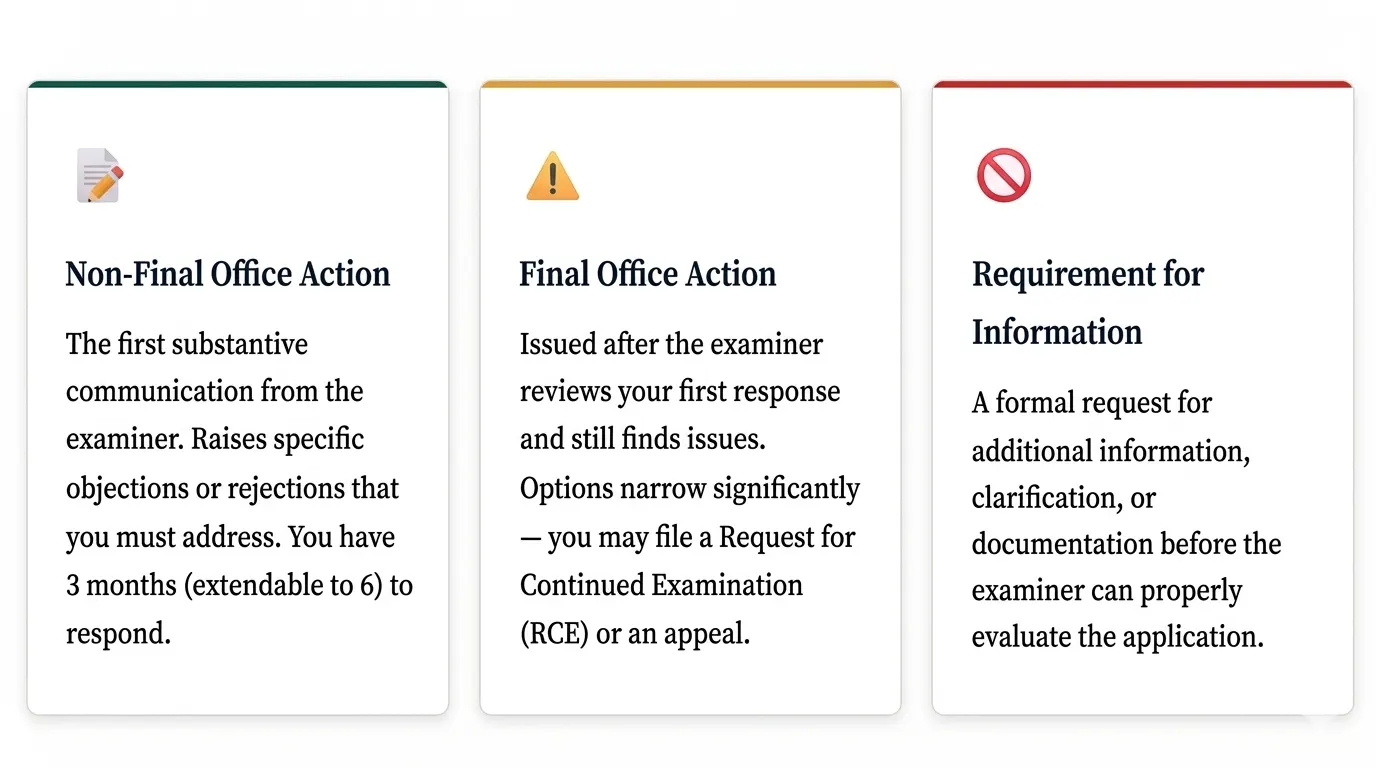
For Trademark Applications Specifically:
- Substantive Office Action – Raises legal issues like likelihood of confusion with an existing mark, lack of distinctiveness, or descriptiveness refusals.
- Procedural Office Action – Points out technical or administrative issues in the application: missing specimens, incorrect identification of goods/services, improper signatures, etc.
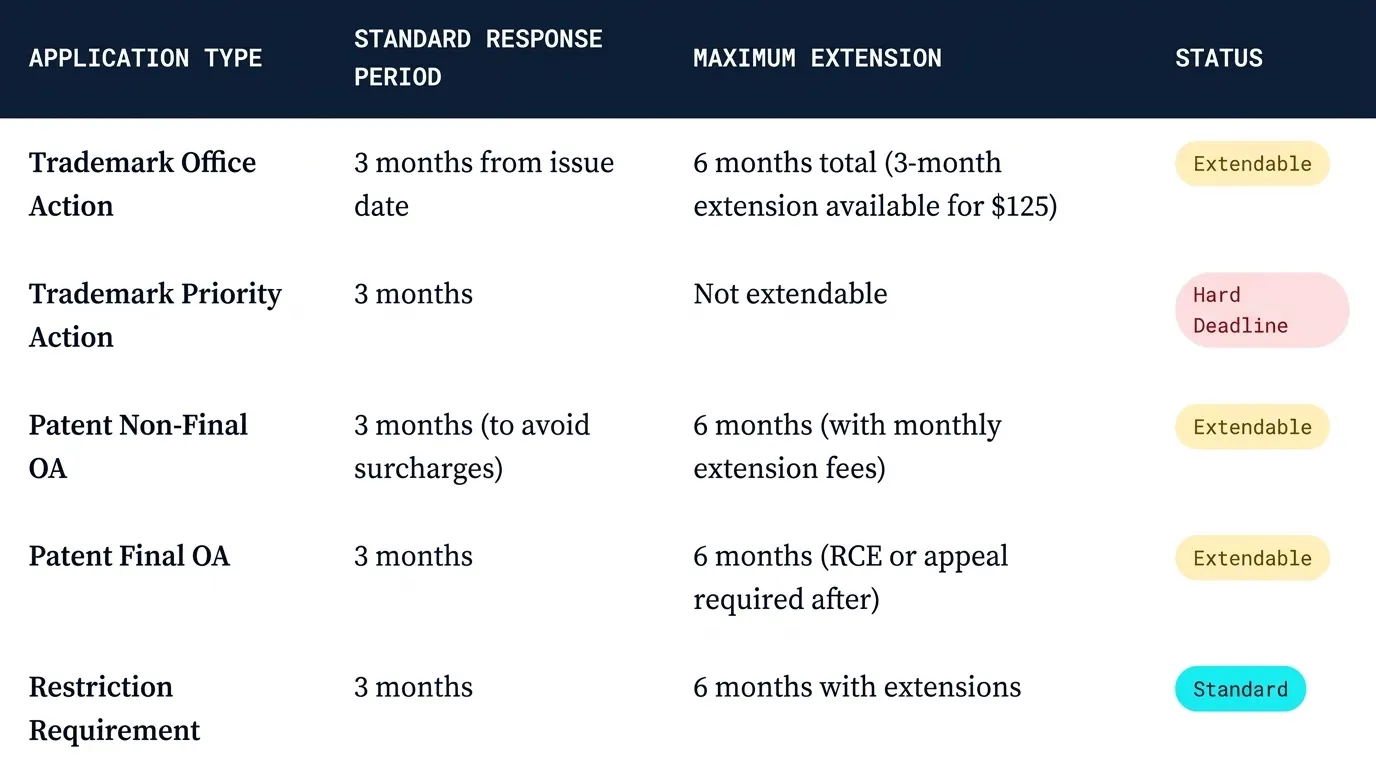
- Priority Action – A faster processing track; requires a response within 3 months but is not extendable.
For Patent Applications:
- Restriction Requirement – Indicates the application claims multiple distinct inventions and requires the applicant to elect one for prosecution.
- Election of Species – Requires selection among different embodiments of the claimed invention.
- Ex Parte Quayle Action – Indicates the claims are allowable subject to minor formal corrections (a good sign!).
3. Why Did You Receive an Office Action?
Understanding the root cause of the office action helps you respond effectively. The most common reasons include:
For Trademark Applications:
- Likelihood of Confusion (Section 2(d)): Your mark is too similar to an already-registered trademark for related goods or services.
- Descriptiveness or Genericness (Section 2(e)(1)): The mark merely describes a feature or characteristic of the product/service.
- Surname Refusal: The mark is primarily considered a surname under trademark law.
- Specimen Issues: The specimen you submitted doesn’t properly show the mark used in commerce.
- Identification of Goods/Services: The description of your goods or services is too vague or broad.
- Ornamental Refusal: The mark appears merely decorative rather than functioning as a source identifier.
- Geographically Descriptive Mark: The mark primarily describes the geographic origin of the goods/services.
For Patent Applications:
- Lack of Novelty (35 U.S.C. § 102): The claimed invention is anticipated by prior art – it already exists somewhere in the public domain.
- Obviousness (35 U.S.C. § 103): While not identical to prior art, the invention would have been obvious to a person skilled in the field.
- Indefiniteness (35 U.S.C. § 112): The claims don’t clearly define the boundaries of the invention.
- Lack of Written Description: The specification doesn’t adequately describe the full scope of the claims.
- Non-Patentable Subject Matter (35 U.S.C. § 101): The claimed invention covers abstract ideas, laws of nature, or natural phenomena.
4. Key Deadlines You Must Know
Deadlines in the USPTO process are strict. Missing them can result in abandonment of your application – and loss of your intellectual property rights.
⚠️ Critical Warning
If you fail to respond within the maximum response period (typically 6 months), your application will be abandoned. Reviving an abandoned application is possible in some cases but is costly, time-consuming, and not guaranteed. Always track your office action dates immediately upon receipt.
5. What Is an Office Action Response?
An office action response is the applicant’s formal, written reply to the USPTO examiner addressing every issue, objection, or rejection raised in the office action – with the goal of advancing the application toward approval.
A proper office action response must address every single issue raised in the office action. Failing to address even one point may result in the response being treated as non-responsive, or the unaddressed objection being carried forward.
An effective response typically combines two strategies:
- Amendment: Making changes to the application – such as narrowing patent claims, correcting the identification of goods/services, or substituting a specimen – to resolve the examiner’s concerns.
- Argument: Presenting legal arguments and evidence to persuade the examiner that the application should be approved as-is or as amended.
In many cases, both strategies are used together in the same response.
6. How to Respond: Step-by-Step Process
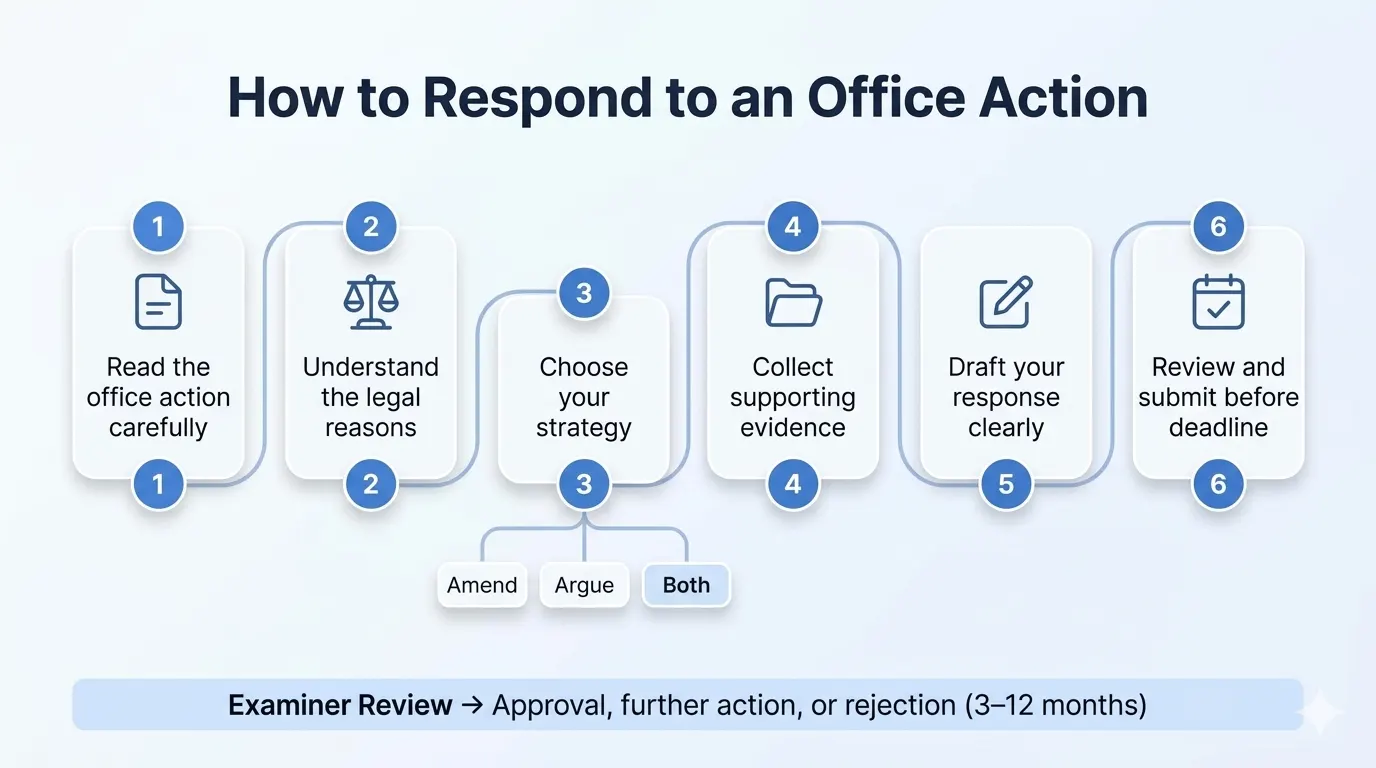
Step 1: Read the Office Action Carefully — All of It
Go through the entire office action before forming any response strategy. Note every issue raised, whether substantive or procedural, and identify whether each is an objection (minor) or a rejection (requires amendment or argument to overcome).
Step 2: Understand the Legal Basis of Each Refusal
Each objection or rejection will cite a specific statute or rule (e.g., Section 2(d) of the Lanham Act for trademark confusion; 35 U.S.C. § 103 for patent obviousness). Understanding the legal standard that applies is essential to crafting a targeted, persuasive argument.
Step 3: Determine Your Strategy – Amend, Argue, or Both
Decide for each issue whether you will: (a) amend the application to resolve the concern, (b) argue that the examiner’s position is incorrect, or (c) use a combination of both. For instance, in a trademark likelihood-of-confusion refusal, you may amend the goods/services description to narrow the overlap while simultaneously arguing the marks are commercially distinct.
Step 4: Gather Supporting Evidence
Depending on the type of office action, you may need to gather: third-party registrations showing the examiner’s cited mark is weak, evidence of acquired distinctiveness, declarations from consumers, sales figures, advertising spend data, or substitute specimens showing proper use in commerce.
Step 5: Draft the Response
Structure your response to address every point raised in the office action in the same order the examiner presented them. Use formal, professional language. Clearly label each section. For patent responses, ensure all claim amendments use the proper strikethrough and underlining formatting required by USPTO rules.
Step 6: Review, Finalize, and File Before the Deadline
Double-check that every issue has been addressed, all forms are complete, and required fees are included. File through the USPTO’s TEAS system (trademark) or EFS-Web/Patent Center (patent). Keep confirmation numbers and track the status of your application after filing.
7. Patent vs. Trademark Office Action Responses
While the overall framework is similar, patent and trademark office action responses differ significantly in their strategy, substance, and technical requirements.
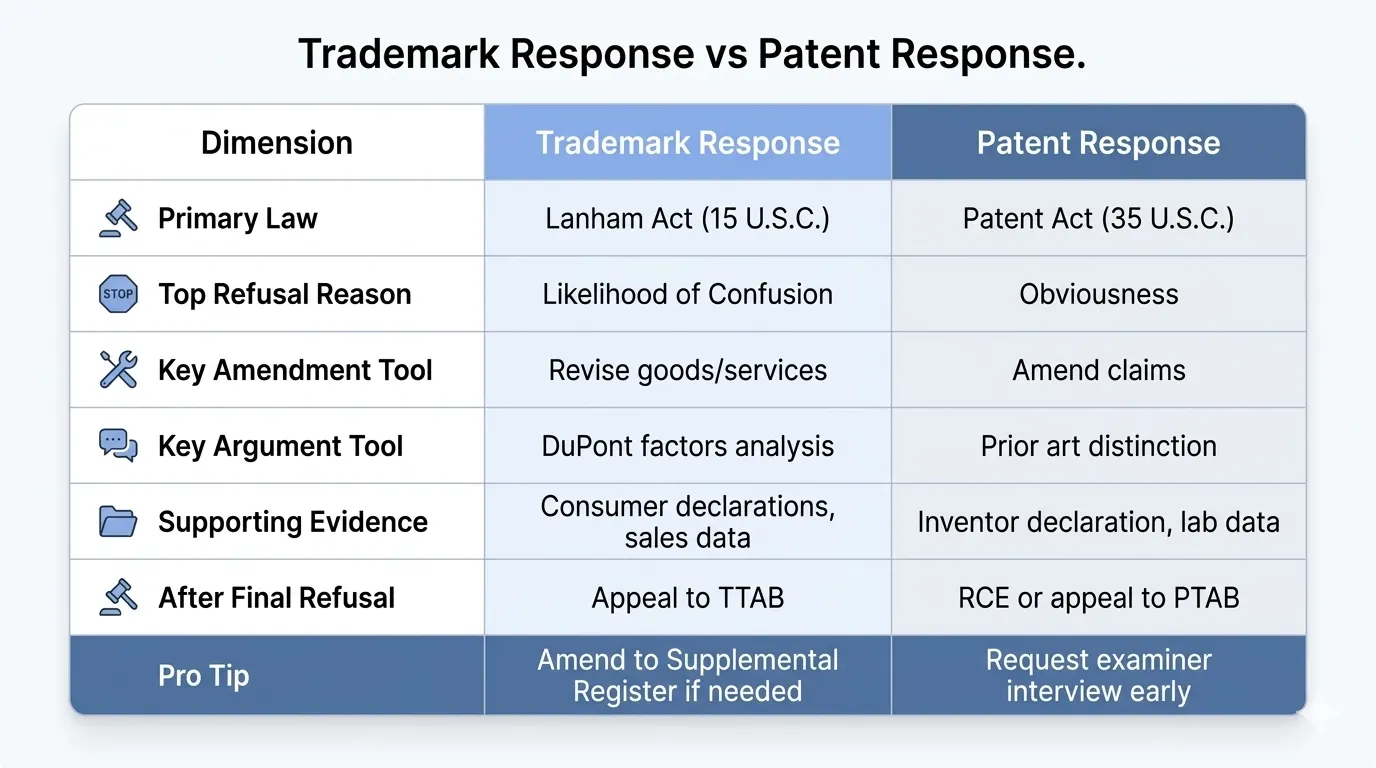
Trademark Office Action Response: Key Elements
- Address likelihood-of-confusion refusals by analyzing the DuPont factors (similarity of marks, relatedness of goods, channels of trade, etc.)
- Overcome descriptiveness refusals by arguing inherent distinctiveness or submitting evidence of acquired distinctiveness (Section 2(f))
- Submit a substitute or supplemental specimen if the original was rejected
- Amend the identification of goods/services to acceptable language from the USPTO’s Acceptable Identification of Goods and Services Manual (ID Manual)
- Claim concurrent use rights or amend to the Supplemental Register as a fallback strategy
- Provide a declaration under 37 C.F.R. § 2.20 where required
Patent Office Action Response: Key Elements
- Amend claims using proper USPTO notation: deletions in strikethrough, additions underlined
- Argue novelty by distinguishing the cited prior art – pointing to specific claim elements the prior art does not disclose
- Overcome obviousness by arguing secondary considerations (commercial success, long-felt need, failure of others, teaching away)
- Amend the specification to address indefiniteness or written description rejections
- File a declaration under 37 C.F.R. § 1.132 by an inventor or expert to establish facts supporting patentability
- Request an examiner interview to informally discuss the examiner’s concerns before formal response
Pro Tip: For patent applications, requesting an examiner interview (in person, by phone, or via video) before filing your response can be extremely valuable. It allows you to understand the examiner’s position more clearly and potentially agree on acceptable claim amendments – saving significant time and cost.
8. Common Mistakes to Avoid
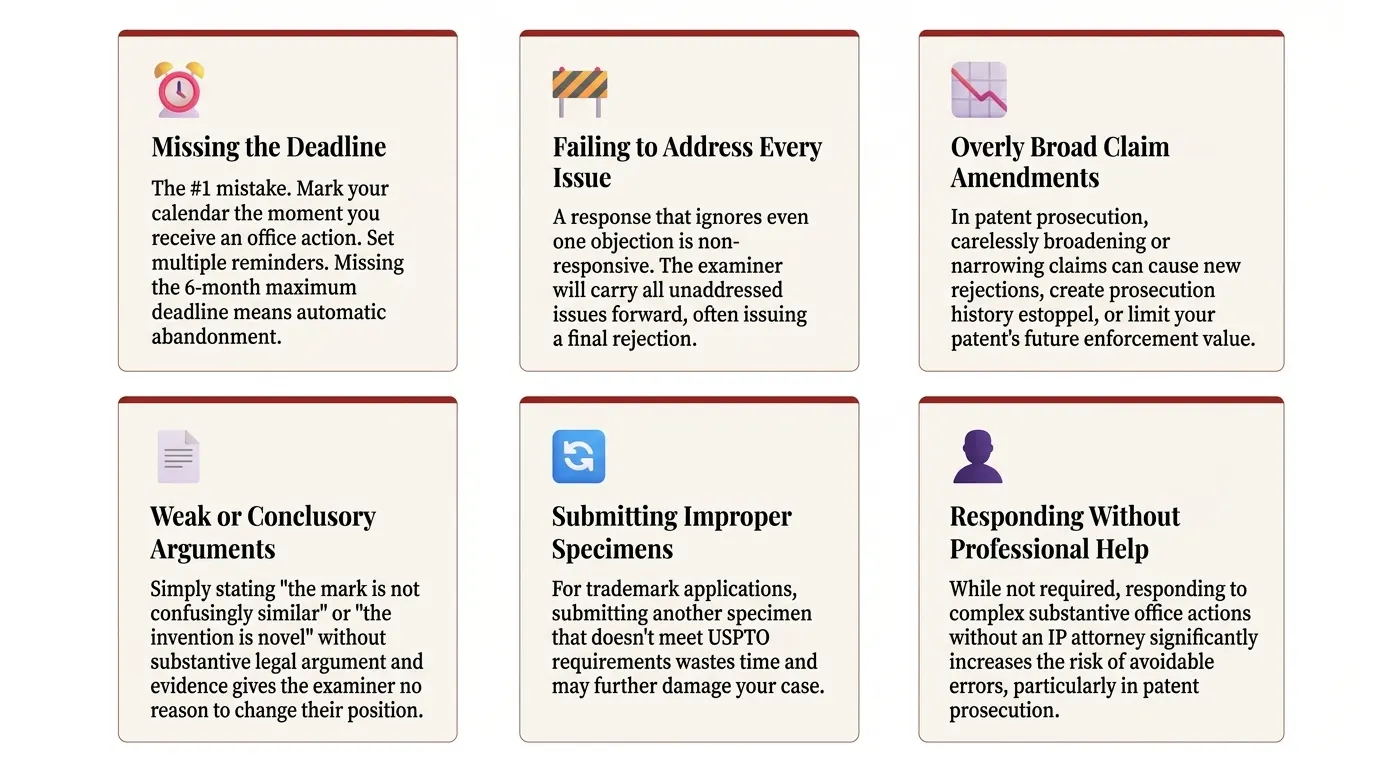
A poorly crafted office action response can delay your application, trigger a final rejection, or result in abandonment. Here are the most critical errors applicants make:
9. Tips for a Strong Office Action Response
Beyond avoiding mistakes, here are actionable best practices for writing a response that effectively advances your application:
- Read the office action multiple times before drafting. Fully understand what the examiner is saying before formulating any strategy.
- Address issues in the order the examiner raised them to ensure clarity and that nothing is missed.
- Be respectful and professional – examiners respond better to well-reasoned, courteous arguments than adversarial or dismissive language.
- Cite legal authority and precedent – TMEP (Trademark Manual of Examining Procedure) and MPEP (Manual of Patent Examining Procedure) sections, relevant case law, and TTAB decisions all strengthen your arguments.
- Use evidence liberally – third-party registrations, coexistence agreements, consumer declarations, market data, and internet evidence can all be powerful tools.
- Make amendments precise and intentional – every change to a patent claim or trademark description has legal implications; don’t amend unnecessarily.
- Consider the examiner’s perspective – their job is to ensure only qualifying IP is registered. Show them why your application meets the applicable legal standards.
- Keep records of everything – save copies of your response, filing confirmations, and all communications with the USPTO.
- Act early – don’t wait until the deadline. Filing earlier gives you time to address any technical issues and demonstrates good faith.
- Consult an IP attorney for complex rejections– especially for final office actions, obviousness rejections, or likelihood-of-confusion refusals involving similar marks in closely related industries.
10. Frequently Asked Questions
Q. Is an office action the same as a rejection?
No. An office action raises objections or concerns, but it is not a final determination. It gives you the opportunity to respond, amend, and argue your case. A rejection only becomes final after repeated unsuccessful responses in patent prosecution, and trademark applications can similarly be refused – but these outcomes are not automatic upon receiving an office action.
Q. Can I respond to an office action without an attorney?
Yes, you are legally allowed to respond pro se (without representation). However, particularly for patent applications and complex trademark substantive refusals, the technical and legal complexity of a proper response makes professional representation strongly advisable. Mistakes made in office action responses can affect the enforceability and scope of your IP rights for decades.
Q. What happens if I don’t respond to an office action?
If you don’t respond within the response period (maximum 6 months for most office actions), your application will be declared abandoned. You may be able to petition for revival by showing that the delay was unintentional, but this involves additional fees and is not guaranteed to succeed.
Q. How long does it take the USPTO to review an office action response?
For trademarks, the USPTO typically takes 3–4 months to review a response and issue a subsequent action or approve the application. For patents, response review times vary significantly by technology center but generally range from 3 to 12 months or more. You can check the status of your application anytime through USPTO’s TSDR (trademark) or Patent Center (patent) portals.
Q. What is the difference between a final and non-final office action response?
A response to a non-final office action is your first substantive reply and provides the most flexibility – you can amend freely and make broad arguments. A response to a final office action is more restricted; in patent prosecution, after a final action, your amendment options narrow significantly and you may need to file a Request for Continued Examination (RCE) or an appeal to the Patent Trial and Appeal Board (PTAB) if the examiner doesn’t allow the application.
Q. Can I appeal if my response doesn’t satisfy the examiner?
Yes. For trademarks, you can appeal a final refusal to the Trademark Trial and Appeal Board (TTAB) and, if necessary, to federal court. For patents, after a final rejection, you can appeal to the Patent Trial and Appeal Board (PTAB). Appeals are formal legal proceedings and almost always require the assistance of a qualified IP attorney.
Q. What is a Request for Continued Examination (RCE)?
An RCE is a USPTO fee-based procedure in patent prosecution that effectively reopens prosecution after a final rejection, allowing you to submit new amendments and arguments. Filing an RCE resets the clock and allows continued negotiation with the examiner, though it involves additional USPTO fees and prosecution time.
Also, Read: Office Action Response Form: How to Complete and Submit It Correctly to the USPTO
11. Conclusion
Receiving an office action can feel like a setback – but for most applicants, it’s simply part of the journey toward securing valuable intellectual property rights. Understanding what an office action is, why you received it, and how to craft a compelling, comprehensive response is one of the most important skills in successful patent and trademark prosecution.
The key principles are simple even when the details are complex:
- Never miss a deadline – track your office action date immediately.
- Address every issue raised – leaving anything unanswered is leaving your application exposed.
- Support your arguments with evidence and legal authority – assertions alone rarely persuade an examiner.
- Know when to amend and when to argue – and when to do both.
- Seek professional guidance for complex refusals – the stakes for your IP portfolio are too high to leave to chance.
At Teak IP Services, our team of experienced IP professionals helps inventors, entrepreneurs, and businesses navigate office actions and the full spectrum of patent and trademark prosecution. Whether you’re facing your first non-final office action or a complex final rejection, we’re here to help you protect what you’ve built.
Also, Read: Office Action Response USPTO: Rules, Process & What to Expect at Every Stage
Need Help With Your Office Action Response?
Teak IP Services provides expert patent and trademark prosecution support. Don’t let a missed deadline or a weak response cost you your IP rights.
Our Services: View Full Office Action Response Services Details

