
Patent docketing systems are foundational infrastructure for any intellectual property practice managing patents at scale. These specialized platforms orchestrate the complex temporal requirements, deadline tracking, and documentation management that define modern patent prosecution and portfolio maintenance.
For patent professionals managing even a modest portfolio of 100+ applications, a reliable docketing system transforms administrative chaos into systematic workflow-enabling teams to protect valuable inventions while maintaining regulatory compliance across multiple jurisdictions and patent offices.

Critical Reality: The cost of poor docketing practices extends far beyond administrative inconvenience. Missed deadlines in patent prosecution represent catastrophic, often irreversible business losses-transforming valuable intellectual assets into worthless abandoned applications. Practices that want to eliminate the risk of missed deadlines without building complex in-house infrastructure can rely on our patent docketing services to provide systematic deadline tracking, documentation management, and compliance support across every stage of patent prosecution.
What is a Patent Docketing System?
A patent docketing systems is specialized software infrastructure designed to manage the temporal and administrative dimensions of patent lifecycle management. At its core, a docketing system performs these critical functions:
- Deadline Tracking and Management: Automatically calculates and monitors critical dates based on filing dates, patent office actions, jurisdiction-specific requirements, and renewal schedules across unlimited applications
- Application Status Monitoring: Maintains real-time visibility into where each patent application stands in the prosecution pipeline—from initial filing through examination, appeal, issuance, and maintenance phases
- Multi-Jurisdictional Coordination: Manages varying procedural requirements, fee schedules, response timeframes, and renewal obligations across different patent offices and countries
- Document Repository and Audit Trail: Creates centralized, searchable records of all communications with patent offices, internal work product, fee payments, and administrative actions with complete audit trails
- Automated Alert Generation: Triggers multi-tier notifications to responsible parties based on proximity to critical deadlines, escalating urgency as deadlines approach
- Workflow Automation: Automates routine administrative processes—from deadline calculations to alert generation to task assignment—freeing attorney time for strategic decision-making
- Portfolio Reporting and Analytics: Generates insights into portfolio composition, prosecution timelines, cost allocation, and performance metrics across applications, inventors, technology areas, and jurisdictions
- Integration Infrastructure: Connects with practice management systems, billing platforms, and document management repositories to enable seamless information flow throughout the organization
Also, Read: What is a Docketing System? Complete A to Z Guide
The Business Imperative: Why Patent Docketing Systems Are Critical Infrastructure
The Irreversible Nature of Patent Deadlines
Unlike most business deadlines, patent office deadlines carry unique consequences. Missing a deadline doesn’t simply delay work—it can permanently destroy valuable intellectual property rights. To avoid such risks, professional [Docketing & IP Management] is essential for maintaining portfolio integrity.
Critical Deadline Categories in Patent Docketing Systems:
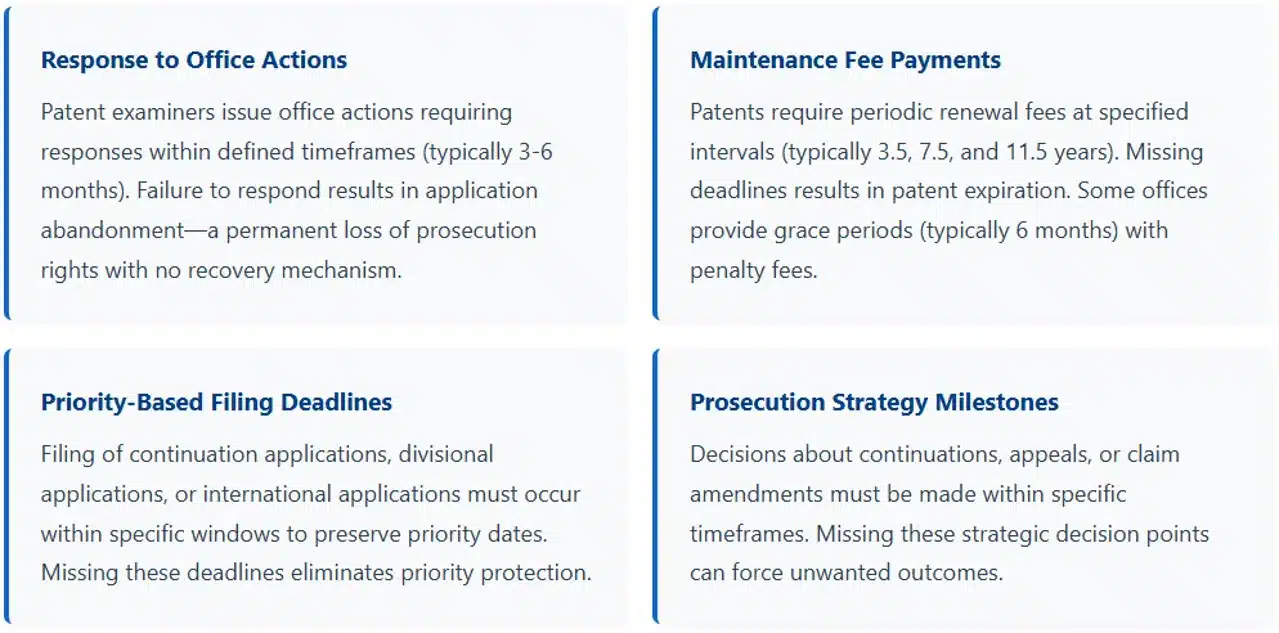
Quantifying the Cost of Missed Deadlines in Patent Docketing Systems
Direct Costs:
- Patent expiration in key markets eliminating market exclusivity
- Abandoned applications with lost prosecution value and eliminated protection
- Extension fees to recover from missed deadlines (where available)
- Re-filing costs for applications that must be refiled to restore protection
- Penalty fees for late renewal payments
Indirect Costs:
- Competitor product launches possible due to expired protection
- Reduced licensing value in markets where patents have expired
- Loss of injunctive relief capability when patents expire
- Damage to client relationships from loss of protection
- Reduced enterprise valuation affecting investor confidence and M&A outcomes
Scale Multiplier Reality: For firms managing 500+ applications, missing even 2-3% of deadlines annually creates dozens of lost or expired patents—transforming a single administrative oversight into a portfolio-level disaster.
Also, Read: Effective Trademark Portfolio Management: Key Components, Challenges & Practices
Core Functional Capabilities of Modern Docketing Systems
1. Intelligent Deadline Calculation and Tracking
Automatic Deadline Computation in Patent Docketing Systems
- System calculates all critical dates from application filing information
- Incorporates jurisdiction-specific rules and procedural requirements
- Accounts for extensions of time and adjustments to deadlines
- Automatically recalculates dependent deadlines when dates change
- Handles complex rules like patent term adjustments and regulatory extensions
Multi-Tier Alert Architecture:
- Preliminary alerts 90, 60, and 30 days before critical deadlines
- Escalating alerts as deadline approaches (7 days, 24 hours, same-day)
- Escalation protocols that engage management if initial alerts are unacknowledged
- Customizable alert thresholds by deadline type and portfolio segment
- Multiple notification channels (email, dashboard, SMS) for critical dates
2. Comprehensive Document Management (Patent Docketing Systems)
Centralized Repository Architecture:
- Single repository for all documents related to each patent application
- Automatic ingestion of patent office correspondence via email capture or bulk import
- Version control tracking document history and modification details
- Document metadata indexing (date received, filing date, applicant, technology area, etc.)
- Search capabilities enabling rapid location of relevant documents
3. Portfolio Visibility and Reporting
Real-Time Portfolio Dashboard:
- Overview of current portfolio composition (total applications, by status, by jurisdiction)
- Identification of pending deadlines by application, inventor, or technology area
- Aging analysis showing oldest applications, most recent filings, and timeline distributions
- Geographic breakdown of portfolio by country and patent office
- Classification by technology area and business unit
Reporting Capabilities:
- Operational Reporting: Deadline summaries, portfolio status, cost tracking, grant rates, and prosecution timelines
- Strategic Reporting: Cost per patent analysis, ROI analysis, competitor filing patterns, expiration tracking
- Reporting Flexibility: Pre-built reports, custom report builder, scheduled automated reporting, export functionality
4. Multi-Jurisdictional Complexity Management
Modern systems incorporate detailed procedural knowledge for major patent offices including the United States Patent Office, European Patent Office, Patent Cooperation Treaty (PCT) procedures, and offices in China, Japan, India, Australia, Canada, South Korea, and other secondary markets.
System Capabilities Include:
- Automatic jurisdiction selection workflow
- Cost impact analysis for each jurisdiction option
- Priority analysis showing strategic value of different jurisdictions
- Automatic generation of checklists for required actions in each jurisdiction
- Cross-jurisdictional coordination and application family management
5. User Access Control and Workflow Management
Role-Based Access Architecture:
- Partner/Principal level: Full access to all portfolios, administrative controls, financial data
- Senior Attorney level: Access to assigned matters, ability to make prosecution decisions
- Associate Attorney level: Access to assigned matters for research and analysis
- Paralegal/Administrator level: Access to assigned matters for deadline and document management
- Outside Counsel level: Limited, jurisdiction-specific access for foreign associate coordination
- Billing/Finance level: Access to cost and fee tracking data
Also, Read: Outsource Patent Docketing: Key Reasons to Consider
Evaluating and Selecting a Patent Docketing Systems: Critical Decision Framework
1. Scalability and Performance Requirements
Key Questions:
- What is your current application count, and what is the projected growth over the next 5 years?
- Will the system maintain acceptable performance as your portfolio grows from 500 to 5,000 applications?
- Are there limits on simultaneous users, and how does performance degrade with multiple users working simultaneously?
- Can the system efficiently handle international portfolios spanning 30+ jurisdictions?
Red Flags to Watch:
- System documentation indicates performance degrades significantly with 5,000+ applications
- Limited to single-office installation without scalability for growth
- Expensive per-user licensing discouraging expansion of user base
2. Integration with Existing Systems
Essential Integration Requirements:
- Practice Management Integration: Connection with case management systems ensuring application information remains synchronized
- Billing System Integration: Automatic time tracking and cost allocation from docketing activities
- Document Management Integration: Link to firm’s document repository ensuring centralized document storage
- Email Integration: Automatic capture of patent office correspondence eliminating manual entry
- Calendar Integration: Automatic population of deadline calendars for team members
- API Access: Documented APIs enabling custom integrations with proprietary firm systems
3. Accuracy of Deadline Calculations
Critical Verification: Incorrect deadline calculations represent an existential risk to the system’s value. Before committing to a system, verify deadline calculations against published patent office rules for each jurisdiction.
Specific Scenarios to Test:
- Application with single extension taken—verify new deadline is calculated correctly
- Patent with term adjustment applied—confirm adjustment is accurately reflected
- Application with incomplete response to office action—verify system identifies deficiency
- International application with national phase deadlines—confirm phase entry dates are accurate
4. Security, Compliance, and Data Protection
Critical Security Features:
- Encryption of data both in transit (during transmission) and at rest (in database)
- Multi-factor authentication preventing unauthorized access
- Regular security audits and penetration testing
- SOC 2 Type II or equivalent compliance certification
- GDPR compliance for international data handling
- Regular backup and disaster recovery capabilities
Vendor Stability Considerations:
- Vendor financial viability—is company well-funded and growing?
- Vendor reputation in industry—track record of reliability and customer satisfaction
- Vendor commitment to ongoing development and security updates
- Data protection policies and privacy practices
5. Cost Structure and Financial Terms
Typical Pricing Models:
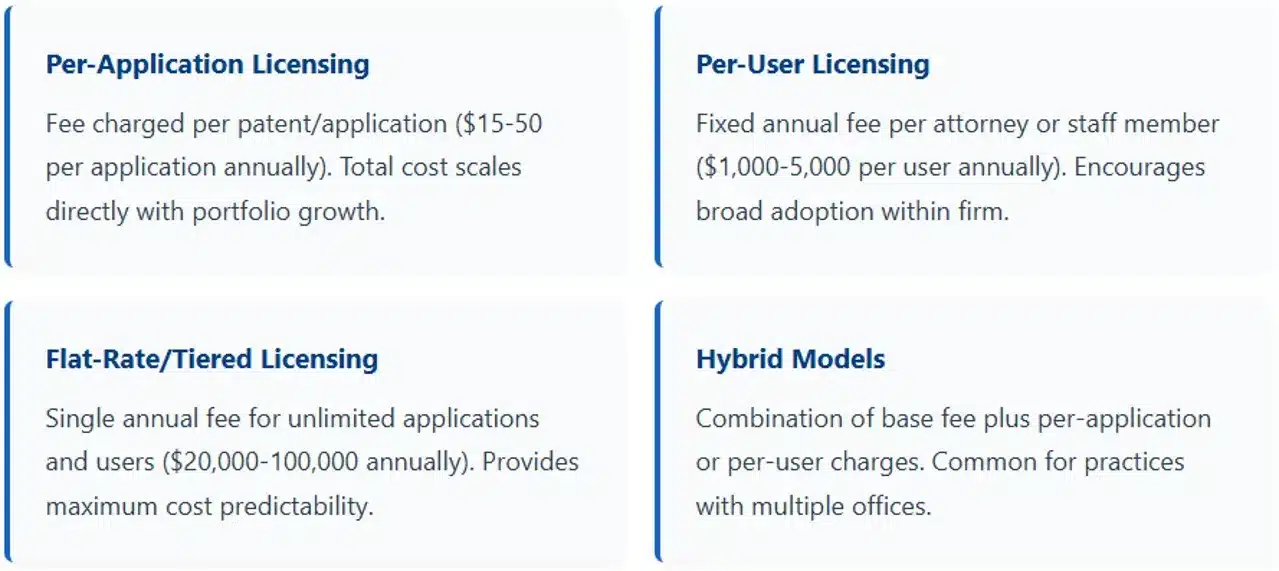
Hidden Costs to Investigate:
- Implementation and data migration fees
- Training and onboarding services
- Custom integration development
- Annual maintenance and support fees (typically 15-20% of software cost)
- Feature upgrades and new module costs
- International transaction fees for multi-currency payments
- Data export fees if switching systems
Implementation Strategy: From Selection to Operational Optimization
Phase 1: Assessment and Planning (Weeks 1-4)
Current State Audit
- Document existing docketing processes (spreadsheets, legacy systems, paper files)
- Identify all applications in current portfolio by jurisdiction and prosecution status
- Interview key users about pain points with current system
- Document current deadline tracking accuracy and missed deadline history
- Identify integration requirements with existing firm systems
Requirements Definition
- Define must-have features
- Identify nice-to-have features
- Establish success metrics
- Determine budget parameters
- Identify project sponsor and implementation team
Phase 2: System Implementation (Weeks 5-16)
Data Migration Strategy:
- Create comprehensive, verified inventory of all applications
- Validate critical fields: application number, filing date, status, responsible attorney
- Clean data before import: standardize formats, eliminate duplicates
- Implement phased import: start with active applications, then historical portfolio
- Run parallel systems during transition (typically 2-4 weeks)
- Identify and resolve discrepancies between old and new systems
System Configuration:
- Set up jurisdiction profiles with office-specific requirements
- Configure deadline calculation rules matching firm’s prosecution strategy
- Establish user roles and access permissions
- Define alert schedules and escalation protocols
- Test deadline calculations on historical applications
- Configure integrations with practice management, billing, and document systems
- Create standard reports needed by different teams
Phase 3: Operational Launch (Weeks 17-20)
Pilot Period & Full Production Launch:
- Run new system on subset of applications for 2-4 weeks
- Verify deadline accuracy against patent office records
- Identify and resolve training gaps
- Adjust configuration based on pilot feedback
- Validate integrations with other firm systems
- Discontinue old docketing system once new system is proven
Phase 4: Optimization and Ongoing Management (Weeks 21+)
First 90 Days:
- Review all deadlines generated to verify accuracy
- Monitor alert quality and adjust thresholds if needed
- Assess user adoption and provide additional training
- Validate that integrations are functioning correctly
- Generate initial reports and verify accuracy
Also, Read: Trademark IP Management Best Practices for Multi-Jurisdiction Brand Protection
Common Patent Docketing System Implementation Mistakes and How to Avoid Them
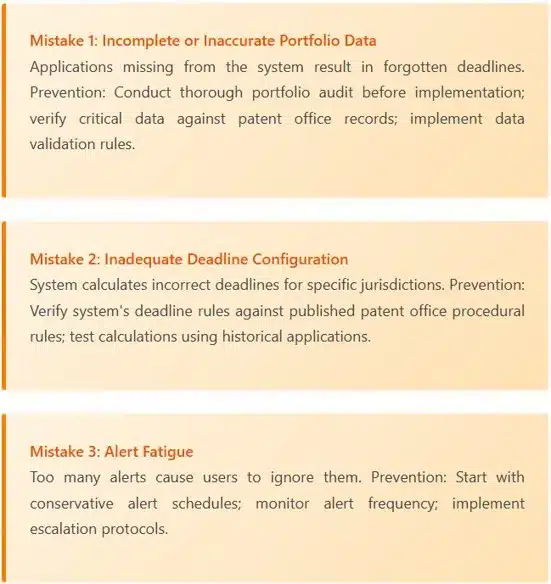
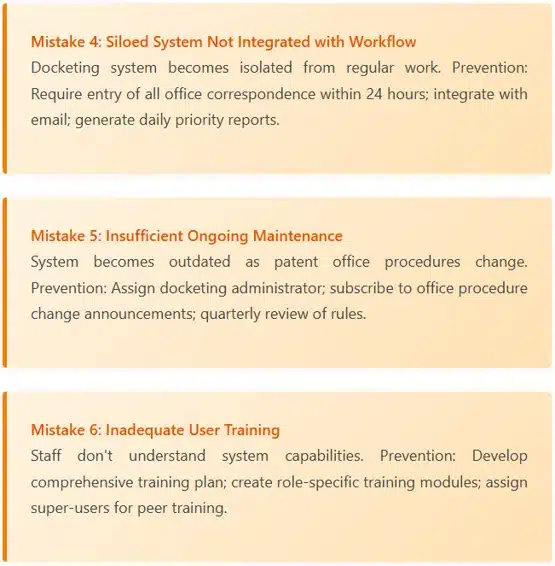
Measuring Return on Investment and Success Metrics
Quantifiable Metrics
Deadline Compliance:
- Target: 99%+ of deadlines met without extension
- Measurement: Number of missed deadlines per quarter
- Target: Zero premium/penalty fees for missed deadlines
- Measurement: Dollar amount of unnecessary fees
Administrative Efficiency:
- Target: 50%+ reduction in time spent on deadline management
- Measurement: Hours per month spent on docketing activities
- Target: 75%+ reduction in deadline-related errors
- Measurement: Number of corrections to deadline information
Cost Reduction:
- Target: Elimination of extension fees
- Measurement: Annual extension fees paid
- Target: Elimination of renewal fee penalties
- Target: Reduction in abandoned applications due to administrative oversight
Qualitative Improvements
Organizational Benefits:
- Increased confidence in deadline management across firm
- Reduced stress associated with deadline uncertainty
- Improved attorney job satisfaction through elimination of administrative burden
- Better visibility into portfolio status for management decision-making
- Improved client communication about patent status
The Future of Patent Docketing Systems: Emerging Capabilities and Trends
Cloud Infrastructure and Accessibility
Modern systems are increasingly cloud-based, offering geographic accessibility, automatic backups and disaster recovery, automatic software updates, scalability, and reduced IT burden.
Artificial Intelligence and Automation
Emerging capabilities being integrated include intelligent document processing, natural language analysis of office actions, predictive analytics for prosecution outcomes, automated task suggestion, and AI-assisted document drafting.
Advanced Analytics and Business Intelligence
Next-generation systems provide real-time portfolio dashboards, predictive forecasting of future demands, benchmarking against industry standards, competitive intelligence monitoring, and integrated business metrics linking patent data to R&D and product revenue.
Conclusion: Making the Strategic Investment in Patent Docketing Systems Infrastructure
Patent docketing systems represent critical infrastructure for any organization with significant intellectual property assets. The decision to implement a robust system should be treated as a strategic business investment, not merely a software purchase.
The business case for modern docketing systems is compelling:
- Risk Mitigation: Eliminating the catastrophic risk of missed deadlines that destroy patent rights
- Cost Optimization: Providing visibility into spending patterns enabling rational investment decisions
- Administrative Efficiency: Automating routine deadline management freeing attorney time for strategic decision-making
- Scalability: Enabling portfolio growth without proportional increases in administrative overhead
- Competitive Advantage: Better-managed portfolios create stronger market positions and support licensing and litigation strategies
The Critical Question:
For IP professionals, the question is not whether a modern docketing system should be implemented, but rather whether your organization can afford not to have one. In a practice where a single missed deadline can destroy millions in patent rights, the investment in professional docketing infrastructure is not optional-it is essential.
Also, Read: Outsource Trademark Docketing: Strong Reasons to Consider
Appendix: Critical Questions for System Evaluation and Vendor Selection
System Capability Questions
- How many patent applications can the system manage, and what are the performance implications for portfolios exceeding 10,000 applications?
- Which patent offices are supported, and how frequently are new office requirements and procedural changes incorporated?
- What jurisdictions are included in the standard system, and how are additional jurisdictions or offices added?
- How does the system handle applications filed under the Patent Cooperation Treaty (PCT), and how are national phase entries managed?
- What is the system’s capability for managing patent families and showing relationships between parent and related applications?
Integration and Technical Architecture Questions
- What integrations exist with legal practice management systems, and how seamless is the data synchronization?
- Can the system integrate with standard accounting and billing software, and how is financial data transmitted?
- What API capabilities are available for custom integrations with firm-specific or proprietary systems?
- How does the system handle email integration, and can patent office correspondence be captured automatically?
- What is the typical timeline and cost for implementing custom integrations with external systems?
Implementation and Onboarding Questions
- What is the typical implementation timeline for a practice of our size with our portfolio scope?
- What resources must the firm provide during implementation?
- How is historical data imported into the system, and what data validation procedures are available?
- What training and onboarding support does the vendor provide, and for how long?
- What happens after the implementation period if issues arise or additional training is needed?
Security, Compliance, and Data Protection Questions
- What security certifications does the vendor hold (SOC 2, ISO 27001, etc.)?
- How is data encrypted both in transit and at rest?
- What backup and disaster recovery procedures are in place?
- What is the vendor’s incident response procedure if a security breach occurs?
- Can we enforce data residency requirements (e.g., data must remain in the United States)?
Support and Ongoing Relationship Questions
- What is the vendor’s typical response time to support requests, and how are urgent issues prioritized?
- Is there an active user community, user conference, or online forum for knowledge sharing?
- How frequently does the vendor release new features and functionality updates?
- What training resources are available (documentation, training videos, webinars, etc.)?
- Can you provide references from firms similar to ours that have successfully implemented your system?
Our Services: Explore Patent Docketing Services

