

Understanding the 30/31-Month PCT National Phase Deadlines
In this section, we will discuss about the 30/31-month PCT national phase deadlines and why they are the most critical dates in the entire PCT process. We will also understand the difference between the 30-month and 31-month deadline countries.
Key Facts About the 30/31-Month Deadline:
- Calculated from your priority date (the filing date of your original application)
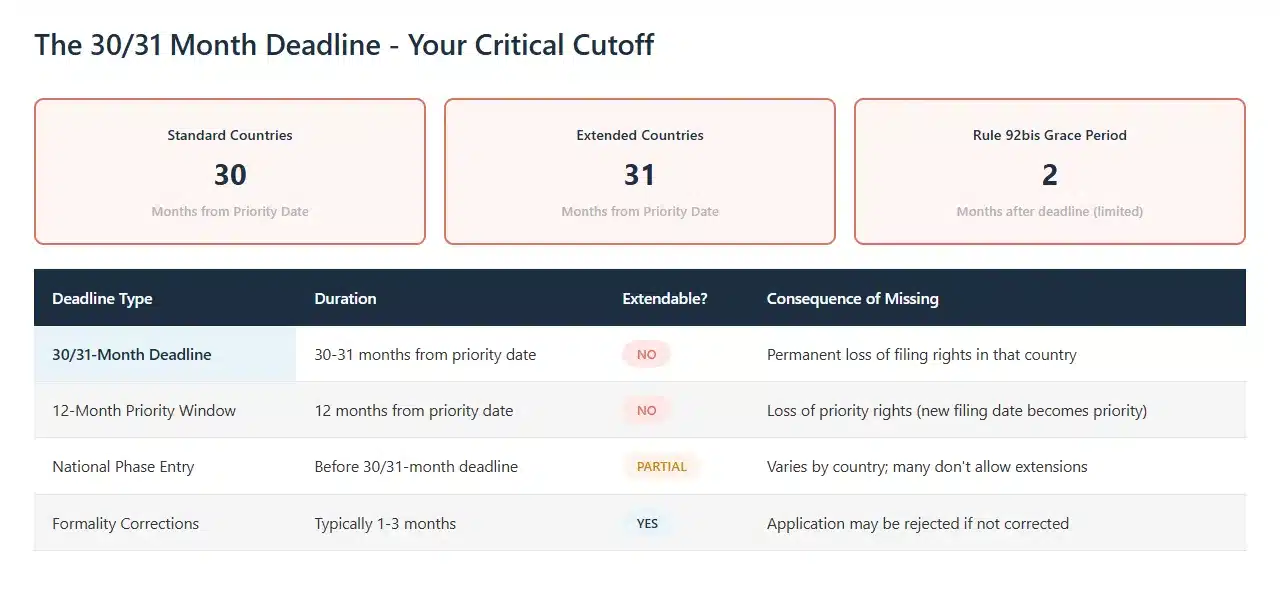
- You have 30 months in most jurisdictions; some countries like Japan, South Korea, and certain others allow 31 months
- This deadline applies to virtually every country participating in the PCT system
- Missing this deadline typically results in permanent loss of filing rights in that jurisdiction
- There are very limited exceptions for late entry—most countries do not permit national phase entry after this date
What Happens at the 30/31-Month Mark: Once this deadline passes, your application is considered abandoned in that country. You cannot retroactively file or recover the lost filing date, which means you lose your priority rights. Any competitor can now patent the invention in that jurisdiction, potentially blocking your future market expansion.
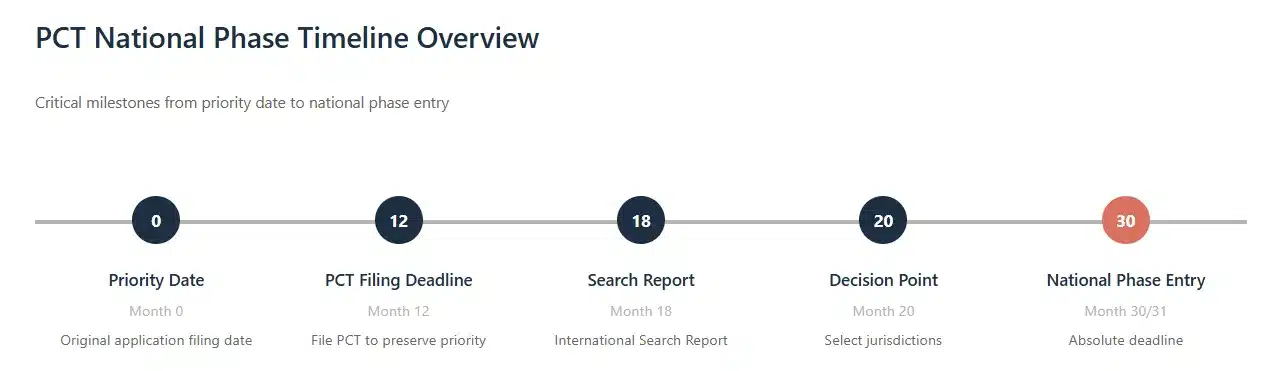
The 30/31-Month PCT National Phase Deadlines
In this part, we will discuss about the visual breakdown of countries that follow the 30-month deadline, countries that follow the 31-month extended deadline, and the very limited Rule 92bis grace period of two months that exists after the deadline.
The 12-Month Priority Window Explained
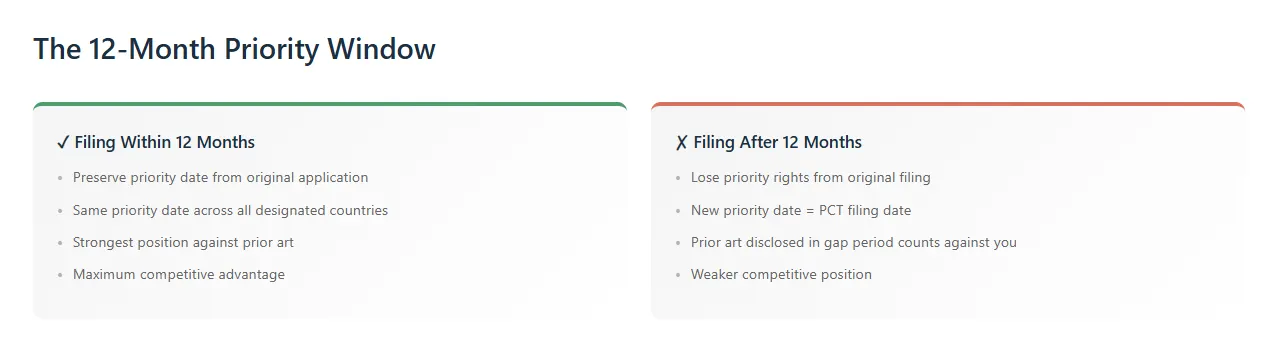
In this section, we will discuss about the 12-month priority window and why it is such an important milestone in the PCT filing process. This window is the period during which we must file our international PCT application to keep our original priority date. The First Critical Milestone: The 12-month priority window is when you must file your international PCT application to claim priority from your original application.
Understanding Priority Rights:
- You have exactly 12 months from your priority date to file a PCT application
- This 12-month window is governed by the Paris Convention and is non-extendable
- Filing within this period allows you to claim the same priority date as your original application
- This is essential because your priority date determines whether your invention is “novel” in the eyes of patent offices
Filing a PCT Application After 12 Months:
- You CAN still file a PCT application after 12 months
- However, you will lose your priority rights from the original application
- Your new priority date becomes the PCT filing date itself
- This can be disadvantageous if prior art has been published in the interim
- For maximum protection, always file within the 12-month window
Strategic Importance: Filing your Patent Cooperation Treaty (PCT) application within this 12-month window is crucial because it locks in your priority date across all designated countries. This gives you the strongest position against competing inventions that may have been disclosed after your original filing.
Country-Specific PCT National Phase Deadlines and Variations
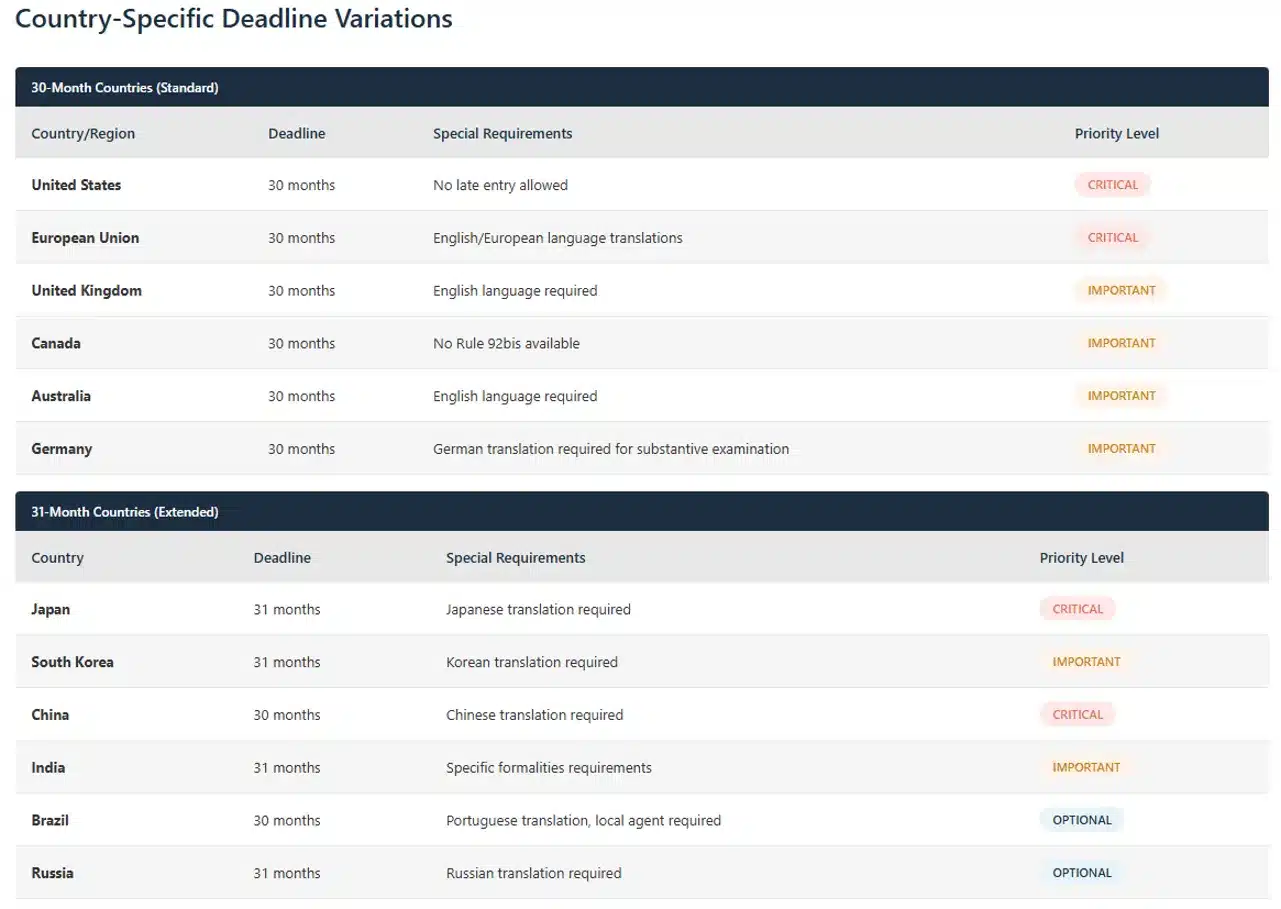
In this section, we will discuss about the country-specific PCT national phase deadlines and the variations that exist between different countries. It is important to know that not all countries follow the same deadline, and each one may have its own special requirements.
Key Country-Specific Variations:
In this part, we will discuss about the key country-specific variations in PCT national phase deadlines. We will look at standard 30-month countries, 31-month countries, regional differences within the EU, and special requirements for emerging markets like Vietnam and Indonesia.
Standard 30-Month Countries: United States, Canada, Australia, United Kingdom, France, Germany, Italy, Spain, Netherlands, and most European countries follow the standard 30-month deadline from the priority date.
31-Month Countries: Japan, South Korea, Chile, and several others allow a full 31 months. This extra month can be crucial when coordinating multiple deadlines.
Extended Timelines: Some countries have different national phase entry requirements:
- India: Follows the 31-month deadline but has specific formalities requirements
- China: Standard 30-month deadline; CNIPA has specific Chinese language requirements
- Brazil: 30-month deadline with particular emphasis on local agent requirements
- Russia: 31-month deadline with requirements for Russian translation
Regional Differences Within the EU: While EU member states follow the 30-month deadline, their national offices may have different fee structures and formality requirements that affect your timeline planning.
Emerging Markets: Countries like Vietnam, Thailand, and Indonesia have varying deadlines and requirements. Vietnam, for example, follows the 30-month deadline but requires specific documentation in Vietnamese.
Critical Action: Create a country-by-country checklist noting each jurisdiction’s specific deadline, language requirements, and fee structures. This ensures you don’t miss critical nuances that could invalidate your filing.
What Happens If You Miss a Deadline? (PCT National Phase Deadlines)
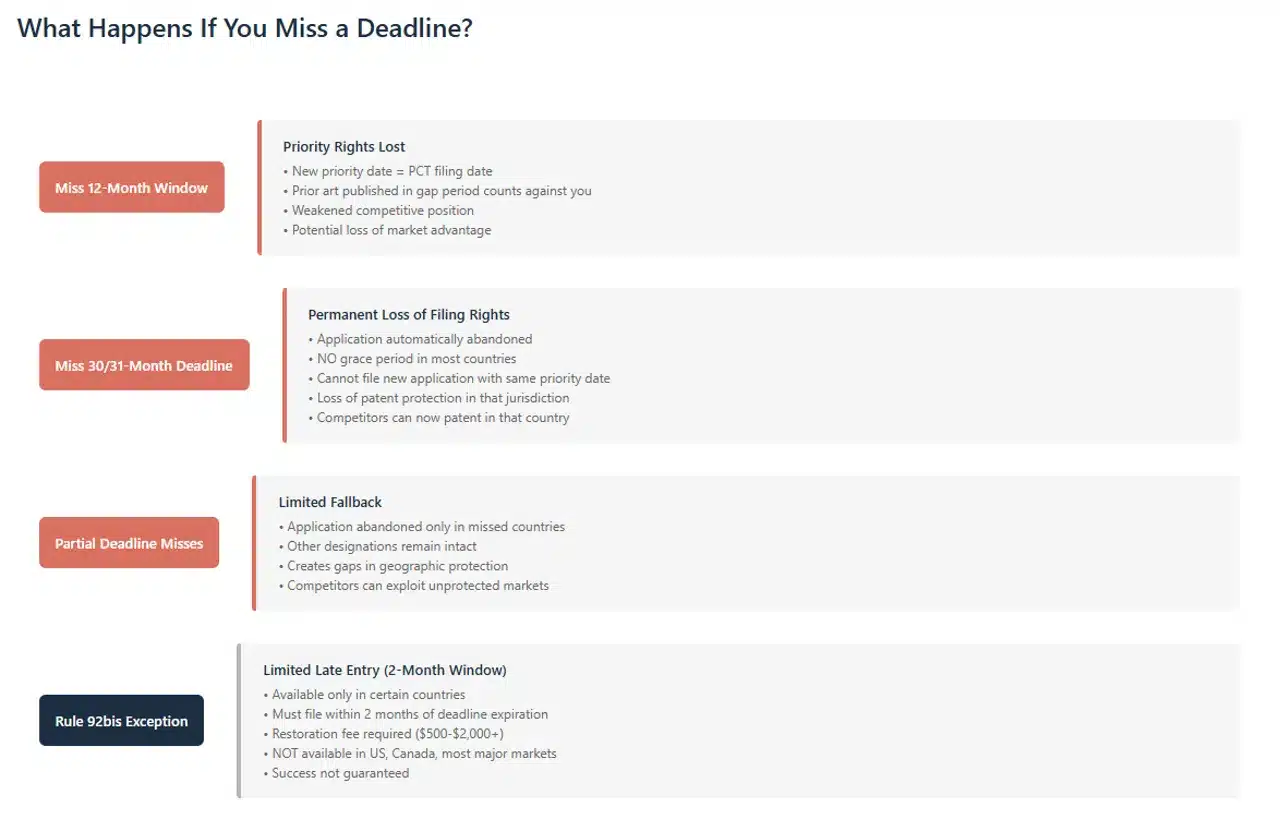
In this section, we will discuss about what happens if we miss a PCT national phase deadline. Missing a deadline in the PCT system can have very serious consequences, so it is important for every applicant to understand exactly what they risk by missing it.
the Missing the 12-Month Priority Deadline:
- Your PCT application is still valid, but it loses priority rights
- The effective priority date becomes your PCT filing date
- Any prior art published between your original filing and PCT filing may affect patentability
- Your competitive advantage is weakened because you lose the earlier priority date
Missing the 30/31-Month National Phase Deadline:
In this part, we will discuss about the consequences of missing the 12-month priority deadline. When this deadline is missed, our PCT application still stays valid but we lose our priority rights, which means our effective priority date becomes the PCT filing date instead.
- Your application is automatically abandoned in that jurisdiction
- No grace period exists for most countries
- You cannot file a new application with the same priority date
- You lose market protection in that entire country
- If the invention becomes commercially valuable later, you have no patent rights to enforce
Partial Deadline Misses: If you miss the deadline in some (but not all) designated countries, your application is abandoned only in those countries. Your other designations remain intact.
Consequences for Business:
In this part, we will discuss about the serious business consequences that come from missing PCT national phase deadlines. These consequences include loss of competitive advantage, reduced patent portfolio value, inability to prevent competitors, and difficulty in licensing or attracting investment.
- Loss of competitive advantage in major markets
- Inability to prevent competitors from launching similar products
- Reduced valuation of your patent portfolio
- Potential loss of investment opportunities or partnerships dependent on patent coverage
- Difficulty licensing the technology without patent protection in key markets
Exception – Rule 92bis: A very limited exception exists under PCT Rule 92bis, which allows late entry in certain circumstances (discussed in detail below).
Also Read: PCT Provisional Applications and Alternative Filing Strategies
Strategies for Managing Multiple Deadlines
In this section, we will discuss about the effective strategies we should use to manage multiple PCT deadlines across different countries. Managing many deadlines at once requires good planning, strong organization, and the right tools to make sure nothing important gets missed.
Create a Master Timeline:
- Map out all critical dates for your designated countries on a single master calendar
- Work backward from each national phase deadline to identify when actions must occur
- Include dates for fee payments, document translations, and local agent engagement
- Use color coding or flags to highlight highest-priority jurisdictions
Designate a Deadline Manager: Assign one person (or team member) responsibility for deadline tracking. This single point of accountability prevents gaps that occur when multiple people share responsibility.
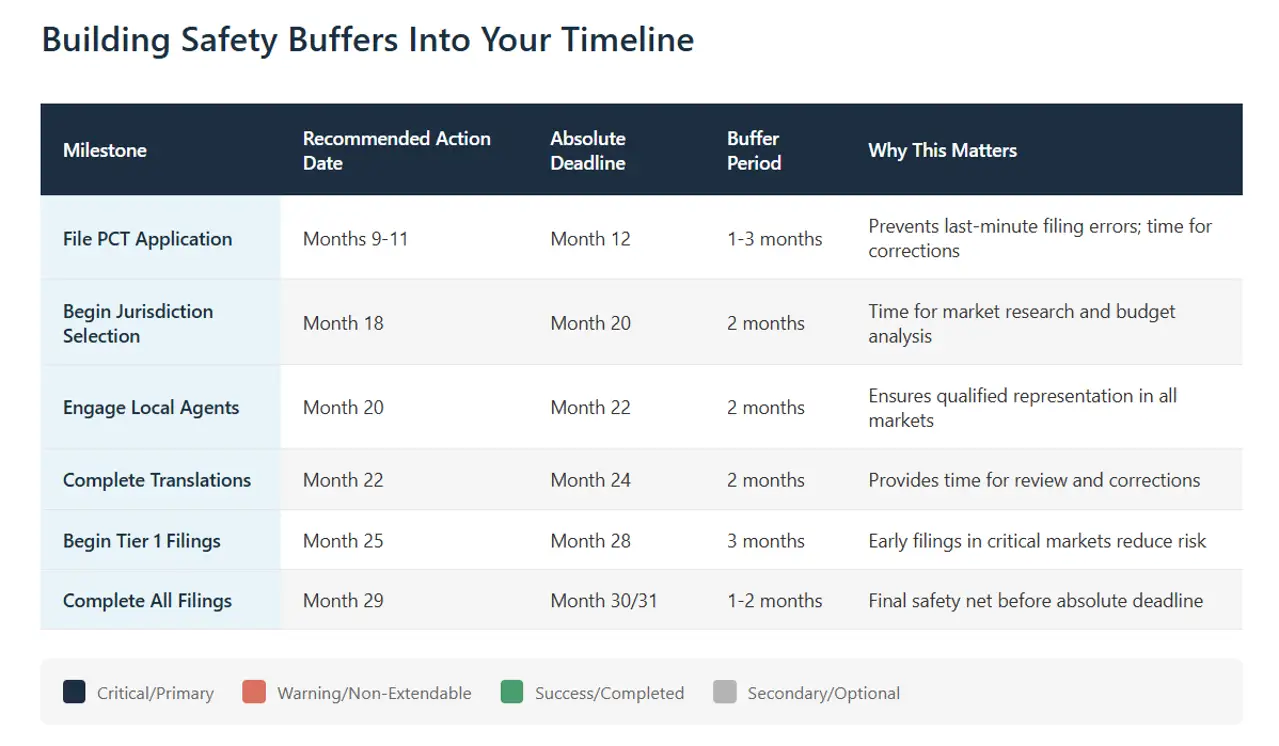
Build in Buffer Periods:
- File your PCT application within 6-9 months of your priority date (not waiting until month 12)
- Begin national phase entry preparations by month 20 (giving you a 10-month buffer before the 30-month deadline)
- Submit national phase filings at least 2-3 months before the deadline to account for unexpected delays
- This buffer approach prevents last-minute scrambling and administrative errors
Building Buffers
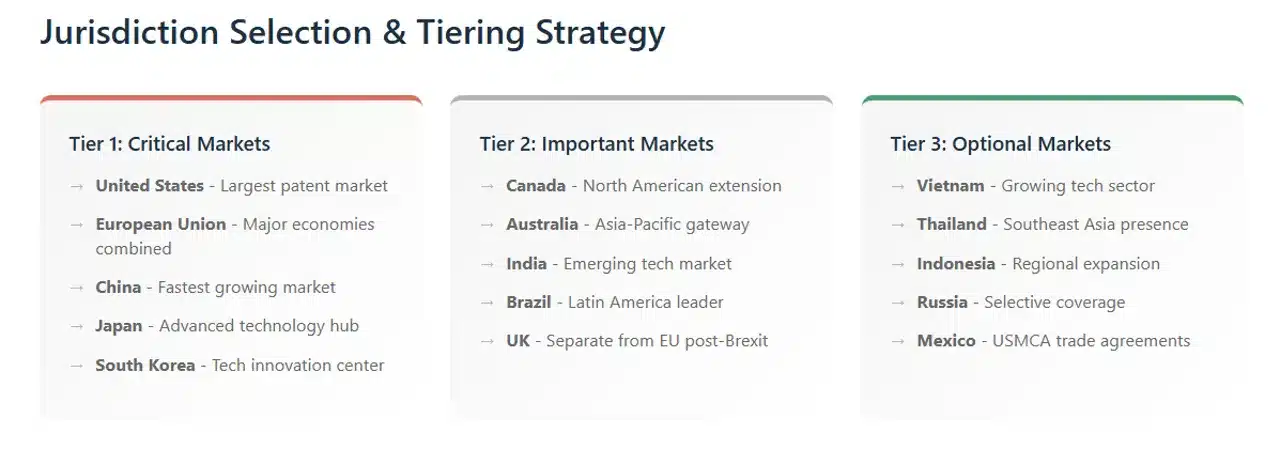
Prioritize Your Jurisdictions:
- Tier 1 (Critical Markets): United States, Europe, China, Japan, South Korea
- Tier 2 (Important Markets): Canada, Australia, India, Brazil
- Tier 3 (Optional Markets): Additional countries if budget permits
- Focus your detailed planning on Tier 1 jurisdictions while maintaining a system for Tier 2 and 3
Coordinate with Local Agents Early:
- Engage patent attorneys and agents in target countries before the 20-month deadline
- Ensure they understand your budget constraints and filing strategy
- Establish clear communication channels for deadline alerts
- Confirm their availability and fee structures upfront
Leverage PCT Rule 84bis: Where permitted, take advantage of international-style claims and descriptions to streamline the national phase entry process. This can reduce preparation time and associated costs.
PCT Rule 92bis and Missed PCT National Phase Deadlines
In this section, we will discuss about PCT Rule 92bis and what it means for applicants who have missed the standard national phase deadline. This rule offers a very limited lifeline in some countries but it is not available everywhere and should never be relied upon. This rule is very important, as applicants who generally miss the standard deadline, for them Rule 92bis is very important. Rule 92bis offers a limited lifeline for applicants who miss the standard 30/31-month national phase deadline. However, its availability and scope are highly restricted.
What Rule 92bis Allows:
- Late national phase entry after the expiration of the 30/31-month deadline
- Available only in countries that have adopted this optional rule
- Must be requested along with payment of additional fees
- Restores your application as if the deadline had been met
Strict Conditions for Rule 92bis Relief:
- The national phase request must be submitted within 2 months after the deadline expires (some countries allow slightly longer periods)
- Your request must include grounds for the delay (unintentional non-compliance)
- Applicants must demonstrate due care and diligence in attempting to meet the original deadline
- Payment of a restoration fee is mandatory (typically $500-$2,000+ depending on the country)
- The WIPO or national office must accept your explanation of the delay
Country Availability – Critical: Rule 92bis is NOT universally available. Participating countries include many (but not all) PCT member states. Notable countries that do NOT allow Rule 92bis include:
- United States (absolutely no late entry permitted)
- Canada (no late entry option)
- Several other jurisdictions
Therefore, you cannot rely on Rule 92bis as a safety net for missing the deadline in major markets like the US.
When Rule 92bis Applies: It’s most valuable as a backup for secondary markets where you may have inadvertently missed the deadline due to administrative oversight.
Important Caveat: Even when Rule 92bis is available, the timing is extremely tight (2 months post-deadline) and success is not guaranteed. Courts and patent offices scrutinize these requests carefully.
Bottom Line: Never plan to use Rule 92bis. Instead, establish systems to prevent ever needing it.
Also, Read: National Phase Entry Patent Filing Process, Deadline and Strategy
PCT National Phase Deadlines Extension Options
In this section, we will discuss about the extension options available for PCT national phase deadlines. While most deadlines are non-extendable, there are some limited situations where extensions or grace periods can help us manage our timeline more effectively in specific countries. PCT National Phase Deadlines Extension Options are important to consider as these are life-saving in the some cases. Here in this section, we will discuss about such options. While most PCT deadlines are non-extendable, certain provisions allow applicants to adjust their timelines in specific circumstances.
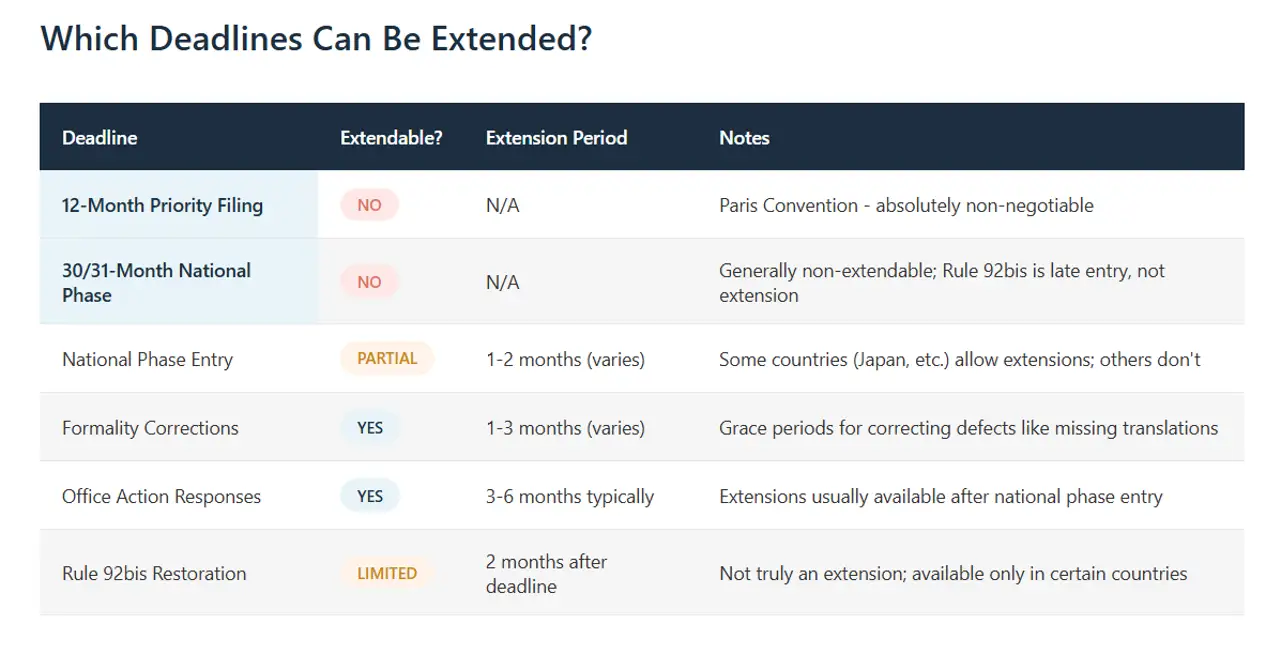
Extendable Deadlines:
National Phase Entry: Some countries (notably Japan and a few others) permit extensions of the national phase entry deadline upon request and payment of additional fees. Extensions are typically limited to 1-2 additional months.
Formality Corrections: Many national offices grant grace periods for correcting formal defects (like missing translations or incomplete documentation). These are typically 1-3 months but vary by jurisdiction.
Response to Office Actions: Once you’ve entered the national phase, patent offices typically grant 3-6 month periods to respond to examination reports. These periods are sometimes extendable by a few additional months.
Non-Extendable Deadlines (Absolute Cutoffs):
The 12-Month Priority Filing Deadline: This is absolutely non-extendable under the Paris Convention. No country permits extension of this deadline.
The 30/31-Month National Phase Deadline: This is generally non-extendable in most countries. Even countries with Rule 92bis provisions only allow entry within 2 months of the deadline expiration—this is not truly an extension but a late entry procedure.
PCT International Search Report Deadline: While you can request reconsideration, you cannot extend the deadline to receive this report.
Strategies for Managing Fixed Deadlines:
- Build the longest possible timelines into your project planning
- Request extensions proactively as early as possible, before deadlines approach
- Maintain backup documentation prepared in advance, so if one jurisdiction denies an extension, you can still file in others on time
- Use the International Preliminary Examination (IPE) strategically to gain additional time for decision-making (extends the deadline for some strategic decisions to month 30)
Also, Read: PCT Filing Costs and Fees: Complete Breakdown
Creating Your PCT Timeline Calendar (PCT National Phase Deadlines)
In this section, we will discuss about how to create a proper PCT timeline calendar to manage all our national phase deadlines. A well-organized calendar is one of the most important tools we have to make sure we never miss a critical PCT filing date. PCT Timeline calendar is an important reminder for all applicants. A well-organized timeline calendar is your most important operational tool for ensuring deadline compliance. This section provides templates and best practices.
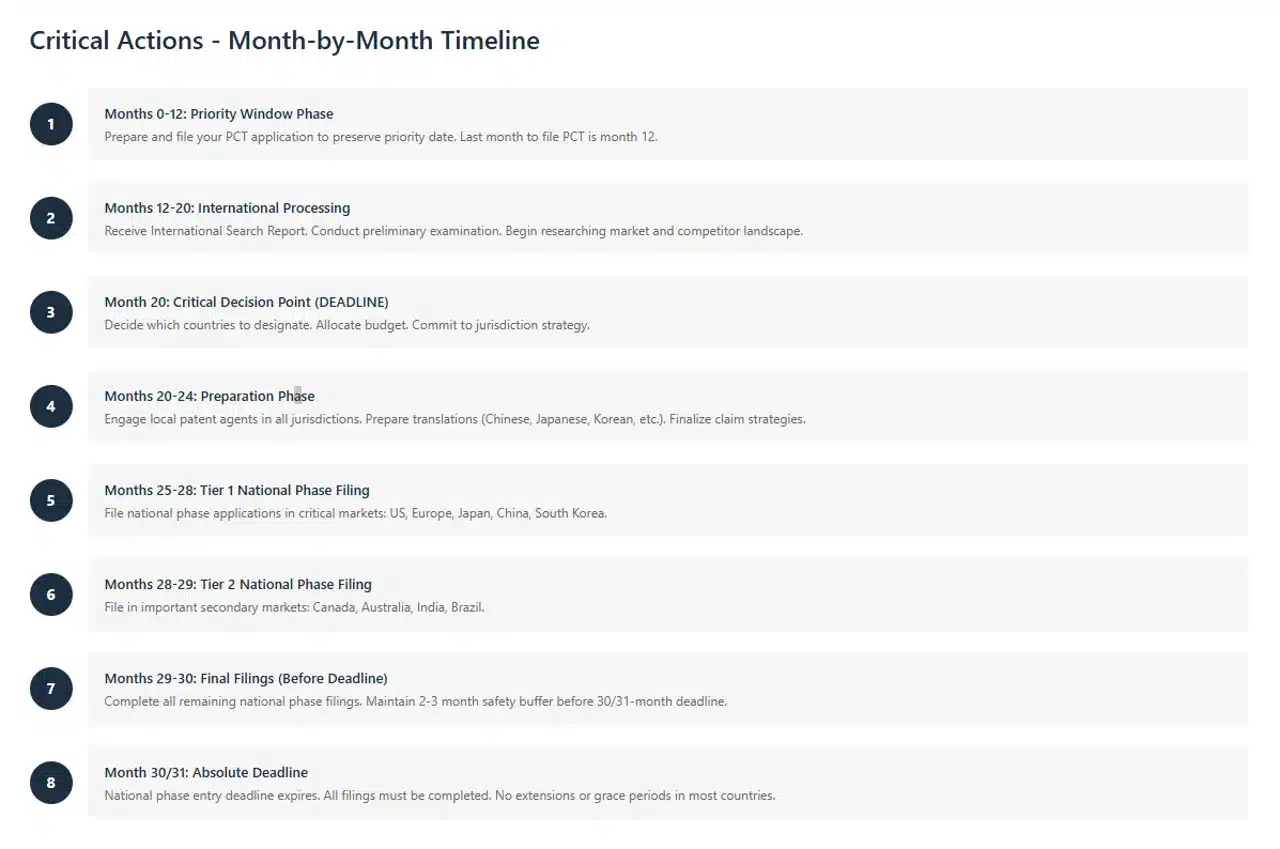
Month-by-Month Breakdown from Priority Date:
Months 0-12: Priority Window
- Month 0-6: Prepare PCT application based on your home country filing
- Month 6-9: Finalize PCT application and gather supplementary documentation
- Month 9-11: Have your patent attorney review and refine the application
- Month 11-12: File your international PCT application with WIPO
12-20 Months International Processing Phase
- Month 18-20: Receive International Search Report from the International Searching Authority
- Month 19-20: Begin preliminary examination (if elected)
- Months 18-20: Begin preliminary discussions with local patent attorneys in key jurisdictions about national phase strategy
- Research market developments, competitive landscape, and budget constraints to inform your national phase decisions
Months 20-25: Critical Decision and Preparation Phase
- Month 20: This is your decision-making deadline. Commit to which countries you’ll enter and allocate budget
- Month 20-22: Formally engage local patent agents in all designated jurisdictions
- Month 21-23: Prepare translations of your application into required languages (Chinese, Japanese, Korean, etc.)
- Month 22-23: Finalize claim strategies with local agents for each jurisdiction
- Month 23-24: Prepare and review all national phase entry documents
Months 25-30: National Phase Entry Phase
- Month 25-28: Begin filing national phase applications in Tier 1 jurisdictions (US, Europe, Japan, China, South Korea)
- Month 28-29: File in Tier 2 jurisdictions
- Month 29-30: Final filings in remaining designated countries
- Maintain 2-3 month buffer before the 30/31-month deadline
Month 31+: National Phase Prosecution
- Respond to office actions as they arrive
- Continue prosecution in each country according to their examination timelines
- Track maintenance fee deadlines, which begin immediately after grant
Also, Read: Comprehensive PCT Guide: Mastering International Patent Applications
Creating Your Physical/Digital Calendar:
In this part, we will discuss about how to create a physical or digital calendar that helps us track all our PCT national phase deadlines properly. Whether we prefer a spreadsheet, a shared calendar, or a digital tool, the key is consistency and regular updating. This is an interesting talk, where you can create a physical or digital calendar for timelines or PCT national phase deadlines.
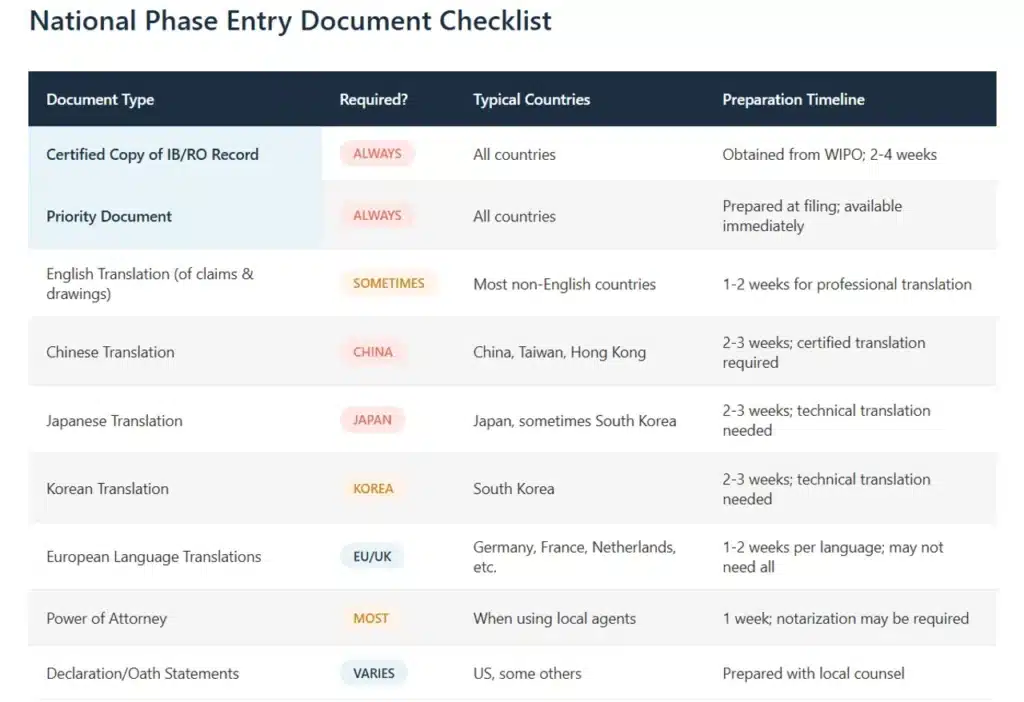
Required Documentation
Recommended Format:
- Use a shared spreadsheet (Google Sheets, Excel) with columns for: Country | Priority Date | 30-Month Deadline | 20-Month Decision Date | Filing Deadline | Status | Assigned Attorney
- Color-code entries: Red (critical), Yellow (important), Green (completed)
- Set automated reminders 90 days, 60 days, 30 days, and 14 days before each deadline
- Use your company calendar system to block time for deadline-related tasks
Key Dates to Include:
- Priority date of your original application
- 12-month PCT filing deadline
- International Search Report expected date
- 30/31-month national phase deadline for each country
- 20-month decision point for budget/jurisdiction selection
- Local agent engagement deadline
- Translation completion deadlines
- National filing deadlines (typically 1-2 months before the 30-month cutoff)
- First office action expected dates (after national filing)
Communication Triggers:
- 120 days before 30-month deadline: Send reminder email to all involved parties
- 90 days before deadline: Confirm all documents are ready for filing
- 60 days before deadline: Verify all local agents have received final materials
- 30 days before deadline: Confirm all national filings are submitted or scheduled
- 14 days before deadline: Final verification check
Also, Read: ePCT Filing Guide using Online PCT Application System Guide
Automated Deadline Tracking Tools (PCT National Phase Deadlines)
In this section, we will discuss about the automated deadline tracking tools that help IP professionals manage PCT national phase deadlines more reliably. Using the right tool reduces the risk of human error and makes tracking across multiple countries much easier and more efficient. PCT National Phase Deadlines are important to remember and act accordingly. Managing PCT deadlines manually across multiple countries is error-prone. Professional tools automate tracking, provide alerts, and integrate with your workflow.
Specialized IP Deadline Management Software:
LexisNexis Redline: Enterprise-level deadline tracking specifically for IP management. Automatically calculates PCT deadlines based on priority dates, integrates with firm management systems, and provides customizable alert mechanisms. Best for large firms managing hundreds of applications.
Anaqua: Comprehensive IP portfolio management suite with advanced deadline tracking, jurisdiction-specific calculation engines, and integration with external counsel management systems. Provides predictive analytics for cost projections.
IPfolio: Focused specifically on deadline management with pre-configured timelines for all major jurisdictions. Offers automatic email alerts, shared calendars, and integration with major accounting systems for deadline-based fee management.
DocketCalendar: Robust deadline tracking designed for IP professionals. Includes jurisdiction-specific deadline calculations, customizable alert workflows, and reporting capabilities for deadline compliance audits.
Intrado’s IP Management Suite: Mid-market solution offering deadline tracking, local agent communication tools, and documentation management in a single platform.
Also, Read: Why Choose PCT Filing? 5 Key Reasons
More Affordable Alternatives:
Projectplace or Monday.com: Generic project management tools configured for PCT deadline tracking. Less specialized than IP-specific software but highly flexible and significantly cheaper (typically $10-20/user/month vs. $500+/application for specialized software).
Notion or Airtable: Free or low-cost database tools that many solo practitioners and small firms use to build customized deadline tracking systems. Require more setup time but offer complete customization.
Google Sheets with Scripts: Advanced users can build automated deadline calculation spreadsheets using Google Apps Script, creating jurisdiction-specific deadline calculations with automatic email alerts.
Key Features to Look For in Any Tool:
- Automatic deadline calculation based on jurisdiction and priority date
- Multiple alert settings: 120-day, 90-day, 60-day, 30-day, and 14-day warnings
- Jurisdiction-specific rules: The tool must account for different deadlines in different countries
- Integration capabilities: Connect to your email, calendar, and document management systems
- Reporting functionality: Generate compliance reports for internal stakeholders or client reports
- User permissions: Control who can view, edit, or receive alerts for specific applications
- Document attachment: Store related filings, correspondence, and supporting documents
- Cost tracking: Link deadlines to budget and fee projections
Implementation Best Practices:
we will discuss about the best practices we should follow when implementing a PCT deadline tracking tool in our workflow. Setting up redundancy, establishing escalation procedures, running regular audits, training the team, and creating regular backups are all very important steps.
Set Up Redundancy: Use automated tools as your primary system, but maintain a backup manual calendar for critical deadlines. This ensures that if your system fails, you still catch critical dates.
Establish Escalation Procedures: Configure your tool to escalate alerts when deadlines approach. For example, at the 30-day mark, automatically copy your managing attorney or supervising counsel on deadline alerts.
Regular Audits: Quarterly audit your deadline tracking system against your actual filed applications to ensure accuracy. Mistakes in deadline calculation can be catastrophic.
Team Training: Ensure everyone involved in IP management understands how the tool works and their specific responsibilities for deadline monitoring.
Regular Backups: Whether using cloud-based or local systems, ensure your deadline data is backed up regularly. Loss of deadline information could result in missed filings.
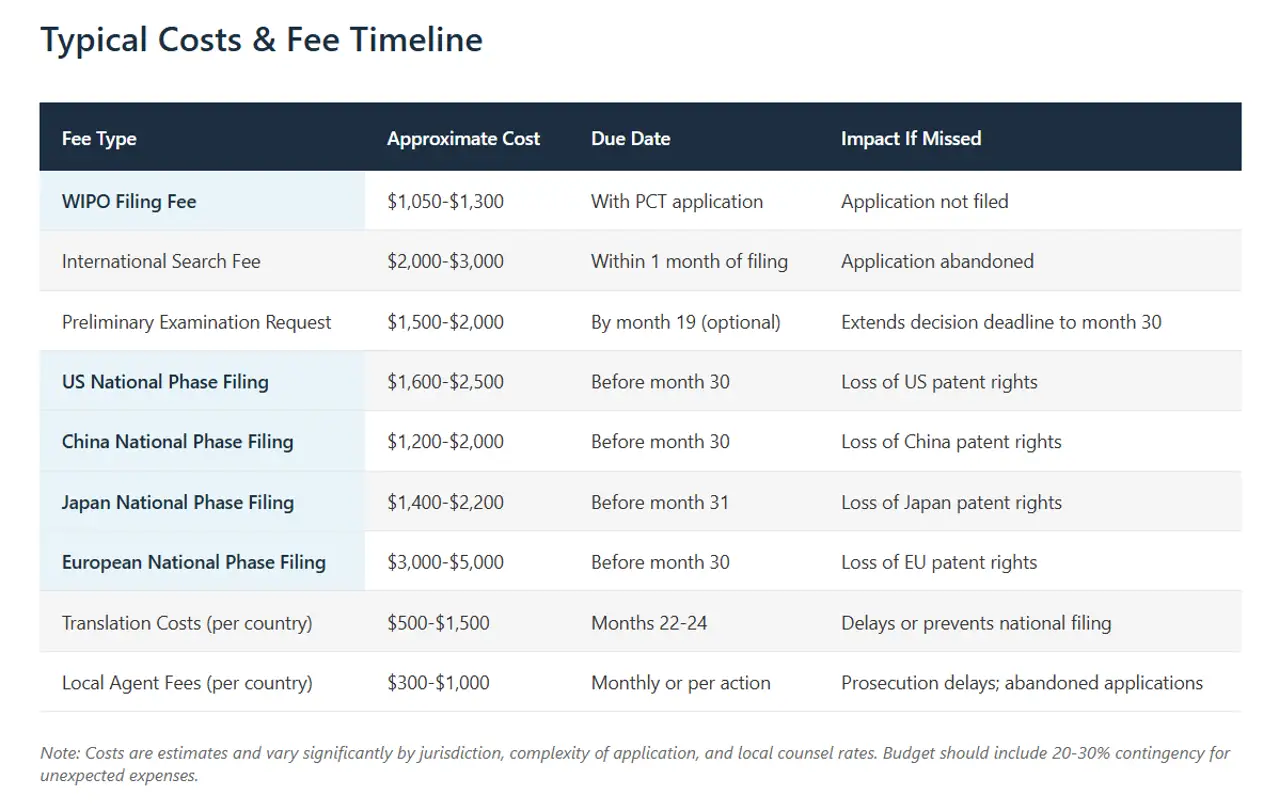
Budget Planning & Fee Management: Costs and Fees as per timelines
In this part, we will discuss about the typical costs and fees that are associated with different stages of the PCT national phase timeline. Planning the budget early and linking it to our deadline calendar helps us avoid surprises and manage our overall patent spending effectively.
Also, Read: PCT Countries and International Coverage
Conclusion: Your Action Plan for PCT Deadline Success
In this conclusion part, we will discuss about the clear action plan that every PCT applicant should follow to achieve deadline success. From filing within 12 months to completing national phase entries by month 29, having a systematic approach is the key to protecting patent rights globally.
Your Immediate Priorities:
Now: Review your current PCT applications and ensure deadlines are properly tracked in your system.
This Month: Engage a deadline management tool (even if it’s just a well-designed spreadsheet) and input all current applications with their critical dates.
Before Month 12 of Any Future Application: File your PCT application to preserve your priority date.
By Month 20: Make your country selection decisions and confirm budget allocation.
Month 25: Have all translations complete and local agents engaged and ready to file.
By Month 29: All national phase filings should be submitted, leaving a safety buffer.
Remember: The 30/31-month deadline is absolute and largely non-negotiable in most countries. Missing it costs you patent rights in that jurisdiction permanently. The 12-month priority deadline is equally inflexible. Build systems, not just reminders, to ensure these deadlines are always met.
For complex portfolios or high-stakes applications, the small investment in professional deadline management software is trivial compared to the cost of missing a critical deadline. Your patent protection—and potentially your company’s competitive advantage—depends on flawless deadline execution.
Start your PCT patent filing journey today with careful planning, professional guidance, and a clear understanding of your commercial objectives.
Need Help With Your PCT National Phase Strategy?
At Teak IP Services, our team specializes in guiding applicants through the entire PCT national phase process. We help you optimize your jurisdiction selection, manage deadlines across multiple countries, and maximize your patent portfolio’s value. Contact us for a consultation on your specific applications and timeline needs.
Missing a PCT national phase deadline can jeopardize your entire patent strategy. This comprehensive guide walks you through every critical date, deadline variation, and strategy you need to protect your intellectual property across multiple jurisdictions.
Our Services: Discover PCT Application Services

