
A single missed exhibit deadline can unravel months of invalidity strategy before a case ever reaches the Patent Trial and Appeal Board (PTAB). That is the quiet pressure sitting behind every Inter Partes Review, and it is exactly why understanding the paralegal’s role in an Inter Partes Review (IPR) proceeding matters so much to junior attorneys, solo practitioners, and in-house IP teams alike.

IPR practice runs on a strict, statutory clock. Petitions, preliminary responses, discovery requests, expert declarations, and briefs all move on tight windows set by 37 C.F.R. Part 42. For a junior attorney building a PTAB practice, or a solo practitioner without a deep litigation support bench, the paralegal’s role in an Inter Partes Review (IPR) proceeding is often the difference between a clean, well-documented filing and a costly procedural misstep.
This guide breaks down exactly what an IPR paralegal does at every stage of the proceeding, the templates and tools they rely on, common mistakes to avoid, and how outsourced paralegal support can help smaller firms compete with big-firm PTAB teams.
Quick Answer: What Does an IPR Paralegal Do?
Docketing
Filing
Coordination
Compliance
Quick Answer
Quick overview defining streamlined notification workflows for legal operations, ensuring complete accuracy and prompt processing for active matters.
An IPR paralegal manages the procedural backbone of an Inter Partes Review. They calculate and docket every statutory deadline, prepare and format the petition and supporting exhibits, coordinate expert declarations, manage electronic filing through PTAB E2E, track mandatory notices, and keep the case team synchronized from petition filing through the final written decision.
In short, the paralegal’s role in an Inter Partes Review (IPR) proceeding is to convert a fast-moving, deadline-driven administrative trial into a well-organized, compliance-ready workflow so the attorney can focus on substantive strategy.
What is an Inter Partes Review (IPR) Proceeding?
Before looking at the paralegal’s responsibilities, it helps to understand the proceeding itself.
Inter Partes Review is a trial proceeding conducted before the PTAB inside the United States Patent and Trademark Office (USPTO). Created by the America Invents Act and effective since September 2012, IPR allows a third party to challenge the patentability of one or more claims in an issued patent using prior art consisting only of patents or printed publications.
District Court Litigation
Inter Partes Review (PTAB)
Unlike federal court litigation, IPR is an administrative proceeding governed by its own set of procedural rules, and it typically moves faster and at a lower cost than a full district court trial. Because IPR petitions are frequently filed alongside parallel district court litigation, timing and procedural precision carry enormous strategic weight.
Key IPR Milestones
| Stage | Approximate Timing | Typical Deliverable |
|---|---|---|
| Petition Filing | Petitioner-initiated | IPR petition, exhibits, mandatory notices |
| Preliminary Response | Within 3 months of petition | Patent owner’s preliminary response |
| Institution Decision | Within 3 months of preliminary response | PTAB institution decision |
| Patent Owner Response | Within 3 months of institution | Response and possible claim amendments |
| Petitioner Reply | Set by scheduling order | Reply brief and rebuttal evidence |
| Oral Hearing | Set by scheduling order | Hearing before administrative patent judges |
| Final Written Decision | Within 12 months of institution (up to 18 with extension) | PTAB final written decision |
This table alone illustrates why the paralegal’s role in an Inter Partes Review (IPR) proceeding is so deadline-intensive. Nearly every stage triggers a new set of downstream due dates that must be calculated correctly and docketed immediately.
Why the Paralegal’s Role in an IPR Proceeding Matters So Much
IPR proceedings are unforgiving of procedural error. The PTAB enforces page limits, formatting rules, and filing deadlines strictly, and there is little tolerance for late submissions absent a showing of good cause. For a junior attorney handling a first PTAB matter, or a solo practitioner without an in-house litigation support team, that leaves very little room for error.
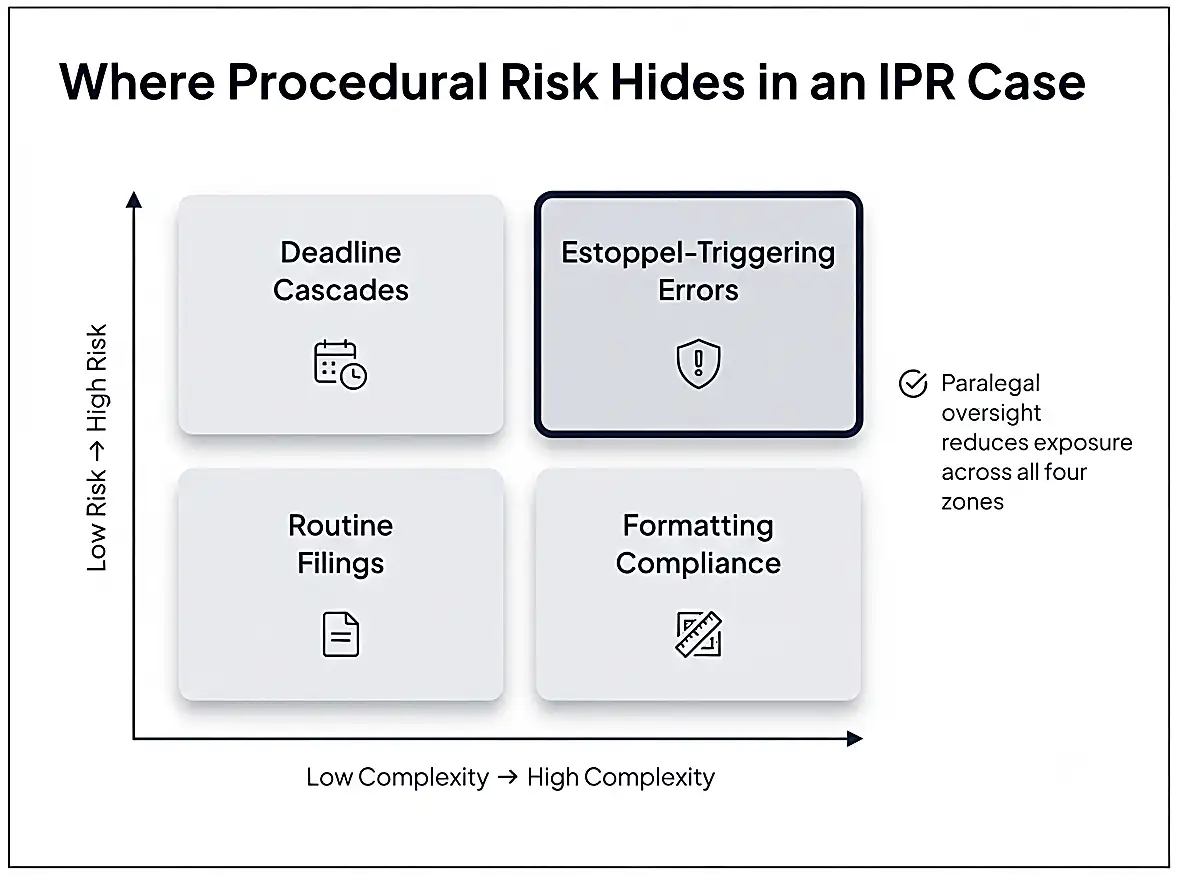
An experienced paralegal absorbs that procedural risk. They are, in effect, the compliance layer of the case team, making sure that:
- Every statutory and Board-ordered deadline is calculated correctly and docketed with reminders.
- Petitions and responses meet PTAB formatting, page-limit, and word-count requirements.
- Exhibits are properly labeled, indexed, and cross-referenced.
- Mandatory notices and real-party-in-interest disclosures are accurate and timely.
- Filings are submitted correctly through the PTAB’s electronic filing system.
Consequently, the paralegal’s role in an Inter Partes Review (IPR) proceeding is not administrative in the narrow sense. It is risk management for the entire case.
Core Responsibilities of a Paralegal in an IPR Proceeding
Six Pillars of IPR Paralegal Support
Docketing & Deadlines
Deadlines tracked per matter: [XX].
Petition & Response Prep
Avg. exhibits per petition: [XX].
Expert Coordination
Declarations managed per case: [XX].
Mandatory Notices
Disclosure accuracy target: 100%.
PTAB E2E Filing
Filing confirmation turnaround: same-day.
Case File Management
Centralized record per matter.
1. Docketing and Deadline Management
The single most important function a paralegal performs in an IPR matter is deadline calculation and docketing. PTAB deadlines cascade: the moment a petition is filed, or an institution decision issues, a chain of subsequent due dates is triggered under 37 C.F.R. § 42.
An experienced paralegal:
- Calendars the petition filing date and all related response windows.
- Tracks the three-month response period after institution.
- Monitors scheduling order deadlines for replies, sur-replies, and motions.
- Sets internal deadlines ahead of the Board’s actual due dates to build in review time.
- Flags conflicts between IPR deadlines and any parallel district court schedule.
Because IPR estoppel provisions under 35 U.S.C. § 315(e) can permanently bar arguments in later litigation, a missed deadline is not simply a scheduling inconvenience. It can foreclose an entire defense theory.
2. Petition and Response Preparation
Paralegals play a hands-on role in assembling the petition or preliminary response itself. This typically includes:
- Formatting the document to PTAB page-limit and typeface requirements.
- Preparing and numbering exhibits in accordance with 37 C.F.R. § 42.63.
- Building the exhibit list and claim charts that map prior art references to challenged claims.
- Cite-checking references against the record to confirm accuracy.
- Coordinating redline and revision cycles between the attorney, technical experts, and outside counsel.
Because IPR petitions rely heavily on precise claim charts and prior art mapping, the paralegal’s attention to formatting consistency often determines whether the Board can easily follow the petitioner’s argument.
3. Managing Expert Declarations and Discovery
Most IPR petitions and responses rely on expert declarations to establish how a person of ordinary skill in the art would understand the challenged claims. Paralegals typically:
- Coordinate scheduling between counsel and technical or industry experts.
- Track declaration drafts, exhibits referenced within them, and signature pages.
- Organize deposition transcripts and exhibits tied to expert testimony.
- Maintain a discovery log for routine and additional discovery requests permitted under PTAB rules.
4. Mandatory Notices and Real-Party-in-Interest Disclosures
IPR petitions require mandatory notices identifying real parties in interest, related matters, and lead and backup counsel. Paralegals are frequently responsible for:
- Preparing and updating mandatory notice filings.
- Tracking any changes in related litigation that must be disclosed to the Board.
- Confirming counsel of record information is current with the PTAB.
Accuracy here matters because incomplete or inaccurate disclosures can draw early scrutiny from the Board and opposing counsel.
5. Electronic Filing Through PTAB E2E
All IPR filings are submitted through the USPTO’s Patent Trial and Appeal Board End to End (PTAB E2E) system. A paralegal typically:
- Prepares final PDF versions of briefs and exhibits that comply with formatting rules.
- Uploads and files documents through PTAB E2E ahead of the filing deadline.
- Confirms filing receipts and archives confirmation records for the case file.
- Serves opposing counsel in accordance with the certificate of service requirements.
6. Case File Organization and Communication
Beyond individual filings, paralegals maintain the overall case file so nothing is lost between stages. This includes:
- Building and maintaining a master exhibit index across the life of the proceeding.
- Organizing correspondence, orders, and Board decisions in a searchable case file.
- Preparing internal status reports so attorneys and clients have visibility into upcoming deadlines.
- Coordinating with foreign associates or co-counsel when a parallel foreign proceeding exists.
IPR Paralegal Responsibilities at a Glance
| Phase of the IPR | Primary Paralegal Task | Why It Matters |
|---|---|---|
| Pre-filing | Prior art organization, claim chart drafting support | Sets the foundation for a defensible petition |
| Petition filing | Formatting, exhibit numbering, PTAB E2E submission | Non-compliant filings risk rejection |
| Preliminary response | Deadline tracking, response formatting | Preliminary response window is fixed at three months |
| Institution decision | Docketing new deadlines triggered by institution | Missing this resets the entire case timeline |
| Discovery and depositions | Scheduling, transcript and exhibit management | Keeps expert testimony organized and citable |
| Oral hearing | Demonstrative exhibit preparation, hearing logistics | Board relies on clean, well-organized demonstratives |
| Final written decision | Docketing appeal deadlines to the Federal Circuit | Appeal windows are short and strictly enforced |
Step-by-Step: How a Paralegal Supports an IPR From Start to Finish
The IPR Paralegal Workflow, Start to Finish
Client Intake & Setup
Prior Art Analysis
Drafting Support & Exhibits
PTAB Portal Upload
Deadline & Docket Sync
Counsel & Expert Coordination
Trial Hearing Prep
Final Decision Archival
- Initial case intake. The paralegal opens the matter, sets up the docket, and confirms the applicable statutory deadlines based on the patent’s issue date and any prior post-grant proceedings.
- Prior art and exhibit organization. Before the petition is drafted, the paralegal helps organize prior art references, technical documents, and file history materials that the attorney and expert will rely on.
- Petition drafting support. The paralegal formats the petition, builds claim charts, numbers exhibits, and cite-checks references against the challenged patent’s claims.
- Filing and service. Once the attorney finalizes the petition, the paralegal files it through PTAB E2E and serves the patent owner in accordance with Board rules.
- Deadline cascade management. After filing, the paralegal calendars every downstream deadline, from the preliminary response window through the institution decision.
- Response and reply coordination. As the case proceeds, the paralegal manages formatting, exhibit updates, and filing logistics for each subsequent brief.
- Hearing preparation. The paralegal assembles demonstrative exhibits and confirms hearing logistics ahead of oral argument before the administrative patent judges.
- Post-decision docketing. After the final written decision issues, the paralegal calendars the appeal deadline to the Court of Appeals for the Federal Circuit, if applicable.
Common Mistakes When Handling IPR Paralegal Support
Common IPR Paralegal Pitfalls
Even experienced teams run into avoidable problems. Some of the most frequent mistakes include:
- Miscalculating the three-month response window. Because IPR deadlines are tied to institution dates rather than fixed calendar dates, manual calculation errors are a recurring risk.
- Inconsistent exhibit numbering. When exhibits are renumbered late in the process without updating cross-references, it creates confusion for the Board and opposing counsel.
- Treating IPR deadlines as flexible. Unlike some district court deadlines, PTAB deadlines are rarely extended absent a strong showing of good cause.
- Underestimating page and word-count limits. Petitions and responses that exceed formatting rules can be rejected outright, costing the case team valuable time.
- Failing to cross-check parallel litigation deadlines. Because most IPRs run alongside district court cases, a paralegal who tracks only the PTAB docket risks missing conflicts with the litigation schedule.
- Waiting too long to loop in support staff. Solo practitioners and junior attorneys sometimes bring in paralegal support only after a filing crunch begins, rather than from the intake stage when it is most valuable.
Expert Tips for Working With an IPR Paralegal
Expert Tips for IPR Paralegal Collaboration
Set Internal Buffer Deadlines
Establish early internal milestones to guarantee review clearance before official PTAB cutoff dates.
Standardize Exhibit Numbering Early
Implement uniform naming conventions across declarations and prior art references from day one.
Involve Paralegals Before Drafting Begins
Integrate support staff early to map out formatting requirements and evidentiary constraints.
Centralize Docketing Access
Maintain a single, synchronized source of truth for all critical dates, filings, and correspondences.
Scale Support With Case Volume
Flexibly expand paralegal resources dynamically to manage peak trial loads without operational strain.
- Build in internal deadlines. Ask your paralegal to set internal due dates several days ahead of the Board’s actual deadline so there is time for a final quality review.
- Standardize your exhibit numbering system early. A consistent naming convention from the first filing avoids costly renumbering later in the case.
- Loop in paralegal support before the petition is drafted, not after. Early involvement allows the paralegal to organize prior art and exhibits in a way that supports efficient drafting.
- Use a shared docketing platform. A centralized system that both counsel and paralegal staff can access reduces the risk of missed updates when a scheduling order changes.
- Lean on outsourced paralegal support for surge capacity. If your firm handles PTAB matters occasionally rather than constantly, an experienced outsourced paralegal team can provide the same procedural discipline as an in-house litigation support department, without the overhead of a full-time hire.
Why Junior Attorneys and Solo Practitioners Benefit Most
Large litigation boutiques often have dedicated PTAB paralegal teams who handle nothing but post-grant proceedings. Junior attorneys at smaller firms, and solo practitioners handling their first IPR matter, rarely have that luxury.
Big-Firm PTAB Bench vs. Solo/Small-Firm Reality
Large Litigation Boutique
Solo Practitioner / Junior Attorney
That gap is precisely where outsourced IP paralegal support adds the most value. A trained IPR paralegal brings:
- Familiarity with PTAB E2E filing requirements and formatting rules.
- Ready-to-use templates for petitions, exhibit lists, and mandatory notices.
- Deadline-calculation experience specific to post-grant proceedings.
- The ability to scale support up or down depending on caseload, without the fixed cost of a full-time hire.
For a solo practitioner or junior attorney building a PTAB practice, this kind of support does not replace legal judgment. It protects the case from the procedural risk that has nothing to do with the merits and everything to do with missed dates or formatting errors.
Frequently Asked Questions
What is the paralegal’s role in an Inter Partes Review (IPR) proceeding?
The paralegal’s role in an Inter Partes Review (IPR) proceeding is to manage the procedural and administrative backbone of the case, including deadline calculation, petition and exhibit formatting, expert declaration coordination, mandatory notice preparation, and filing through PTAB E2E.
Can a paralegal file documents with the PTAB?
Yes. Paralegals routinely handle the mechanical filing of documents through PTAB E2E under attorney supervision, though the substantive legal arguments and strategy remain the attorney’s responsibility.
How long does an IPR proceeding typically take?
From institution to final written decision, an IPR typically concludes within twelve months, with a possible six-month extension for good cause, making accurate docketing essential from day one.
Do solo practitioners need dedicated IPR paralegal support?
Not necessarily on staff, but most benefit significantly from outsourced or contract paralegal support, especially for deadline management and formatting compliance, since a single missed PTAB deadline can be far more costly than the cost of that support.
What happens if an IPR deadline is missed?
Missed deadlines can result in waived arguments, adverse judgment, or in some cases estoppel effects that carry into parallel district court litigation, which is why the paralegal’s docketing function is treated as a critical safeguard rather than a clerical task.
Conclusion
The paralegal’s role in an Inter Partes Review (IPR) proceeding goes well beyond routine administrative support. From the moment a petition is contemplated through the final written decision and any subsequent appeal, a skilled IPR paralegal keeps the deadlines calculated, the exhibits organized, and the filings compliant, so the attorney can focus on the substantive invalidity or patentability arguments that actually win the case.
Build a Deadline-Proof IPR Workflow
For junior attorneys building a PTAB practice, and for solo practitioners who cannot justify a full-time litigation support hire, experienced outsourced paralegal support offers a practical way to bring big-firm procedural discipline to a smaller caseload. If your team is preparing for an upcoming IPR matter, Teak IP Services’ paralegal support team can help you build the docketing, formatting, and filing workflow your case needs from day one.

