
Why Sequence Listing Rules Matter: If your patent application discloses nucleotide (DNA/RNA) or amino acid (protein) sequences, you are legally required to comply with sequence listing rules – a set of international standards governing how biological sequence data must be formatted, submitted, and referenced within a patent application. To ensure full compliance with ST.26 standards across USPTO, EPO, and PCT filings, our sequence listing preparation services help life sciences applicants submit accurate, properly formatted biological sequence data from the outset.

Failure to comply can result in delayed prosecution, costly resubmissions, incomplete prior-art searches, or, in serious cases, refusal of the application itself. With the global transition from the older WIPO Standard ST.25 to the newer ST.26 framework now in full effect, both seasoned patent practitioners and life sciences researchers must stay current with the evolving landscape.
This guide breaks down the key guidelines and regulations covering sequence listing rules – from USPTO to EPO to PCT – so you can file with confidence.
What is a Sequence Listing?
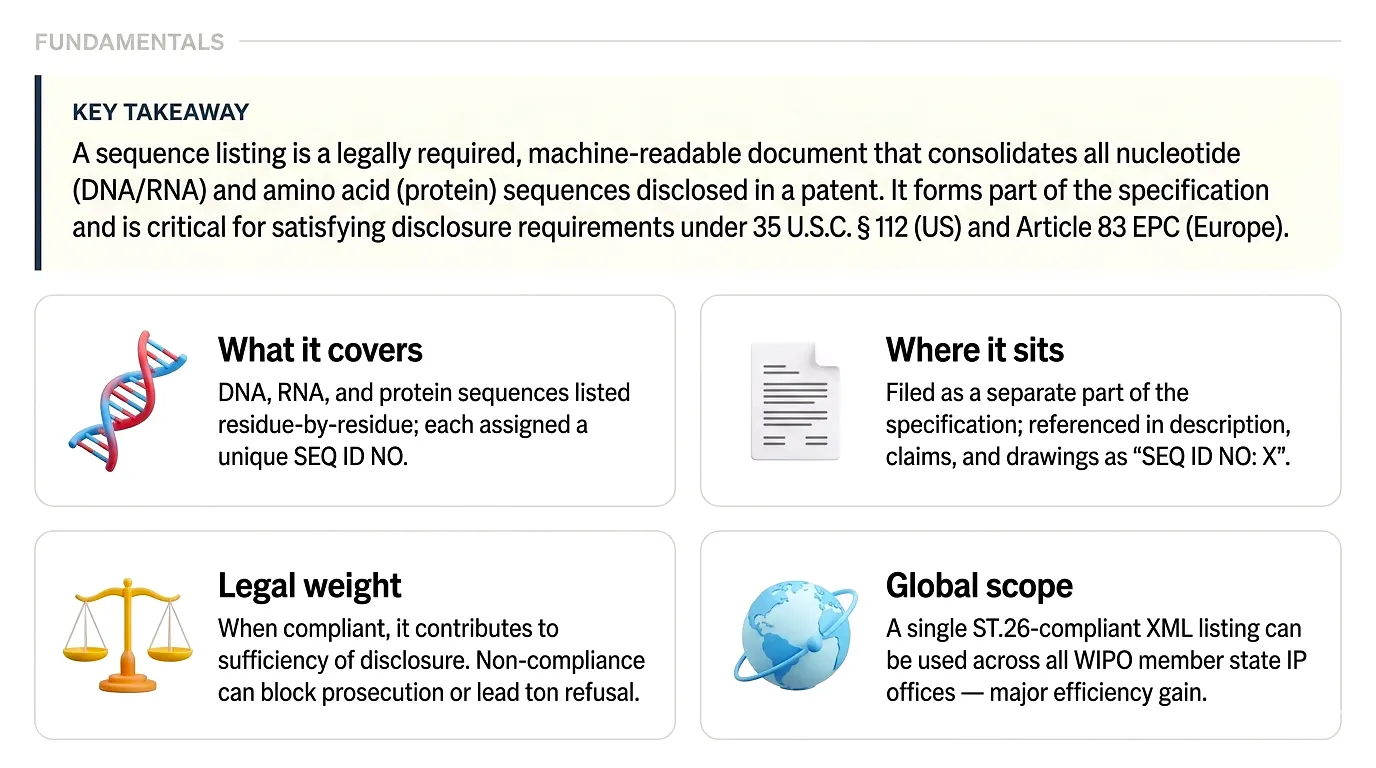
A sequence listing is a standardized document that presents all nucleotide and/or amino acid sequences disclosed in a patent application in a single, machine-readable format. Rather than embedding raw sequence data throughout the description or claims, patent offices require all such sequences to be consolidated in a structured listing.
Key characteristics:
- Covers DNA, RNA, and protein sequences enumerated residue by residue
- Must be submitted as a separate part of the patent specification
- Each sequence is assigned its own SEQ ID NO: identifier
- The listing is referenced throughout the description, claims, and drawings using the format “SEQ ID NO: X”
Important: A sequence listing that is filed in compliance with the applicable rules is considered part of the specification and contributes to disclosure under 35 U.S.C. § 112 (USPTO) and Article 83 EPC (EPO).
Also, Read: A Deep Dive into Patent Drawing Rules & Guidelines
The Two Core International Standards: ST.25 vs. ST.26
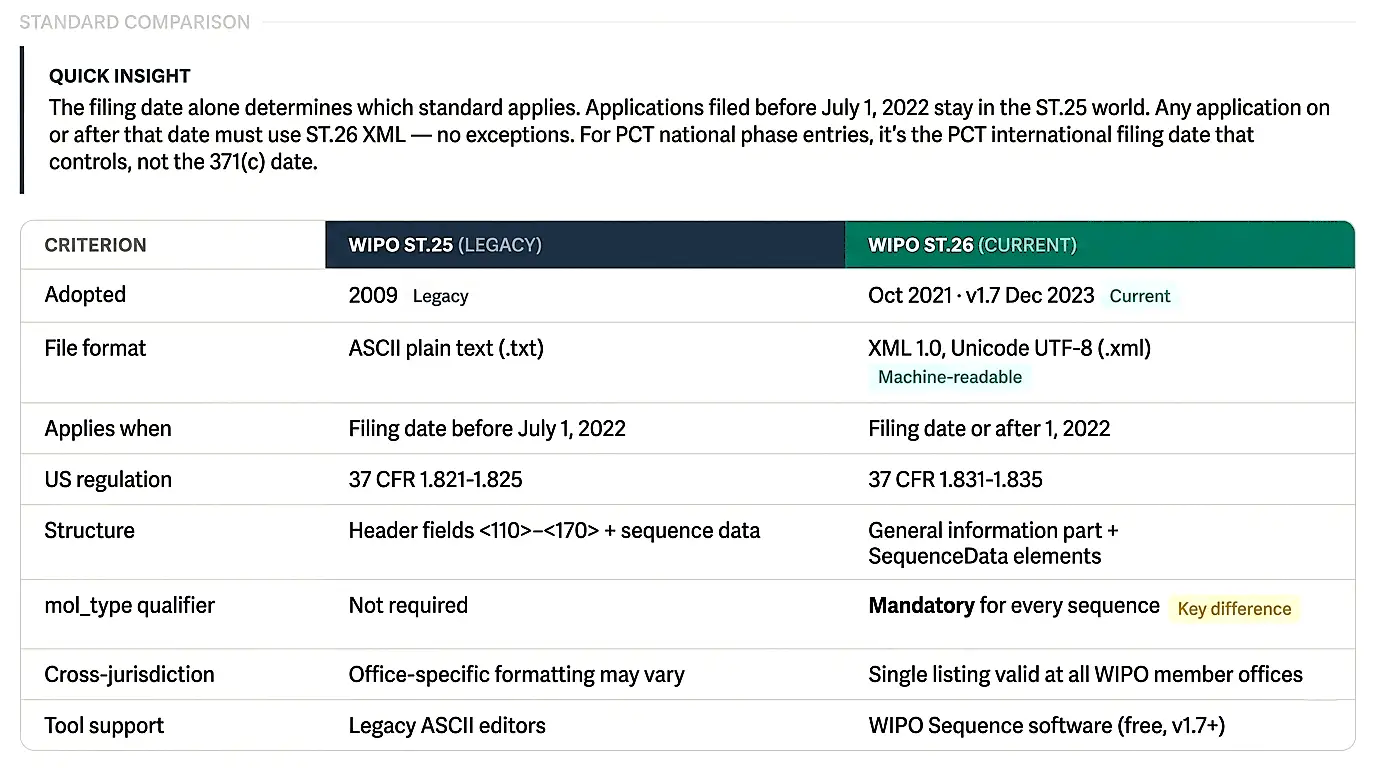
Understanding which standard applies to your application is the single most critical step in sequence listing compliance.
WIPO Standard ST.25 (Legacy Format)
- Adopted: 2009
- Format: ASCII plain text (.txt)
- Applicability: All applications with a filing date before July 1, 2022
- US Regulations: 37 CFR 1.821 – 1.825
- Structure: Header fields (numeric identifiers
<110>through<170>) followed by individual sequence data
Note: ST.25 is no longer applicable to new applications filed from July 1, 2022, onward. However, it remains binding for any application with an international or national filing date before that cutoff.
WIPO Standard ST.26 (Current XML Format)
- Adopted: October 2021; Implemented: July 1, 2022
- Latest Version: v1.7 (adopted by WIPO December 8, 2023; effective at USPTO July 1, 2024)
- Format: eXtensible Markup Language (XML 1.0, Unicode UTF-8)
- Applicability: All applications with a filing date on or after July 1, 2022
- US Regulations: 37 CFR 1.831 – 1.835
- PCT Basis: Annex C of the PCT Administrative Instructions
Key structural components of an ST.26 XML listing:
- General Information Part – bibliographic data (applicant name, inventor, application number, filing date, invention title)
- Sequence Data Part – individual
<SequenceData>elements, each containing one sequence and its associated qualifiers
Also, Read: PCT Filing Through USPTO and CIPO: Complete US and Canadian Applicants Guide
USPTO Sequence Listing Rules: Detailed Guidelines
Applicability and Cutoff Date
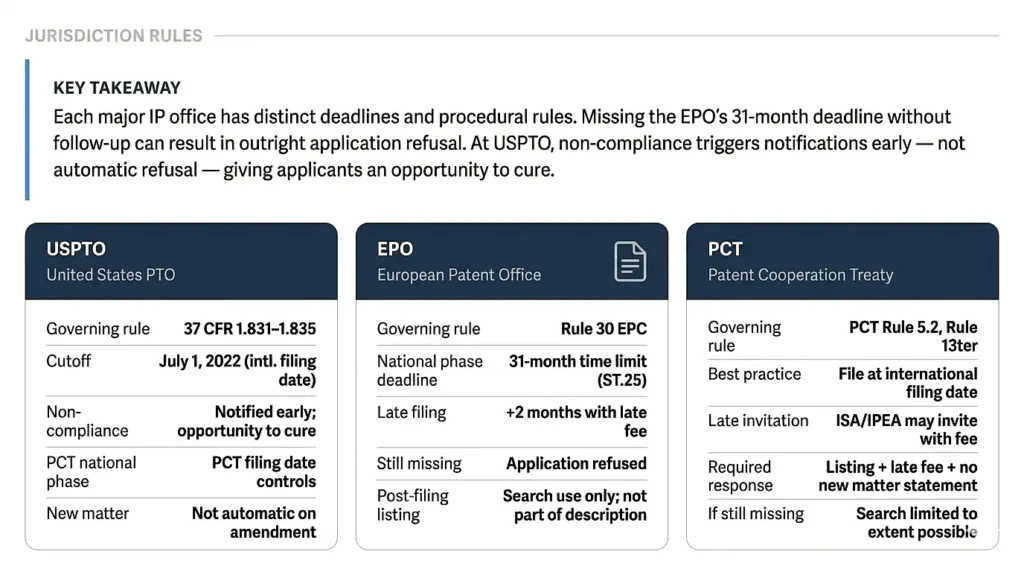
The filing date of the application determines which set of regulations applies:
| Filing Date | Applicable Standard | Governing Regulation |
|---|---|---|
| Before July 1, 2022 | WIPO ST.25 | 37 CFR 1.821–1.825 |
| On or after July 1, 2022 | WIPO ST.26 | 37 CFR 1.831–1.835 |
| PCT (371) national phase | PCT international filing date controls | ST.25 or ST.26 based on PCT filing date |
Critical rule for national phase applicants: For U.S. national phase (35 U.S.C. § 371) applications, the PCT international filing date – not the 371(c) date – determines whether ST.25 or ST.26 applies.
ST.26 Compliance Rules at USPTO (37 CFR 1.831–1.835)
Identify qualifying sequences
Flag all nucleotide sequences with ≥ 10 specifically defined residues and amino acid sequences with ≥ 4 specifically defined residues. Include variants, subsequences, D-amino acids, and modified amino acids independently enumerated.
Confirm applicable standard
Check the filing date or PCT international filing date. On/after July 1, 2022 → ST.26 XML required. Before July 1, 2022 → ST.25 ASCII text. For 371 national phase, PCT filing date – not the 371(c) date – controls.
Generate XML using WIPO Sequence (v1.7+)
Use the latest free WIPO Sequence tool. If converting from ST.25, import the valid ASCII listing, then add all ST.26-only required fields – particularly mol_type – before generating the XML.
Validate file and qualifiers
Confirm: XML 1.0 encoding, UTF-8, DTD-compliant. Verify that each sequence has mol_type and a valid organism qualifier (single Latin genus/species, virus name, “unidentified,” or “synthetic construct” only).
Add incorporation-by-reference statement
Include the required statement in the specification that incorporates the XML file by reference. All sequences must be referred to as “SEQ ID NO: X” throughout the description, claims, and drawings.
File with the international application
Submit the ST.26 XML on the international filing date. For PCT filings, this is strongly preferred over waiting for an ISA invitation, which incurs late fees and search limitations.
37 CFR 1.831 – Scope and Definitions
- Defines what constitutes a “sequence” for listing purposes
- Sequences must be enumerated residue by residue
- Applies to nucleotide sequences of 10 or more specifically defined residues; amino acid sequences of 4 or more specifically defined residues
- “Specifically defined” = any residue other than “n” (nucleotide) or “X” (amino acid)
Key requirements under ST.26:
- Single XML file: The ST.26 listing must be presented as a single XML 1.0 file
- Encoding: Unicode UTF-8 required
- DTD compliance: Must conform to the WIPO ST.26 Document Type Definition (DTD) in Annex II
- Unique SEQ ID numbers: Every sequence meeting the length threshold must receive its own SEQ ID NO – including subsequences enumerated separately
- Mol_type qualifier: Mandatory for each sequence (not required in ST.25 – a critical difference during ST.25-to-ST.26 conversion)
- Organism qualifier: Must contain a single Latin genus/species name, virus name, “unidentified,” or “synthetic construct” – not strains or subspecies (those go in separate qualifier fields)
What sequences must be included:
- All nucleotide or amino acid sequences that meet the length and specificity thresholds, whether or not they appear elsewhere in the description or claims
- D-amino acids, modified amino acids, and linear portions of branched sequences
- Variant sequences disclosed by enumeration of residues – each must receive its own SEQ ID NO
- Subsequences, if independently enumerated
Filing Mechanics and Compliance Tips (USPTO)
Helpful compliance notes from the USPTO:
- Compliance with sequence listing rules is not required merely to establish a filing date
- Failure to submit a compliant listing is not per se a “new matter” issue
- A PCT-transmitted ST.26 listing entering national phase does not require a new incorporation-by-reference statement or new-matter statement
- Bibliographic data (e.g., application number) in a PCT-transmitted listing does not need to be amended for the 371 application number
- If an ST.25 ASCII text file is erroneously submitted where ST.26 XML is required, the USPTO will notify the applicant of the deficiency
Converting from ST.25 to ST.26:
- The WIPO Sequence software tool (free download from WIPO) supports import of valid ST.25 listings and conversion to an ST.26 project
- The imported ST.25 file must be fully valid – importing a non-compliant ST.25 listing may result in data loss
- After import, you must add mandatory elements absent from ST.25 (e.g.,
mol_typequalifiers) before generating the final XML
Amendments to Sequence Listings
Adding or replacing a sequence listing (37 CFR 1.835):
- Amendments that add to, delete from, or replace sequence information require a new, complete listing – partial updates are not accepted
- Amendments must be accompanied by a statement confirming no new matter has been introduced
- SEQ ID numbers and sequence count must be consistent with the original disclosure
- An incorporated-by-reference statement for the XML file must be present in the specification
EPO Sequence Listing Rules: Key Regulations
Applicable Framework
The European Patent Office (EPO) follows the same WIPO ST.26 standard for applications with an international or European filing date on or after July 1, 2022. Earlier applications remain subject to ST.25.
Governing provisions:
- Rule 30 EPC – requirements for sequence listings
- PCT Rule 5.2, Rule 13ter – sequence listings in international applications
- Administrative Instructions Annex C (PCT applications)
EPO-Specific Requirements
At the filing stage:
- The sequence listing must be filed as part of the description
- If filed after the filing date, it does not form part of the description and is used for search purposes only
- A statement must accompany any later-filed listing confirming it introduces no new matter beyond the original application
In Euro-PCT national phase (31-month deadline):
- For applications filed before July 1, 2022 (ST.25): the sequence listing in TXT format must be available to the EPO by the expiry of the 31-month time limit
- If not available at that point, the EPO will invite the applicant to submit it with payment of a late-furnishing fee within two months
- If the listing is still not submitted within that extended period, the application will be refused
- Refusal may be remedied through a request for further processing
Key EPO compliance points:
- A sequence listing submitted after the filing date and not forming part of the description cannot be used to determine originally disclosed content
- Corrections to a listing forming part of the description must comply with Rule 139 EPC and Art. 123(2) EPC, and require a complete new listing file
- The EPO does not examine a subsequently filed standardised listing for compliance with Art. 123(2) since it is not part of the description
PCT Sequence Listing Rules
For international applications filed under the Patent Cooperation Treaty:
- PCT Rule 5.2 requires the description to include a sequence listing complying with Annex C of the Administrative Instructions (i.e., WIPO ST.26 for filings on or after July 1, 2022)
- The sequence listing must be submitted with the international application at filing – waiting for an invitation from the International Searching Authority (ISA) introduces risk
- If a listing is not provided and the USPTO acts as ISA/IPEA, it may invite the applicant to furnish one under PCT Rule 13ter, accompanied by a late-furnishing fee
- A proper response to such an invitation must include: (1) the ST.26-compliant XML listing, (2) the required late fee (37 CFR 1.445(a)(5)), and (3) a statement that the listing does not go beyond the disclosure of the application as filed
- If no compliant listing is furnished within the time limit, the ISA/IPEA will search or examine only to the extent possible without the sequence listing
Best practice: Always file the ST.26 XML listing together with the PCT international application on the international filing date. A single ST.26-compliant listing can be used across all WIPO member state IP offices.
WIPO ST.26 Version 1.7: July 2024 Updates
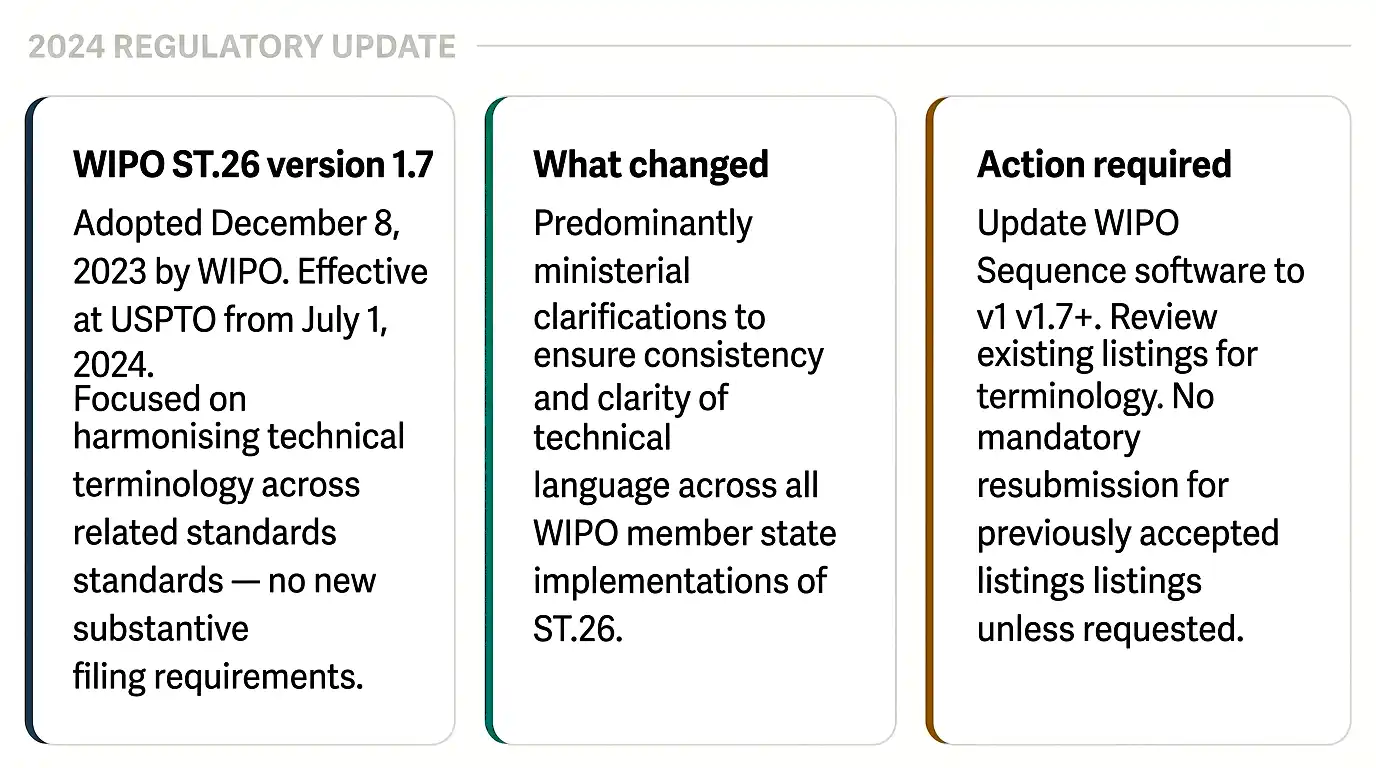
On December 8, 2023, WIPO adopted version 1.7 of Standard ST.26. The USPTO finalized adoption effective July 1, 2024.
Nature of the changes:
- Predominantly ministerial/procedural — no new substantive requirements for filers
- Focused on ensuring consistency and clarity of technical terminology across related documents
- Aimed at harmonizing technical language across all WIPO member state implementations
What applicants should do:
- Review existing sequence listings for compliance with updated terminology and formatting
- Ensure the WIPO Sequence software is updated to the latest version before generating new ST.26 XML files
- No resubmission is required for listings already accepted under prior ST.26 versions unless specifically requested by the office
Common Compliance Mistakes to Avoid
Formatting errors:
- Submitting ST.25 ASCII text when ST.26 XML is required (based on filing date)
- Using encoding other than UTF-8 in the XML file
- Failing to include the
mol_typequalifier (mandatory in ST.26 but absent in ST.25)
Content errors:
- Omitting subsequences that were independently enumerated in the disclosure
- Listing more than one organism in the “organism” qualifier field
- Including the same sequence multiple times with separate SEQ ID NOs without necessity (creates confusion if different IDs reference the same sequence)
- Using shorthand for repeated residues (each residue must be individually enumerated unless a shorthand formula is expressly recognized under Annex VI of ST.26)
Procedural errors:
- Missing the 31-month EPO deadline without requesting further processing
- Failing to include a new-matter statement with a later-filed or amended listing
- Using PCT-SAFE software (discontinued as of July 2022) to generate PCT Request Forms – use ePCT instead
Quick Reference: Sequence Listing Rules Checklist
Use the following checklist before filing any patent application with biological sequence disclosures:
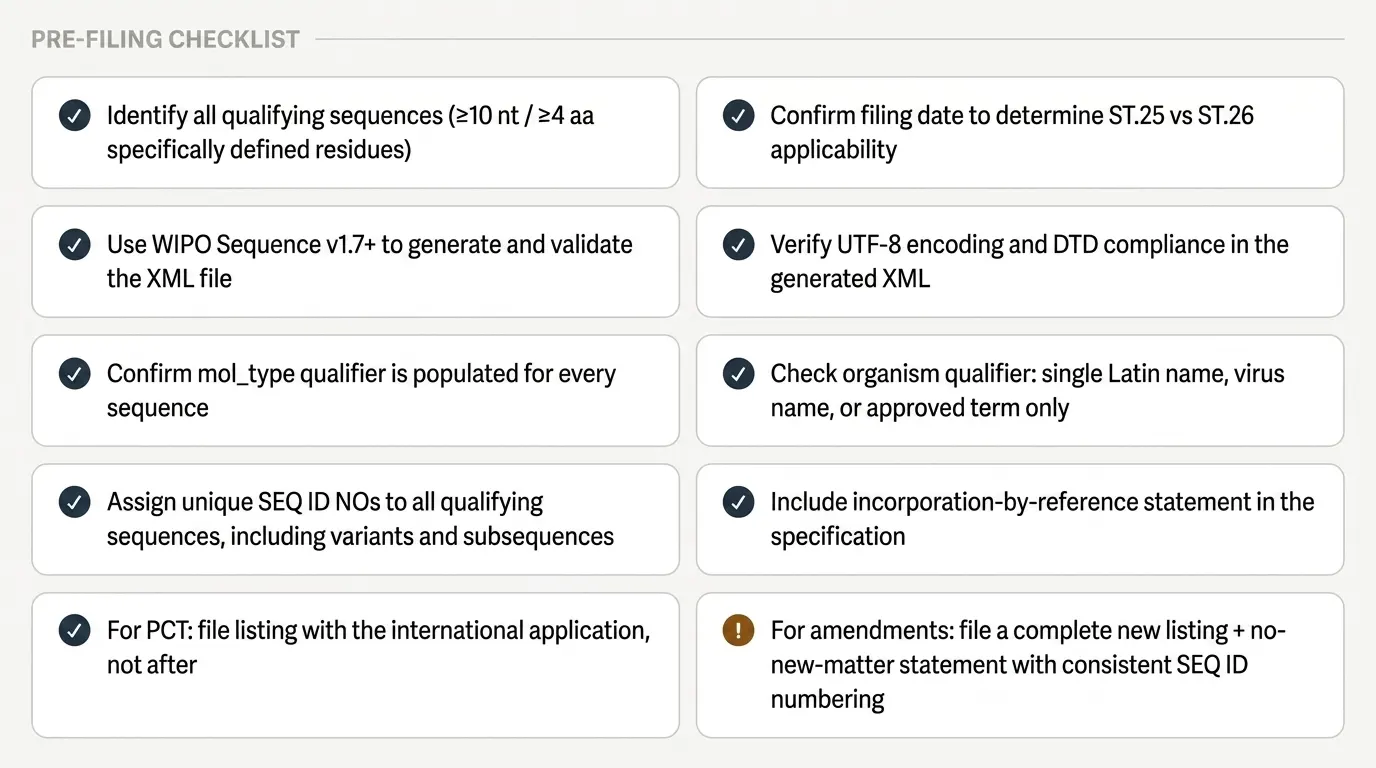
Before Filing:
- Identify all sequences meeting ST.26 length thresholds (nucleotides ≥ 10 specifically defined residues; amino acids ≥ 4)
- Confirm filing date to determine applicable standard (ST.25 or ST.26)
- Generate listing using current WIPO Sequence software (v1.7 or later)
- Verify XML encoding (UTF-8), DTD compliance, and file format
- Ensure
mol_typeandorganismqualifiers are correctly populated for each sequence - Assign unique SEQ ID NOs to all qualifying sequences, including variants and subsequences
- Include incorporation-by-reference statement in the specification for the XML file
For PCT Applications:
- File ST.26 XML listing together with the international application
- Confirm that the listing is included in the description under PCT Rule 5.2
For Amendments:
- File a complete new listing, not a partial update
- Include a statement that no new matter has been introduced
- Ensure SEQ ID numbering is consistent with the original disclosure
Conclusion
The transition from WIPO ST.25 to ST.26 represents a significant modernization of sequence listing rules – moving from plain-text ASCII to structured XML to improve global consistency, data accessibility, and machine readability. For life sciences patent practitioners, understanding the precise regulations at the USPTO, EPO, and PCT level is essential to keeping applications on track.
Whether you are preparing a fresh biotechnology patent, converting an older ST.25 listing, or entering the national phase of a PCT application, adherence to the correct sequence listing rules is non-negotiable. A small procedural error can translate into significant delays and costs.
At Teak IP Services, our team specializes in supporting patent applicants through the complex technicalities of sequence listing preparation and compliance – ensuring your biological innovations receive the protection they deserve.
Our Service: View Full Sequence Listing Services Details

