
A client picks a brand name in a conference room, files the application the same week, and receives a cease-and-desist letter four months later. The rebrand that follows costs far more than the search that would have caught the conflict in the first place. That single scenario explains why every junior attorney, solo practitioner, and in-house counsel needs a clear answer to one question: what does a pre-filing trademark clearance search involve?

A pre-filing trademark clearance search is the structured process of checking a proposed mark against existing federal registrations, state filings, common law uses, and online presence before an application ever reaches the United States Patent and Trademark Office (USPTO). Done correctly, it protects the client from refusal, opposition, and costly rebranding later. Done poorly, or skipped entirely, it exposes both the client and the filing attorney to real risk.
This guide walks through exactly what a thorough clearance search covers, the tools and databases involved, common mistakes that even experienced filers make, and what the process typically costs in the United States today. It also outlines how a firm can build this process into a repeatable, delegable workflow rather than reinventing it for every new matter.
What is a Pre-Filing Trademark Clearance Search?
A pre-filing trademark clearance search, sometimes called a trademark availability search, is a review conducted before submitting a trademark application. Its purpose is to determine whether a proposed mark is available for use and registration, or whether it conflicts with an existing mark in a way that could block registration or trigger a legal dispute.
Section 2(d) refusal for similarity
30-day publication challenge window
Materials, packaging & domains redone
Skipped due diligence, firm liability
In short, a clearance search answers two distinct questions:
- Registrability: Can this mark actually be registered with the USPTO, or will it be refused for similarity to an existing mark?
- Freedom to use: Can the client use this mark commercially without infringing on someone else’s rights, even if that party never filed a federal application?
These two questions are related but not identical, and a search limited to only one of them leaves a gap. A mark can clear the federal register and still infringe on a strong common law user in a specific region. Understanding this distinction is the foundation of everything that follows.
Why Does a Pre-Filing Trademark Clearance Search Matter?
Skipping or rushing a clearance search creates downstream problems that are almost always more expensive than the search itself. Consider the practical stakes:
- Office Action risk: The USPTO examining attorney runs their own search. If they find a confusingly similar registered mark, they issue a Section 2(d) likelihood-of-confusion refusal, which can take months and additional fees to overcome, if it can be overcome at all.
- Opposition risk: Even a mark that clears examination can be opposed during the 30-day publication window by a third party who believes it conflicts with their rights.
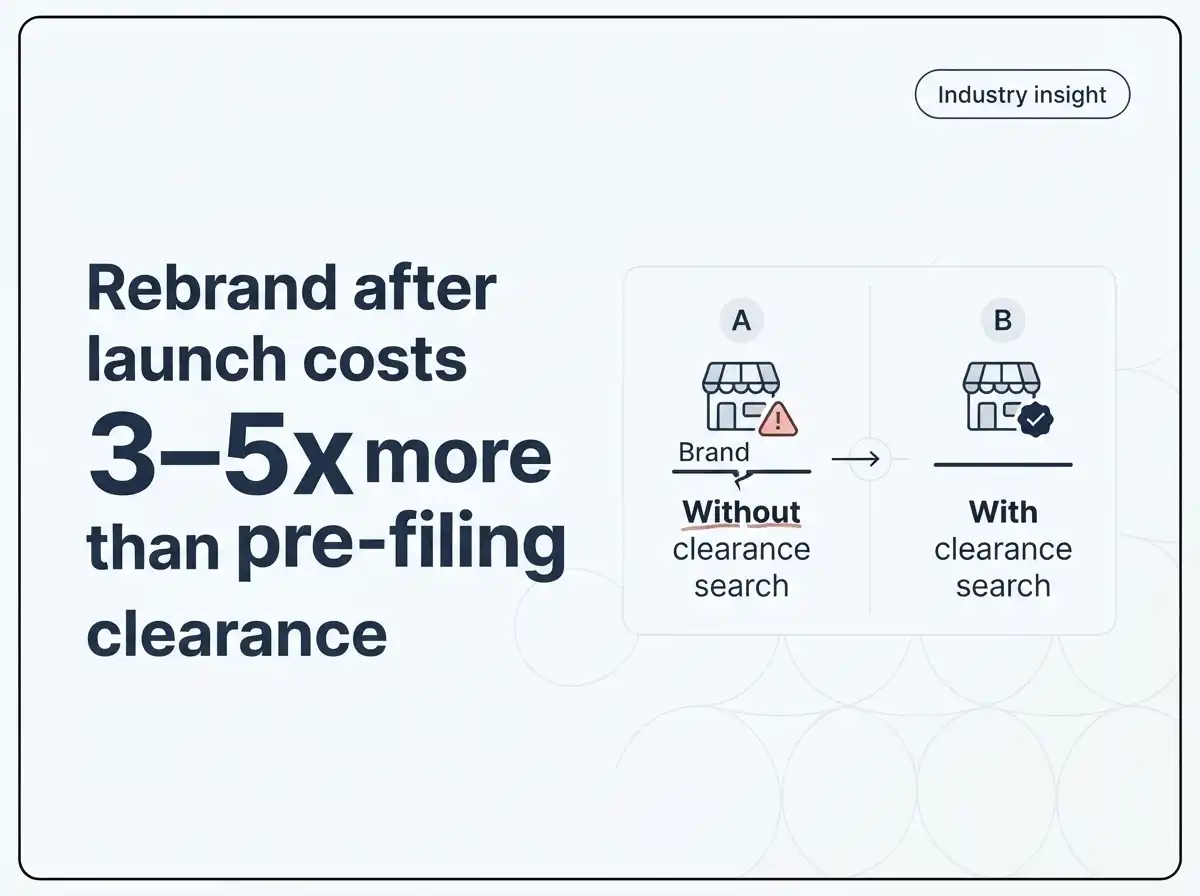
- Rebrand cost: If a conflict surfaces after launch, marketing materials, packaging, domain names, and signage may all need to change, on top of the original filing fees already spent.
- Malpractice exposure: For law firms, failing to conduct a reasonable clearance search before filing or advising a client to proceed can raise professional liability concerns.
An experienced trademark attorney generally treats the clearance search as a non-negotiable first step, not an optional add-on. It shapes whether the firm even recommends filing, and if so, in which classes and with what disclaimers.
What Does a Pre-Filing Trademark Clearance Search Involve? A Step-by-Step Breakdown
Here is the core answer to what does a pre-filing trademark clearance search involve, broken into the sequence most trademark practices follow.
Step 1: The Preliminary Knockout Search
The knockout search is a fast, low-cost first pass designed to catch obvious conflicts before investing time in a full search. It typically takes less than an hour and includes:
- A direct search of the proposed mark on the USPTO’s Trademark Search System (TMSS, formerly TESS).
- A general internet search of the exact mark name plus close variations.
- A quick domain availability check for the primary top-level domains relevant to the business.
If the knockout search reveals an identical or near-identical mark already registered in the same or a closely related class, the client can pivot to a new name early, before spending money on a comprehensive search or an application.
Step 2: The Comprehensive Federal Trademark Search
If the mark survives the knockout stage, the next step is a comprehensive federal search. This goes beyond an exact-match query and includes:
- Phonetic equivalents: Marks that sound alike even if spelled differently (for example, “Kwik” versus “Quick”).
- Visual and structural similarity: Marks that look alike in stylization, layout, or design elements for logo marks.
- Translation equivalents: Under the doctrine of foreign equivalents, a mark’s meaning in another language can create a conflict with an English-language mark of similar meaning.
- Root and stem variations: Searching common prefixes, suffixes, and word fragments that examiners often flag.
- Related and adjacent Nice classification classes: Not just the client’s intended class, but classes covering related goods or services where confusion is plausible.
This stage typically draws on the USPTO’s own search tools, along with commercial trademark search platforms that aggregate federal, state, and international registration data in a single report.
Step 3: State Trademark Register Search
Federal registration is not the only source of trademark rights in the United States. Many businesses register only at the state level, particularly smaller companies operating in a single state. A thorough clearance search checks state trademark databases in states where the client currently operates or plans to expand, since a state registration can still create a regional conflict even without federal protection.
Step 4: Common Law Search
Common law rights arise automatically through actual use in commerce, with or without any registration. This is often the most overlooked part of a clearance search, and also the hardest to search comprehensively. A common law search typically covers:
- Business name and entity registries by state
- Industry directories and trade publications
- Social media handles and business listing platforms
- General web search results for the mark combined with relevant industry terms
- Trade show exhibitor lists and industry association member directories, where relevant
Common law users can have priority rights in their specific geographic market even without ever filing an application, which is why this step cannot be skipped for a truly defensible clearance opinion.
Step 5: Domain Name and Social Media Availability Check
While domain and handle availability is not a legal clearance factor on its own, it is a practical business consideration most clients care about immediately. This step checks:
- Availability of the primary domain extensions (.com, and relevant country-code domains for target markets)
- Availability of consistent handles across major social platforms
- Whether an existing website or account under a similar name suggests active, unregistered common law use
Step 6: International Search (When Relevant)
For clients planning to expand internationally, or for businesses already operating abroad, the search should extend to the relevant foreign jurisdictions or to the Madrid System through the World Intellectual Property Organization (WIPO). This step is scoped based on the client’s actual and planned markets, not run by default for every domestic filing.
Step 7: Likelihood-of-Confusion Analysis
Once the raw search data is gathered, a trademark attorney analyzes it against the factors the USPTO and courts use to assess likelihood of confusion, commonly derived from the In re E.I. du Pont de Nemours & Co. framework. Key factors include:
- Similarity of the marks in sound, appearance, and meaning
- Relatedness of the goods or services
- Similarity of trade channels and customer bases
- Strength of the potentially conflicting mark
- Evidence of actual confusion, if any exists
This analysis is where the human judgment of an attorney, not just database output, determines the real risk level.
Step 8: Written Clearance Opinion
The final deliverable is typically a written opinion letter or search summary memo that documents:
- The scope of the search performed
- Marks identified as potential conflicts
- The attorney’s risk assessment for each identified conflict
- A recommendation: proceed as-is, proceed with modification, or select a new mark
This document also serves as a record of due diligence, which matters if the mark is ever challenged later.
Who Should Conduct a Pre-Filing Trademark Clearance Search?
Free USPTO tools
Rules out obvious conflicts
Organizes results by class
Flags close matches for review
Runs likelihood-of-confusion test
Only licensed role for sign-off
Clients sometimes ask whether they can run this process themselves. The honest answer depends on the stakes involved.
- Business owners and founders can reasonably run an initial knockout search on their own using the USPTO’s free tools, mainly to rule out obvious conflicts before spending money on legal review.
- Paralegals and trademark search specialists are typically the ones who gather the comprehensive data: pulling federal, state, and common law results, organizing them by class, and flagging anything that looks close enough to warrant attorney attention.
- Licensed trademark attorneys are the only ones who should issue the final legal opinion, since the likelihood-of-confusion analysis requires legal judgment, not just database output.
This division of labor is exactly why many firms outsource the data-gathering stage to a dedicated paralegal team. It frees attorney time for the analysis that actually requires a law license, while still keeping the final opinion under direct attorney oversight. It also creates a consistent, repeatable process instead of one that varies depending on which associate happens to run the search that week.
Documentation and Recordkeeping for Clearance Searches
A clearance search is only as useful as the record it leaves behind. Best practice is to retain, for every mark searched:
- The full search report, including the databases and date ranges queried
- A list of every potentially conflicting mark identified, even ones ultimately deemed low-risk
- The attorney’s written risk assessment and final recommendation
- The date the search was performed, since trademark databases change daily
This record matters for two practical reasons. First, if a dispute ever arises, it demonstrates that reasonable due diligence was performed before filing, which can matter for both the client’s litigation posture and the firm’s own risk management. Second, it gives the firm a reusable reference if the client later expands into new classes or new markets and needs a follow-up search rather than starting from zero.
When to Repeat or Update a Clearance Search
A clearance search is a snapshot in time, not a permanent guarantee. Several situations call for repeating or updating the search even after an initial clearance opinion was issued:
- Significant time has passed. New applications are filed with the USPTO every business day, so a search that is several months old may no longer reflect the current register.
- The client expands into new goods or services. A mark cleared for one class does not automatically clear for an unrelated class the business later decides to enter.
- The client expands into new geographic markets. Entering a new state or country reintroduces the common law and, where relevant, international search steps.
- The mark itself changes. Even a minor change to spelling, logo design, or tagline can shift the likelihood-of-confusion analysis enough to warrant a fresh look.
Building a habit of a light refresh search immediately before filing, rather than relying solely on a search performed weeks earlier, closes the gap between when the clearance work was done and when the application actually goes in.
What a Pre-Filing Clearance Search Covers: Quick Reference Table
USPTO register
State registers
Unregistered use
Web & handles
WIPO Madrid
Risk analysis
| Component | Why It Matters |
|---|---|
| Common law | Reveals prior regional users with no federal filing on record |
| Phonetic match | Catches sound-alike marks a text-only search misses |
| Search Component | What It Covers | Why It Matters |
|---|---|---|
| Federal trademark database | Registered and pending marks with the USPTO | Identifies direct conflicts that could trigger a Section 2(d) refusal |
| State trademark registers | State-level registrations | Catches regional rights not visible in federal-only searches |
| Common law search | Unregistered business and brand use | Reveals prior users with enforceable regional rights |
| Domain and social media | Website and handle availability | Flags active unregistered use and practical branding conflicts |
| International registers | Foreign national and Madrid System filings | Relevant for clients with global expansion plans |
| Likelihood-of-confusion analysis | Attorney assessment against legal factors | Translates raw search hits into an actionable risk rating |
Knockout Search vs. Comprehensive Search vs. Full Clearance Opinion
Clients and even some junior associates often use “trademark search” as a catch-all term, but these three service levels differ significantly in scope, cost, and reliability.
24 hrs · $0–$300
Exact & near-exact hits
3–5 days · $300–$1,000
Federal + state + phonetic
5–10 days · $1,000–$3,500+
+ common law + legal analysis
| Feature | Knockout | Comprehensive | Full Opinion |
|---|---|---|---|
| Output | Informal summary | Detailed report | Written opinion letter |
| Best for | Early brainstorm | Pre-filing check | High-value marks |
| Feature | Knockout Search | Comprehensive Search | Full Clearance Opinion |
|---|---|---|---|
| Typical turnaround | Same day to 24 hours | 3–5 business days | 5–10 business days |
| Scope | Exact and near-exact federal matches | Federal, state, phonetic, and design variations | All of the above plus common law, domain, and legal analysis |
| Output | Informal summary | Detailed search report | Formal written opinion letter |
| Best used for | Early-stage brainstorming | Pre-application confirmation | High-value marks, litigation risk, or investor due diligence |
| Typical cost range | $0–$300 | $300–$1,000 | $1,000–$3,500+ |
Common Mistakes in Pre-Filing Trademark Clearance Searches
Even experienced filers fall into predictable traps. Watch for these:
- Searching only the exact mark. Examiners and courts weigh phonetic and visual similarity heavily, so an exact-match-only search misses real risk.
- Ignoring related classes. A mark cleared in Class 25 (clothing) might still conflict with a registration in Class 35 (retail services) if the goods and channels overlap.
- Skipping the common law check. Federal-only searches routinely miss regional businesses that hold enforceable prior rights.
- Treating domain availability as legal clearance. A free domain name does not mean the mark is free of trademark risk.
- Filing before the opinion is finalized. Under deadline pressure, some filers submit the application while the search is still in progress, defeating the purpose of clearing first.
- Not documenting the search. An undocumented search provides no record of due diligence if a dispute arises later.
Expert Tips for a Thorough Pre-Filing Clearance Search
- Start the knockout search before the client falls in love with the name, not after.
- Widen the class search to cover goods and services a reasonable examiner would consider related, not just the client’s exact offering.
- Always run the doctrine-of-foreign-equivalents check for marks with any non-English meaning.
- Build a standard search template so paralegal staff can consistently gather raw data before attorney review, keeping attorney time focused on judgment calls rather than data collection.
- Re-run a lighter knockout search immediately before filing if more than a few weeks have passed since the comprehensive search, since new applications are filed daily.
- Keep every search report and opinion letter in the client file as part of standard risk management practice.
How Much Does a Pre-Filing Trademark Clearance Search Cost in the United States?
Pricing for trademark clearance work varies widely across the U.S. market depending on the provider, the scope of the search, and whether the work is performed in-house, by outside counsel, or outsourced to a paralegal support provider. Based on general industry patterns:
- DIY searches using free USPTO tools cost nothing directly but carry the highest risk of missed conflicts, since they rely entirely on the searcher’s own skill and time.
- Basic knockout searches from law firms or online legal services generally run from free to around $300.
- Comprehensive search reports from commercial search vendors typically range from $300 to $1,000, depending on the number of classes and jurisdictions covered.
- Full attorney-reviewed clearance opinions, including a written legal analysis, commonly range from $1,000 to $3,500 or more, particularly for marks tied to significant investment, franchising, or international expansion.
- Attorney hourly rates for trademark clearance work in the U.S. generally fall between $200 and $600 per hour, depending on firm size, market, and attorney seniority, with the total cost driven by how many hours the search and analysis require.
These figures reflect the general U.S. market and may vary depending on the geographic region, complexity of the mark, and the number of classes and jurisdictions involved. For additional budgeting context, read our guide on evaluating and comparing IP outsourcing companies, which explains the key pricing and vendor-selection factors to consider when outsourcing trademark search and clearance work.
How Teak IP Services Supports Pre-Filing Trademark Clearance Work
Pay per service, zero minimums
U.S. contact, offshore efficiency
Search, docketing, deadlines
For firms and in-house teams that need clearance searches handled efficiently without adding full-time headcount, Teak IP Services structures its trademark paralegal support around a few core principles.
Flexible, à la carte pricing. The à la carte model puts firms in complete control of their IP services spend. Clients pay only for the specific search, report, or paralegal task they need, with no minimum commitments, which makes it practical to order a single comprehensive search or a full ongoing clearance and docketing relationship, whichever fits the matter.
U.S. and India IP experts, working together. Clients talk to a paralegal in the U.S. during their own business hours while benefiting from offshore resources for the detailed data-gathering work. Lower-cost experts in India combine with experienced IP attorneys and paralegals in the U.S. to deliver faster turnaround times, competitive rates, and consistent quality, rather than forcing a choice between speed and cost.
Full-scope paralegal support beyond the search itself. The paralegal team handles the tasks that surround a clearance search and the resulting filing, including reporting, letter drafting, docketing, and deadline tracking for both foreign and domestic IP prosecution. Support is available on a full-time equivalent basis for firms with steady volume, or as an à la carte service for firms that only need occasional help. Either way, the goal is to function as an extended team that reflects the client’s own organizational standards, not a detached outside vendor.
For firms weighing whether to build this capability internally or outsource it, our guides on IP support services for boutique IP law firms and trademark paralegal services for law firms explore these same trade-offs in greater depth.
Building the Clearance Search Into a Repeatable Firm Workflow
For a solo practitioner or a small firm handling a steady stream of new trademark clients, treating each clearance search as a one-off project wastes time and invites inconsistency. A more efficient approach is to standardize the process:
- Create a fixed intake checklist that captures the proposed mark, the intended goods or services, target geographic markets, and any known competitors before the search begins.
- Assign the data-gathering stage to a trained paralegal using a consistent search template, so every matter receives the same baseline coverage regardless of who handles it.
- Reserve attorney time for the analysis stage, reviewing the paralegal’s findings and applying the likelihood-of-confusion factors rather than re-running raw searches from scratch.
- Store every report and opinion in a searchable client file system, so future filings for the same client can reference prior clearance work instead of starting over.
- Set a policy for refresh searches, such as automatically re-running a knockout search if more than 30 days pass between the original clearance opinion and the actual filing date.
This kind of workflow is exactly where outsourced paralegal support tends to deliver the most value. It turns a process that could otherwise consume several attorney hours per matter into a predictable, delegable task, while keeping the final legal judgment where it belongs.
Frequently Asked Questions
What does a pre-filing trademark clearance search involve, in one sentence?
It involves checking a proposed mark against federal, state, and common law sources, along with domain and social media availability, then having an attorney analyze the results for likelihood of confusion before filing.
How long does a pre-filing trademark clearance search take?
A knockout search can be completed same-day, a comprehensive search generally takes three to five business days, and a full written clearance opinion usually takes five to ten business days depending on complexity.
Is a knockout search enough before filing?
Not usually. A knockout search is a fast first filter, but it typically misses phonetic variations, related classes, and common law users, all of which can still block registration or trigger a dispute.
Do I need a common law search if my mark is already clear on the federal register?
Yes. Common law rights exist independently of federal registration, and a regional business using a similar mark can still have enforceable priority rights in its market even without ever filing an application.
Who typically performs a pre-filing trademark clearance search?
The raw data-gathering is often handled by a trained paralegal using commercial search tools, while the legal risk analysis and final opinion are provided by a licensed trademark attorney.
How much does a comprehensive trademark clearance search cost?
In the U.S. market, comprehensive search reports generally range from $300 to $1,000, while a full attorney-reviewed clearance opinion typically runs from $1,000 to $3,500 or more, depending on scope.
Can a mark pass a clearance search and still get refused by the USPTO?
Yes. A clearance search reduces risk but cannot guarantee an outcome, since the USPTO examining attorney applies independent judgment and newly filed applications may not yet appear in search results at the time the clearance work was performed.
What happens after a clearance search comes back clean?
Once the search and legal analysis show acceptable risk, the attorney typically moves forward with preparing and filing the actual trademark application, selecting the correct classes and filing basis based on the client’s current or intended use.
Conclusion
So, what does a pre-filing trademark clearance search involve? It involves far more than typing a name into a single database and checking for an exact match. A defensible search moves through a knockout check, a comprehensive federal and state review, a common law search, domain and social media verification, and, for marks with real commercial stakes, an international review and a formal attorney opinion. Skipping any one of these steps leaves a gap that can surface later as an Office Action, an opposition, or a costly rebrand.
For a junior attorney or solo practitioner building a repeatable filing process, or for a firm that wants this work handled consistently without pulling attorney time away from higher-value matters, delegating the search-and-report stage to a trained paralegal team is often the most efficient path. Teak IP Services offers exactly that kind of support, with U.S.-based paralegal contact, offshore cost efficiency, and à la carte pricing that scales with actual need. Talk to a Teak IP paralegal today to see how a pre-filing clearance search fits into your firm’s workflow.


One Response