
If you are trying to manage an international trademark portfolio, you already know the challenge: one mistake in any single jurisdiction can cost your client a registration, expose a brand to infringement, or trigger months of costly legal remediation. As businesses expand across borders, the complexity of global trademark protection grows exponentially.

Consider this: a brand that files in 30 countries is juggling 30 different legal systems, renewal calendars, local-language oppositions, and watch services – all simultaneously. The margin for error is essentially zero.
This guide covers every essential component of international trademark portfolio management: from strategic filing decisions and docketing workflows to monitoring, renewals, and the role of expert paralegal support. Whether you represent a global corporation or a fast-growing startup, the principles here apply directly to your practice.
What is an International Trademark Portfolio?
An international trademark portfolio is the complete collection of trademark registrations, pending applications, and licensing agreements that a brand owner holds across multiple countries and jurisdictions.
A well-structured portfolio typically includes:
- Core word marks and logo marks registered in priority markets
- Country-of-use registrations in each jurisdiction where the brand operates commercially
- Defensive registrations in key markets where counterfeiting or squatting risk is high
- Domain name and social media handle records aligned to trademark filings
- Active watch notices and monitoring coverage across all registered classes
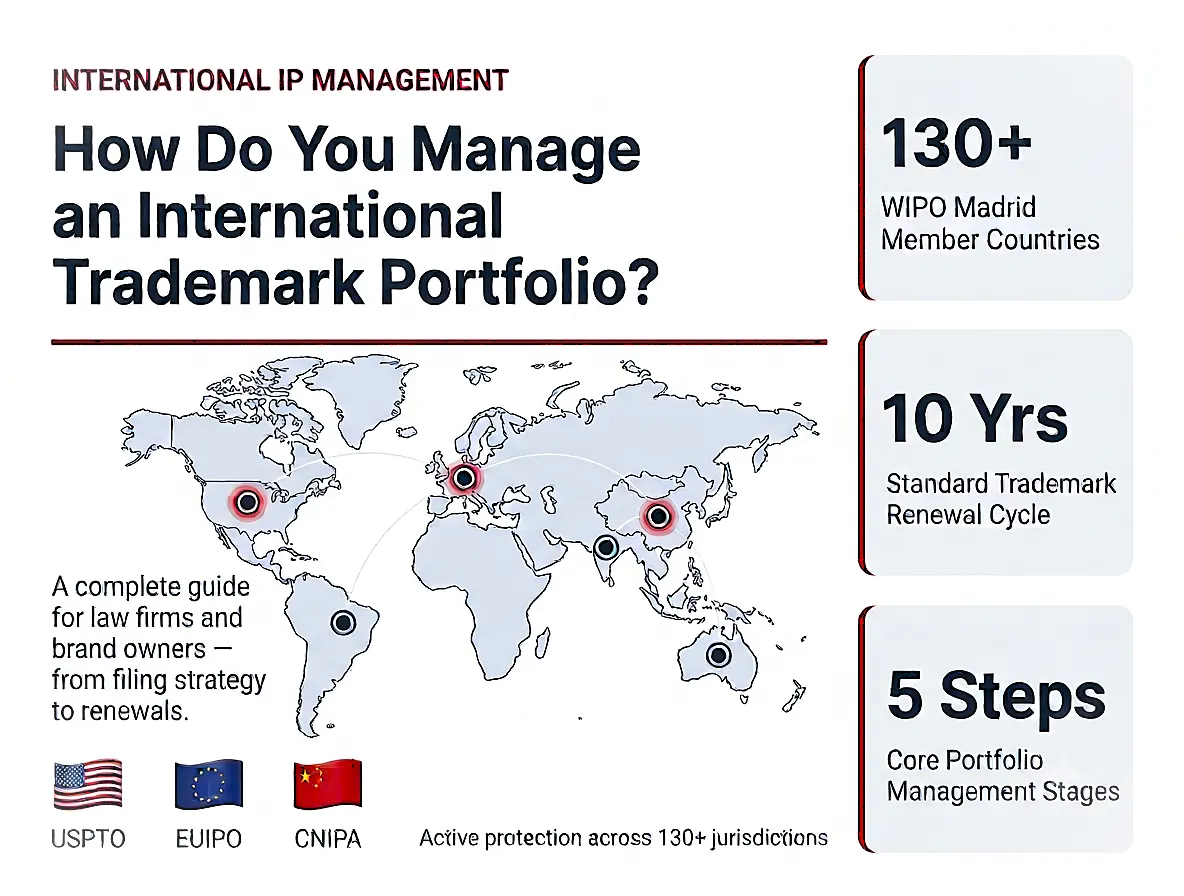
Managing this portfolio means tracking all of the above – maintaining accurate docketing records, meeting renewal deadlines, responding to office actions, and enforcing rights when necessary.
Step-by-Step: How to Manage an International Trademark Portfolio
International Trademark Portfolio Management — 7-Step Workflow
PORTFOLIO AUDIT
- ■ Map all active registrations
- ■ Identify coverage gaps
- ■ Audit all deadlines
FILING STRATEGY
- ■ Prioritize by market exposure
- ■ Evaluate Madrid vs. direct
- ■ Define defensive territories
DOCKETING SYSTEM
- ■ Centralize all deadlines
- ■ Automate reminder alerts
- ■ Integrate with attorney workflow
TRADEMARK MONITORING
- ■ Watch newly filed marks
- ■ Monitor e-commerce platforms
- ■ Track customs recordation
RENEWAL MANAGEMENT
- ■ Build 18-month renewal calendar
- ■ Account for jurisdiction rules
- ■ Pre-budget government fees
LOCAL COUNSEL NETWORK
- ■ Vet local counsel network
- ■ Standardize instruction templates
- ■ Coordinate via paralegal team
OFFICE ACTION RESPONSE
- ■ Log receipt date immediately
- ■ Delegate via clear protocol
- ■ Track response deadlines
Step 1: Conduct a Comprehensive Portfolio Audit
Every effective portfolio management strategy begins with a full audit. Before you can manage what you have, you need to know exactly what exists – and what gaps remain.
A trademark portfolio audit should document:
- All active registrations, their registration numbers, and expiration dates
- All pending applications and their current prosecution stage
- Classes of goods and services covered in each jurisdiction
- Gaps in coverage: countries where the brand operates but lacks registration
- Conflicting third-party marks discovered during clearance searches
Step 2: Define Your Filing Strategy by Jurisdiction
Not every brand needs trademark protection in every country. However, the cost of not filing in the right markets can far exceed any savings from a conservative filing strategy.
Prioritize jurisdictions based on:
- Current and planned commercial activity in each country
- Manufacturing hubs, distribution centers, and licensing territories
- E-commerce exposure, including cross-border shipping destinations
- High-risk jurisdictions for counterfeiting, such as parts of Southeast Asia and Eastern Europe
- Countries with first-to-file systems, such as China, where early registration is critical
Use the Madrid System for cost-efficient multi-country filing where possible. The Madrid Protocol, administered by WIPO, allows a single international application to extend trademark protection to over 130 member countries. However, it is not always the right approach: some jurisdictions require local filings for stronger enforcement, and Madrid-based applications that fail in the home country can trigger a cascade of international abandonments.
For authoritative guidance on international filing routes, consult WIPO’s Madrid System resources directly.
Step 3: Build a Robust Docketing System
Docketing is the operational backbone of international trademark portfolio management. Every deadline – renewal, response, statement of use – must be captured accurately and monitored proactively.
An effective trademark docketing system should:
- Automatically calculate statutory deadlines in each jurisdiction, accounting for local rules
- Send advance reminders at 6-month, 3-month, and 1-month intervals before critical dates
- Track multi-jurisdictional renewal cycles, which vary widely across countries
- Integrate with attorney workflow systems to assign tasks and track completion
- Maintain a chain of custody for all office action responses and correspondence
Missing even one trademark deadline can have severe consequences. For a detailed breakdown of how to avoid these pitfalls, read our guide on how to prevent missed deadlines in trademark docketing.
Step 4: Implement a Trademark Monitoring and Watch Service
Registering a trademark does not automatically protect it. You must actively monitor the trademark landscape to identify conflicting applications, infringement, and unauthorized use.
Comprehensive trademark monitoring includes:
- Watching for newly published trademark applications that are confusingly similar to your marks
- Monitoring e-commerce platforms, social media, and domain registrations for brand misuse
- Tracking customs recordation to intercept counterfeit goods at borders
- Reviewing competitor filings in your core goods and services classes
Teak IP’s trademark monitoring and watch services are specifically designed to give IP teams early warning of potential conflicts, enabling timely oppositions and enforcement actions before infringement escalates.
Step 5: Manage Renewals Across All Jurisdictions
Trademark renewal schedules differ significantly by country. In the United States, for example, trademarks must be renewed between the 5th and 6th year, and then every 10 years. In the European Union, renewals occur every 10 years from the filing date. China requires renewal every 10 years as well – but within the 12 months before expiry only.
Missing a renewal deadline can result in:
- Automatic abandonment of the registration
- Third parties filing for the same mark
- Costly restoration proceedings or fresh filings
Build a forward-looking renewal calendar at least 18 months ahead of each expiry date, and budget for all associated government fees well in advance.
Step 6: Coordinate with Local Counsel in Each Jurisdiction
Despite the availability of centralized international filing systems, local counsel remains essential in most jurisdictions. Local attorneys understand jurisdiction-specific formalities, examination practices, and enforcement nuances that no centralized system can fully replicate.
Best practices for managing local counsel networks include:
- Maintaining a vetted counsel list with performance benchmarks and cost structures
- Standardizing instruction templates to reduce errors in cross-border communications
- Using a centralized trademark paralegal team to coordinate all inbound and outbound correspondence
- Conducting periodic audits of local counsel performance, particularly for opposition and litigation matters
Understanding the difference between an IP generalist and a specialist is also important here – learn more about what separates an IP paralegal from a trademark paralegal, and how each role serves your portfolio management needs.
Step 7: Handle Office Actions Efficiently
Across a large international portfolio, receiving office actions is a constant and expected reality. An office action – whether a refusal on relative grounds, an objection to the specification, or a formality requirement – must be answered accurately and within the applicable deadline.
Efficient office action handling requires:
- Immediate logging of the office action receipt date in the docketing system
- Clear attorney review and delegation protocols
- Paralegal preparation of routine responses under attorney supervision
- Jurisdictional deadline tracking to avoid extensions where possible
For a detailed look at what trademark paralegals can and cannot handle in this process, read can a trademark paralegal file an office action response.
International Trademark Renewal Schedule: Key Jurisdictions at a Glance
The following table summarizes renewal requirements in major jurisdictions to help teams build an accurate forward-looking calendar.
International Trademark Renewal Deadlines at a Glance
18+ months ahead
Renewal Window: Before expiry date
Grace Period: 6 months
Renewal Window: Before expiry date
Grace Period: 6 months
Renewal Window: Before expiry date
Grace Period: 6 months
Renewal Window: Before expiry date
Grace Period: 6 months
Renewal Window: Before expiry date
Grace Period: 6 months
Renewal Window: Before expiry date
Grace Period: 6 months
Renewal Window: Before expiry date
Grace Period: None
| Jurisdiction | Renewal Period | Renewal Window | Grace Period |
| United States (USPTO) | 10 years (+ 5-6 yr maintenance) | Before expiry date | 6 months (surcharge applies) |
| European Union (EUIPO) | 10 years | 6 months before expiry | 6 months after expiry |
| China (CNIPA) | 10 years | 12 months before expiry | 6 months after expiry |
| United Kingdom (UKIPO) | 10 years | Before expiry date | 6 months after expiry |
| India (IP India) | 10 years | Before expiry date | 6 months after expiry |
| Australia (IP Australia) | 10 years | Before expiry date | 6 months after expiry |
| Canada (CIPO) | 10 years | Before expiry date | None (strict deadline) |
Note: Always verify current deadlines directly with local counsel or the official IP office, as regulations change. The USPTO’s official guidance is available at
Note: Always verify current deadlines directly with local counsel or the official IP office. The USPTO’s trademark renewal guidance is the authoritative source for U.S. requirements.
Madrid System vs. Direct National Filings: Which Approach Is Right for You?
Choosing between the Madrid System and direct national filings is one of the most consequential decisions in international trademark strategy. Both approaches have distinct advantages and limitations.
| Factor | Madrid System (WIPO) | Direct National Filing |
| Cost | Lower upfront cost for multiple countries | Higher per-country costs but no dependency on home registration |
| Speed | Single application extends to multiple countries | Timeline varies by jurisdiction; no home-country dependency |
| Central Attack Risk | Yes – home registration cancellation can invalidate all international extensions (5-year vulnerability) | No – each national registration is independent |
| Coverage | 130+ WIPO member countries | Unlimited – any jurisdiction globally |
| Local Counsel Need | Reduced for routine filings; still needed for oppositions and enforcement | Required in most jurisdictions for filing and prosecution |
| Best For | Brands filing in 5 or more countries simultaneously; early-stage global expansion | High-priority markets requiring stronger local control; China, specific risk jurisdictions |
Common Mistakes When Managing an International Trademark Portfolio
‘5 Critical Mistakes in International Trademark Management’
Avoid these to protect your portfolio — and your client’s brand.
01 — Skipping Clearance Searches
Filing without a jurisdiction-specific search is the most expensive shortcut in trademark practice.
02 — Ignoring Local Filing Requirements
The Madrid System does not cover every country. Gaps in Taiwan, Iran, and parts of Africa leave brands unprotected.
03 — Portfolio Fragmentation
Multiple disconnected systems mean missed deadlines and reactive enforcement. Centralized docketing is not optional.
04 — Neglecting Use Requirements
Non-use for 3–5 years triggers cancellation risk in most jurisdictions. Use deadlines must be tracked alongside renewals.
05 — Underestimating Resource Requirements
Large portfolios need dedicated paralegal support, docketing infrastructure, and a vetted local counsel network.
Key Takeaway
The cost of remediation always exceeds the cost of prevention. Build the right system from day one.
1. Failing to Conduct Clearance Searches Before Filing
Filing without a proper clearance search in each target jurisdiction is one of the costliest mistakes possible. A conflicting prior mark in one country can derail an entire regional strategy. Always conduct jurisdiction-specific trademark searches before committing to a filing.
Teak IP’s trademark search services provide in-depth clearance analysis before you commit to a filing strategy.
2. Ignoring Local Filing Requirements
The Madrid System is efficient, but it does not cover every country. Some jurisdictions, such as Iran, Taiwan, and several African nations, require direct local filings. Relying solely on Madrid for a global brand is a coverage risk.
3. Allowing Portfolio Fragmentation
When trademark records are stored across multiple systems, spreadsheets, or law firms without central coordination, fragmentation occurs. Records become inaccurate, renewal dates are missed, and enforcement becomes reactive rather than strategic. Centralizing docketing across the full portfolio is non-negotiable.
4. Neglecting Use Requirements
Many jurisdictions require evidence of genuine commercial use within a specified period after registration – typically 3 to 5 years. Failure to meet use requirements can result in cancellation on non-use grounds. Track use obligations alongside renewal and office action deadlines.
5. Underestimating the Resources Required
International trademark portfolio management is resource-intensive. Firms that attempt to manage large global portfolios without adequate paralegal support, docketing systems, and local counsel networks consistently fall behind. Building the right operational infrastructure from the outset is far more cost-effective than remediation later.
Expert Tips for Smarter International Trademark Portfolio Management
5 Strategies to Manage an International Trademark Portfolio Smarter
Commercial Priority
Docketing Software
Volume Work
Authorities
Tip 1: Tier Your Portfolio by Commercial Priority
Not all marks are equally valuable. Segment your portfolio into tiers based on commercial importance: core marks generating revenue in active markets sit in Tier 1 and receive maximum protection, monitoring, and enforcement attention. Defensive registrations and legacy marks can be managed with lighter-touch monitoring.
Tip 2: Use Docketing Software Built for Trademark, Not General Practice
General practice management software is often inadequate for the specific deadline structures, classification systems, and jurisdiction-specific requirements of trademark work. Invest in purpose-built trademark docketing platforms, or partner with an IP support provider that already has that infrastructure in place.
Tip 3: Schedule Annual Portfolio Reviews
Market conditions change, brands evolve, and businesses enter new territories. An annual portfolio review – covering coverage gaps, use requirements, renewal calendars, and monitoring effectiveness – is the minimum standard for proactive management.
Tip 4: Leverage Paralegal Support for Volume Work
Attorneys should focus on strategic decisions and complex legal matters. Routine tasks such as renewal filings, docketing updates, office action preparation, and local counsel coordination are ideal for experienced paralegal support. This model improves throughput, controls costs, and reduces attorney burnout.
For a deeper dive into the cost and quality tradeoffs, read our analysis of whether to hire an in-house or virtual patent paralegal – many of the same principles apply to trademark paralegal roles.
Tip 5: Record Trademarks with Customs Authorities
In countries with strong customs enforcement programs – including the United States and the European Union – recording registered trademarks with customs authorities significantly improves your ability to intercept counterfeit goods at borders. This step is often overlooked but provides a substantial return for relatively little cost.
The U.S. Customs and Border Protection IP recordation program provides step-by-step guidance on how to record your marks.
The Role of Trademark Paralegal Support in Portfolio Management
Managing a large international trademark portfolio without dedicated paralegal support is like managing a global supply chain without logistics software. The volume, complexity, and deadline sensitivity of the work require a dedicated operational layer between attorneys and the administrative task queue.
How Trademark Paralegal Support Scales Your Practice
The paralegal layer is the operational backbone — enabling attorneys to focus on what only they can do.
Deadline Docketing
Accurate entry and deadline calculation for all jurisdictions and renewal cycles.
Renewal Filing Prep
Prepares renewal submissions and fee schedules ahead of each expiry window.
Local Counsel Coordination
Translates attorney instructions and manages inbound/outbound correspondence across offices.
Office Action Drafting
Prepares routine response drafts under attorney supervision for efficiency.
Portfolio Status Reporting
Generates client-facing and internal reports on registration status, renewals, and open matts.
Quality Control Checks
Reviews filings for accuracy before submission to reduce costly correction procedures.
Experienced trademark paralegals provide:
- Accurate docketing entry and deadline calculations across all jurisdictions
- Preparation of renewal filings, response drafts, and watch reports
- Coordination with local counsel and translation of instructions
- Status tracking and portfolio reporting for client updates and internal reviews
- Quality control checks on filings before submission
Teak IP’s trademark support team operates as a seamless extension of your firm, delivering the operational depth needed to manage large portfolios without increasing your overhead. Our team has hands-on experience in multi-jurisdictional trademark work spanning the Americas, Europe, Asia, and beyond.
Frequently Asked Questions: How to Manage an International Trademark Portfolio
What is the most efficient way to manage an international trademark portfolio?
The most efficient approach combines three elements: a centralized docketing system that tracks all deadlines across every jurisdiction, a reliable trademark monitoring service that provides early warning of conflicts, and a skilled paralegal support team that handles volume tasks so attorneys can focus on strategy and complex decisions.
How does the Madrid System help in managing international trademarks?
The Madrid System, administered by WIPO, allows brand owners to file a single international trademark application that can be extended to over 130 countries. This reduces administrative complexity and filing costs significantly. However, it carries a ‘central attack’ risk during the first five years, meaning cancellation of the home-country base registration can invalidate all international extensions. A balanced portfolio strategy often combines Madrid filings with direct national applications in high-priority markets.
How often should trademarks be renewed internationally?
Renewal periods vary by jurisdiction, but the most common cycle is every 10 years. Some countries, including the United States, also require mid-term maintenance filings. Building a renewal calendar at least 18 months ahead of each expiry date – and monitoring it actively through your docketing system – is the standard best practice for international portfolios.
What are the biggest risks in international trademark portfolio management?
The most significant risks include: missing renewal or maintenance deadlines resulting in lapsed registrations; failing to meet use requirements leading to non-use cancellations; gaps in monitoring coverage allowing third parties to register confusingly similar marks; and central attack vulnerability in Madrid-based portfolios. Each of these risks is manageable with the right systems and support in place.
Do I need local counsel in every country where I have a trademark?
Not necessarily for routine management, but local counsel is strongly recommended for office action responses, opposition proceedings, enforcement actions, and any litigation. For filings in jurisdictions outside the Madrid System, local counsel is often required as a matter of law. Building and maintaining a reliable network of vetted local counsel is an essential component of international trademark portfolio management.
How can trademark paralegals help manage an international trademark portfolio?
Trademark paralegals handle the operational backbone of portfolio management: docketing deadlines, preparing renewal filings, coordinating with local counsel, drafting routine office action responses under attorney supervision, and generating portfolio status reports. This delegation model allows attorneys to focus on high-value strategic work while ensuring nothing falls through the cracks in a complex multi-jurisdictional portfolio.
Build a System That Protects Your Brand Everywhere
To effectively manage an international trademark portfolio, you need more than good intentions – you need systematic processes, reliable technology, expert human support, and proactive legal strategy working in concert.
The brands that do this well share a common approach: they audit rigorously, file strategically, docket precisely, monitor continuously, and respond to threats quickly. They invest in the right tools and the right people from the beginning, rather than reacting to crises after deadlines are missed.
Teak IP Services specializes in providing the paralegal support, docketing infrastructure, and trademark monitoring capabilities that IP teams and law firms need to manage global trademark portfolios with confidence. Whether you are building a portfolio from scratch or restructuring a complex existing one, our team is equipped to support every stage of the process.
Learn more about our full range of trademark services and how we can support your practice.

