
Two Titles, Two Distinct Roles: The difference between an IP paralegal and a trademark paralegal is not just a matter of semantics – it reflects a real division in daily responsibilities, technical knowledge, and the type of legal support each professional provides. If you work in an intellectual property firm, an in-house IP department, or a general law practice that handles brand or innovation matters, understanding this distinction matters enormously for staffing, workflow design, and risk management.

Both roles sit under the broad umbrella of IP legal support. However, an IP paralegal typically covers a wider range of intellectual property disciplines – including patents, trade secrets, and copyrights – while a trademark paralegal focuses specifically on brand protection matters such as USPTO filings, office action responses, and international trademark prosecution. Choosing the wrong support model can lead to missed deadlines, compliance gaps, and unnecessary attorney billing hours.
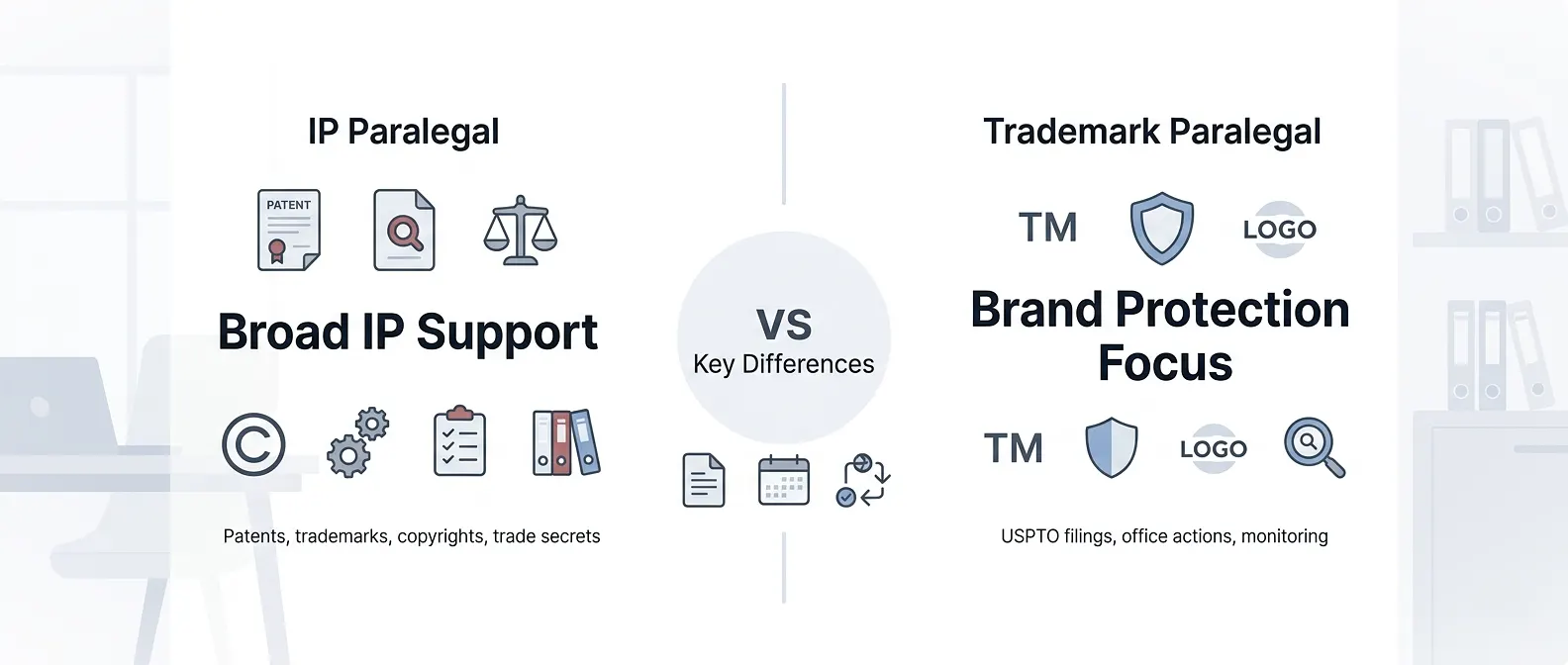
This guide breaks down each role in precise, practical terms so that IP professionals can make informed staffing and outsourcing decisions.
IP Paralegal vs. Trademark Paralegal Roles Compared
IP Paralegal
Broad coverage across all IP disciplines
Trademark Paralegal
Deep specialization in brand protection
Quick Answer: What is the Core Difference?
An IP paralegal handles support tasks across multiple intellectual property disciplines – including patents, trademarks, copyrights, and trade secrets – under attorney supervision. A trademark paralegal is a specialist whose work centers exclusively on trademark law: prosecution, docketing, monitoring, and maintenance filings. Think of it this way: every trademark paralegal is a type of IP paralegal, but not every IP paralegal is a trademark specialist.
What Does an IP Paralegal Do?
An IP paralegal provides legal support across the full spectrum of intellectual property law. Their responsibilities span patent prosecution, trademark filings, copyright registrations, trade secret management, IP portfolio maintenance, and inter partes proceedings.
Core Responsibilities of an IP Paralegal
The IP Paralegal Skill Wheel
IP Paralegals cover all disciplines; Trademark Paralegals specialize in brand protection only
- Patent prosecution support: Preparing and filing patent applications, responding to USPTO office actions, docketing prosecution deadlines, and managing Information Disclosure Statements (IDS).
- PCT and international filings: Coordinating Patent Cooperation Treaty (PCT) national phase entries, managing WIPO deadlines, and liaising with foreign associates.
- Trademark support (generalist level): Filing trademark applications, handling basic office actions, and monitoring renewal deadlines.
- Copyright registration: Preparing copyright applications and maintaining copyright portfolios.
- Trade secret documentation: Organizing and tracking confidential business information that qualifies for trade secret protection.
- Portfolio management: Maintaining IP docket software, generating deadline reports, and managing IP asset data across multiple clients or business units.
- Inter partes proceedings: Supporting attorneys in Inter Partes Review (IPR), Post-Grant Review (PGR), and Interference proceedings before the Patent Trial and Appeal Board (PTAB).
Skills an IP Paralegal Needs
An effective IP paralegal must have strong working knowledge of USPTO procedures for both patents and trademarks, familiarity with international IP systems (EPO, WIPO, IP Australia, CIPO), and proficiency in IP docketing platforms such as Anaqua, CPI, or Dennemeyer. Analytical precision and deadline awareness are non-negotiable because even a single missed USPTO response deadline can result in patent abandonment.
For a deeper look at how IP portfolio management works across patents and trademarks, the Intellectual Property Management – Complete and Comprehensive Guide on the Teak IP blog provides a thorough breakdown of the full lifecycle.
What Does a Trademark Paralegal Do?
A trademark paralegal specializes exclusively in trademark law. Their work centers on brand protection: filing new trademark applications with the USPTO or international registries, managing office action responses, monitoring marks for infringement, and handling maintenance and renewal filings under Sections 8, 9, 15, and 71 of the Lanham Act.
Core Responsibilities of a Trademark Paralegal
- Trademark application preparation: Drafting and filing TEAS Plus, TEAS Standard, and Madrid Protocol applications.
- Office action response support: Preparing responses to USPTO refusals under attorney supervision, including likelihood-of-confusion analyses, specimen submissions, and disclaimer arguments.
- Trademark docketing: Monitoring and managing critical deadlines – Statements of Use (SOU), extensions of time to file SOU, maintenance filings, and renewals.
- Trademark search coordination: Ordering and reviewing preliminary clearance searches, coordinating full knockout and comprehensive searches with specialized vendors.
- Trademark monitoring: Overseeing watch services to detect potentially conflicting third-party marks filed at the USPTO, EUIPO, and WIPO.
- Madrid System filings: Preparing international trademark applications under the Madrid Protocol via WIPO.
- TTAB proceedings support: Assisting with Trademark Trial and Appeal Board (TTAB) opposition and cancellation proceedings.
Skills a Trademark Paralegal Needs
A trademark paralegal requires deep knowledge of the Lanham Act (15 U.S.C. §§ 1051 et seq.), USPTO TEAS filing procedures, the Nice Classification system, the Madrid System for international trademarks, and brand maintenance timelines. Strong attention to detail is critical: a missed Section 8 declaration or a late Statement of Use can permanently cancel an otherwise valid trademark registration.
To understand how trademark-specific deadlines are managed at a system level, the Teak IP article on Trademark Docketing Systems: The Complete Guide covers the key platforms and processes in detail.
IP Paralegal vs. Trademark Paralegal: Side-by-Side Comparison
| Attribute |
IP Paralegal
|
Trademark Paralegal
|
|---|---|---|
| Scope of Work | Broad (Patents, Trademarks, Copyrights) | Specialized (Trademarks Only) |
| Patent Prosecution | ||
| Trademark Filings | ||
| USPTO Docketing | ||
| International Work | PCT & Foreign Patents/Trademarks | Madrid Protocol & Foreign Trademarks |
| Copyright Support | Occasional | |
| PTAB / IPR Proceedings | ||
| TTAB Proceedings | ||
| Trademark Monitoring | Occasional | |
| Typical Setting | Law Firms, Corporations | Law Firms, Corporations |
| Software Used | IP Docketing, Annuity Services | IP Docketing, Trademark Search Tools |
- Suggested visual: Clean two-column table graphic with Teak IP branding showing IP Paralegal vs. Trademark Paralegal tasks side by side.
- Image title: IP Paralegal vs Trademark Paralegal Comparison Table
- SEO filename:
ip-paralegal-trademark-paralegal-comparison-table.webp - ALT text: Table showing the difference between an IP paralegal and a trademark paralegal by task and specialty
- Caption: IP paralegals manage broad portfolios across all IP types; trademark paralegals focus exclusively on brand protection matters.
Key Areas of Overlap Between IP Paralegals and Trademark Paralegals
Despite their differences, IP paralegals and trademark paralegals share several overlapping functions. Understanding where they converge helps firms avoid duplication of effort and assign tasks more efficiently.
Where the Roles Overlap
- Basic USPTO trademark filings: Both roles may handle initial TEAS filings for straightforward trademark applications.
- Deadline monitoring: Both use IP docketing systems to track and alert on USPTO response deadlines.
- Office action response support: Both assist attorneys in drafting responses to USPTO office actions, though the trademark paralegal brings deeper subject-matter expertise.
- Client communication: Both roles often serve as the primary point of contact between the IP firm and the client for status updates.
- IP portfolio reporting: Both may generate portfolio reports summarizing the status of pending and registered marks or patents.
The key distinction is depth versus breadth. The IP paralegal brings breadth – spanning multiple IP disciplines. The trademark paralegal brings depth – specialized fluency in trademark law that allows them to handle more complex matters with less attorney oversight.
Can a Trademark Paralegal Handle Patent Work – and Vice Versa?
No – and this is a critical risk point for IP firms. Patent prosecution involves highly technical legal procedures governed by 37 C.F.R. Part 1, including claims drafting support, double-patenting analysis, and compliance with USPTO examination rules. These tasks require specific knowledge that most trademark paralegals have not developed.
Conversely, a patent-focused IP paralegal who handles trademark matters without sufficient training risks errors in Nice Classification, specimen preparation, or Lanham Act compliance – any of which can jeopardize a client’s mark.
The best-staffed IP firms match task type to role expertise. Where workloads surge in one area, they use outsourced IP paralegal support to fill the gap without compromising quality. For firms evaluating when and how to use external support, IP Paralegal Services from Teak IP offer a flexible model that covers both trademark and patent paralegal functions under attorney supervision.
Office Action Responses: How the Roles Differ in Practice
One area where the difference between an IP paralegal and a trademark paralegal becomes especially clear is in handling USPTO office actions.
Trademark Office Actions
A trademark paralegal who handles office action responses understands Section 2(d) likelihood-of-confusion refusals, Section 2(e)(1) mere descriptiveness refusals, specimen requirements, and disclaimer practice. They can prepare a structured response draft for attorney review, reducing turnaround time significantly.
As the Teak IP blog explains in Can a Trademark Paralegal File an Office Action Response?, a trademark paralegal cannot sign or submit a response independently – that requires a licensed attorney. However, the paralegal’s role in preparing the substantive response is substantial and directly affects case quality.
Patent Office Actions
An IP paralegal supporting patent prosecution helps prepare claim amendments, organize prior art references for IDS submissions, and draft argument summaries in response to USPTO rejections under 35 U.S.C. §§ 101, 102, and 103. This is technically distinct from trademark office action work and requires familiarity with patent claim language and examination guidelines under the Manual of Patent Examining Procedure (MPEP).
The Teak IP article on Office Action Response Extension: How to Buy More Time Without Risking Your Patent provides a detailed look at the patent office action response timeline and extension rules.
Docketing Responsibilities: Where Specialization Matters Most
Docketing is arguably the most operationally critical function in both roles, and it is where the consequences of misassignment are most severe. A missed USPTO deadline is not a minor administrative error – it can result in abandonment, loss of priority, or permanent cancellation of valuable IP assets.
Trademark Docketing Specifics
A trademark paralegal manages a calendar of Lanham Act deadlines that includes:
- Statements of Use and extensions under 15 U.S.C. § 1051(d)
- Section 8 Declarations of Continued Use (due between the 5th and 6th year after registration)
- Section 9 Renewals (due every 10 years)
- Section 15 Declarations of Incontestability (optional but strategically important)
- Madrid Protocol renewal and maintenance deadlines through WIPO
For a comprehensive breakdown of how to prevent missed deadlines in this context, the Teak IP guide on How to Prevent Missed Deadlines in Trademark Docketing outlines both the risk framework and the operational solutions.
Patent Docketing Specifics
An IP paralegal managing patent docketing tracks:
- USPTO office action response deadlines (typically 3 months with up to 3-month extensions under 37 C.F.R. § 1.136)
- PCT Chapter I and Chapter II filing deadlines
- National phase entry deadlines in individual countries (30 months from priority under PCT Article 22)
- Annuity and maintenance fee due dates across multiple jurisdictions (USPTO, EPO, national phase countries)
- IDS submission windows relative to prosecution activity
The critical overlap here is software: both roles rely on IP docketing platforms to automate alerts and reduce human error. However, the underlying deadline logic – and the consequences of missing each type – differs substantially between patents and trademarks.
IP Paralegal Staffing: Decision Matrix
How to choose the right support model based on your firm’s matter mix
IN-HOUSE SPECIALIST
Hire a dedicated trademark or patent paralegal
OUTSOURCED SPECIALIST SUPPORT
Engage a specialist outsourcing provider (e.g. Teak IP)
IN-HOUSE GENERALIST
One IP paralegal covers all matter types
OUTSOURCED GENERALIST SUPPORT
Scale with outsourced IP paralegal coverage
Matching your staffing model to your actual practice needs reduces overhead and protects IP quality.
Which Role Does Your Firm Actually Need?
This depends on your practice mix. Use the criteria below to guide your assessment.
You Likely Need a General IP Paralegal If:
- Your firm handles both patent and trademark matters regularly.
- You manage international PCT filings and national phase entries alongside trademark prosecution.
- You need paralegal support across IDS preparation, patent prosecution, and trademark filings under one resource.
- Your practice includes copyright or trade secret matters.
A Trademark-Specialized Paralegal Could Be Necessary If:
- Your practice is exclusively or predominantly trademark-focused.
- You manage large brand portfolios with frequent renewal cycles, monitoring obligations, and multi-class registrations.
- You regularly file and prosecute international trademark applications via the Madrid System.
- You are involved in TTAB opposition or cancellation proceedings.
You May Need Both If:
- Your firm or IP department is mid-size or larger with distinct patent and trademark practice groups.
- You experience volume spikes in one area that your existing team cannot absorb.
- You are building a dedicated trademark practice within a broader IP firm.
Teak IP’s Trademark Services and IP Paralegal Support Services are structured to serve both needs, allowing firms to scale specific functions without committing to full-time headcount.
Common Mistakes IP Firms Make When Assigning These Roles
1. Assuming Any IP Paralegal Can Handle Trademark Specialization
General IP paralegals may be unfamiliar with the nuances of TEAS filing requirements, Nice Classification, or the specific evidentiary standards for overcoming Section 2(d) refusals. Assigning complex trademark prosecution to an untrained IP paralegal increases the risk of office action errors and client dissatisfaction.
2. Treating the Trademark Paralegal as a Universal IP Resource
Conversely, firms sometimes assign patent prosecution tasks to their trademark paralegal during busy periods. This creates liability exposure. Patent prosecution errors – especially in IDS management or claim amendment drafting – can affect patent enforceability. The USPTO Rule 56 Duty of Disclosure obligations alone carry serious legal risk if managed by someone without patent-specific training.
3. Under-resourcing Trademark Docketing During Portfolio Growth
As a brand portfolio grows – especially across international markets – trademark docketing complexity scales rapidly. Firms that rely on a single generalist IP paralegal to manage multi-class, multi-jurisdiction trademark portfolios are operating with a compressed margin for error.
4. Conflating Title with Competency
Job titles are inconsistent across firms. Someone called an “IP paralegal” at one firm may have spent 90% of their career on trademark matters. Another firm’s “trademark paralegal” may have substantial patent experience. When evaluating in-house hires or outsourced support, always review the actual task history rather than the title alone.
Expert Tips for Structuring IP Paralegal Support
Tip 1: Audit your matter mix before defining roles. Run a 12-month report on matter types. If 70% of your open matters involve trademarks, prioritize trademark specialist support rather than generalist IP coverage.
Tip 2: Use role-specific onboarding checklists. An IP paralegal joining a patent-heavy team should complete a patent procedure orientation. A trademark paralegal joining a multi-discipline firm should be assessed on their USPTO examination procedures knowledge for trademarks specifically.
Tip 3: Separate docketing from prosecution support. In high-volume practices, docketing (deadline tracking) and prosecution support (drafting assistance, filing coordination) are distinct functions. Separating them reduces cognitive load and error rates.
Tip 4: Leverage outsourced support to cover specialization gaps. Rather than hiring a second full-time paralegal to cover a practice area your team lacks depth in, outsourced IP paralegal services offer a cost-effective alternative. Teak IP’s model provides U.S.-supervised, India-based paralegal support across both patent and trademark functions, with senior attorneys reviewing all deliverables.
Tip 5: Establish clear escalation protocols. Both IP and trademark paralegals should have explicit guidance on when to escalate a matter to the supervising attorney. This is especially important for complex office action responses, TTAB filings, and any matter involving international prosecution.
According to WIPO’s latest data on trademark filing trends, international trademark filings via the Madrid System have grown significantly in recent years, underscoring why trademark specialization within IP paralegal teams is increasingly important for firms with global clients.
The USPTO’s official guidance on paralegal roles in patent and trademark practice also makes clear the distinctions between tasks that require attorney authorization and those that paralegals may handle under supervision.
Frequently Asked Questions
What is the difference between an IP paralegal and a trademark paralegal?
An IP paralegal provides legal support across all intellectual property disciplines, including patents, trademarks, copyrights, and trade secrets. A trademark paralegal specializes exclusively in trademark law – handling USPTO filings, office action response preparation, docketing, monitoring, and international trademark prosecution. Trademark paralegals offer deeper specialization within a narrower scope; IP paralegals offer broader coverage across the full IP spectrum.
Can an IP paralegal do trademark work?
Yes, most IP paralegals can handle basic trademark tasks such as filing TEAS applications and tracking renewal deadlines. However, for complex trademark prosecution – such as responding to Section 2(d) refusals, managing Madrid Protocol portfolios, or supporting TTAB proceedings – a trademark specialist’s depth of knowledge typically produces better outcomes and reduces attorney supervision time.
Can a trademark paralegal do patent work?
Generally, no – unless they have specific patent prosecution training. Patent procedures at the USPTO involve technically distinct rules, claim language, and examination standards that require dedicated expertise. Assigning patent prosecution support to a trademark specialist creates compliance and quality risks.
What qualifications does a trademark paralegal need?
Most trademark paralegals hold a paralegal certificate or associate/bachelor’s degree, combined with specialized training in trademark law. Proficiency in USPTO TEAS filing, WIPO Madrid System procedures, Nice Classification, and IP docketing software is standard. Many trademark paralegals also pursue the International Trademark Association (INTA) certificate programs for professional development.
What qualifications does an IP paralegal need?
An IP paralegal typically needs a paralegal credential plus specialized training in either patent or trademark prosecution, or both. Knowledge of USPTO filing procedures, PCT rules, IDS requirements, and IP portfolio management systems is essential. Patent-focused IP paralegals often hold technical degrees to support patent prosecution across specific technology areas.
Is outsourcing IP paralegal or trademark paralegal support a viable option?
Yes – and it is increasingly common among IP firms managing fluctuating workloads. Outsourced IP paralegal providers like Teak IP offer both generalist IP paralegal support and trademark-specific paralegal functions, with all work reviewed by U.S.-licensed IP attorneys. This model provides specialization on demand without the overhead of full-time hiring.
How does trademark docketing differ from patent docketing?
Trademark docketing tracks Lanham Act deadlines: Statements of Use, Sections 8 and 9 filings, and Madrid Protocol maintenance dates. Patent docketing tracks prosecution response deadlines, PCT national phase entry dates, annuity fees, and IDS submission windows. The underlying deadline logic, software configuration, and risk consequences differ significantly between the two – which is why specialization in each area matters.
Match the Role to the Requirement
The difference between an IP paralegal and a trademark paralegal is not just definitional – it is operational. Assigning the right type of paralegal support to the right type of IP matter reduces attorney supervision time, improves filing quality, and protects clients from costly mistakes.
For firms managing both patent and trademark portfolios, the optimal approach is either a well-trained general IP paralegal who understands both disciplines, or a team structure that includes both role types. For practices focused predominantly on brand protection, a trademark specialist delivers measurably better results than a generalist.
Teak IP provides both models: flexible IP paralegal services covering patents, trademarks, and portfolio management, all backed by U.S. attorney oversight and a team with over 70 years of combined paralegal experience. Whether you need trademark-specific prosecution support or broad IP paralegal coverage, Teak IP’s team is ready to scale with your practice.
Contact Teak IP today to discuss the right paralegal support model for your firm’s specific practice mix.

