
Outsource IDS filing is becoming an increasingly common strategy among modern patent practices. There’s a hidden cost in every patent practice that rarely shows up on a client invoice – the cost of doing IDS filing in-house.
On the surface, managing Information Disclosure Statement (IDS) filings internally seems straightforward. You gather the references, fill out the forms, submit them to the United States Patent and Trademark Office, and move on. But patent attorneys and IP managers who have scaled their practices know the truth: IDS filing is one of the most time-consuming, error-prone, and compliance-critical tasks in patent prosecution – and doing it in-house often costs far more than it appears. Patent practices that are ready to make the shift can partner with our IDS filing services to offload the preparation, compliance review, and USPTO submission of every Information Disclosure Statement.

That’s why a growing number of U.S. law firms, boutique patent practices, and corporate IP departments are making a strategic shift: they’re choosing to outsource IDS filing to specialized providers.
This blog post breaks down the real cost of DIY IDS filing, exposes the hidden risks most practices overlook, and explains why outsourcing has become the smarter – and increasingly standard – choice for forward-thinking IP professionals.
What is IDS Filing, and Why is It So Demanding?
An Information Disclosure Statement (IDS) requires every person associated with a patent application to disclose all material prior art known to them. This obligation, governed by 37 C.F.R. § 1.56, sounds simple – but execution is anything but.
The IDS Filing Process Involves:
- Collecting and categorizing all relevant references – patents, published applications, non-patent literature (NPL), foreign office actions, and more
- Verifying publication dates, citation details, and legal sufficiency of each reference
- Preparing USPTO-compliant forms (PTO/SB/08A and PTO/SB/08B) with exact formatting requirements
- Tracking timing windows – different rules apply before vs. after the first Office Action, and before vs. after issue fee payment
- Filing through the USPTO’s Patent Center with proper docketing and confirmation
- Maintaining IDS logs across related applications (continuations, divisionals, national phase entries)
- Monitoring foreign prosecution for new references requiring supplemental IDS filings
- Coordinating across multiple applications that may share overlapping prior art
For a practice handling dozens or hundreds of active applications simultaneously, this volume quickly becomes a specialized operation – not a side task.
Also, Read: USPTO Rule 56: Duty of Disclosure Explained for Patent Practitioners
The Real Cost of Doing IDS In-House
Most firms underestimate the true cost of managing IDS filings internally. Here’s where the hidden expenses accumulate:
1. Attorney Time – Your Most Expensive Resource
Attorney billing rates typically range from $300 to $600+ per hour at mid-to-large U.S. firms. When a licensed attorney spends time on IDS work – reviewing reference lists, formatting forms, tracking deadlines, and cross-checking related applications – that’s premium-priced time spent on administrative-level work.
A conservative estimate per IDS filing:
- Reference review and classification: 30–60 minutes
- Form preparation and verification: 20–40 minutes
- Filing and docketing confirmation: 15–30 minutes
- Total: 1–2.5 hours of attorney or senior paralegal time per filing
At $350/hour, even one IDS filing costs $350–$875 in internal labor before overhead.
2. Paralegal and Staff Overhead
If you’ve offloaded IDS work to paralegals or legal assistants, the rate is lower – but the volume often compensates. Paralegals at U.S. firms typically bill internally at $80–$175/hour, and IDS tasks require trained, IP-literate staff who understand USPTO requirements, citation formatting, and related application tracking.
Training new staff, maintaining internal procedures, and managing quality control all add to the overhead.
3. Technology and Software Costs
Efficient in-house IDS management typically requires:
- Docketing software (e.g., Anaqua, CPI, Dennemeyer) – licensing fees ranging from thousands to tens of thousands annually
- Patent database access – Derwent Innovation, PatSnap, or similar tools for cross-referencing prior art
- Document management systems – for organizing and retrieving reference materials across application families
- USPTO Patent Center access and training – ongoing staff education as the portal evolves
These tools are necessary for a high-quality IDS practice – and they come with significant recurring costs.
4. Error and Omission Risk – The Most Expensive Line Item of All
This is the cost most firms never see coming – until it’s too late.
Common IDS errors in DIY filing include:
- Missing the filing deadline – resulting in additional USPTO fees or, worse, non-consideration of cited references
- Incorrect or incomplete form preparation – references improperly listed, missing inventor signatures, or wrong application numbers
- Failing to file supplemental IDS when new references surface during prosecution
- Overlooking foreign office actions from co-pending PCT or national phase applications
- Miscategorizing references – submitting NPL on a patent form or vice versa
- Failure to disclose in continuation applications – assuming the parent’s IDS carries over (it doesn’t, in most circumstances)
The consequences of these errors are severe:
- Additional USPTO fees (from late filing or exceeding reference thresholds)
- Examiner non-consideration of references – defeating the entire purpose of the IDS
- Inequitable conduct findings – rendering an otherwise valid patent completely unenforceable
- Malpractice exposure – for attorneys who miss material deadlines or mishandle disclosure obligations
A single inequitable conduct finding in litigation can wipe out years of prosecution investment. No filing fee savings justify that risk.
5. Opportunity Cost
Every hour your attorneys and paralegals spend on IDS administration is an hour not spent on:
- Drafting claims
- Responding to Office Actions
- Client counseling and business development
- Building your firm’s expertise and competitive edge
For high-growth practices, the opportunity cost of in-house IDS management is one of the largest – and most invisible – drains on firm productivity.
Why IDS Filing is More Complex Than It Looks
Even experienced practitioners are surprised by the nuances that make IDS filing a discipline unto itself. Here are the complexities that catch DIY filers off guard:
Timing Rules Are Unforgiving
The USPTO has four distinct timing windows for IDS filing – each with different fee and certification requirements. Missing the right window means extra fees or, in the worst case, non-consideration of the submitted references.
Foreign Application Coordination
If your client has co-pending applications at the EPO, JPO, CNIPA, or through the PCT, every office action and search report issued by those offices may contain material references that must be submitted to the USPTO. Tracking and processing foreign office actions in real time – across multiple clients and matters – is a significant operational challenge.
Related Application Families
Continuation, divisional, and continuation-in-part (CIP) applications each require their own IDS submissions. References disclosed in a parent application must be re-evaluated for each child application – and new references discovered during prosecution of any family member may need to be disclosed across the entire family.
The Supplemental IDS Obligation
The duty of disclosure is continuous throughout prosecution. A reference discovered the day before issue fee payment still must be disclosed – even if it means triggering a late-filing fee and certification requirement. DIY filers often miss this obligation because there’s no single “IDS event” – it’s an ongoing monitoring and disclosure process.
Non-Patent Literature (NPL) Complexity
NPL references – journal articles, conference papers, technical standards – require different form treatment than patent references. They must be provided with sufficient bibliographic detail to allow the examiner to locate them. Incomplete or incorrectly formatted NPL citations are a common source of IDS deficiencies.
Also, Read: How to Prepare an IDS: A Step-by-Step Guide for Patent Applicants
The Shift to Outsourced IDS Filing : What’s Driving It?
The legal industry has seen a dramatic shift toward specialized outsourcing over the past decade. IDS filing have emerged as one of the most widely adopted areas of patent outsourcing – and for good reason.
Key Drivers Behind the Shift:
1. Volume Growth As patent portfolios expand globally, the volume of IDS-triggering events – foreign office actions, new publications, co-pending application activities – has multiplied. Firms that managed 50 IDS filings per year a decade ago may now face 300+. In-house infrastructure simply hasn’t kept pace.
2. Cost Pressure on Clients Corporate IP departments and startup clients are scrutinizing legal costs more closely than ever. Law firms are under pressure to deliver high-quality work at competitive rates – which means finding efficiencies without sacrificing quality. Outsourcing IDS filing offers exactly that.
3. Focus on Core Competency Top patent attorneys didn’t spend years in technical and legal training to become IDS administrators. Outsourcing non-core tasks frees attorneys to focus on the high-value, high-expertise work that justifies their rates and builds their reputations.
4. Specialized Expertise Dedicated IDS service providers handle hundreds or thousands of filings monthly. They develop specialized knowledge of USPTO requirements, form conventions, timing rules, and foreign office action processing that generalist in-house staff cannot match.
5. Risk Reduction Professional IDS service providers implement rigorous quality control processes – double-checking form accuracy, deadline tracking, and filing confirmations – that reduce the error rate compared to in-house filing done by staff with competing priorities.
6. Scalability Outsourced IDS scale instantly with your practice. During high-volume periods – PCT national phase entries, large portfolio acquisitions, or rapid client growth – you don’t need to hire, train, or manage additional staff.
Also, Read: What is an Information Disclosure Statement (IDS) and Why Does It Matter for Your Patent?
What to Look for in an IDS Filing Service Provider
Not all IDS outsourcing providers are equal. When evaluating a partner for your practice, consider:
Accuracy and Quality Control
- Does the provider have a documented QC process?
- What is their error rate and how is it tracked?
- Do they provide a checklist or verification report with each filing?
USPTO Compliance Expertise
- Are they current with USPTO Patent Center filing requirements?
- Do they track timing windows and proactively flag deadline risks?
- Do they handle both patent references (SB/08A) and NPL (SB/08B) correctly?
Foreign Office Action Processing
- Can they process and translate foreign office actions from EPO, JPO, CNIPA, KIPO, and other major offices?
- Do they flag material references from foreign search reports for attorney review?
Turnaround Time and Responsiveness
- What is their standard turnaround for a standard IDS filing?
- Do they offer expedited processing when deadline risk is elevated?
- Is there a dedicated point of contact for your firm?
Integration with Your Practice
- Can they work within your existing docketing system?
- Do they provide filing confirmations and USPTO receipts in a format compatible with your document management workflow?
- Do they offer volume pricing or retainer arrangements for high-volume practices?
Data Security and Confidentiality
- Do they have NDAs and data security protocols in place?
- How is client and application information stored and protected?
- Are they compliant with relevant data protection standards?
Also, Read: IDS Filing Deadlines: How to Avoid Costly USPTO Penalties
The Business Case for Outsourcing IDS Filing
Let’s put real numbers to the decision.
The True Cost of DIY vs. Outsourced IDS Filing Service
Per-filing cost breakdown for a mid-size firm · 200 IDS filings per year estimate

Estimated Annual Savings: $45,000–$60,000 – plus significant reduction in compliance risk, attorney stress, and malpractice exposure.
💡 Teak IP Note: These figures are illustrative estimates based on industry benchmarks. Actual savings vary depending on firm size, billing rates, and portfolio complexity. Contact Teak IP for a custom cost analysis tailored to your practice.
How Teak IP’s IDS Filing Work
At Teak IP Services, we’ve built our IDS filing practice around one core principle: accuracy, speed, and compliance – every time.
Here’s what working with us looks like:
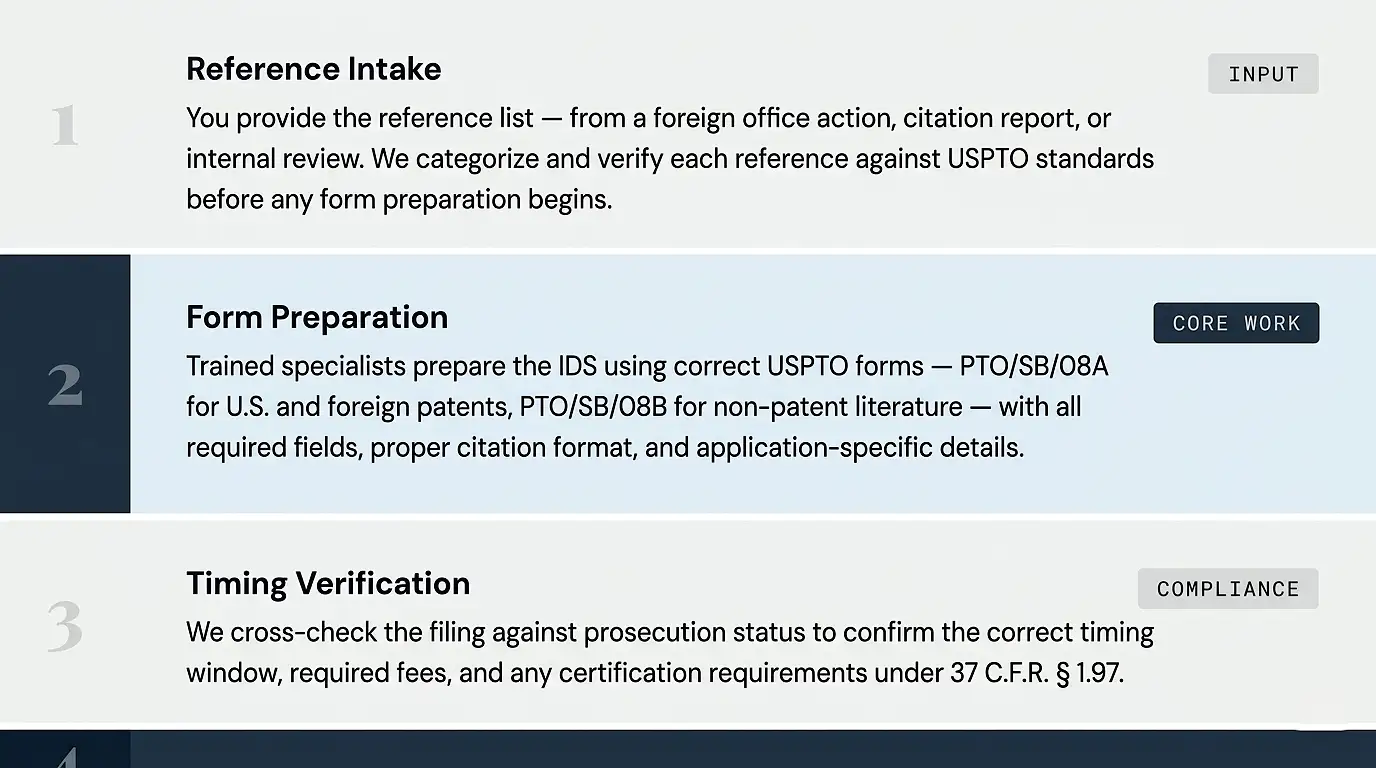
How Teak IP’s IDS Filing Process Works
Six-step managed workflow – from reference intake to USPTO confirmation
Our IDS Filing Process:
Step 1 – Reference Intake You provide us with the reference list (or raw materials from a foreign office action, citation report, or internal review). We categorize and verify each reference against USPTO standards.
Step 2 – Form Preparation
Our trained specialists prepare the IDS using correct USPTO forms – PTO/SB/08A for U.S. and foreign patents, PTO/SB/08B for NPL – with all required fields, proper citation format, and application-specific details.
Step 3 – Timing Verification
We cross-check the filing against prosecution status to confirm the correct timing window, required fees, and any certification requirements.
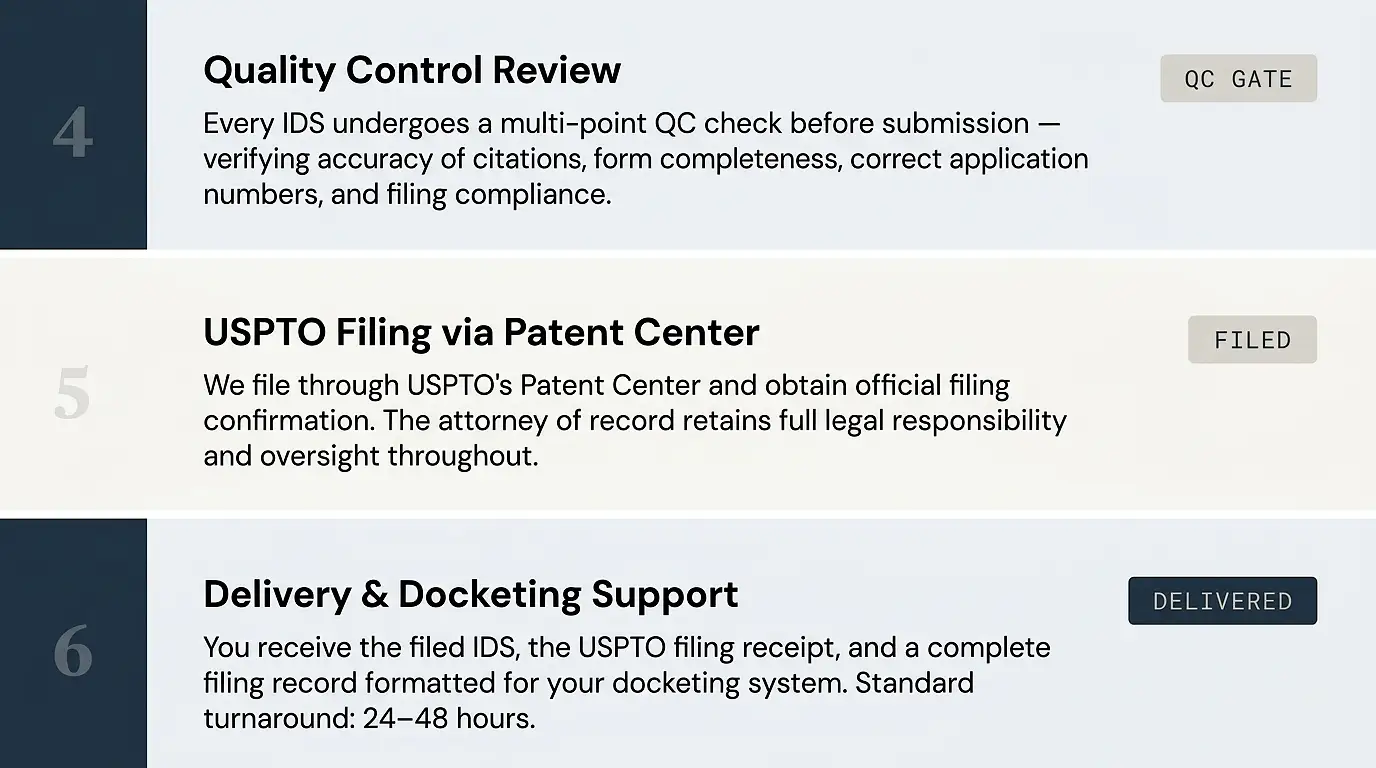
Step 4 – Quality Control Review
Every IDS undergoes a multi-point QC check before submission – verifying accuracy of citations, form completeness, and filing compliance.
Step 5 – USPTO Filing
We file through USPTO’s Patent Center and obtain official filing confirmation.
Step 6 – Delivery and Docketing Support
You receive the filed IDS, the USPTO filing receipt, and a complete filing record for your docketing system.
Our IDS Include:
- Standard and supplemental IDS preparation and filing
- Foreign patent and NPL processing
- Foreign office action review and reference extraction
- IDS tracking across related application families
- Continuation/divisional IDS coordination
- Expedited filing for time-sensitive matters
- Portfolio-level IDS audits for existing patents
Who Should Consider Outsource IDS filing ?
Outsourcing IDS filing isn’t just for large firms. It’s the right choice for any practice where:
- IDS volume is growing faster than internal capacity can absorb
- Attorney time is constrained and every billable hour matters
- Client cost sensitivity demands more efficient service delivery
- Foreign prosecution activity is generating a high volume of supplemental IDS triggers
- Compliance risk needs to be minimized and documentation needs to be airtight
- Staff turnover is creating gaps in institutional knowledge around IDS procedures
- The firm is scaling and needs a reliable, consistent IDS process that doesn’t depend on any single employee
Whether you’re a solo practitioner managing a growing client roster, a boutique firm expanding your prosecution practice, or a large firm looking to optimize operations – outsourcing IDS filing delivers measurable value.
Frequently Asked Questions (Outsource IDS filing)
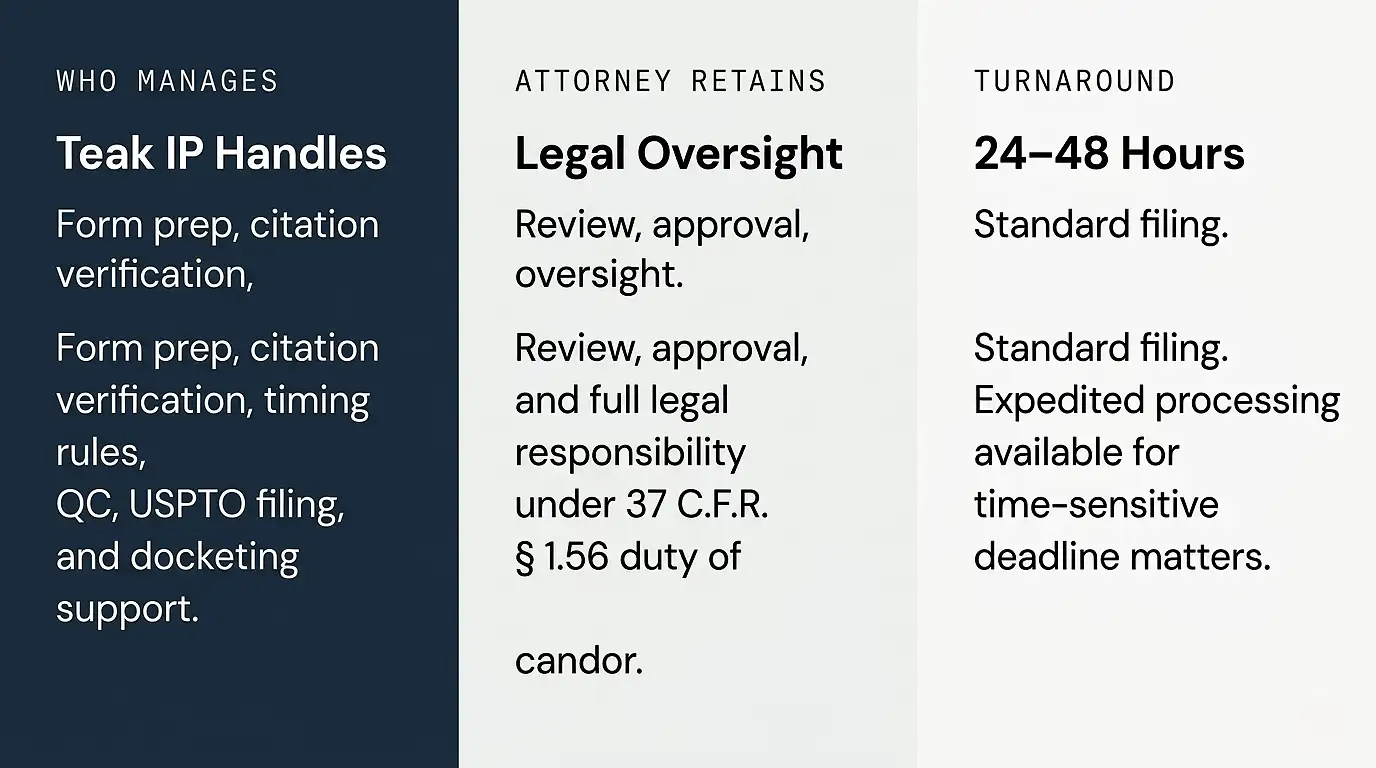
Q: Does outsourcing IDS filing mean the law firm loses control of the process? A: Not at all. The attorney of record retains full legal responsibility and oversight. The IDS service provider handles the administrative and procedural execution – preparing forms, verifying citations, and filing through Patent Center – while the attorney reviews and approves before submission.
Q: Is it ethical for a law firm to outsource IDS filing to a third party? A: Yes, provided appropriate safeguards are in place. Law firms routinely outsource non-legal administrative tasks to third-party vendors. Best practice includes having a confidentiality agreement with the provider and maintaining attorney oversight of the final filed document.
Q: What if the IDS service provider makes an error? A: A reputable provider will have quality control processes and indemnification provisions. At Teak IP, we maintain rigorous QC at every step and work transparently with our law firm partners to resolve any issues promptly.
Q: Can Teak IP handle IDS filings for large portfolio clients with hundreds of applications? A: Absolutely. Our processes are designed to scale. We work with firms of all sizes and handle high-volume portfolios with consistent turnaround and quality standards.
Q: How does Teak IP handle confidentiality of client and application information? A: We operate under strict NDAs and maintain robust data security protocols. Client information is never shared and is stored in compliance with applicable data protection standards.
Q: What is the typical turnaround time for an IDS filing with Teak IP? A: Standard turnaround is 24–48 hours from receipt of complete reference materials. Expedited filings are available for time-sensitive matters – contact us to discuss your specific needs.
Also, Read: IDS vs. Prior Art Disclosure: Key Points for Patent Owners
Conclusion: Outsource IDS filing
The question isn’t whether your practice can handle IDS filing in-house. The question is whether it makes sense – financially, operationally, and from a risk management perspective – to continue doing so.
When you add up attorney time, paralegal overhead, software costs, error risk, and opportunity cost, DIY IDS filing is almost always more expensive than it appears – and far more risky than it needs to be.
The firms and IP departments that are winning today aren’t trying to do everything themselves. They’re making strategic decisions about where their expertise adds the most value – and partnering with specialists for everything else.
Outsourcing IDS filing to a trusted provider like Teak IP is not a compromise. It’s a competitive advantage.
Ready to reclaim your attorneys’ time, reduce your compliance risk, and deliver more value to your clients? Contact Teak IP today and let’s talk about how our IDS filing can work for your practice.
Ready to strengthen your patent portfolio with expert IDS management?
Our Services: Access IDS Preparation & Filing Services Page

