
Legal Basis of an Information Disclosure Statement: The Duty of Candor
The requirement to file an IDS stems from 37 CFR § 1.56, which establishes a duty of candor and good faith with the USPTO. This duty applies to:
- Inventors named on the patent application
- Patent attorneys and agents prosecuting the application
- Assignees and other individuals substantively involved in preparing or prosecuting the application
Failure to comply with this duty can result in a finding of inequitable conduct, which can render a patent unenforceable – even if the invention itself is valid and novel.
Things to Know What is an Information Disclosure Statement

Also, Read: How to Prepare an IDS: A Step-by-Step Guide for Patent Applicants
What Must Be Disclosed in an IDS?
Any information that is material to patentability must be disclosed. Under 37 CFR § 1.56(b), information is considered material if it is not cumulative to information already of record and if it:
- Establishes (by itself or in combination with other information) a prima facie case of unpatentability
- Refutes or is inconsistent with a position the applicant takes in asserting an argument of patentability
Disclosed in IDS What is an Information Disclosure Statement

Common Types of Information Disclosed in an IDS:
- Prior art patents – Both U.S. and foreign patents that relate to the invention
- Published patent applications – Pre-grant publications from any country
- Scientific and technical literature – Journal articles, conference papers, white papers
- Non-patent literature (NPL) – Books, manuals, product brochures, standards
- Prior use evidence – Public demonstrations, sales, or offers for sale predating the filing
- Prior art cited in related applications – References cited in parent, divisional, or continuation applications
- Prior art cited in foreign counterpart applications – References from international searches (PCT, EPO, JPO, etc.)
- Information from litigation – Prior art identified during patent lawsuits involving related patents
When Must an IDS Be Filed?
Timing is critical when it comes to IDS submissions. The USPTO has established specific windows for filing — and the requirements differ significantly depending on when the IDS is submitted.
IDS Timing Windows What is an Information Disclosure Statement
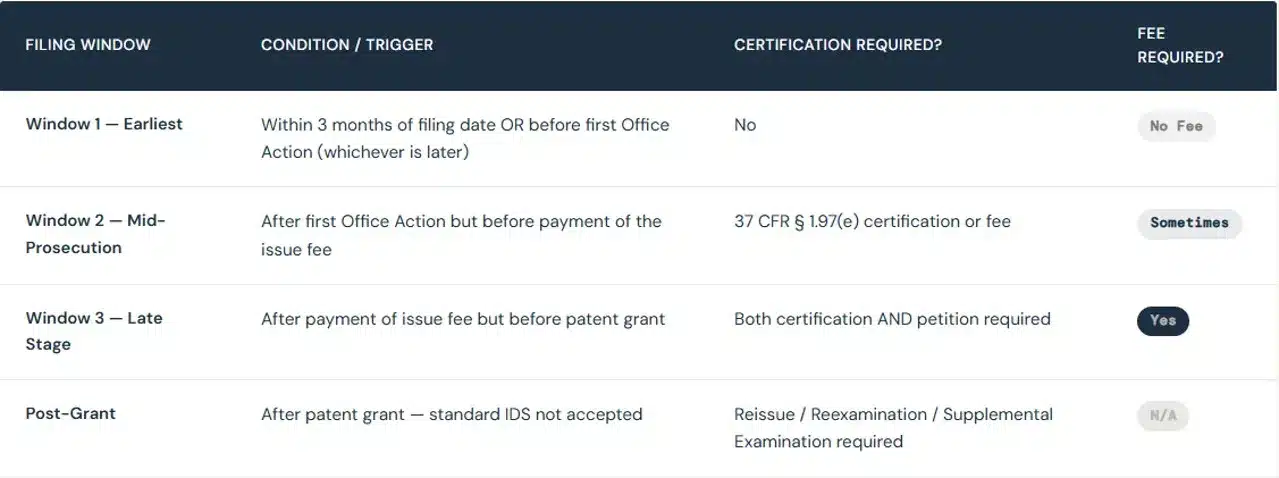
Best Practice: Submit your IDS as early as possible in the prosecution process. Early submission eliminates the risk of timing-related complications and additional fees.
How to Prepare an IDS: Step-by-Step
Filing a complete and accurate IDS requires diligence. Here’s how the process typically works:
Step 1: Conduct a Prior Art Search for an Information Disclosure Statement
Before or during the application process, conduct a thorough prior art search covering:
- USPTO patent databases
- European Patent Office (Espacenet)
- Google Patents
- Relevant technical literature databases (IEEE, PubMed, etc.)
Step 2: Collect All Known References for the IDS
Gather every reference that could be material to the patentability of your claims, including:
- References uncovered during your own R&D
- References cited in any related or foreign application
- Anything cited by the examiner in a related case
Step 3: Complete the IDS Form (USPTO Form PTO/SB/08)
For each reference, provide:
- Patent number or application number
- Country of origin
- Date of publication or issue
- Name(s) of patentee(s) or applicant(s)
- For NPL: Title, publication name, volume, page numbers, and date
Step 4: Provide Copies of References in the Information Disclosure Statement
You must provide a legible copy of each reference unless:
- It is a U.S. patent or U.S. patent application publication
- It was previously submitted in the same application
- It is cited in an IDS filed during a reexamination
Step 5: Submit the Information Disclosure Statement During Patent Prosecution
File the IDS through the USPTO’s Electronic Filing System (EFS-Web/Patent Center) with the appropriate certification or fee if required by the timing rules.
IDS in International Patent Applications
If you are pursuing international patent protection through the Patent Cooperation Treaty (PCT), you should also be aware of related obligations:
- International Search Reports (ISR) generated during PCT prosecution must typically be submitted to the USPTO in corresponding U.S. applications
- Office Actions from foreign counterpart applications may generate prior art that needs to be disclosed in the U.S. application
- References cited during prosecution of European, Japanese, Chinese, or Korean applications should be reviewed and submitted as needed
Pro Tip: Maintain a system to track foreign prosecution activity so relevant prior art is captured and submitted promptly in the U.S. application.
Consequences of Failing to File a Proper IDS
The stakes of non-compliance are very high. Failing to submit a complete and timely IDS — or worse, deliberately withholding material information — can have severe consequences:

Inequitable Conduct
If a court finds that an applicant intentionally withheld material information with an intent to deceive the USPTO, the patent can be declared unenforceable due to inequitable conduct. This is sometimes called the “atomic bomb” of patent law – once found, it cannot be cured.
Patent Invalidity
Material prior art not disclosed during prosecution can later be used by competitors in inter partes review (IPR) or district court litigation to invalidate the patent.
Malpractice Exposure
Patent practitioners who fail to advise clients properly about IDS obligations can face professional liability and malpractice claims.
Reputational Damage
A finding of inequitable conduct can seriously damage an inventor’s or company’s credibility in future patent proceedings.
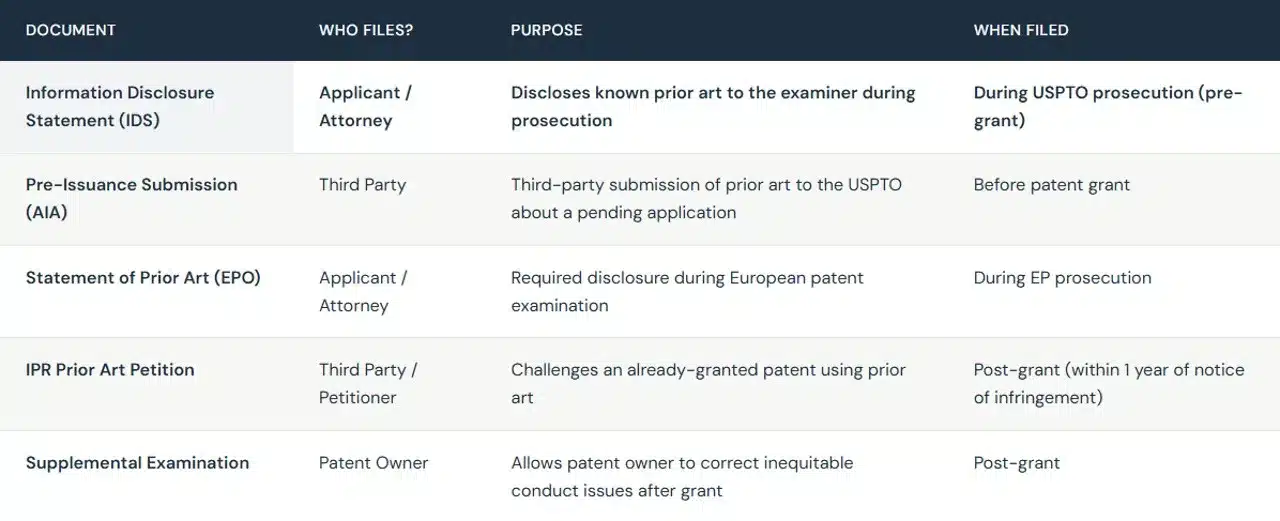
IDS vs. Prior Art Statement: Key Differences
Many applicants confuse an IDS with other prior art-related filings. Here’s a quick comparison:
Best Practices for Managing IDS Obligations
Managing IDS obligations across a growing patent portfolio can be complex. Here are best practices Teak IP recommends:

- Implement a prior art tracking system – Use docketing software or spreadsheets to track all references identified during R&D, prosecution, and litigation
- Train your inventors – Educate your R&D teams to forward relevant publications and competitor patents to your IP team regularly
- Monitor related applications – Set alerts for office actions in related U.S. and foreign cases that may generate citable prior art
- File early and often – Don’t wait until the last moment; submit supplemental IDS filings as new material references are discovered
- Review international search reports immediately – When you receive an ISR or foreign office action, review it promptly and file a corresponding IDS if needed
- Work with experienced IP counsel – Given the complexity of IDS rules, work with qualified patent attorneys to ensure full compliance
How Teak IP Can Help
At Teak IP Services, we specialize in providing comprehensive patent prosecution support, including:
- IDS preparation and filing – We handle the entire process from prior art collection to USPTO submission
- Prior art search and analysis – We conduct thorough searches to identify all relevant references
- Portfolio-level IDS management – For clients with large patent portfolios, we implement systems to track and manage IDS obligations across hundreds of applications
- International coordination – We coordinate with foreign associates to ensure that references cited abroad are captured and disclosed in U.S. applications
- IDS audits – We review existing applications to identify potential gaps in prior art disclosure
Whether you’re an independent inventor filing your first patent or an enterprise managing a global IP portfolio, Teak IP has the expertise to keep your patents strong, valid, and enforceable.
Frequently Asked Questions (FAQs) About an Information Disclosure Statement
Q1: Is filing an IDS mandatory?
Yes. All individuals associated with the filing or prosecution of a patent application have a duty to disclose known material information to the USPTO under 37 CFR § 1.56.
Q2: Does citing a reference in an IDS mean it will reject my patent?
Not necessarily. Disclosing a reference does not mean the examiner will use it to reject your claims. The examiner determines whether the reference is material to the specific claims being pursued.
Q3: How many references can be included in an IDS?
There is no strict limit, but be thoughtful. Submitting an overwhelming number of marginally relevant references can slow prosecution. Focus on what is genuinely material.
Q4: What happens if I discover new prior art after my patent is granted?
Once a patent is granted, the standard IDS process no longer applies. Options include ex parte reexamination, inter partes review, or supplemental examination to address newly discovered prior art.
Q5: Do I need to submit foreign language references?
You must submit a copy of foreign language references but are not always required to provide a translation. However, a concise explanation of relevance is required.
Q6: What is a 37 CFR § 1.97(e) certification?
This is a certification that either (a) each item of information was first cited in a communication from a foreign patent office not more than three months prior to filing the IDS, or (b) no item of information was known to any individual associated with the application more than three months prior to filing the IDS. This certification allows late IDS filings without a fee under certain conditions.
Conclusion: What Is an Information Disclosure Statement and Why It Matters
Understanding what is an information disclosure statement is not just a matter of legal compliance – it’s a cornerstone of building a defensible, enforceable patent portfolio. An IDS filed completely and on time demonstrates good faith with the USPTO, strengthens the presumption of validity of your patent, and protects your invention from future invalidity challenges.
The consequences of getting it wrong – from unenforceability to patent invalidation – are too significant to leave to chance. At Teak IP Services, we are committed to helping you navigate these obligations with confidence.
Ready to strengthen your patent portfolio with expert IDS management?
👉 Contact Teak IP Services Today | Explore Our Patent Services | IDS Preparation & Filing Services

