

This comprehensive guide explores what a trademark monitoring report looks like, why it matters, and how it can safeguard your intellectual property investment. Learn about the different types of trademark monitoring reports available and what key information they contain to help you make informed brand protection decisions.
Download Now:
Why Trademark Monitoring Matters (Trademark Monitoring Report Sample)
Trademark registration is just the beginning of brand protection. Consider these critical facts:
-
- New trademark applications are filed continuously through the USPTO and international databases
-
- Potential infringers may not intentionally copy your brand—many conflicts arise from similar marks filed independently
-
- Early detection of conflicting marks allows you to take action before infringers establish market presence
-
- Brand dilution—even from non-competing marks—can weaken your trademark’s distinctiveness and enforcement strength
Types of Trademark Monitoring Report Sample
Trademark monitoring services typically offer two main types of reports. Each provides different levels of oversight depending on your brand protection needs.
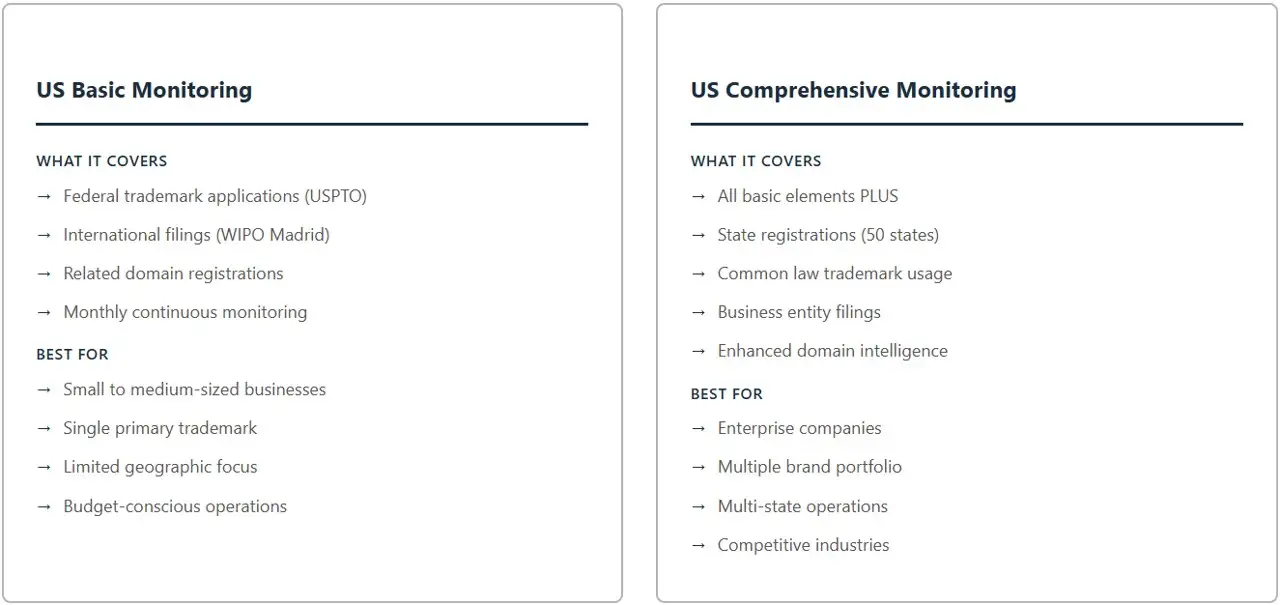
1. US Basic Trademark Monitoring Report Sample
What It Covers:
- Federal trademark applications and registrations (USPTO)
- International trademark filings (WIPO Madrid Database)
- Related domain name registrations
- Monthly continuous monitoring with organized results
Best For:
- Small to medium-sized businesses with a single primary trademark
- Brands with limited geographic expansion plans
2. US Comprehensive Trademark Monitoring Report Sample
What It Covers (Beyond Basic):
- All basic monitoring elements, PLUS:
- State-level trademark registrations (all 50 U.S. states)
- Common law trademark usage (unregistered but legally protected brand uses)
- Business entity filings and registrations
- Enhanced domain intelligence with WHOIS details
Best For:
- Enterprise companies with multiple brands and geographic reach
- Brands that need complete visibility across all legal channels
Key Components of a Trademark Monitoring Report Sample
A professional trademark monitoring report should include these essential sections:
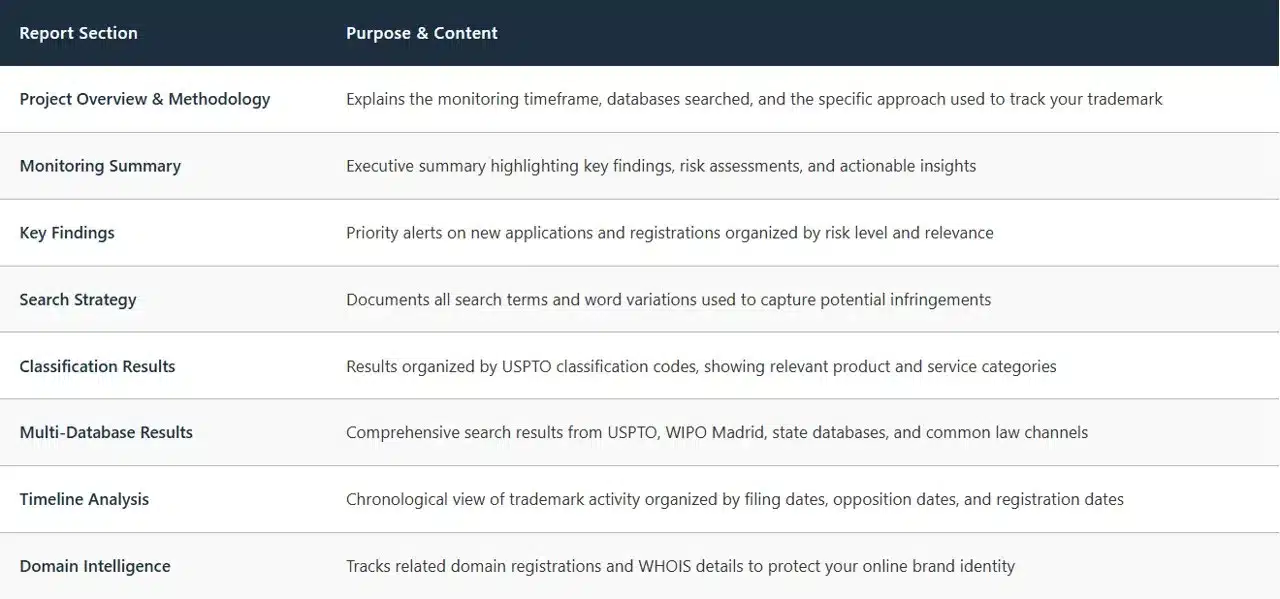
Project Overview & Methodology
Explains the monitoring timeframe, databases searched, and the specific approach used to track your trademark.
Monitoring Summary
Executive summary highlighting key findings, risk assessments, and actionable insights.
Key Findings
Priority alerts on new applications and registrations organized by risk level and relevance.
Search Strategy
Documents all search terms and word variations used to capture potential infringements.
Classification Results
Results organized by USPTO classification codes, showing relevant product and service categories.
Multi-Database Results
Comprehensive search results from USPTO, WIPO Madrid, state databases, and common law channels.
Timeline Analysis
Chronological view of trademark activity organized by filing dates, opposition dates, and registration dates.
Domain Intelligence
Tracks related domain registrations and WHOIS details to protect your online brand identity.
What Makes an Effective Trademark Monitoring Report Sample
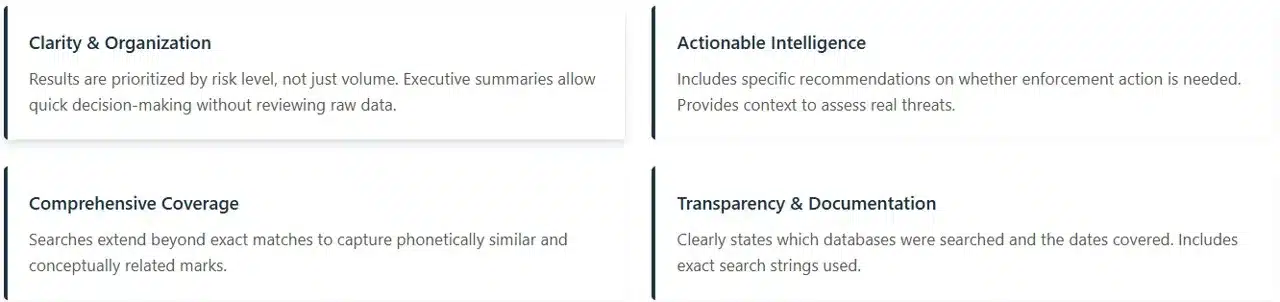
Clarity & Organization
- Results are prioritized by risk level, not just volume
- Executive summaries allow quick decision-making without reviewing raw data
Actionable Intelligence
- Includes specific recommendations on whether enforcement action is needed
- Provides context about competing marks to help you assess real threats
Comprehensive Coverage
- Searches extend beyond exact matches to capture phonetically similar and conceptually related marks
- Monitors multiple databases to ensure no threats slip through undetected
Transparency & Documentation
- Clearly states which databases were searched and the dates covered
- Includes the exact search strings and variations used, allowing you to verify methodology
How to Use Your Trademark Monitoring Report Sample
Receiving a report is just the first step. Here’s how to maximize its value:

1. Review the Executive Summary First Identify the month’s key threats and risk level. This allows you to prioritize your response immediately.
2. Assess Risk Level for Each Finding Not all findings require action. Determine whether each threat is a direct competitor, in a related field, or purely coincidental based on your brand’s market position.
3. Take Strategic Action High-risk findings may warrant a cease-and-desist letter, opposition filing, or cancellation proceedings. Medium-risk findings might benefit from monitoring before action. Low-risk findings can often be noted for future reference.
4. Document Your Response Keep records of which findings you investigated and what actions you took. This documentation is valuable for proving trademark enforcement efforts if litigation occurs later.
Frequency: Why Monthly Reports Matter
Monthly trademark monitoring offers several advantages over less frequent alternatives:

Early Detection Window Trademark applications undergo a standard examination timeline of 3-6 months. Monthly reports catch threats during this vulnerable window before they become registered marks.
Market Protection Competitors may begin using their mark in commerce immediately after filing. Monthly monitoring allows you to identify and potentially challenge them before they establish market presence.
Manageable Workload Monthly reports keep findings current and manageable. Quarterly or annual reports may result in hundreds of findings, making it difficult to prioritize effectively.
Litigation Advantage Regular monitoring and documented responses demonstrate diligent brand protection efforts, which strengthens your position in potential infringement litigation.
Choosing Your Monitoring Level
Your choice between basic and comprehensive monitoring depends on several factors:
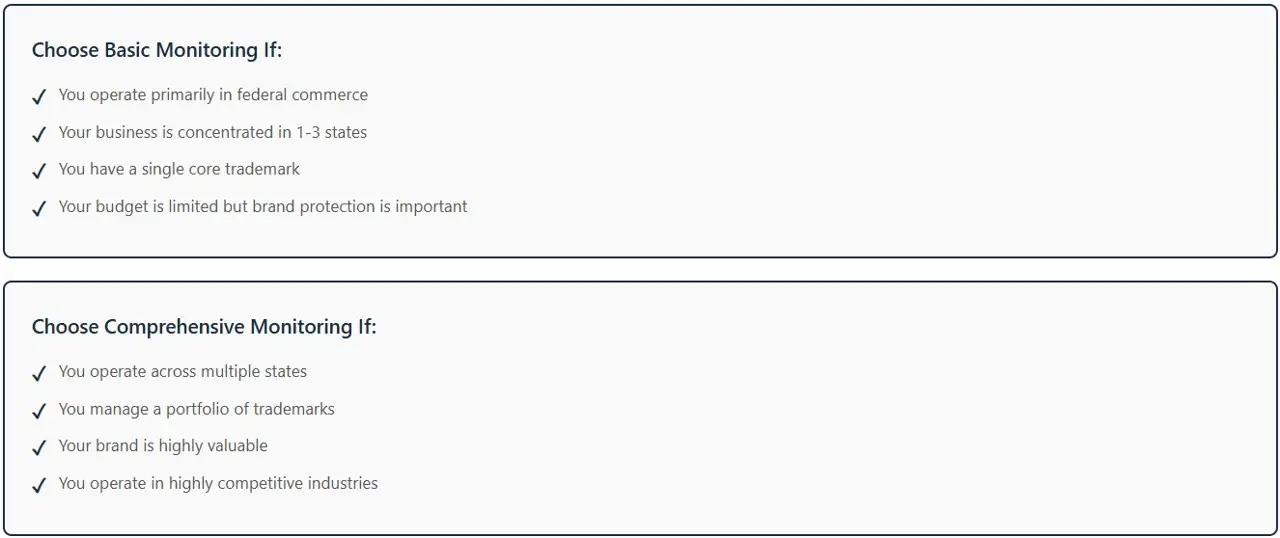
Choose Basic Monitoring If:
- You operate primarily in federal commerce
- Your business is concentrated in 1-3 states
- You have a single core trademark
- Your budget is limited but brand protection is important
Choose Comprehensive Monitoring If:
- You operate across multiple states
- You manage a portfolio of trademarks
- Your brand is highly valuable and requires maximum protection
- You operate in highly competitive industries
Real-World Impact: Understanding Actual Report Findings
Sample reports typically include various types of findings. Here’s how to interpret them:
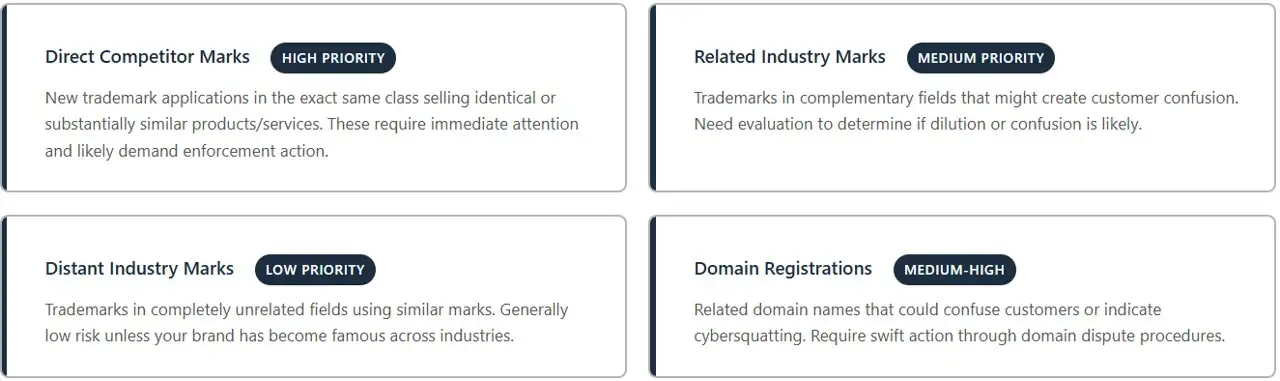
Direct Competitor Marks A new trademark application in the exact same class as your business selling identical or substantially similar products/services. These require immediate attention and likely demand enforcement action.
Related Industry Marks Trademarks in complementary fields that might create customer confusion. These need evaluation to determine if dilution or confusion is likely based on your brand’s reputation and market reach.
Distant Industry Marks Trademarks in completely unrelated fields using similar marks. Generally low risk unless your brand has become famous/well-known across industries.
Domain Registrations Related domain names that could confuse customers or indicate cybersquatting. These require swift action, often through domain dispute procedures.
Taking Action on Monitoring Findings
Once you’ve identified a threat, several enforcement options are available:
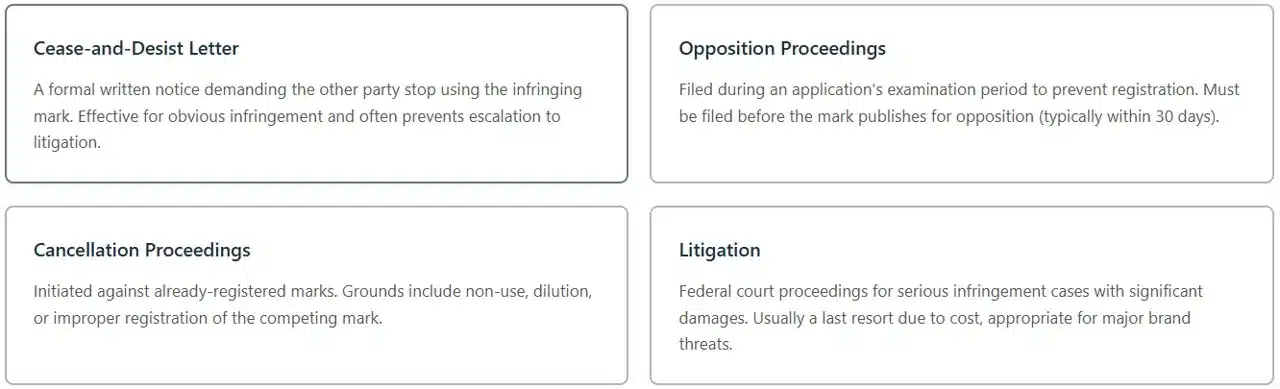
Cease-and-Desist Letter A formal written notice demanding the other party stop using the infringing mark. Effective for obvious infringement and often prevents escalation to litigation.
Opposition Proceedings Filed during an application’s examination period to prevent registration. Must be filed before the mark publishes for opposition (typically within 30 days of publication).
Cancellation Proceedings Initiated against already-registered marks. Grounds include non-use, dilution, or improper registration.
Litigation Federal court proceedings for serious infringement cases with significant damages. Usually a last resort due to cost, but appropriate for major brand threats.
Aslo, Read: Trademark Search Report Sample
Best Practices for Trademark Monitoring
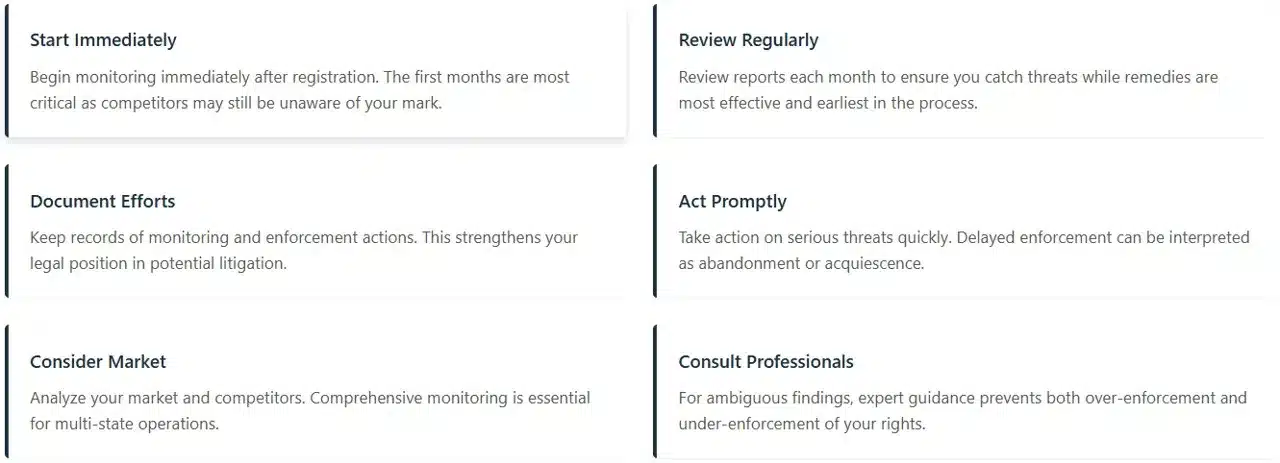
- Start monitoring immediately after registration. The first months are most critical as competitors may still be unaware of your mark.
- Review reports regularly. Monthly review ensures you catch threats while remedies are most effective.
- Document your enforcement efforts. Records of monitoring and enforcement actions strengthen your legal position.
- Act promptly on serious threats. Delayed enforcement can be interpreted as abandonment or acquiescence.
- Consider your market and competitors. Comprehensive monitoring is essential if you operate across multiple markets.
- Consult IP professionals for gray areas. When findings are ambiguous, expert guidance prevents both over-enforcement and under-enforcement.
Conclusion: Ongoing Protection for Your Brand
A trademark monitoring report is far more than administrative paperwork—it’s your early warning system against brand threats. By understanding what these reports contain and how to use them effectively, you transform them from data into actionable intelligence that protects your most valuable business asset.
Whether you choose basic monitoring for federal coverage or comprehensive monitoring for complete market visibility, regular trademark oversight ensures that your brand remains protected indefinitely. The investment in consistent monitoring is minimal compared to the cost of defending against diluted brand equity or fighting infringement in court.
Ready to protect your brand continuously? Download a sample report today to see the exact intelligence and findings format you’ll receive on a monthly basis. Protect your brand before threats become problems—the earlier you detect and address infringement, the stronger your legal position and the healthier your brand equity will remain.
Download Trademark Reports Now
Service Page Weblink: Discover Trademark Monitoring Services

