
One of the most persistent misconceptions in international patent law is that applicants can file a “PCT provisional applications.” This simply does not exist. However, understanding how to strategically combine U.S. provisional applications with PCT filings – or choosing alternative filing routes – can save significant costs while maximizing protection. This comprehensive guide clarifies the myths, explores your options, and provides actionable strategies for managing your 12-month priority window.
1. Can You File a PCT Provisional? (Clarifying Misconceptions)
The Simple Answer: No
There is no such thing as a PCT provisional application. The Patent Cooperation Treaty framework does not offer a provisional filing option. This is one of the most common misunderstandings among startups and emerging companies seeking to protect innovations internationally.
Why the Confusion?
The confusion typically arises from conflating two separate concepts:
- U.S. Provisional Patent Applications: Available under U.S. patent law (35 U.S.C. § 111(b)) and filed only with the U.S. Patent and Trademark Office (USPTO).
- PCT Applications: Filed under the Patent Cooperation Treaty with designated countries’ patent offices but not available in provisional form.
What Actually Exists
- Provisional Patent Applications: Available only in the United States (and a few other countries like Australia and India in limited forms)
- PCT Regular Applications: Available to applicants from PCT member states (currently 157 countries)
- Non-Provisional Patent Applications: Available globally through national and regional patent offices
Critical Clarification: If you want to file internationally through the PCT, your initial U.S. filing must be either a U.S. non-provisional application or a U.S. provisional application that is later converted or referenced for priority. Simply filing a “PCT provisional” does not exist in any patent office’s regulations.
2. US Provisional Application as PCT Priority Basis
What is a Priority Claim?
A priority claim is your legal right to claim the earlier filing date of an original patent application. If you file a U.S. provisional application on January 15, 2024, and later file a PCT application claiming priority to that provisional on January 10, 2025, your PCT application receives the January 15, 2024 filing date for priority purposes.
How U.S. Provisionals Work as Priority
Key Advantages:
- Lower upfront costs: Provisional applications are cheaper than non-provisional filings
- 12-month grace period: You have 12 months from the U.S. provisional filing date to file the actual patent application
- Flexible timeline: Allows you to test market reception, secure funding, or refine your invention
- Earlier priority date: Your later formal application benefits from the earlier provisional date
Important Limitations:
- Provisional applications are NOT examined
- They expire after 12 months
- They do NOT automatically convert to an application – you must file a proper application claiming priority
- They must adequately describe the invention (though less rigorous than formal applications)
Filing a Provisional, Then Converting to PCT
Timeline Example:
- Day 1 (January 15, 2024): File U.S. provisional application (Cost: ~$100-$300)
- Month 12 (January 2025): File PCT application claiming priority to the provisional (Cost: ~$2,000-$4,000 globally)
- Month 30 (July 2025): National phase entry into individual countries begins (Costs vary by country)
Priority Chain Benefits
When you file a PCT application claiming priority to a U.S. provisional:
- Your effective priority date is the provisional filing date
- Earlier applicants cannot block your PCT filing on prior art grounds
- Your invention appears to have been conceived/developed earlier in the eyes of patent offices
- You benefit from a stable priority date while keeping international options open
3. PCT vs. Paris Convention Route
Understanding Your International Filing Options
Patent applicants have two main routes for seeking international protection: the Paris Convention route and the PCT route. Understanding the differences is critical for strategic planning.
International Patent Filing Routes (PCT Provisional Applications)

Paris Convention Route
What It Is:
The Paris Convention for the Protection of Industrial Property (established 1883) is a treaty allowing applicants to file directly in multiple countries within 12 months of their initial filing.
How It Works:
- File initial application in your home country (e.g., U.S. non-provisional)
- Within 12 months, file separate applications directly with each country’s patent office
- Each country application claims priority to your initial application
Advantages:
- Direct relationship with each national patent office
- No additional PCT fees
- Potentially faster examination in some countries
- More control over application specifics per jurisdiction
Disadvantages:
- Multiple filing fees (filing in 10 countries = 10 separate applications)
- Language translation costs for each country
- Requires managing individual applications and deadlines
- Higher administrative burden
- Provisional applications do NOT extend beyond 12 months for national filings
Cost Estimate: $5,000-$15,000+ depending on number of countries and translation needs
PCT Route
What It Is:
An international patent application system administered by the World Intellectual Property Organization (WIPO) that allows filing ONE application to claim protection in up to 157 countries.
How It Works:
- File initial PCT application (which designates countries)
- PCT examiner conducts International Search and Preliminary Examination
- At 30-31 months after priority date, file in national/regional phases
- Each designated country’s office conducts its own examination
Advantages:
- File one application instead of many
- Automatic priority to all designated countries
- Preliminary examination report helps assess patentability
- More time to decide where to actually pursue protection (national phase)
- Professional International Search Report (ISR)
Disadvantages:
- PCT filing fee ($4,000+ depending on country of origin)
- Still must pay national phase entry fees (usually lower than Paris Convention direct filing)
- Additional examination reports add time before patent grant
- Longer path to issuance compared to national filing
Cost Estimate: PCT phase: ~$4,000-$6,000 | National phase (10 countries): ~$8,000-$20,000 depending on costs and prosecution
Side-by-Side Comparison (PCT Provisional Applications)

Choosing Between Routes
Choose Paris Convention if:
- You know exactly which countries you need protection in
- You want to minimize costs
- Speed to issuance is critical
- Targeting primarily one region
Choose PCT if:
- You’re uncertain about target markets
- You want to maintain flexibility
- You want a professional patentability assessment before large spending
- You’re targeting 5+ countries
Aslo, Read: ePCT Filing Guide using Online PCT Application System Guide
4. Converting Provisional to PCT Application
The Conversion Process
Converting a U.S. provisional application into a PCT filing is a common and strategic approach. This section explains exactly how it works.
Method 1: Direct PCT Filing with Priority Claim
Process:
- File a PCT application before the 12-month deadline of your provisional
- File with the USPTO as the receiving office
- Claim priority to the U.S. provisional
- Include claims in the PCT application (provisionals typically don’t require claims)
Requirements:
- PCT must reference the U.S. provisional filing date and number
- PCT application must contain at least one independent claim
- Application must contain a description enabling one of ordinary skill to make and use the invention
Timeline:
- File provisional: January 15, 2024
- File PCT claiming priority: Any day before January 15, 2025
- Latest practicality: December 2024 (to allow processing time)
Advantages:
- Single priority date across all designated countries
- Maintains relationship to U.S. filing
- Professional examination through PCT process
- Lowest-cost international expansion
Method 2: File U.S. Non-Provisional Claiming Provisional Priority
Process:
- File U.S. non-provisional claiming priority to provisional
- File PCT within 12 months claiming priority to either provisional or non-provisional
- Your non-provisional can reference provisional in supporting documentation
When This Matters:
- You need formal examination before international expansion
- You want a second opinion from USPTO examiners
- You’re unsure about international markets
Advantages:
- Full U.S. examination occurs first
- PCT examiner has benefit of prior U.S. examination
- More robust U.S. patent position
Disadvantage:
- Additional cost of non-provisional filing (~$1,000-$2,000)
Critical Timing Requirements
The 12-Month Window is Absolute:
- Provisional filed: January 15, 2024
- Last day to file PCT: January 14, 2025
- One day late = complete loss of priority
What This Means: Set calendar reminders at 6 months and 3 months before deadline. Account for holidays and weekends. If approaching deadline, consider filing continuation applications. Never rely on mail delivery dates—file electronically.
Documents You Need
For a Provisional-to-PCT Conversion:
- Specification (description of invention)
- Drawings (if any)
- Claims (must be added; provisionals typically omit these)
- Priority claim statement
- Filing fee
Common Mistakes:
- Omitting claims in PCT application
- Failing to properly reference provisional number
- Missing priority claim language
- Filing without confirming adequate disclosure in provisional
5. Strategic Use of Provisional + PCT Combination
The Optimal 24-Month Strategy
Many sophisticated patent applicants use a combination of U.S. provisional and PCT filings to maximize strategic advantage. Here’s how:
Phase 1: U.S. Provisional (Month 0)
What to Do:
- File provisional with comprehensive specification
- Include detailed drawings
- Describe all known variations and embodiments
- Include claims (even though not required)
- Focus on broadest possible language
Investment: $100-$300
Purpose: Establish earliest possible priority date | Test market acceptance with provisional filing | Signal IP activity to investors
Phase 2: Market/Product Development (Months 1-10)
What to Do:
- Test product in market
- Gather customer feedback
- Refine technical specifications
- Determine international markets needed
- Build competitive landscape analysis
Investment: Time and market research
Purpose: Informed decision-making on international expansion | Identify most valuable territories | Understand competitive threats
Phase 3: PCT Filing (Month 11-12)
What to Do:
- File PCT claiming priority to provisional
- Refine claims based on Phase 2 learnings
- Include new dependent claim variations discovered during Phase 2
- Designate countries strategically based on market analysis
Investment: $4,000-$6,000
Purpose: Obtain International Search Report (ISR) from WIPO | Professional patentability assessment | Maintain priority date globally | Buy time before National Phase commitment
Phase 4: Written Opinion Review (Months 18-22)
What to Do:
- Receive PCT International Preliminary Examination Report (IPER)
- Conduct freedom-to-operate analysis
- Evaluate market conditions in each designated country
- Adjust claims based on IPER suggestions
Purpose: Understand patentability challenges early | Make informed decisions about which countries to pursue
Phase 5: National Phase Filings (Months 28-31)
What to Do:
- File in selected countries’ national patent offices
- Pay national phase entry fees
- Submit country-specific responses to office actions
Investment: $8,000-$20,000+ depending on countries
Purpose: Obtain actual patents in target markets | Complete patent prosecution
Why This Strategy Works
Cost Efficiency:
Provisional ($300) + PCT ($5,000) + 5 countries ($12,000) = $17,300 vs. Direct Paris Convention filing in 5 countries ($8,000-$15,000) PLUS costs of additional countries if markets expand
Timeline Benefits:
Total time to first patents: ~33 months (if pursuing quickly in national phase) | Time to understand international market: 12 months | Flexibility to adjust strategy: Throughout 30-month period
Risk Reduction:
Don’t invest heavily in weak markets | Leverage WIPO examination before national investment | Gather competitive intelligence before commitment
Real-World Example: SaaS Startup
Scenario:
A SaaS company develops innovative software for data analytics.
Timeline:
- January 2024: File U.S. provisional ($250 cost)
- January 2024-December 2024: Develop MVP, test with customers, secure Series A funding
- November 2024: File PCT application designating US, Europe (EP), China (CN), Japan (JP), Canada (CA) ($5,200 cost)
- June 2025: Receive WIPO ISR indicating strong patentability
- August 2025: Receive Preliminary Examination Report
- November 2025: National phase planning begins
- January 2026: Enter national phase in US, EP, CN, JP, CA ($14,000 cost)
Total Investment:
~$19,450 for protection in 5 major markets with 30-month runway
Alternative (Paris Convention):
January 2024: File U.S. non-provisional ($1,500 cost) | January 2025: File applications in EP, CN, JP, CA simultaneously ($12,000 cost) | Total: $13,500 but with less flexibility and information
Also, Read: National Phase Entry Patent Filing Process, Deadline and Strategy
6. 12-Month Timeline Management
Critical Dates and Deadlines
The 12-month window from your provisional filing is absolute. Missing this deadline means losing priority. Here’s how to manage it strategically.
Timeline Overview
| Month | Action | Deadline Risk | Cost |
|---|---|---|---|
| 0 | File provisional | N/A | $100-$300 |
| 1-3 | Develop business plan | Low | Minimal |
| 4-6 | First market research | Low | Minimal |
| 7-9 | Finalize PCT filing plan | Medium | Time intensive |
| 10 | Prepare PCT application | Medium | Minimal |
| 11 | File PCT | CRITICAL | $4,000-$6,000 |
| 12 | Provisional expires | FINAL | Lost priority if no PCT filed |
Month 0-3: Filing and Initial Planning
Day 1 (Filing Day):
- File provisional application with USPTO
- Save filing receipt date (your priority date)
- Set calendar reminders:
- Red alert at 6-month mark
- Yellow alert at 9-month mark
- Critical alert at 10-month mark
Month 1:
- Conduct internal prior art search
- Begin competitive analysis
- Document all technical improvements
- Assess market opportunity
Month 3:
- First comprehensive business review
- Evaluate patentability concerns
- Determine provisional adequacy
- Plan next steps
4-9 Months: Decision Period
Month 4-6 (Midpoint):
Red Flag Alert: You’re halfway through your 12-month window
- Conduct freedom-to-operate analysis
- Research target markets
- Meet with patent counsel
- Draft provisional PCT application outline
Month 7-9 (Final Decision Period):
Final Decision Window: Determine whether to pursue PCT
- If pursuing: Prepare PCT application thoroughly
- If not pursuing: Document business justification
- Finalize claim strategies
- Budget for international filings
Month 10-11: Critical Filing Phase
Month 10 (One Month Before Deadline):
CRITICAL DEADLINE LOOMING: Two weeks until safe filing
- Submit final PCT application to counsel for review
- Prepare all required documentation
- Arrange payment/authorization
- Confirm all priority information
Month 11 (Last Month Before Deadline):
FINAL TWO WEEKS: File PCT application
- File electronically (avoids mail delays)
- Confirm receipt from WIPO
- Save all confirmation documentation
- Immediately update calendar with new deadlines (30-month national phase deadline)
Month 12 and Beyond
Day 365-366 (Provisional Expiration):
- Provisional application automatically expires
- Non-existent unless you’ve filed a continuing application
- If PCT was filed, it continues with international priority
- If no PCT filed, you’ve lost the priority date
What Happens If You Miss the Deadline?
Scenario 1: PCT Filed After 12-Month Window
- You’ve lost priority to the provisional
- Your PCT filing date becomes the priority date
- Competitors’ disclosures between provisional date and PCT date can destroy patentability
- Your patent position is materially weakened
Scenario 2: No PCT Filed Within 12 Months
- Provisional completely expires
- You lose all rights under the provisional filing
- Filing a standalone PCT application loses priority
- You’ve wasted the provisional filing cost
Also, Read: PCT Filing Costs and Fees: Complete Breakdown
7. Cost-Benefit Analysis: Provisional First Approach
Cost Structure Comparison
Understanding the full cost picture is essential for strategic decision-making. Here’s a detailed breakdown.
1st Scenario: Provisional + PCT + National Phase (10 Countries) (PCT Provisional Applications)

2nd Scenario: Direct Paris Convention Filings (10 Countries) (PCT Provisional Applications)

3rd Scenario: Provisional Only (No International, U.S. Only) (PCT Provisional Applications)

When is PCT Worth the Cost?
True Cost of International Protection:
- PCT adds $4,500-$5,500 to cost
- National phase adds $8,000-$15,000 (varies by country)
- But eliminates $3,000-$8,000 in direct translation/filing costs
When Provisional + PCT Makes Economic Sense:
- Targeting 4+ countries internationally
- Product will be sold globally
- Competitors likely in multiple jurisdictions
- International market size > domestic market
- Seeking investor funding (PCT signals global ambitions)
- Uncertain about exact target markets
Skip PCT if ALL of these apply:
- Targeting U.S. market only
- No international market plans
- Budget is severely limited (<$10,000 total)
- Technology unlikely to appeal internationally
- Domestic market is sufficient for business model
Also, Read: Comprehensive PCT Guide: Mastering International Patent Applications
8. When to Skip the Provisional Route
Situations Where Provisional Applications Are NOT Recommended
Despite their advantages, provisional applications are not appropriate in every situation. Understanding when to skip the provisional route saves money and prevents strategic missteps.
When To Skip Provisional Route 8 Situations (PCT Provisional Applications)
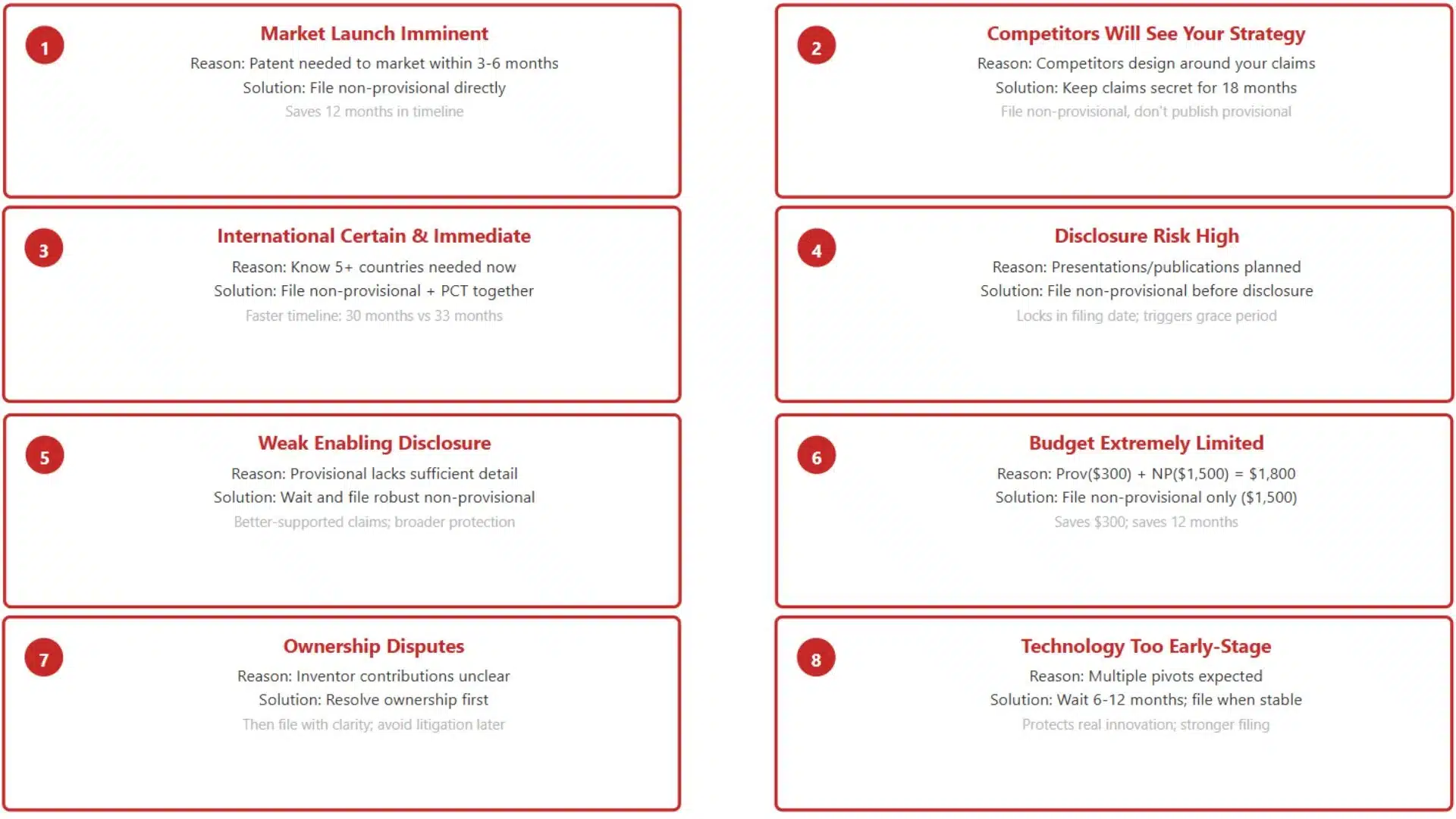
Reason 1: Invention Requires Immediate Prosecution
When This Applies:
- You need a patent to market your product now
- Sales are imminent (within 3-6 months)
- Regulatory approval requires issued patents
- Investors demand issued patents before funding
- Competitors are close to disclosing similar technology
Solution:
File non-provisional directly. Reduces time by 12 months. Exam process begins immediately. Costs slightly higher upfront ($1,500-$2,500 vs. $300) but you begin accumulating patents while market-testing.
Reason 2: Broad Claims Are Critical
When This Applies:
- Competitive landscape is crowded
- Claims scope determines enforceability
- You need maximum protection immediately
- Freedom-to-operate depends on specific claim language
Solution:
File non-provisional with claims kept confidential until publication. Claims remain secret for 18 months before publication. Better negotiating position if selling company.
Reason 3: International Filing is Certain and Immediate
When This Applies:
- You know you need patents in 5+ countries
- Markets are already identified
- Product launch is global
- You can fund international strategy immediately
Solution:
File non-provisional + PCT simultaneously. Month 1: File U.S. non-provisional | Month 6: File PCT claiming priority to non-provisional | Month 30-31: Begin national phase entries. Total cost slightly higher but timeline 6-12 months faster.
Reason 4: Disclosure Risk is High
When This Applies:
- Your industry conducts frequent conferences
- Presentations, publications, or academic journals are planned
- Trade secrets will be publicly discussed before patent filing
- Grace period might not apply in target countries
Solution:
File non-provisional immediately before any disclosure. Locks in filing date before presentations. 12-month grace period applies (in some countries). Formal application in place protects against prior art.
Reason 5: Weak Enabling Disclosure
When This Applies:
- Provisional application lacks sufficient detail
- Claims would be narrow if examined
- Dependent on improvements not yet fully conceptualized
- Engineering details are missing
Solution:
Delay and file stronger formal application later. More engineering time to flesh out invention. File robust non-provisional with comprehensive disclosure. Claims are broader and more valuable.
Reason 6: Budget Constraints Require Immediate Cost-Cutting
When This Applies:
- Startup with minimal funding ($5,000 total IP budget)
- Need to prove concept before further investment
- Cannot afford multiple patent applications
- Provisional cost ($300) vs. non-provisional ($1,500)
Why You Still Skip Provisional:
Provisional + non-provisional = $1,800 total cost vs. Non-provisional alone = $1,500 total cost. Provisional saves only $300 but adds 12 months to patent protection. Cost difference is negligible; timeline benefit is enormous.
Better Approach:
File one strong non-provisional instead. Save 12 months, spend only $1,200 extra. Better ROI on limited budget.
Reason 7: Ownership Disputes May Arise
When This Applies:
- Multiple inventors with unclear contribution
- Employer-employee relationship unresolved
- Joint venture partners with conflicting interests
- Acquisition planned that includes IP
Solution:
Resolve ownership first, then file non-provisional. Ensure all inventors properly identified. Document assignment agreements. File single comprehensive application with clarity. Avoid future litigation over patent ownership.
Reason 8: Technology is Too Early-Stage
When This Applies:
- Invention is still being conceptualized
- Multiple pivots expected
- Core technology is changing monthly
- Market application is uncertain
Solution:
Wait and file when technology is stable. Document development process. Wait 6-12 months until concept is proven. File provisional or non-provisional when you know what you’re protecting. Better filing will actually protect your real innovation.
Decision Matrix: Should You File a Provisional?
Answer YES if:
- Market launch is 12-18+ months away
- Budget is limited but feasible
- You want flexibility on international expansion
- Investors want to see patent activity
- Multiple iterations of technology are planned
- You want time to conduct market research
Answer NO if:
- Market launch is imminent (3-6 months)
- Patent grants are needed before sales
- Competitors will see your strategy and design around it
- International markets are certain now
- Technology is still in very early stages
- Ownership disputes are unresolved
- Budget allows for non-provisional filing
Also, Read: Why Choose PCT Filing? 5 Key Reasons
9. Multiple Priority Claims in PCT (PCT Provisional Applications)
Advanced Strategy: Claiming Benefits of Multiple Provisional Applications
Sophisticated patent applicants often file multiple provisional applications over time to capture improvements and create a network of priority dates. This section explains how to use this strategy effectively.
Why File Multiple Provisional Applications?
You develop an initial invention (Product v1.0) and file a provisional on January 15, 2024. Over the next 10 months, you discover three significant improvements:
- Improvement A (Month 3): More efficient algorithm reduces processing time by 50%
- Improvement B (Month 6): Hardware design modification reduces manufacturing cost by 30%
- Improvement C (Month 9): User interface enhancement improves adoption rates
How to Properly Claim Multiple Priority Dates
Multiple Priority Date Structure
Timeline:
- January 15, 2024: File original provisional (A)
- March 15, 2024: File improvement provisional (B) claiming priority to provisional A
- June 15, 2024: File improvement provisional (C) claiming priority to provisionals A and B
- December 15, 2024: File PCT application claiming priority to A, B, and C
Practical Multiple Priority Example: SaaS Product
Original Invention (Provisional A):
- Filed: January 15, 2024
- Content: Basic software architecture for data processing
- Claims planned: “Method for data processing comprising steps X, Y, Z”
Improvement 1 (Provisional B):
- Filed: March 15, 2024 (claims priority to A)
- Content: Machine learning algorithm for pattern recognition
- Claims planned: “Method of claim 1, wherein step Y comprises ML pattern recognition”
Improvement 2 (Provisional C):
- Filed: June 15, 2024 (claims priority to A and B)
- Content: User interface for visualization results
- Claims planned: “System of claim 1, including visualization module that displays results in format [details]”
PCT Application Results:
- Claim 1 (Supported by A, B, C): Priority date = January 15, 2024
- Claim 2 (Supported by B, C): Priority date = March 15, 2024
- Claim 3 (Supported by C only): Priority date = June 15, 2024
Cost Analysis: Multiple Provisionals Strategy
Investment:
- Provisional A: $250
- Provisional B: $250
- Provisional C: $250
- Single PCT (instead of three): $5,200
- Total: $6,200 (vs. $6,500 for three separate PCTs)
Benefit:
- Layered patent portfolio
- If broad claims fail, narrow claims survive with different priority dates
- Stronger defense against prior art
- More litigation-proof patents
Also, Read: PCT Countries and International Coverage
Conclusion: Strategic Decision-Making Framework
The Patent Strategy Checklist (PCT Provisional Applications)
Before filing any provisional application, answer these questions:
- Timeline: When do I need patent protection?
- Imminent (<6 months): Skip provisional, file non-provisional
- Medium (6-18 months): File provisional + PCT
- Long (18+ months): File provisional, assess during 12-month window
- Geography: Which markets do I need protection in?
- U.S. only: Provisional + non-provisional (domestic)
- Few countries (1-3): Paris Convention direct filing
- Multiple countries (4+): Provisional + PCT
- Budget: What can I invest?
- <$2,000: Provisional only, domestic
- $2,000-$10,000: Provisional + non-provisional + 1-2 countries
- $10,000-$20,000: Provisional + PCT + 3-5 countries
- $20,000+: Provisional + PCT + 8+ countries
- Technology: How stable is my invention?
- Evolving/improving: File provisional, expect improvements
- Stable/complete: File non-provisional, locks it in
- Too early: Wait 6 months, then file
- Competition: How quickly will competitors copy?
- Slow (18+ months): Provisional is fine, gives 12 months to market
- Fast (6-12 months): Skip provisional, file formal app immediately
- Very fast (<6 months): File both provisional and non-provisional simultaneously
- Ownership: Are there any ownership questions?
- Unclear: Resolve first, then file
- Clear: Proceed with filing
Key Takeaways
1. PCT Provisional Applications Don’t Exist
No such thing as a “PCT provisional” exists. Only U.S. provisional applications exist. International protection requires either PCT application or Paris Convention direct filing.
2. U.S. Provisional as Priority Basis is Powerful
File provisional ($300) to establish early priority date. 12-month window to decide on international strategy. Later PCT application claims priority to provisional. Costs <$6,000 total for provisional + PCT.
3. Provisional + PCT is Often Optimal for Startups
Lowest cost for international coverage (vs. Paris Convention). Maximum flexibility on market decisions. Professional WIPO examination informs strategy. 30-month runway to national phase.
4. The 12-Month Window is Absolute
Set calendar reminders at 6, 9, and 10 months. One day late = complete loss of priority. No extensions available for provisionals.
5. Provisional is Not Always Best
Avoid filing a provisional application if a patent is needed immediately. A provisional filing should also be reconsidered when the technology is still at an early stage. It may not be advisable where competitors could identify the strategy and design around it. Similarly, a provisional application may be unsuitable when market launch is imminent.
6. Multiple Priority Dates Create Robust Portfolio
File new provisional for each significant improvement. Claim benefits of all provisionals in single PCT. Creates layered patent protection. If broad claims fail, narrow claims with later priority dates survive.
Final Thoughts: Protecting Your Innovation
The decision between provisional applications, PCT filings, and alternative strategies is not one-size-fits-all. What works for a software startup differs from a hardware manufacturer. What makes sense for a well-funded biotech company differs from a bootstrapped venture.
The key is understanding your options, recognizing the myths (like “PCT provisional applications”), and making informed decisions based on your specific business timeline, budget, and international ambitions.
By strategically combining U.S. provisional applications with PCT filings, you can establish early priority dates globally while maintaining flexibility on where to ultimately invest in patent protection. The 12-month window provides crucial breathing room to validate your market, secure funding, and make informed decisions about international expansion.
If you’re uncertain about the best path forward, consulting with experienced patent counsel who understands both U.S. provisional strategy and international filing options can provide invaluable guidance—guidance that typically costs far less than mistakes made without it.
Start your PCT patent filing journey today with careful planning, professional guidance, and a clear understanding of your commercial objectives. Visit our website for PCT Application Services.

