
What Is an IDS and Why Does It Matter?
An Information Disclosure Statement (IDS) is a document filed with the United States Patent and Trademark Office (USPTO) that discloses all information known to the applicant that may be “material to patentability.” This duty is defined under 37 CFR 1.56.
Key Points:
- Who must file? All individuals associated with the filing and prosecution of a patent application — including inventors, attorneys, agents, and assignees.
- What must be disclosed? Any prior art, publications, patents, foreign applications, or other information that is material to the examination of the application.
- Why does it matter? Failure to disclose material information can lead to a finding of inequitable conduct, which can render a patent unenforceable — even after issuance.
Bottom Line: The IDS is not just a formality. It is a legal obligation with serious consequences if mishandled.
IDS Filing Deadlines at the USPTO: A Complete Timeline
Understanding when to file your IDS is just as important as knowing what to include. The USPTO has established specific time windows — each with different rules and associated fees.

Deadline 1: Before First Office Action (Free Window)
File IDS with: No fee required (under most circumstances)
Conditions:
- Filed before the mailing date of a first Office Action on the merits, OR
- Filed within 3 months of the U.S. filing date (whichever is later)
Best Practice:
- Submit your IDS at the time of filing or as soon as prior art is identified.
- This is the most cost-effective and administratively simplest window.
Priority Alert: Filing in this window avoids surcharges and certification requirements entirely. Always aim to file here.
Deadline 2: After First Office Action but Before Final Action or Notice of Allowance
File IDS with: A certification under 37 CFR 1.97(e) OR pay a $240 surcharge (small entity: $120; micro entity: $60)
Conditions:
- Filed after the mailing of a first Office Action on the merits, but before:
- The mailing of a final Office Action, OR
- The mailing of a Notice of Allowance
Certification Options (37 CFR 1.97(e)):
- Each item of information was first cited in a communication from a foreign patent office in a counterpart foreign application not more than 3 months before the filing of the IDS.
- No item of information was known to any individual associated with the filing and prosecution more than 3 months before the filing of the IDS.
Priority Alert: Missing the certification window forces you to pay the surcharge. Track foreign office actions and new prior art discoveries in real time.

Deadline 3: After Final Action or Notice of Allowance (Most Restrictive)
File IDS with: BOTH a certification under 37 CFR 1.97(e) AND the $240 surcharge
Conditions:
- Filed after the mailing of:
- A final Office Action, OR
- A Notice of Allowance
Additional Requirements:
- The IDS must be filed before payment of the issue fee.
- The examiner must consider the IDS before the patent issues.
Priority Alert: This is the most restrictive and expensive window. Delay past this point means the IDS cannot be entered before issuance — and may require a Continued Prosecution Application (CPA) or Reissue to correct.
After Payment of Issue Fee: No IDS Without Further Action
Once the issue fee has been paid, an IDS cannot be filed in the pending application. Your only options are:
- File a Continuation Application or RCE (Request for Continued Examination)
- File a Reissue Application (if the undisclosed information would have resulted in a claim being invalid)
Priority Alert: This is a point of no return in standard prosecution. Monitor your docket closely as the issue fee deadline approaches.
Also, Read: What Is an Information Disclosure Statement (IDS) and Why Does It Matter for Your Patent?
Summary Table: IDS Filing Windows & Requirements

Fee amounts are for large entities. Small entity: 50% reduction. Micro entity: 80% reduction.
Common IDS Filing Mistakes (And How to Avoid Them)
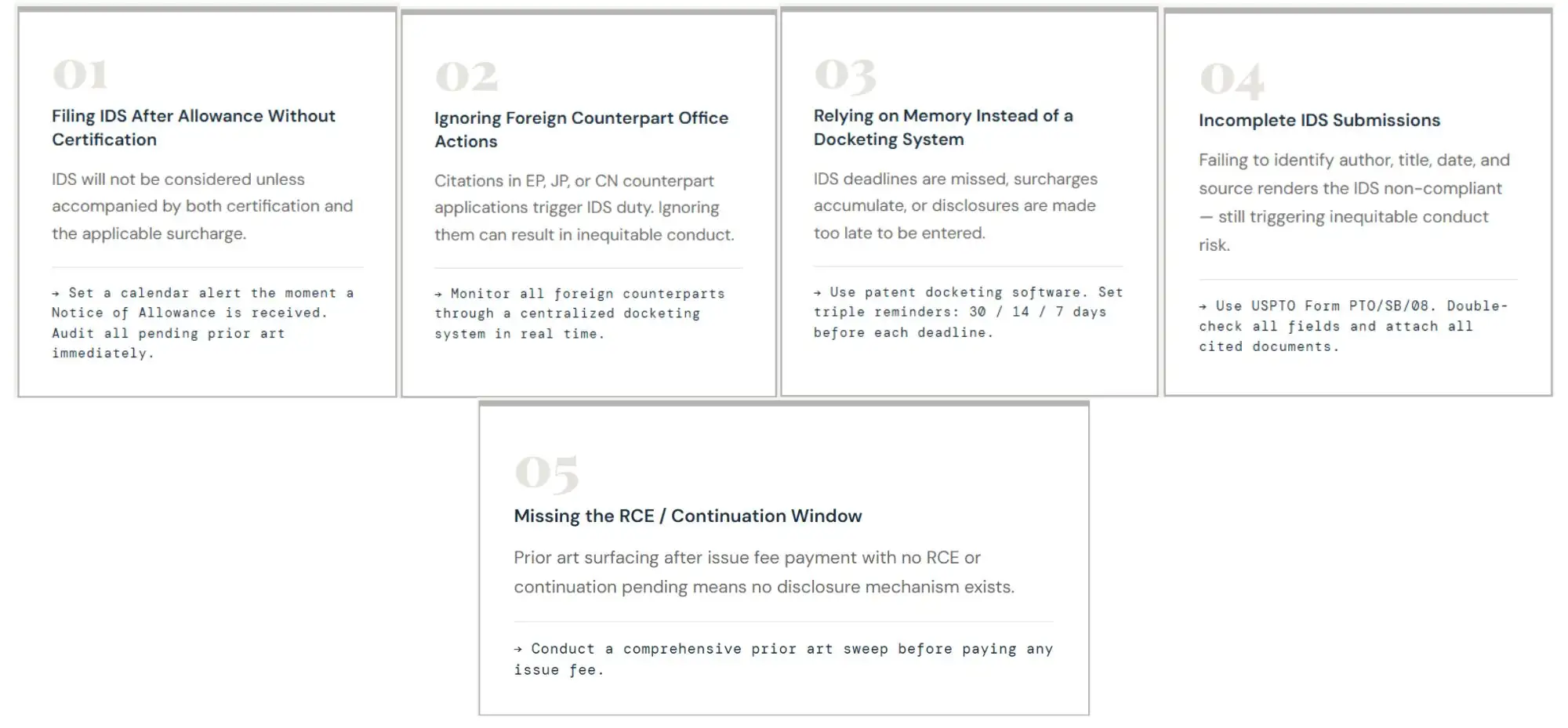
Mistake 1: Filing IDS After Allowance Without Certification
What happens: The IDS will not be considered unless accompanied by both the required certification and surcharge.
How to avoid it:
- Set calendar alerts the moment a Notice of Allowance is received.
- Immediately audit all pending prior art and foreign office actions.
- Prepare the IDS, certification, and payment together.
Mistake 2: Ignoring Foreign Counterpart Office Actions (IDS filing deadlines USPTO)
What happens: A citation in a European, Japanese, or Chinese counterpart application triggers the IDS duty. Ignoring it = potential inequitable conduct.
How to avoid it:
- Monitor all foreign counterpart applications through a centralized docketing system.
- Use the 3-month rule: If a foreign office action arrives, you have 3 months to file the IDS under certification (or pay the surcharge if past that window).
Mistake 3: Relying on Memory Instead of a Docketing System
What happens: IDS deadlines are missed, surcharges accumulate, or disclosures are made too late to be entered.
How to avoid it:
- Use patent docketing software (e.g., Anaqua, CPA Global, or IP management platforms).
- Set triple reminders: 30 days before deadline, 14 days, and 7 days.
- Assign a dedicated team member or service provider to IDS management.
Mistake 4: Incomplete IDS Submissions (IDS filing deadlines USPTO)
What happens: An IDS that fails to properly identify or disclose material information is treated as non-compliant, and can still result in an inequitable conduct finding.
How to avoid it:
- Include full citation information: author, title, date, source, and relevance.
- Use USPTO Form PTO/SB/08 (IDS form) and ensure all fields are complete.
- Double-check that all cited documents are attached or accessible via patent number/publication number.
Mistake 5: Missing the RCE/Continuation Window
What happens: If prior art surfaces after the issue fee is paid and no RCE or continuation is pending, there may be no mechanism to disclose it.
How to avoid it:
- Conduct a comprehensive prior art sweep before paying the issue fee.
- If uncertain, file an RCE before paying the issue fee to preserve the ability to submit IDS.
IDS Filing Deadlines at the USPTO: A Complete Timeline
Understanding when to file your IDS is just as important as knowing what to include. The USPTO has established specific time windows — each with different rules and associated fees.
Deadline 1: Before First Office Action (Free Window)
File IDS with: No fee required (under most circumstances)
Conditions:
- Filed before the mailing date of a first Office Action on the merits, OR
- Filed within 3 months of the U.S. filing date (whichever is later)
Best Practice:
- Submit your IDS at the time of filing or as soon as prior art is identified.
- This is the most cost-effective and administratively simplest window.
Priority Alert: Filing in this window avoids surcharges and certification requirements entirely. Always aim to file here.
Deadline 2: After First Office Action but Before Final Action or Notice of Allowance
File IDS with: A certification under 37 CFR 1.97(e) OR pay a $240 surcharge (small entity: $120; micro entity: $60)
Conditions:
- Filed after the mailing of a first Office Action on the merits, but before:
- The mailing of a final Office Action, OR
- The mailing of a Notice of Allowance
Certification Options (37 CFR 1.97(e)):
- Each item of information was first cited in a communication from a foreign patent office in a counterpart foreign application not more than 3 months before the filing of the IDS.
- No item of information was known to any individual associated with the filing and prosecution more than 3 months before the filing of the IDS.
Priority Alert: Missing the certification window forces you to pay the surcharge. Track foreign office actions and new prior art discoveries in real time.
Deadline 3: After Final Action or Notice of Allowance (Most Restrictive)
File IDS with: BOTH a certification under 37 CFR 1.97(e) AND the $240 surcharge
Conditions:
- Filed after the mailing of:
- A final Office Action, OR
- A Notice of Allowance
Additional Requirements:
- The IDS must be filed before payment of the issue fee.
- The examiner must consider the IDS before the patent issues.
Priority Alert: This is the most restrictive and expensive window. Delay past this point means the IDS cannot be entered before issuance — and may require a Continued Prosecution Application (CPA) or Reissue to correct.
After Payment of Issue Fee: No IDS Without Further Action
Once the issue fee has been paid, an IDS cannot be filed in the pending application. Your only options are:
- File a Continuation Application or RCE (Request for Continued Examination)
- File a Reissue Application (if the undisclosed information would have resulted in a claim being invalid)
Priority Alert: This is a point of no return in standard prosecution. Monitor your docket closely as the issue fee deadline approaches.
Also, Read: What Is an Information Disclosure Statement (IDS) and Why Does It Matter for Your Patent?
Summary Table: IDS Filing Windows & Requirements
Fee amounts are for large entities. Small entity: 50% reduction. Micro entity: 80% reduction.
Common IDS Filing Mistakes (And How to Avoid Them)
Mistake 1: Filing IDS After Allowance Without Certification
What happens: The IDS will not be considered unless accompanied by both the required certification and surcharge.
How to avoid it:
- Set calendar alerts the moment a Notice of Allowance is received.
- Immediately audit all pending prior art and foreign office actions.
- Prepare the IDS, certification, and payment together.
Mistake 2: Ignoring Foreign Counterpart Office Actions (IDS filing deadlines USPTO)
What happens: A citation in a European, Japanese, or Chinese counterpart application triggers the IDS duty. Ignoring it = potential inequitable conduct.
How to avoid it:
- Monitor all foreign counterpart applications through a centralized docketing system.
- Use the 3-month rule: If a foreign office action arrives, you have 3 months to file the IDS under certification (or pay the surcharge if past that window).
Mistake 3: Relying on Memory Instead of a Docketing System
What happens: IDS deadlines are missed, surcharges accumulate, or disclosures are made too late to be entered.
How to avoid it:
- Use patent docketing software (e.g., Anaqua, CPA Global, or IP management platforms).
- Set triple reminders: 30 days before deadline, 14 days, and 7 days.
- Assign a dedicated team member or service provider to IDS management.
Mistake 4: Incomplete IDS Submissions (IDS filing deadlines USPTO)
What happens: An IDS that fails to properly identify or disclose material information is treated as non-compliant, and can still result in an inequitable conduct finding.
How to avoid it:
- Include full citation information: author, title, date, source, and relevance.
- Use USPTO Form PTO/SB/08 (IDS form) and ensure all fields are complete.
- Double-check that all cited documents are attached or accessible via patent number/publication number.
Mistake 5: Missing the RCE/Continuation Window
What happens: If prior art surfaces after the issue fee is paid and no RCE or continuation is pending, there may be no mechanism to disclose it.
How to avoid it:
- Conduct a comprehensive prior art sweep before paying the issue fee.
- If uncertain, file an RCE before paying the issue fee to preserve the ability to submit IDS.
IDS Filing After Allowance: Step-by-Step Checklist
If you’ve received a Notice of Allowance and new prior art has emerged, follow these steps:

- Step 1: Identify all material prior art, foreign office actions, or new information discovered since the last IDS.
- Step 2: Confirm the issue fee has NOT yet been paid.
- Step 3: Prepare the IDS using USPTO Form PTO/SB/08.
- Step 4: Determine if you qualify for a 37 CFR 1.97(e) certification (information discovered/cited within 3 months).
- Step 5: Calculate the applicable surcharge based on entity size (large, small, or micro).
- Step 6: File the IDS, certification (if applicable), and fee payment simultaneously.
- Step 7: Confirm USPTO docket entry and that the examiner has considered the submission before issuance.
IDS and Inequitable Conduct: The High-Stakes Risk
The legal doctrine of inequitable conduct is one of the most feared outcomes in patent law. A patent found unenforceable due to inequitable conduct cannot be enforced — even against clear infringers.
What Constitutes Inequitable Conduct?
- Threshold: The withheld information must be material to patentability.
- Intent: There must be evidence of deliberate deception or knowing omission (per Therasense, Inc. v. Becton, Dickinson and Co., Fed. Cir. 2011).
- Result: If proven, the patent is unenforceable — permanently.
Key Points on Avoiding Inequitable Conduct:
- Disclose all known prior art — even if you believe it does not affect patentability.
- Train your inventors and R&D teams to flag relevant publications, conferences, and competitor activity throughout prosecution.
- When in doubt, disclose. The cost of over-disclosure is zero. The cost of under-disclosure can be everything.
Best Practices for IDS Management at Scale (IDS filing deadlines USPTO)
For IP teams managing large patent portfolios, ad hoc IDS filing is a recipe for disaster. Here are the best practices for systematic IDS compliance:

Implement a Centralized Docketing System (IDS filing deadlines USPTO)
- Track all U.S. and foreign applications in one platform.
- Automate deadline calculations for each IDS window.
- Flag incoming foreign office actions for immediate IDS review.
Establish a Prior Art Review Protocol (IDS filing deadlines USPTO)
- Conduct regular (quarterly or milestone-triggered) prior art searches.
- Assign responsibility: who reviews, who files, who tracks.
- Create a log of all disclosures made per application.
Train Inventors and R&D Staff (IDS filing deadlines USPTO)
- Many material disclosures originate with inventors — not attorneys.
- Educate teams on what constitutes material information.
- Create a simple “tip line” or intake form for inventors to flag publications, presentations, and third-party patents.
Use Outsourced IDS Services (IDS filing deadlines USPTO)
- IDS preparation and filing is a high-volume, detail-intensive task.
- IP service firms like Teak IP Services specialize in end-to-end IDS management — from prior art identification to USPTO submission — at scale.
- Outsourcing reduces risk of error, reduces overhead, and ensures deadline compliance.
Conduct Pre-Issuance Audits (IDS filing deadlines USPTO)
- Before paying any issue fee, conduct a final sweep:
- All foreign counterpart office actions reviewed?
- All publications from the past 12 months checked?
- All inventor-known references included?
How Teak IP Services Can Help (IDS Filing Deadlines USPTO)
At Teak IP Services, we understand that IDS filing is one of the most compliance-sensitive areas of patent prosecution. Our team of experienced patent professionals provides:
- End-to-end IDS preparation and filing — from prior art compilation to USPTO submission
- Foreign office action monitoring — ensuring no counterpart citations are missed
- Deadline tracking and docketing support — so your team never misses a window
- IDS audits for portfolio management — identify gaps before they become liabilities
- Scalable solutions for law firms and corporate IP departments — whether you’re filing 10 or 10,000 applications per year
Ready to streamline your IDS process? Contact Teak IP Services today and let our experts handle your compliance needs — efficiently, accurately, and on time.
Also, Read: How to Prepare an IDS: A Step-by-Step Guide for Patent Applicants
Frequently Asked Questions (FAQs)

Q: What happens if I miss an IDS filing deadline? A: Depending on when you missed it, you may still be able to file with a surcharge and/or certification. However, if the issue fee has already been paid without a pending IDS, you’ll need to file an RCE or continuation — which restarts prosecution and adds significant cost and delay.
Q: Is an IDS required for every patent application? A: The duty of disclosure applies to all utility, design, and plant patent applications. However, the requirement only applies to individuals who are aware of material information — you cannot disclose what you do not know.
Q: Can I file an IDS after the patent issues? A: No. Once a patent issues, you cannot file an IDS in that application. If material prior art surfaces post-issuance, your options include ex parte reexamination or reissue proceedings, each with their own requirements and costs.
Q: Does filing an IDS mean the examiner will reject my claims? A: Not necessarily. The examiner must consider the disclosed information, but disclosure does not predetermine rejection. In many cases, applicants file IDS with prior art that the examiner finds non-material to the claims.
Q: What is the difference between an IDS and prior art? A: Prior art is the underlying information (patents, publications, etc.) that may be relevant to your invention’s patentability. An IDS is the USPTO form and procedure through which you formally disclose that prior art during prosecution.
Conclusion: IDS Filing Deadlines USPTO
IDS filing deadlines are not bureaucratic nuisances — they are legal obligations with real consequences. Missing a window can cost you hundreds of dollars in surcharges; missing the underlying duty entirely can cost you your patent.
Key Takeaways: IDS filing deadlines USPTO
- File early — the pre-first Office Action window is free and hassle-free.
- Monitor continuously — foreign office actions and new publications trigger disclosure duties in real time.
- Never assume — when in doubt about whether information is material, disclose it.
- Build systems — docketing, training, and outsourced support are essential for portfolio-level compliance.
- Partner with experts — firms like Teak IP Services exist to ensure your IDS process is airtight.
The USPTO’s rules around IDS filings exist to ensure the integrity of the patent system. The good news: with the right processes and partners in place, compliance is entirely achievable — and the cost of getting it right is far less than the cost of getting it wrong.
Ready to strengthen your patent portfolio with expert IDS management?
Our Services
👉 IDS Preparation & Filing Services

