
If you’re navigating the U.S. patent application process, knowing how to prepare an IDS is one of the most critical – yet often misunderstood – obligations. The Information Disclosure Statement (IDS) plays a key role in your patent submission, and failing to prepare and file it correctly can jeopardize your patent rights, expose you to inequitable conduct claims, or delay your application unnecessarily.
Whether you’re a first-time inventor, a startup founder, or a seasoned IP professional, this step-by-step guide will walk you through how to prepare an IDS patent submission with accuracy, efficiency, and compliance.
Important Notice: The duty to disclose material information is a legal requirement under 37 C.F.R. § 1.56. Non-compliance can render a patent unenforceable.
What Is an Information Disclosure Statement (IDS)?
An Information Disclosure Statement (IDS) is a formal document filed with the United States Patent and Trademark Office (USPTO) during the patent prosecution process. It lists all information known to the applicant that may be material to the patentability of the invention.

Key Facts About an IDS:
- It is not optional – it is a legal duty for inventors, attorneys, and assignees
- It must include all prior art and relevant references known to the applicant
- It applies throughout the entire pendency of the patent application
- Failure to disclose can result in the patent being declared unenforceable
Also, Read: IDS Filing Deadlines: How to Avoid Costly USPTO Penalties
Who Has a Duty to File an IDS?

Under 37 C.F.R. § 1.56, the duty to disclose applies to:
- Inventors named in the application
- Patent attorneys or agents prosecuting the application
- Assignees (companies or individuals who own the patent rights)
- Any other person substantially involved in the preparation or prosecution of the application
Pro Tip: Every individual with a duty to disclose must be proactive. If you become aware of material prior art at any stage – even after allowance – you are required to disclose it.
What Must Be Included in an IDS?
Knowing what to include is just as important as knowing how to prepare an IDS patent filing. The following categories of information are typically disclosed:

1. Prior Art References
- U.S. patents (granted or published applications)
- Foreign patent documents (EP, WO, JP, CN, KR, etc.)
- Non-patent literature (NPL) – journal articles, conference papers, books, websites, datasheets
2. Related Applications
- Co-pending U.S. patent applications by the same inventors
- International applications (PCT) related to the same invention
- References cited in foreign counterpart applications
3. Information from Third Parties
- Office Actions issued in related foreign applications
- Search reports from foreign patent offices (EPO, JPO, CNIPA, etc.)
- Any information received from third parties relating to patentability
4. What Is Considered “Material”?
Under the broadest reasonable interpretation, information is material if:
- It is not cumulative to other information already on record
- It establishes, alone or combined with other information, a prima facie case of unpatentability
- It refutes or is inconsistent with a position taken by the applicant
IDS Forms Used at the USPTO
The USPTO requires use of specific forms for IDS submissions:
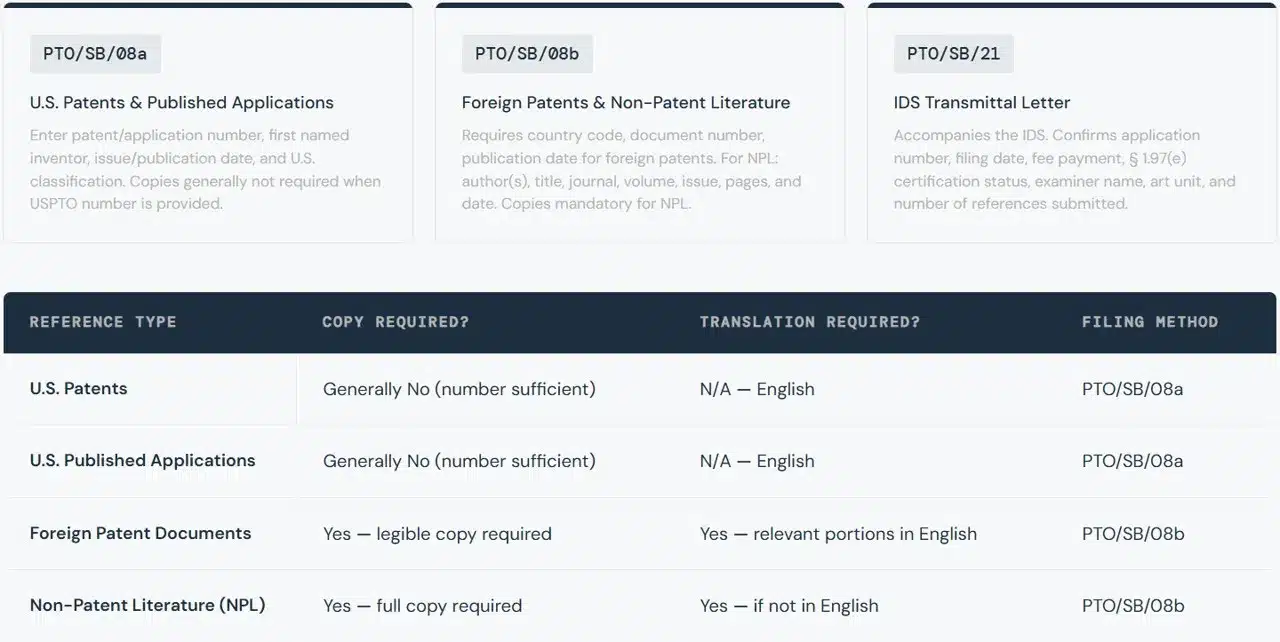
Note: These forms are available for free download at the USPTO website.
Step-by-Step Guide: How to Prepare an IDS Patent Submission
✅ Step 1: Conduct a Thorough Prior Art Search
Before preparing your IDS, you need a complete picture of the relevant prior art landscape.
What to do:
- Search USPTO Patent Full-Text and Image Database (PatFT/AppFT)
- Search Google Patents, Espacenet, WIPO PATENTSCOPE, and Derwent Innovation
- Search academic databases for non-patent literature (PubMed, IEEE Xplore, Google Scholar)
- Review references cited by the inventors, R&D teams, and technical experts
- Gather office actions and search reports from related foreign applications
Key Tip: Document every database searched, the search terms used, and the date of the search. This record-keeping is essential if the IDS is ever challenged.
Step 2: Evaluate Each Reference for Materiality
Not every reference found in a prior art search needs to be included. However, when in doubt – disclose it.
Checklist for materiality evaluation:
- Is the reference cumulative of something already of record?
- Does it anticipate or render obvious any claim?
- Does it contradict or undercut any argument made to the USPTO?
- Was it cited in a related foreign prosecution?
- Would a reasonable examiner likely consider it important?
Best Practice: Err on the side of over-disclosure. Including a marginal reference is far less risky than omitting a material one.
Step 3: Gather Complete Bibliographic Information
For each reference to be disclosed, collect the following details:
For U.S. Patents:
- Patent Number
- First Named Inventor
- Issue Date
- U.S. Classification (if available)
For Foreign Patent Documents:
- Country Code
- Publication Number
- Publication Date
- Applicant / Assignee Name
For Non-Patent Literature (NPL):
- Author(s)
- Title of the article or document
- Publication name (journal, conference, book)
- Volume, issue, page numbers
- Date of publication
Important: All NPL references must be submitted as physical copies (or electronically uploaded copies) unless they are already of record. No citation-only submissions are acceptable for NPL.
Step 4: Complete the IDS Forms (PTO/SB/08a and PTO/SB/08b)
Fill out the appropriate USPTO forms carefully:
For PTO/SB/08a (U.S. Patents and Applications):
- Enter each U.S. patent or published application in a separate row
- Fill in Patent/Application Number, Inventor Name, Issue/Publication Date, and Classification
For PTO/SB/08b (Foreign and NPL):
- Enter each foreign patent document with country code, document number, and date
- For NPL, include all bibliographic data and a clear identification of the document
Common Mistakes to Avoid:
- Incomplete bibliographic data (missing dates, wrong numbers)
- Submitting references without copies (required for NPL)
- Filing on the wrong form (U.S. patents on NPL form, etc.)
- Listing references that are already of record without checking
- Failing to include translations (required when documents are not in English)
Step 5: Prepare Copies of Each Reference
USPTO requirements for copies:
- U.S. patents & published applications – Copies are generally not required if a USPTO patent number is provided
- Foreign patents – Legible copies must be submitted
- NPL – A copy of each non-patent literature reference must be submitted
- Translations – If the reference is in a foreign language, an English translation of the relevant portions must be included
Electronic Filing: If using USPTO’s EFS-Web/Patent Center, upload each reference as a separate PDF with a descriptive filename.
Step 6: Determine the Applicable Timing and Fees
Timing is critical when filing an IDS. The requirements – including fees – vary depending on when the IDS is filed.
Filing Windows and Associated Requirements:

Current IDS Fee (as of 2024):
- Large entity: $260
- Small entity: $130
- Micro entity: $65
Certification under 37 C.F.R. § 1.97(e): This certifies that each item of information first became known to the applicant less than 3 months prior to filing, OR that no item of information was known more than 3 months before filing. Use this to avoid fees when applicable.
Step 7: Prepare the Transmittal Letter (PTO/SB/21)
The transmittal letter accompanies your IDS filing and confirms:
- The application number and filing date
- The number of references being cited
- Whether fees are being paid (and in what amount)
- Whether a § 1.97(e) certification is being made
- A list of any attached copies
Transmittal Letter Must Include:
- Application number
- Filing date
- Title of invention
- Art unit (if known)
- Examiner name (if assigned)
- Confirmation number
- Number of pages of the IDS forms and attached copies
Step 8: File the IDS with the USPTO
Filing Methods:
- Patent Center (Electronic Filing): Preferred method – faster, generates acknowledgment receipt, no paper handling delays
- Mail: Acceptable but slower; use Certificate of Mailing under 37 C.F.R. § 1.8
- Hand Delivery: Possible at USPTO offices
When filing electronically via Patent Center:
- Log in to Patent Center
- Select the application
- Choose “Submit Documents” → “Information Disclosure Statement”
- Upload: IDS forms (08a/08b), copies of references (NPL/foreign), transmittal
- Submit and save the acknowledgment receipt
Always save your filing receipt. It serves as proof of timely submission.
Step 9: Monitor and Update the IDS Throughout Prosecution
The duty to disclose is continuous. You must file supplemental IDS submissions whenever new material information becomes known.
Common triggers for supplemental IDS filings:
- Receipt of an Office Action in a related U.S. or foreign application
- Discovery of a new prior art reference during prosecution
- Search results received from foreign patent offices on related PCT or national phase applications
- New publications by the inventors or co-workers in the same technical field
- Litigation-related discovery that reveals material prior art
Best Practice: Establish a regular internal review cadence – quarterly or upon receipt of any foreign prosecution correspondence – to identify new disclosable information.
IDS in PCT (International) Applications
For PCT applications, the disclosure obligations are handled differently:
- The International Searching Authority (ISA) conducts the international search
- References cited in the International Search Report (ISR) must be included in the IDS when entering the U.S. national phase
- Any references cited in Chapter II examination (IPEA) must also be disclosed
- The IDS must be filed within 30 months of the priority date (or the national phase entry date, whichever is later)
Special Situations in IDS Preparation

IDS After Patent Grant (Reexamination)
If prior art is discovered after a patent has been granted, you may need to:
- File a Supplemental Examination request
- Consider Ex Parte Reexamination
- These processes have different procedures than standard IDS filings
IDS in Continuation Applications
- References previously cited in the parent application do not automatically carry over
- You must re-cite all material references in each continuation, CIP, or divisional application
- However, you may submit a concise explanation that the references were previously considered
IDS for Design Patents
- The same duty to disclose applies to design patent applications
- Prior art in the same ornamental design space must be included
Top IDS Mistakes That Can Cost You Your Patent
Understanding how to prepare an IDS patent filing means knowing what not to do:
- Ignoring foreign search reports – Office Actions from EPO, JPO, or other offices always need review
- Omitting references cited by co-inventors – If an inventor cites a paper in a related publication, it may be material
- Missing the filing window – Late filings require fees and certifications; post-issue fee filing is extremely restricted
- Burying material references – Disclosing a key reference among hundreds of irrelevant ones can still be considered inequitable conduct
- Failing to translate foreign language references – English translations of relevant portions are required
- Not updating the IDS – Failing to file a supplemental IDS when new art becomes known
- Relying solely on attorney knowledge – Inventors must actively participate and share all known relevant information
IDS Preparation Checklist: Quick Reference
Use this checklist to ensure a complete and compliant IDS filing:

Before Filing:
- Conducted thorough prior art search across all relevant databases
- Evaluated each reference for materiality
- Collected complete bibliographic data for all references
- Gathered copies of all NPL and foreign patent references
- Arranged English translations for non-English references
- Completed PTO/SB/08a (U.S. references)
- Completed PTO/SB/08b (Foreign and NPL references)
- Determined the filing window and fee/certification requirements
- Prepared the transmittal letter (PTO/SB/21)
At Filing:
- Submitted via Patent Center or mail with Certificate of Mailing
- Paid applicable fees (if required)
- Included § 1.97(e) certification (if applicable)
- Saved filing acknowledgment receipt
Ongoing Monitoring:
- Established a process to monitor related U.S. and foreign applications
- Scheduled periodic reviews of incoming search reports and Office Actions
- Briefed inventors on the ongoing duty to disclose
Why Choose Teak IP Services for Your IDS Preparation?
At Teak IP Services, we understand that IDS preparation is not just a formality – it’s a critical component of patent prosecution strategy. Our team of experienced patent professionals provides:
- Comprehensive prior art searches tailored to your technology area
- Accurate and compliant IDS drafting using the latest USPTO forms
- Timely filing management to avoid missed deadlines and unnecessary fees
- Ongoing prosecution monitoring to ensure continuous compliance
- Cost-effective solutions for startups, SMEs, and large enterprises
Whether you’re preparing your first IDS or managing a complex portfolio across multiple jurisdictions, Teak IP is your trusted partner in patent prosecution support.
📩 Contact us today at teakipservices.com to learn how we can help protect your innovations.
Frequently Asked Questions (FAQs) in How to Prepare an IDS
Q1: Is an IDS required for every patent application?
A: Yes, for U.S. patent applications, the duty to disclose material information under 37 C.F.R. § 1.56 applies to all utility, design, and plant patent applications.
Q2: What happens if I forget to include a reference in the IDS?
A: If the omission was unintentional and the reference is not material, the consequences may be limited. However, intentional omission of material prior art can lead to a finding of inequitable conduct, which renders the patent unenforceable.
Q3: Do I need to translate all foreign language documents?
A: You must provide an English translation of the relevant portions of any foreign-language reference. A full translation is not required, but the translated portions must be sufficient for the examiner to understand the relevance.
Q4: Can I cite too many references in an IDS?
A: While there is no formal limit, submitting an excessive number of references – particularly marginal or irrelevant ones – can be considered a “reference dumping” strategy and may actually harm your prosecution if it obscures more material references.
Q5: How does an IDS differ from a prior art statement?
A: An IDS is a formal USPTO filing listing prior art. A prior art statement is a more general term used informally. In USPTO practice, the IDS is the required formal document.
Q6: Can I file an IDS after the patent has been granted?
A: Generally, you cannot file a standard IDS after a patent has been granted. You may need to pursue supplemental examination or reexamination. Consult with a registered patent attorney for guidance.
Conclusion: How to Prepare an IDS
Understanding how to prepare an IDS patent filing is an essential skill for any patent applicant. The IDS is not a bureaucratic hurdle – it’s a fundamental mechanism that ensures the integrity of the patent system and protects your patent from future challenges.
By following the steps outlined in this guide – from conducting a thorough prior art search to monitoring your application throughout prosecution – you can fulfill your disclosure obligations confidently and strategically.
Key Takeaways:
- The duty to disclose is continuous and applies to all individuals substantially involved in prosecution
- Use the correct USPTO forms (PTO/SB/08a, PTO/SB/08b, PTO/SB/21)
- Understand the filing windows to avoid unnecessary fees
- When in doubt, disclose – omission of material prior art is far riskier than over-disclosure
- Partner with experienced IP professionals like Teak IP to ensure compliance and strategic preparation
Ready to strengthen your patent portfolio with expert IDS management?

