
A USPTO Office Action lands in your inbox on a Tuesday afternoon, and the response deadline is already running. If you are a junior associate juggling a dozen open matters, or a solo practitioner without a paralegal down the hall, that deadline pressure compounds fast. Finding the best office action response support is not a luxury at that point; it is the difference between a clean, well-documented response and a rushed extension request that eats into your fee.

This guide walks through what office action response support actually includes, how to evaluate the vendors offering it, which red flags to avoid, and how firms of every size structure this work so nothing slips through the cracks. Whether you handle patent Office Actions, trademark Office Actions, or both, you will leave with a clear framework for choosing a partner instead of guessing.
Teak IP Services has spent years building the templates, docketing systems, and attorney-reviewed workflows that make this process repeatable. What follows draws directly on that operational experience, not generic advice.
What is Office Action Response Support?
Office action response support is outsourced or augmented paralegal and administrative assistance that helps attorneys prepare, format, and file responses to Office Actions issued by the USPTO (or foreign IP offices) for pending patent and trademark applications.
It typically does not replace attorney judgment on legal arguments. Instead, it handles the surrounding workload: docketing the deadline, pulling the correct forms, drafting procedural sections, formatting claim amendments, preparing exhibits, and ensuring the final response meets every formatting rule before it is filed through EFS-Web or TEAS.
In short: the best office action response support gives attorneys back the hours they would otherwise spend on formatting, cross-referencing, and administrative assembly, so they can focus on substantive legal strategy.
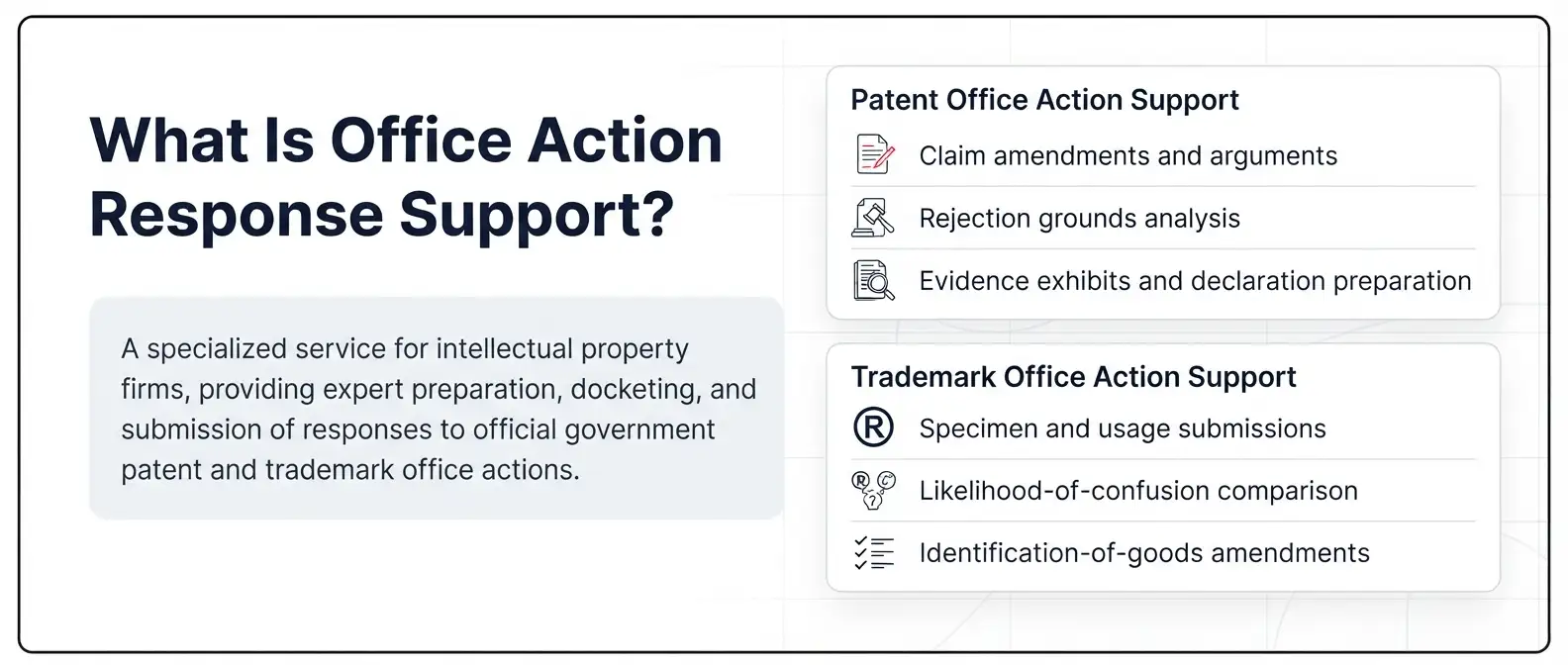
Patent vs. Trademark Office Action Support
The two disciplines overlap procedurally but differ substantively:
- Patent Office Actions often involve rejections under 35 U.S.C. §101, §102, §103, or §112. Support teams prepare claim charts, amendment redlines, and prior-art comparison tables.
- Trademark Office Actions commonly cite likelihood-of-confusion refusals, descriptiveness refusals, or specimen deficiencies. Support teams draft evidence exhibits, format identification-of-goods amendments, and manage TEAS/TSDR filing logistics.
Firms handling both application types need a vendor comfortable moving between the two, since a junior attorney rarely has the luxury of specializing in just one.
Why This Matters More in a Firm’s Growth Stage
Growing firms and solo practitioners hit a predictable wall: the number of Office Actions in the pipeline grows faster than the headcount available to process them.
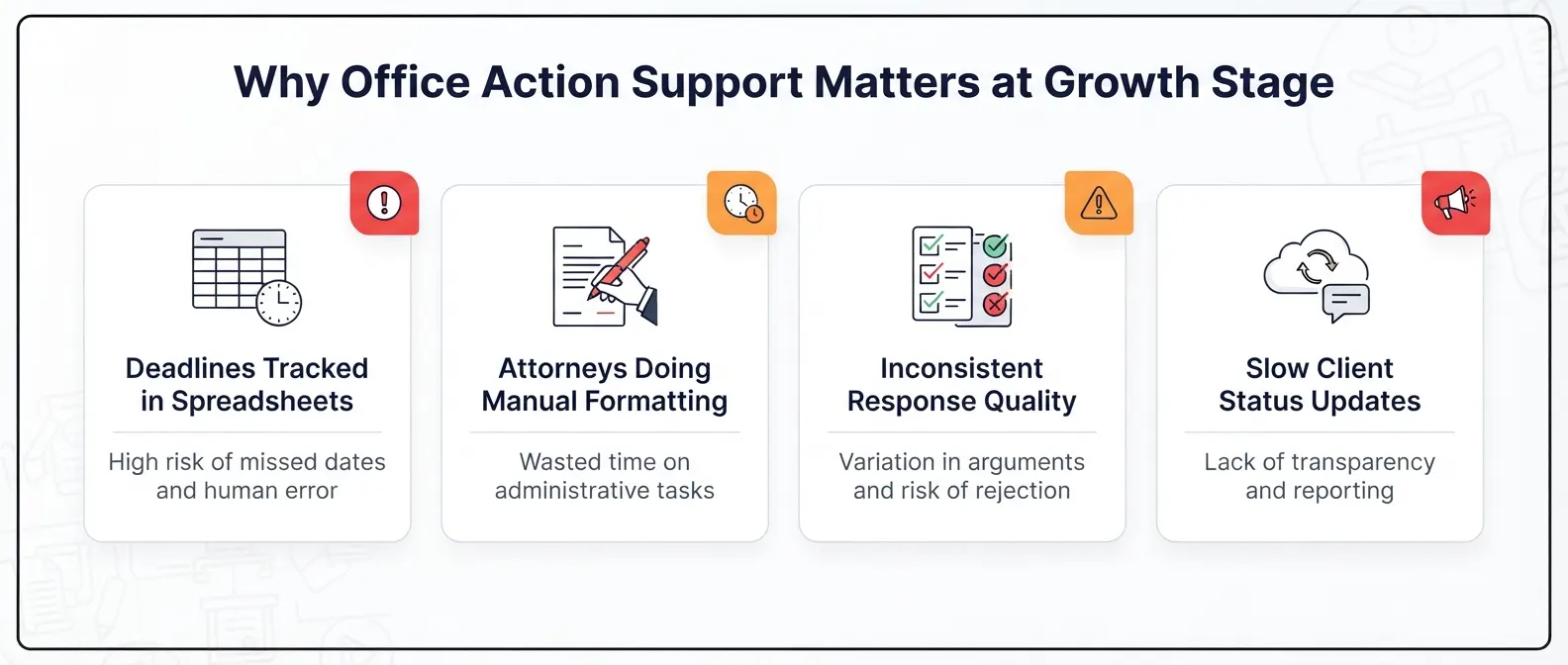
A few consequences show up quickly.
- Deadlines get tracked in spreadsheets instead of a real docketing system, which increases missed-date risk.
- Attorneys spend billable hours on template formatting instead of legal analysis.
- Response quality becomes inconsistent because there is no standardized internal process.
- Client communication slows down because someone has to manually check status on every matter.
Consequently, firms searching for the best office action response support are usually not just looking for extra hands. They are looking for a repeatable system that removes variability from a high-stakes, deadline-driven process.
Core Components of a Strong Office Action Response Service
Not every vendor offering “office action help” provides the same depth of support. Before comparing options, it helps to know what a comprehensive service actually includes.
1. Deadline Docketing and Alerts
The response window (usually three months for patents, six months for trademarks, both extendable in specific circumstances) needs to be calendared the moment the Office Action is received. A dependable service cross-checks the docket against the USPTO’s Patent Application Information Retrieval (PAIR) or Trademark Status and Document Retrieval (TSDR) system to confirm accuracy.
2. Procedural Drafting and Formatting
This includes preparing the response shell, formatting claim amendments with proper markup (strikethrough for deletions, underline for additions), building exhibit indexes, and ensuring the document conforms to USPTO formatting rules before it reaches the attorney for legal review.
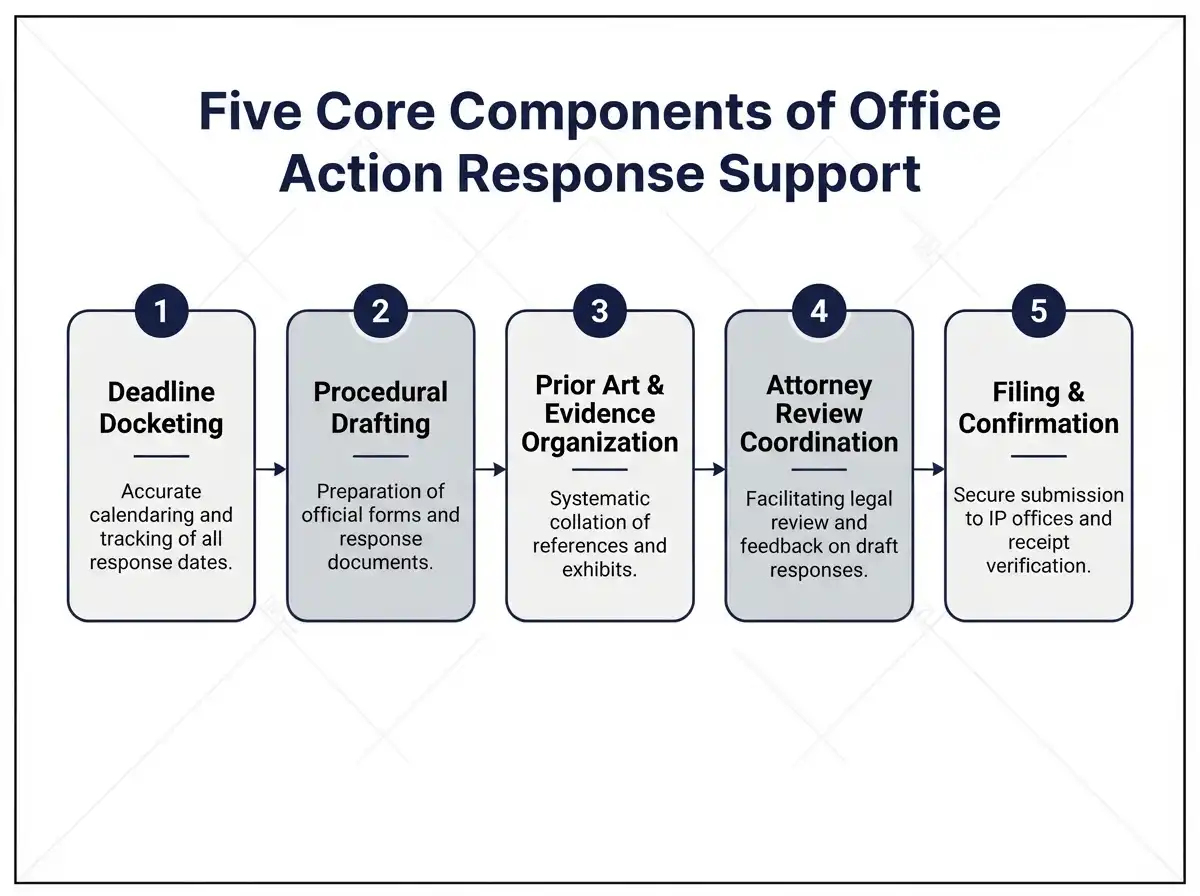
3. Prior Art and Evidence Organization
For patent matters, this means organizing cited references, building claim-versus-reference comparison tables, and flagging overlapping limitations. For trademark matters, it means assembling specimen evidence, third-party registration searches, and consumer-recognition exhibits.
4. Attorney Review Coordination
The best office action response support does not operate as a black box. It routes drafts back to the responsible attorney with clear tracked changes, so final legal judgment always rests with a licensed practitioner.
5. Filing and Confirmation
Once the attorney approves the response, the support team files it through EFS-Web or TEAS, confirms the filing receipt, and updates the docket to reflect the new status.
Quick Answer: What Should You Look for in an Office Action Support Vendor?
If you only have thirty seconds, here is the shortlist:
- Attorney-reviewed output, not just paralegal drafting.
- A real docketing system, not a shared spreadsheet.
- Experience with both USPTO patent and trademark procedures.
- Transparent, à la carte pricing instead of opaque retainers.
- Fast turnaround with a documented quality-control step.
- U.S.-based oversight, even if drafting support is partially offshore.
Comparison Table: In-House vs. Freelance Paralegal vs. Managed Office Action Support
| Factor | In-House Paralegal | Freelance/Contract Paralegal | Managed Support Service (e.g., Teak IP) |
|---|---|---|---|
| Cost structure | Fixed salary + benefits | Hourly, variable availability | À la carte, pay-per-matter |
| Deadline tracking | Depends on internal system | Often manual | Dedicated docketing software |
| Attorney oversight | Internal only | Rarely included | Built into workflow |
| Scalability | Slow to scale up/down | Limited, one person | Scales with matter volume |
| Backup coverage | None during leave/turnover | None | Team-based redundancy |
| Onboarding time | Weeks to months | Days to weeks | Typically under a week |
This table alone often clarifies the decision for junior attorneys and solo practitioners: a managed service closes the redundancy and scalability gaps that both in-house and freelance options leave open.
How to Choose the Best Office Action Response Support: A Step-by-Step Approach
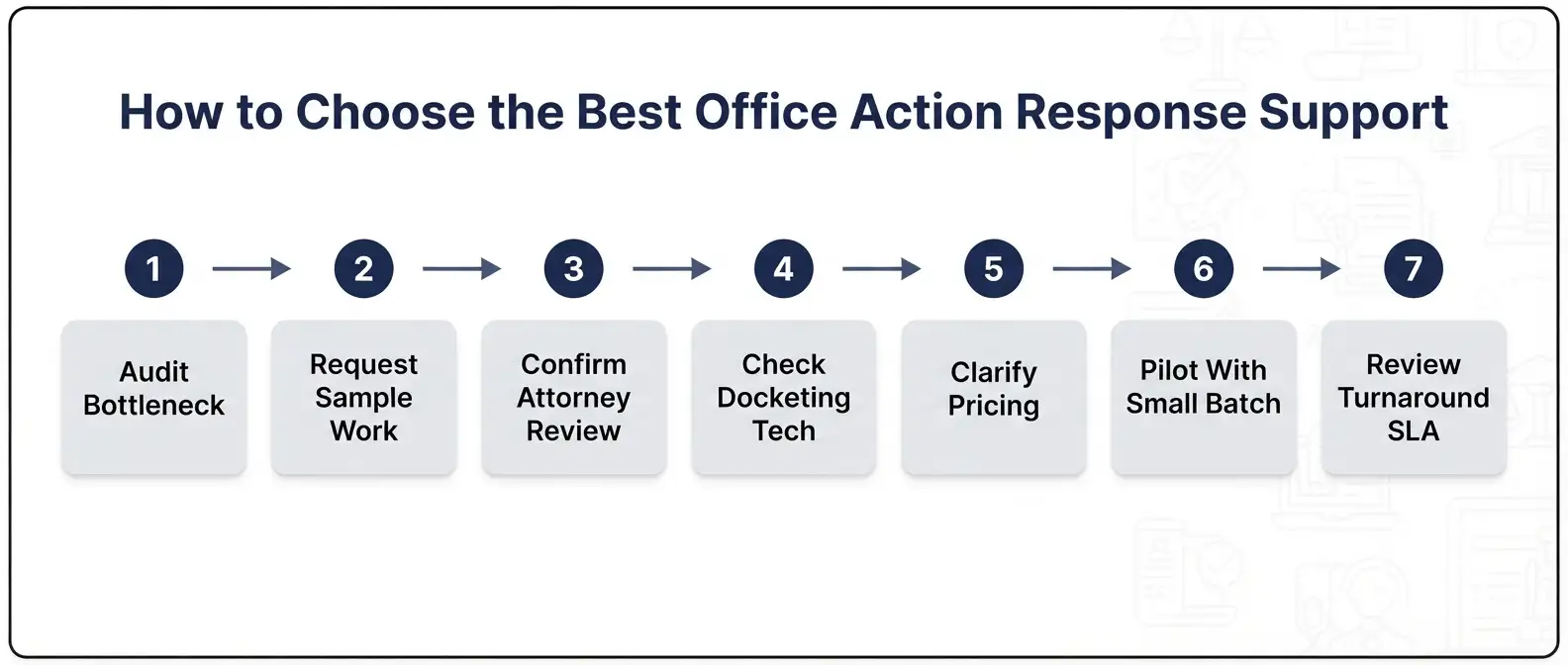
Selecting a vendor should follow the same rigor as any other vendor-selection decision inside a law firm. Here is a practical sequence.
- Audit your current bottleneck. Determine whether the pain point is drafting volume, docketing accuracy, or formatting consistency. Different vendors specialize in different combinations.
- Request sample work product. Ask for a redacted sample response or amendment to evaluate formatting quality and attention to USPTO rules.
- Confirm attorney involvement. Ask directly who reviews the substantive legal content before filing, and get that answer in writing.
- Check docketing technology. A vendor relying on shared spreadsheets is a liability. Ask what docketing software they use and how alerts are triggered.
- Clarify pricing model. À la carte pricing tends to fit growing firms better than blanket retainers, since matter volume fluctuates month to month.
- Pilot with a small batch. Before committing to full-portfolio support, run two or three matters through the vendor to test turnaround time and communication.
- Review turnaround SLAs. Ask for a written service-level agreement covering standard and expedited response timelines.
Common Mistakes Firms Make When Outsourcing Office Action Support
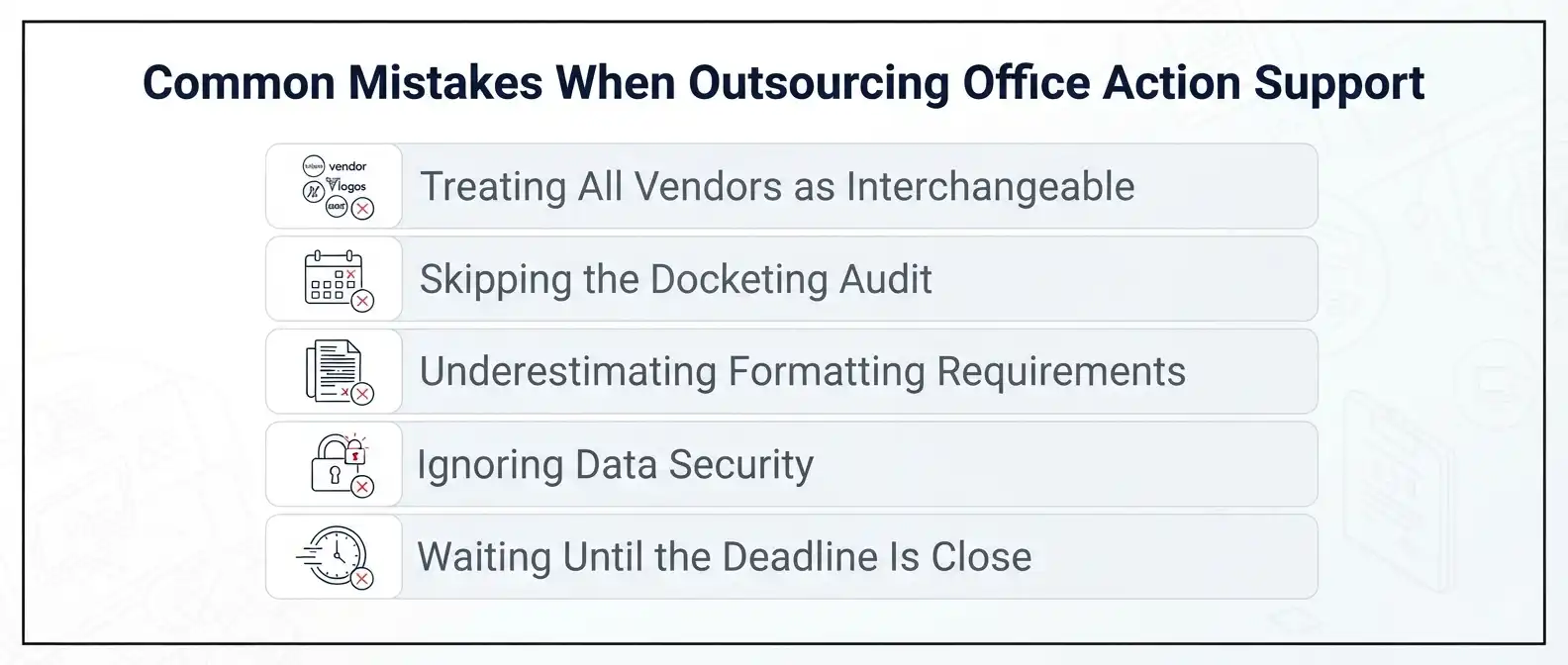
Even experienced attorneys stumble into a few recurring traps.
- Treating all vendors as interchangeable. Pricing varies widely, and the cheapest option often lacks attorney oversight entirely.
- Skipping the docketing audit. Firms sometimes assume a vendor’s system automatically syncs with internal deadlines, when in fast it needs manual confirmation during onboarding.
- Underestimating formatting requirements. USPTO rejects malformed claim amendments regularly; a vendor unfamiliar with current formatting rules can create rework instead of saving time.
- Ignoring data security. Office Action responses often reference confidential invention details or unregistered brand strategy. Always confirm NDA terms and data-handling protocols before sharing files.
- Waiting until the deadline is close. Engaging support only after an extension has already been filed removes the buffer that makes outsourcing valuable in the first place.
Expert Tips for Getting the Most Out of Office Action Support
- Standardize your intake process so every Office Action, regardless of examiner or art unit, follows the same initial triage checklist.
- Ask your vendor for a monthly status report rather than relying on ad hoc email updates; it surfaces bottlenecks before they become missed deadlines.
- Keep a running log of examiner-specific patterns (interview receptiveness, common rejection types) so future responses in the same art unit or class benefit from that history.
- Build a two-week internal buffer ahead of every statutory deadline, even with outside support, so unexpected delays never threaten the filing date.
- Request that the support team flag any response requiring an interview request separately, since examiner interviews often resolve rejections faster than a written response alone.
Featured Snippet Summary: Office Action Response Support in Five Steps
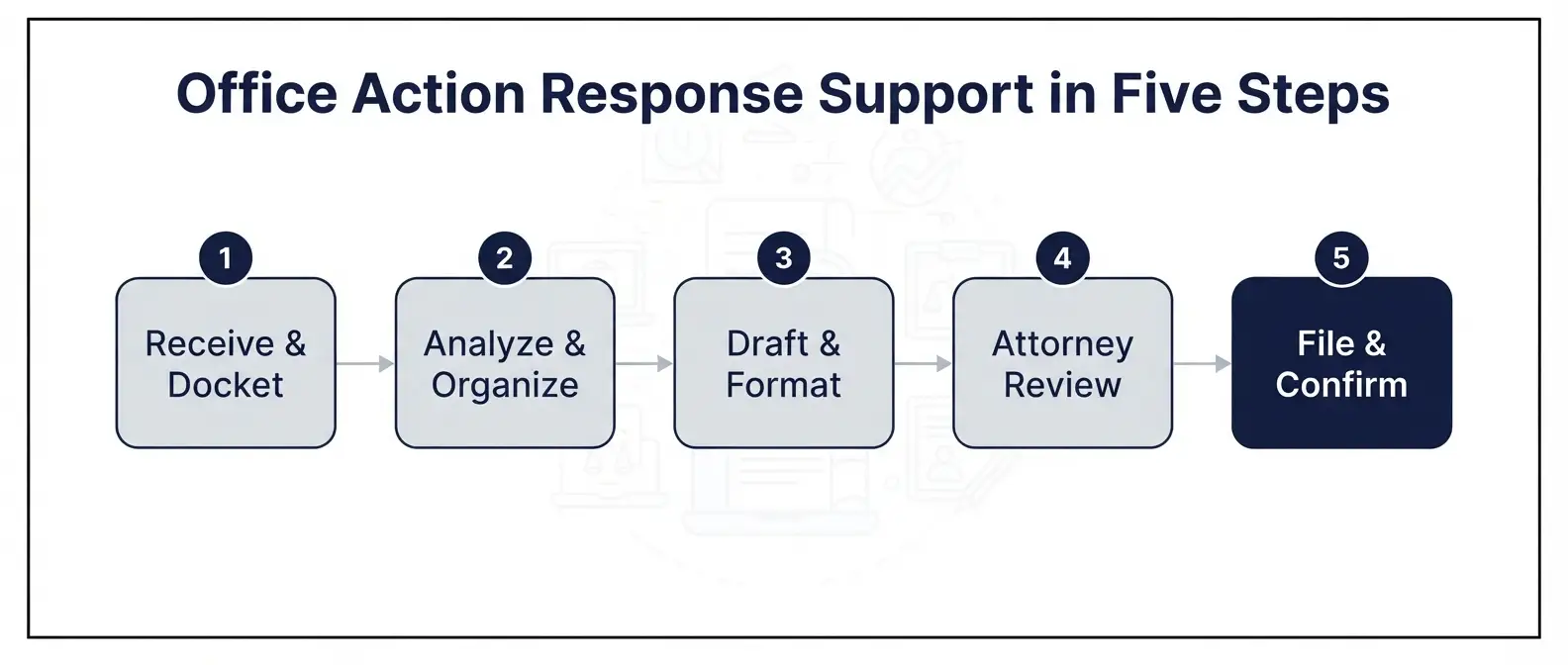
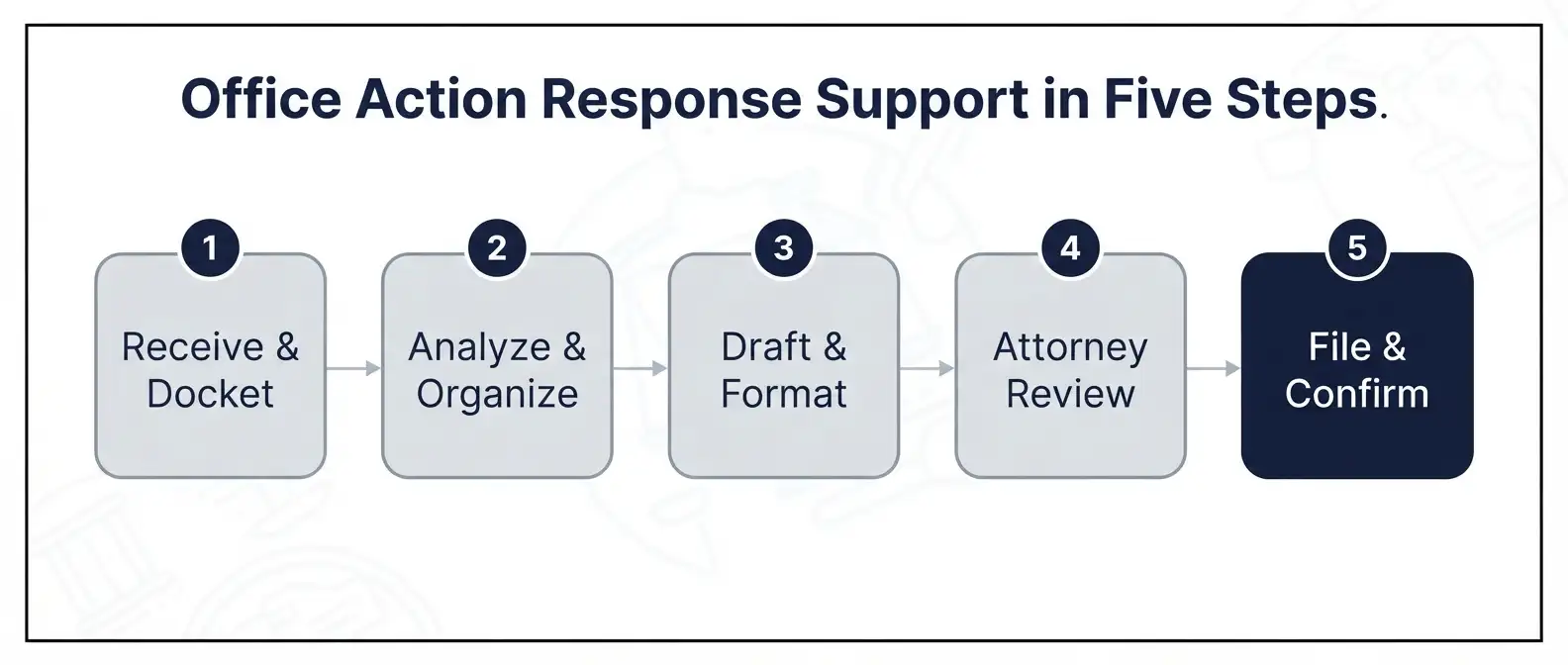
- Office Action is received and immediately docketed with a calculated deadline.
- Support team reviews rejection grounds and organizes supporting evidence or prior art.
- Draft response and any amendments are prepared following USPTO formatting rules.
- The reviewing attorney finalizes legal arguments and approves the draft.
- The response is filed electronically, and the docket is updated with confirmation.
Why Teak IP Services Is a Strong Fit for Office Action Response Support
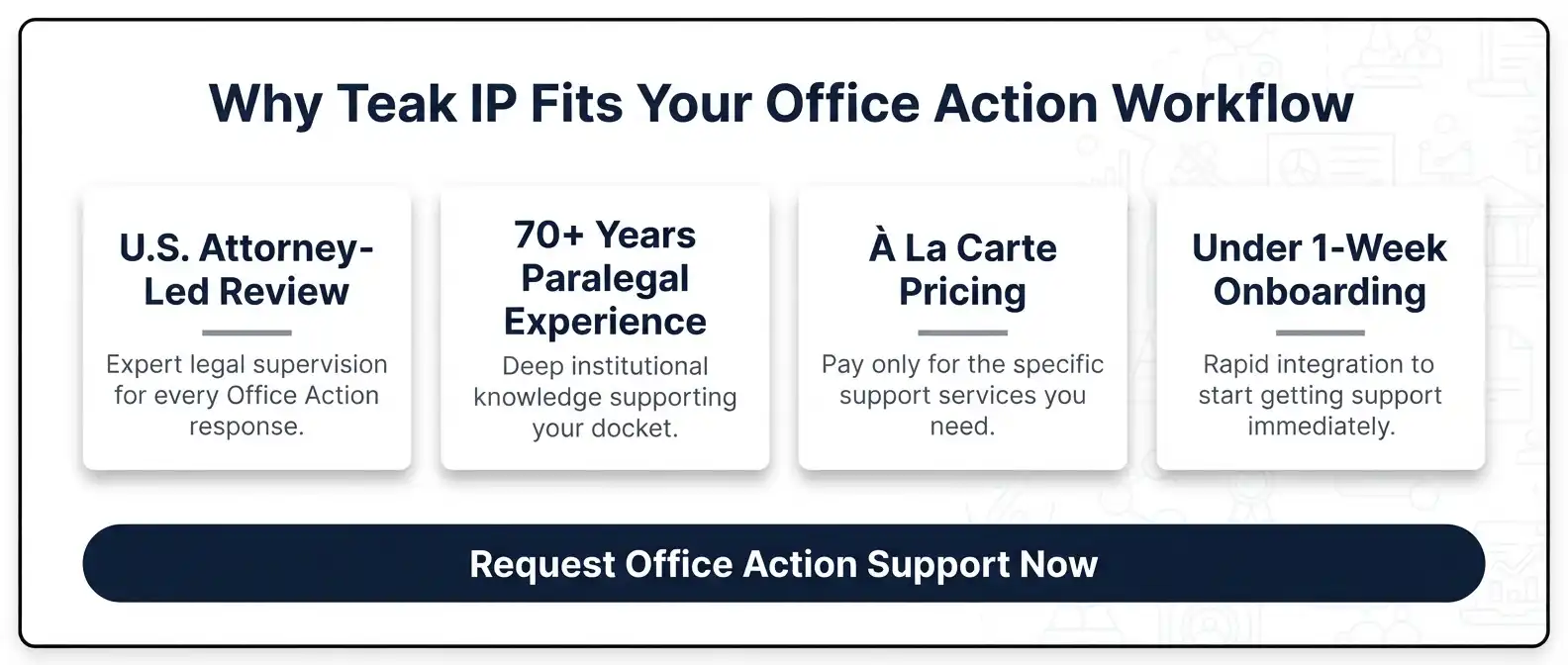
Teak IP is led by U.S. IP attorneys who personally review deliverables before they reach a client, which matters when a rejection response carries real prosecution consequences. The firm pairs U.S.-based attorney oversight with an experienced India-based support team, giving firms faster turnaround at a more predictable cost than a purely domestic hire.
The à la carte pricing model also solves a real problem for growing firms: instead of committing to a retainer sized for peak volume, firms pay only for the matters that actually need support that month. That structure, paired with a dedicated docketing system, is what makes this approach to office action response support scale cleanly as a firm’s caseload grows.
If your firm is currently evaluating vendors, our Office Action Response Services page outlines the specific deliverables included in each engagement.
Frequently Asked Questions
What makes a service the best office action response support option for a small firm?
The best office action response support for a small firm combines attorney-reviewed output, transparent à la carte pricing, and a real docketing system, so a solo practitioner is not personally tracking every deadline in a spreadsheet.
How much does office action response support typically cost?
Pricing varies by complexity and rejection type, but à la carte models charge per matter or per response rather than a flat monthly retainer, which tends to be more predictable for firms with fluctuating Office Action volume.
Can outsourced support draft substantive legal arguments?
Support teams typically prepare the procedural and evidentiary groundwork, while a licensed, reviewing attorney finalizes and approves the substantive legal arguments before filing.
How quickly can a support team turn around a standard Office Action response?
Turnaround depends on complexity, but most managed services offer standard timelines of one to two weeks with expedited options available closer to a statutory deadline.
Is it safe to share confidential invention or brand details with an outsourced vendor?
It is safe when the vendor operates under a signed NDA and documented data-handling protocols; always confirm those terms before transmitting any confidential filing details.
Does office action response support work for both patent and trademark matters?
Yes, though the procedural requirements differ significantly, so it is worth confirming a vendor has direct experience with both USPTO patent examination and trademark examination procedures.
Conclusion
Choosing the best office action response support ultimately comes down to matching your firm’s real bottleneck, whether that is docketing accuracy, drafting bandwidth, or formatting consistency, with a vendor that has attorney oversight built into every step. A managed service with transparent pricing, real docketing technology, and a documented quality-control process removes the guesswork that spreadsheets and ad hoc freelance help cannot fully solve.
If missed deadlines, formatting rework, or inconsistent response quality are costing your firm billable hours, it may be time to bring in dedicated support rather than stretching your existing team further.

