
A Decision That Shapes Your Entire IP Practice: Is it better to hire an in-house or virtual patent paralegal? If you run an IP law firm, a corporate patent department, or a growing startup managing intellectual property, this question likely comes up far more often than you would expect. The answer directly affects your overhead costs, your team’s flexibility, and ultimately the quality of support your attorneys receive day-to-day.
Patent paralegal work is not generic legal support. It demands a deep understanding of USPTO procedures, tight deadlines, complex prosecution workflows, and ever-evolving patent rules. Choosing the wrong staffing model can lead to missed filings, compliance gaps, and ballooning operational costs.
In this article, we break down the real differences between in-house and virtual patent paralegals: what each model delivers, where each falls short, and how to determine which option truly serves your practice best.
What Does a Patent Paralegal Actually Do?
Before comparing staffing models, it is worth understanding the scope of patent paralegal work. A patent paralegal handles a wide range of tasks that keep prosecution on track and filings compliant.
Common responsibilities include:
- Preparing and filing patent applications with the USPTO
- Managing patent docketing and deadline tracking
- Preparing and filing Information Disclosure Statements (IDS)
- Coordinating office action responses and extension requests
- Handling PCT application filings and national phase entries
- Preparing patent drawings and sequence listings
- Monitoring deadlines for maintenance fees and renewals
- Communicating with foreign associates for international filings
The depth and breadth of these tasks means that quality, consistency, and reliability are non-negotiable. Both in-house and virtual paralegals can fulfill these functions; the question is which model does it more effectively and economically for your specific situation.
In-House Patent Paralegal: Key Advantages
1. On-Site Presence and Immediate Availability
One of the clearest benefits of hiring an in-house patent paralegal is physical proximity. When an attorney needs to discuss a case, clarify a filing strategy, or handle an urgent matter, the paralegal is right there. Real-time collaboration happens naturally, without scheduling calls or navigating time zones.
2. Deep Firm-Specific Knowledge
An in-house paralegal, over time, becomes intimately familiar with your firm’s clients, internal workflows, preferred docketing software, and communication style. That institutional knowledge can be genuinely valuable, particularly for complex multi-family prosecution portfolios.
3. Dedicated Focus
An employee hired specifically for your firm is not simultaneously supporting other clients. Their full attention, during working hours, belongs to your practice.
4. Cultural Integration
In-house staff participate in team meetings, training sessions, and firm culture. For firms that value tight-knit collaboration, this integration can matter.
In-House Patent Paralegal: The Real Costs and Limitations
Here is where many firms encounter a significant reality check.
High Fixed Costs
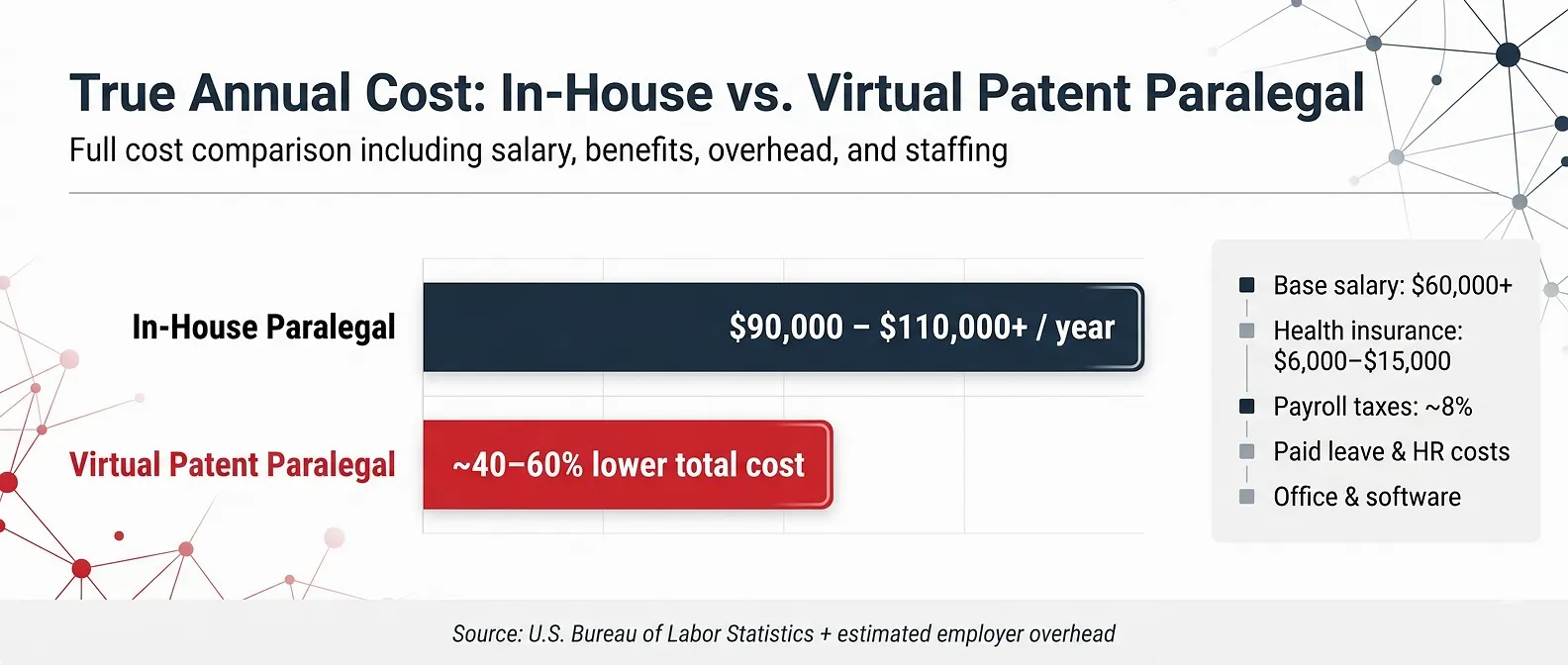
According to the U.S. Bureau of Labor Statistics, the median annual wage for paralegals and legal assistants in the United States is over $60,000. For a senior patent paralegal in major metro areas, that figure can climb substantially higher. Add to that:
- Employer payroll taxes (typically 7-8% of salary)
- Health insurance and benefits (often $6,000 to $15,000 per year per employee)
- Paid time off, sick leave, and holidays
- Recruitment and onboarding costs
- Ongoing training and CLE costs
- Office space, equipment, and software licenses
The true annual cost of a single in-house patent paralegal often exceeds $90,000 to $110,000 when all factors are accounted for.
Scalability Challenges
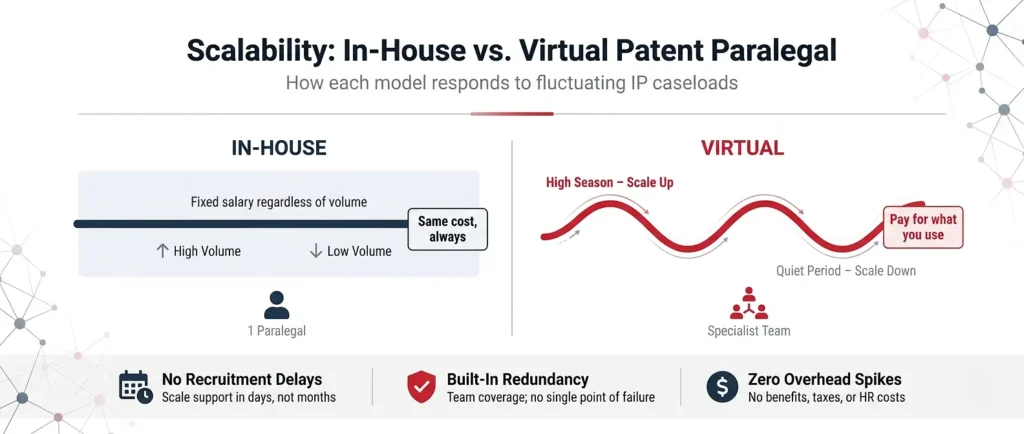
What happens when your case volume doubles? You hire another paralegal. What happens when it drops? You still pay the same fixed salary. In-house staffing does not scale efficiently with fluctuating workloads, which is a reality for virtually every IP practice.
Limited Specialization
A single in-house hire must cover everything: docketing, IDS preparation, PCT filings, sequence listings, patent drawings, and more. Rarely does one individual excel across all of these specialized areas.
Turnover Risk
Patent paralegals are in high demand. When an in-house paralegal leaves, you face immediate disruption: lost institutional knowledge, urgent recruiting, and a gap in coverage during the transition.
Virtual Patent Paralegal: Key Advantages
1. Significant Cost Savings
Virtual patent paralegal services, particularly those offered through specialized IP support firms, cost a fraction of full-time employment. Rather than paying a fixed six-figure salary plus benefits, firms typically pay only for the work actually performed. This model eliminates payroll taxes, benefits overhead, office costs, and recruitment fees.
For smaller firms and solo practitioners especially, this cost difference can be the factor that determines whether high-quality paralegal support is even financially viable.
2. Access to a Full Team of Specialists
This is perhaps the most underappreciated advantage. A reputable virtual IP support provider does not give you a single generalist; it gives you access to a team of specialists. One professional handles IDS preparation and filing, another focuses on patent docketing and IP management, and yet another manages PCT applications or sequence listings. You receive specialist-level work across every function without needing to hire multiple full-time employees. This specialization is critical for maintaining an organized portfolio; for instance, choosing the right patent docketing services for small firms ensures that no deadline is missed even as your caseload grows.
3. Scalability on Demand
Virtual services scale with your actual workload. During a busy prosecution season, you increase the support level. During quieter periods, you scale back. You pay for what you use, not for what you might need.
4. Reduced Administrative Burden
Managing employees takes time: HR, performance reviews, training, supervision, compliance. Virtual services remove much of this burden, allowing attorneys to focus on legal strategy and client relationships rather than staffing logistics.
5. Business Continuity
When a virtual service provider has a team behind it, your work does not stop because one person is sick, on vacation, or has resigned. Redundancy is built into the model.
6. Attorney-Led Quality Oversight
The strongest virtual IP support providers operate under direct attorney oversight. At Teak IP Services, for example, every deliverable undergoes thorough review by U.S. IP attorneys before it reaches the client. That quality control layer is not always present with a single in-house hire. Quality control is particularly vital during complex filings, where following a rigorous IDS preparation checklist can be the difference between a seamless prosecution and a costly office action.
Virtual Patent Paralegal: Potential Considerations
Fairness requires acknowledging that virtual support is not without its considerations.
Communication Requires Intention
Without shared office space, communication relies on email, video calls, and project management platforms. For attorneys accustomed to walking down the hall to ask a quick question, this adjustment requires a deliberate communication process. However, most firms adapt quickly, and many find that structured communication actually improves workflow clarity.
Onboarding Investment
Any new support relationship requires an onboarding period. The firm needs to share preferences, templates, software credentials, and workflow expectations. This upfront investment is real, though it pays dividends quickly once the working rhythm is established.
Time Zone Coordination
If the virtual service operates across multiple time zones, response times for urgent matters require a clear protocol. Reputable providers address this directly by offering defined turnaround commitments and escalation paths.
In-House vs. Virtual Patent Paralegal: Side-by-Side Comparison
| Factor | In-House Paralegal | Virtual Patent Paralegal |
|---|---|---|
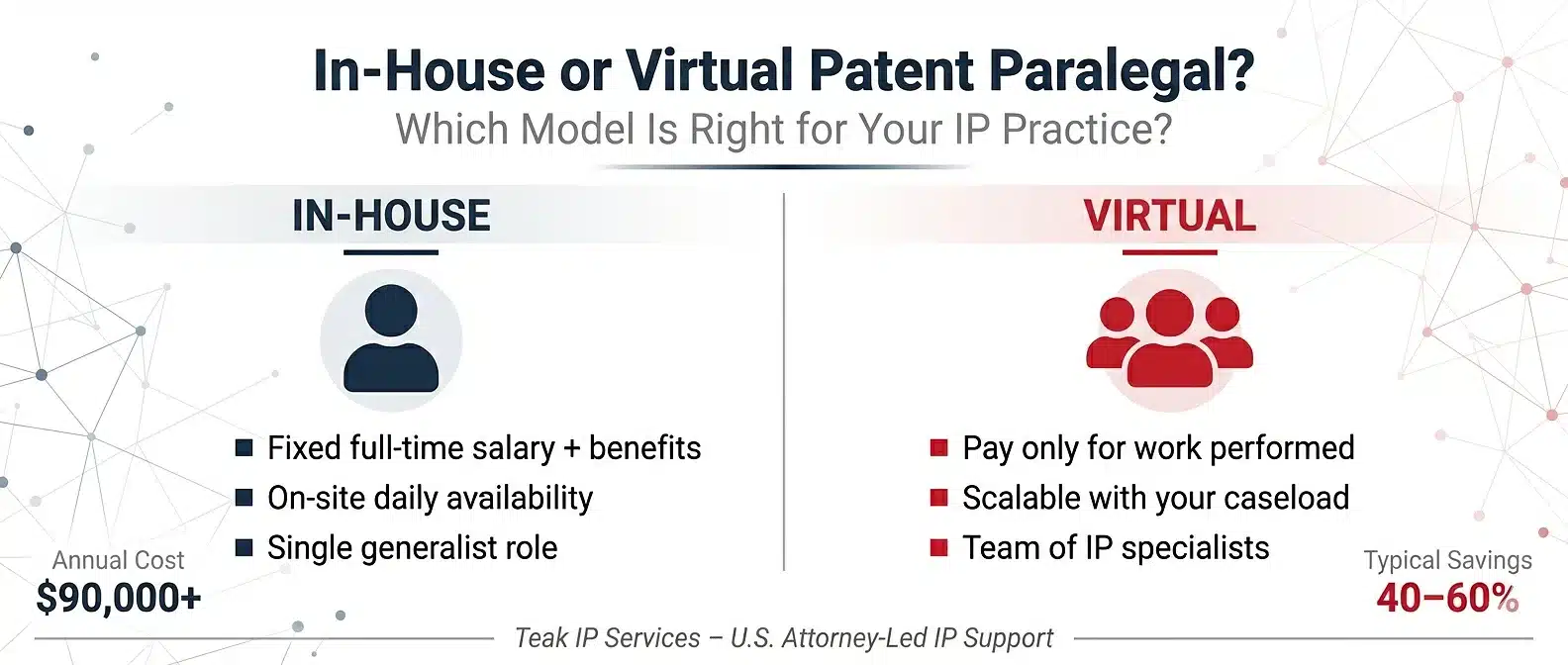
| Annual cost | $90,000 – $110,000+ (with overhead) | Pay-per-use; typically 40-60% lower total cost |
| Specialization | Single generalist | Team of specialists by function |
| Scalability | Fixed; difficult to scale | Fully scalable with workload |
| Availability | Business hours, on-site | Defined turnaround; often extended hours |
| Continuity | Risk if individual leaves | Built-in redundancy |
| Attorney oversight | Depends on management | Included in top-tier providers |
| Onboarding | High (recruitment + training) | Moderate (workflow sharing) |
| Benefits/HR burden | Full employer responsibility | None |
| Best for | Large firms with consistent high volume | Small-to-mid firms; growing practices; fluctuating volume |
Which Model Is Right for Your Practice?
The honest answer is that there is no universal right choice. The best model depends on your firm’s specific profile. Consider these factors carefully:
Choose an In-House Patent Paralegal If:
- Your firm has consistent, high-volume patent work that justifies a full-time salary and benefits package.
- Real-time, in-office collaboration is essential to your workflow and culture.
- You have a dedicated HR function to manage employment logistics.
- Your practice is large enough to absorb the fixed overhead even during slow periods.
Choose a Virtual Patent Paralegal If:
- You want to reduce fixed overhead and pay only for work performed.
- Your workload fluctuates across seasons or client cycles.
- You need access to specialized expertise across multiple patent functions. This is especially beneficial for practices operating globally that require IP management best practices for multi-jurisdiction brand protection to keep international portfolios secure.
- You are a solo practitioner, small firm, or mid-sized firm growing your IP practice.
- You want attorney-overseen quality control built into your support model.
- You need business continuity and redundancy without managing a larger in-house team.
For most small-to-mid-sized IP firms and corporate patent departments managing varied portfolios, a virtual patent paralegal model increasingly delivers superior value. The combination of lower cost, specialist access, and scalability is difficult for a single in-house hire to match. Ultimately, the goal is a more efficient and protected practice. For a deeper look at the strategic side of this transition, explore our comprehensive guide to intellectual property management which covers the full lifecycle of IP assets.
Common Mistakes Firms Make When Choosing Paralegal Support
Understanding what goes wrong helps you avoid the same pitfalls.
1. Choosing based on cost alone. The cheapest option rarely delivers the quality required in patent prosecution. Look for the best value, not the lowest price.
2. Underestimating in-house total cost. Many firms only compare base salaries. The full picture, including benefits, taxes, recruitment, and office costs, often looks very different.
3. Assuming virtual means lower quality. Specialist IP support firms hire experienced patent paralegals and attorneys. Quality in this model depends on choosing the right provider, not the delivery format.
4. Neglecting to verify attorney oversight. For any external support, confirm whether a licensed attorney reviews and approves the work. This matters enormously for IDS reference management, office action response support, and other prosecution-critical tasks. High-level oversight ensures technical accuracy in nuanced areas, such as understanding exactly how patent family cross-referencing works in IDS preparation to meet all disclosure requirements.
5. Failing to define clear workflows upfront. Whether in-house or virtual, paralegals need clear processes, templates, and communication expectations from the start.
Expert Tips for Evaluating Virtual Patent Paralegal Providers
If you are seriously considering a virtual model, here is how to evaluate your options effectively:
- Verify attorney oversight: Confirm that a licensed U.S. IP attorney reviews work product before delivery. This is non-negotiable for prosecution support.
- Request work samples: Ask for sample IDS filings, docketing reports, or PCT preparation documents. Reputable providers share these readily.
- Clarify turnaround commitments: Understand exactly how urgent requests are handled. What is the response window for a same-day deadline?
- Assess the team depth: Ask about the breadth of services covered and whether specialists handle distinct functions rather than one person covering everything.
- Check for IP management system compatibility: Confirm that the provider can work with your existing docketing or IP management software.
- Start with a pilot engagement: Consider beginning with a defined scope, such as IDS preparation or patent docketing support, before fully transitioning your paralegal support model.
How Teak IP Services Delivers Virtual Patent Paralegal Support
Teak IP Services is a U.S. attorney-led IP support firm providing specialist virtual paralegal services to law firms, corporate IP departments, and individual practitioners. Key differentiators include:
- U.S. attorney oversight on every deliverable
- 70+ years of combined paralegal experience across the team
- Full spectrum of patent paralegal services: IDS preparation and filing, patent docketing, PCT applications, patent drawings, sequence listings, office action support, and more
- An a la carte pricing model so firms pay only for services actually used, with no minimum commitments
- U.S. and India team integration enabling faster turnaround times and competitive rates without sacrificing quality
Frequently Asked Questions
Is it better to hire an in-house or virtual patent paralegal for a small firm?
For most small firms, a virtual patent paralegal is the better choice. It eliminates fixed salary and benefits overhead, provides access to specialist expertise across multiple patent functions, and scales with your actual caseload. The cost savings alone often make high-quality paralegal support accessible to practices that could not otherwise afford a full-time hire.
What is the typical cost difference between in-house and virtual patent paralegal services?
When you account for salary, benefits, payroll taxes, and overhead, an in-house patent paralegal can cost $90,000 or more per year. Virtual patent paralegal services typically reduce that total cost by 40-60%, with firms paying only for work actually performed rather than a fixed annual salary.
Can a virtual patent paralegal handle urgent USPTO filings and deadlines?
Yes, reputable virtual IP support providers have defined turnaround commitments and escalation processes specifically for time-sensitive matters. It is important to clarify these protocols before engaging any provider, but urgent deadline management is a core competency of established virtual patent paralegal services.
What tasks can a virtual patent paralegal perform?
A qualified virtual patent paralegal can handle the full range of prosecution support tasks, including IDS preparation and filing, patent docketing, PCT application support, office action coordination, patent drawings, sequence listings, deadline tracking, and foreign associate communication. For a full overview of available services, see Teak IP’s IP paralegal services.
How do I ensure quality when using a virtual patent paralegal service?
Look for providers that operate under direct U.S. attorney oversight, offer transparent work samples, provide clear turnaround commitments, and have verifiable experience in patent prosecution support. Attorney review of every deliverable is the most important quality safeguard to confirm before engaging any virtual service.
Is it better to hire an in-house or virtual patent paralegal for a large firm?
Large firms with consistent, high-volume patent work and established HR infrastructure can justify in-house hiring. However, even large firms increasingly use virtual paralegal services for overflow work, specialized tasks such as patent docketing or IDS management, and geographic expansion without adding permanent headcount.
What should I look for in a virtual patent paralegal provider?
Prioritize providers with: licensed attorney oversight, a specialist team (not a single generalist), verifiable experience in USPTO procedures, transparent pricing, clear turnaround commitments, and demonstrated expertise in the specific services you need most, whether that is docketing, IDS preparation, PCT filings, or a combination.
Conclusion: Making the Right Call for Your IP Practice
So, is it better to hire an in-house or virtual patent paralegal? The answer depends on your firm’s size, workload patterns, budget, and long-term growth plans. However, for a growing number of IP practices, the virtual model consistently delivers superior value: lower cost, access to specialists, scalability, and built-in quality oversight.
In-house hiring still makes sense for large firms with consistently high, predictable prosecution volume and the infrastructure to manage full-time employees efficiently. But for smaller firms, solo practitioners, and corporate IP teams managing varied portfolios, a virtual patent paralegal service provides the expertise and flexibility that a single in-house hire simply cannot match.
The best decisions in IP practice management are informed by real data, honest cost analysis, and a clear view of what your team actually needs. Use the comparison framework in this article to evaluate your options, and consider starting with a pilot engagement to experience the difference firsthand.
Whether you need ongoing paralegal support or targeted specialist assistance for specific matters, Teak IP offers a flexible and scalable alternative to traditional in-house hiring.
Ready to explore virtual patent paralegal support for your practice?
Explore the full range of IP paralegal services at Teak IP Services.

