
If you run a small patent law firm, you already know the pressure: tight deadlines, complex multi-jurisdictional filings, and the unforgiving consequences of a single missed date. Choosing the best patent docketing services for small firms is not just an operational decision; it is a risk management imperative that can determine whether your practice thrives or faces malpractice exposure.

Patent docketing refers to the systematic tracking and management of all critical IP-related dates, deadlines, and actions. For small firms, where one or two attorneys may handle dozens of active matters, a robust docketing system or service is the backbone of the practice. Yet many small firms still rely on outdated spreadsheets, manual reminders, or inadequate software, leaving them unnecessarily vulnerable.
This guide walks you through the top patent docketing services and solutions tailored to the needs of small IP practices. You will learn what to look for, which providers stand out, how to avoid common pitfalls, and how to make a confident, informed decision for your firm.
What is Patent Docketing and Why Does It Matter?
Patent docketing is the process of recording, organizing, and monitoring all procedural deadlines and action items associated with patent applications and granted patents. These include filing deadlines, office action response windows, annuity payment due dates, PCT national phase entry deadlines, and maintenance fee schedules.
For small firms, a single missed deadline can result in the abandonment of a patent application, loss of patent rights, financial liability, and damaged client relationships. Unlike larger firms that have dedicated docketing departments, small practices often bear this risk with limited administrative infrastructure.
To understand the foundational elements of docketing in more depth, see Teak IP’s complete patent docketing guide, which covers everything from terminology to workflow design.
Key Dates Typically Tracked in Patent Docketing
- USPTO filing deadlines and office action response periods
- PCT Chapter I and Chapter II international deadlines
- National phase entry deadlines across all designated countries
- Annuity and maintenance fee payment schedules
- Continuation, continuation-in-part, and divisional filing windows
- Appeal and post-grant review deadlines
- Assignment recordal and formalities deadlines
Types of Patent Docketing Solutions Available to Small Firms
Before evaluating specific providers, it helps to understand the landscape of options available to small law firms.
1. Outsourced Patent Docketing Services
Outsourcing means entrusting your docketing function to a specialized third-party provider. Trained docketing professionals manage your deadlines, update your docket calendar, and alert attorneys to upcoming actions. This model is increasingly popular among small firms because it provides enterprise-grade accuracy without the overhead of hiring full-time staff.
For a detailed breakdown of why outsourcing makes sense, read Outsource Patent Docketing: Key Reasons to Consider on the Teak IP blog.
2. Patent Docketing Software Platforms
Software platforms such as Anaqua, CPA Global (now part of Clarivate), and FoundationIP provide dedicated tools for deadline tracking, document management, and workflow automation. These platforms are powerful but often carry significant setup costs and learning curves that may not suit a solo practitioner or a two-attorney shop.
For a detailed guide to software platforms, explore the comprehensive guide to patent docketing systems from Teak IP Services.
3. Hybrid Models
Some firms combine affordable software for internal tracking with outsourced oversight for high-stakes verification and deadline monitoring. This hybrid approach provides redundancy and peace of mind without requiring a full in-house docketing staff.
Best Patent Docketing Services for Small Firms: Top Providers Reviewed
When evaluating patent docketing support specifically for small and boutique IP practices, Teak IP Services stands out as a purpose-built solution rather than a scaled-down version of enterprise offerings. Instead of trying to serve every segment of the market, Teak IP is intentionally structured around the operational realities, budget constraints, and risk exposure of smaller firms.
Why Teak IP Services Is Built for Small Firms
Unlike large providers that often prioritize high-volume corporate portfolios, Teak IP focuses on precision, responsiveness, and adaptability-three factors that matter most to solo practitioners and small teams managing critical deadlines without extensive internal support.
Teak IP’s model centers on dedicated docketing professionals (docketers) who align closely with your firm’s workflow. This is not a generic, pooled-service environment. Instead, you get consistent personnel who understand your preferences, filing habits, and jurisdictional nuances, which significantly reduces communication gaps and errors.
Core Strengths
1. Tailored Docketing Support
Teak IP customizes its services based on how your firm operates. Whether you need full-service docketing or supplemental support for peak workloads, the engagement is flexible and scalable.
2. Cross-Jurisdictional Expertise
Their team is experienced in handling deadlines and procedures across major patent offices, including:
- USPTO (United States)
- EPO (Europe)
- WIPO (PCT applications)
This ensures accurate tracking of complex, multi-country prosecution timelines.
3. High Accuracy & Risk Reduction
Missed deadlines can lead to irreversible loss of rights and malpractice exposure. Teak IP emphasizes:
- Multi-level deadline verification
- Proactive alerts and reminders
- Redundancy checks for critical dates
This structured approach helps small firms operate with the reliability of a much larger practice.
4. Cost-Effective for Small Practices
Hiring and training an in-house docketing specialist can be expensive and time-consuming. Teak IP offers:
- Lower operational cost compared to full-time staff
- No software licensing burden
- Minimal onboarding friction
This makes it especially attractive for firms that want professional-grade docketing without heavy infrastructure investment.
5. Flexible Engagement Models
Teak IP adapts to different working styles:
- Fully outsourced docketing
- Hybrid support alongside in-house staff
- Overflow/backup support during busy periods
This flexibility allows firms to scale services as their caseload grows.
Best Fit Use Cases
Teak IP Services is particularly well-suited for:
- Solo patent attorneys and agents
- Small and boutique IP law firms
- Growing practices transitioning away from manual tracking
- Firms seeking to reduce malpractice risk without expanding headcount
Bottom Line
If your priority is accuracy, personalization, and cost control, Teak IP Services offers a highly focused alternative to enterprise-heavy providers. Its tailored approach ensures that small firms receive hands-on, reliable docketing support without unnecessary complexity or overhead—making it one of the most practical choices in this category.
To compare software-based approaches, see Teak IP’s overview of what a docketing system is and how it works.
Comparison Table: Best Patent Docketing Services for Small Firms
The table below compares the key attributes of leading patent docketing services and approaches, helping small firms make an informed selection:
Table 1: Patent Docketing Service Comparison for Small Firms
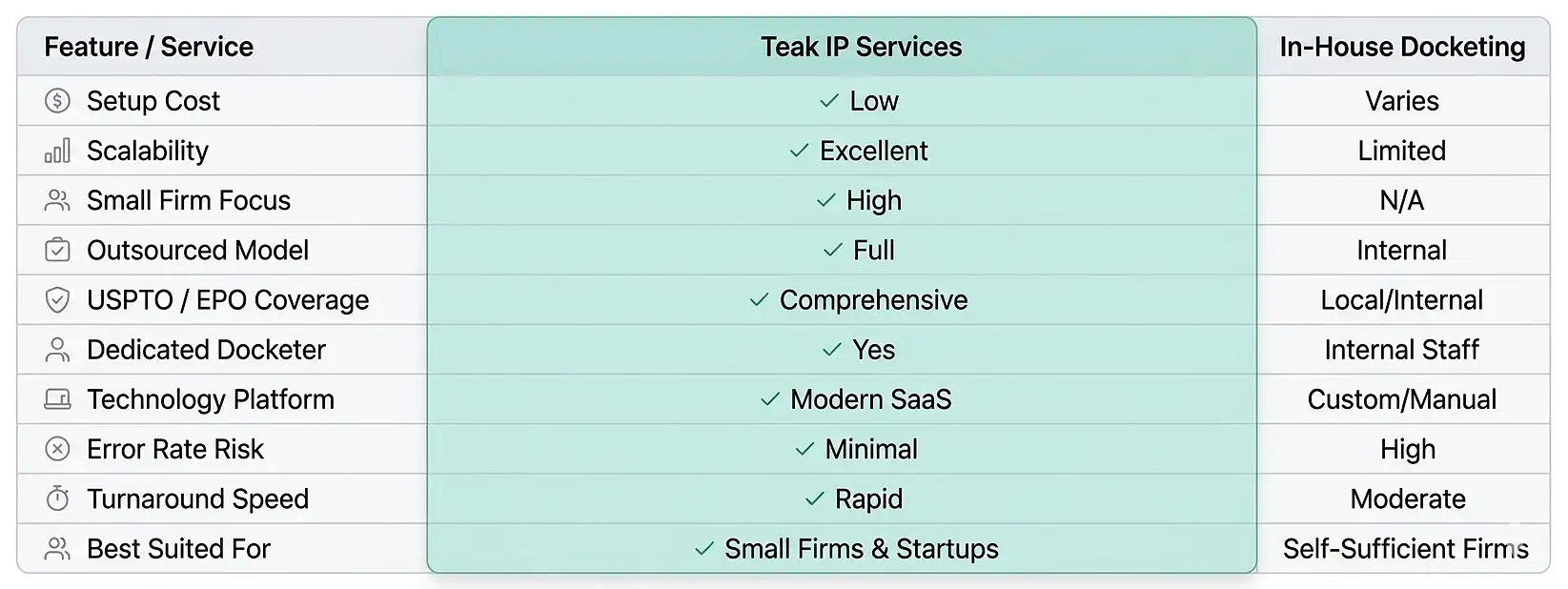
Note: This table is based on publicly available service information and general market positioning. Pricing and features may vary.
Key Factors to Evaluate When Choosing a Patent Docketing Service
Not all patent docketing services are created equal. Before committing to any provider or platform, small firms should evaluate the following factors carefully:
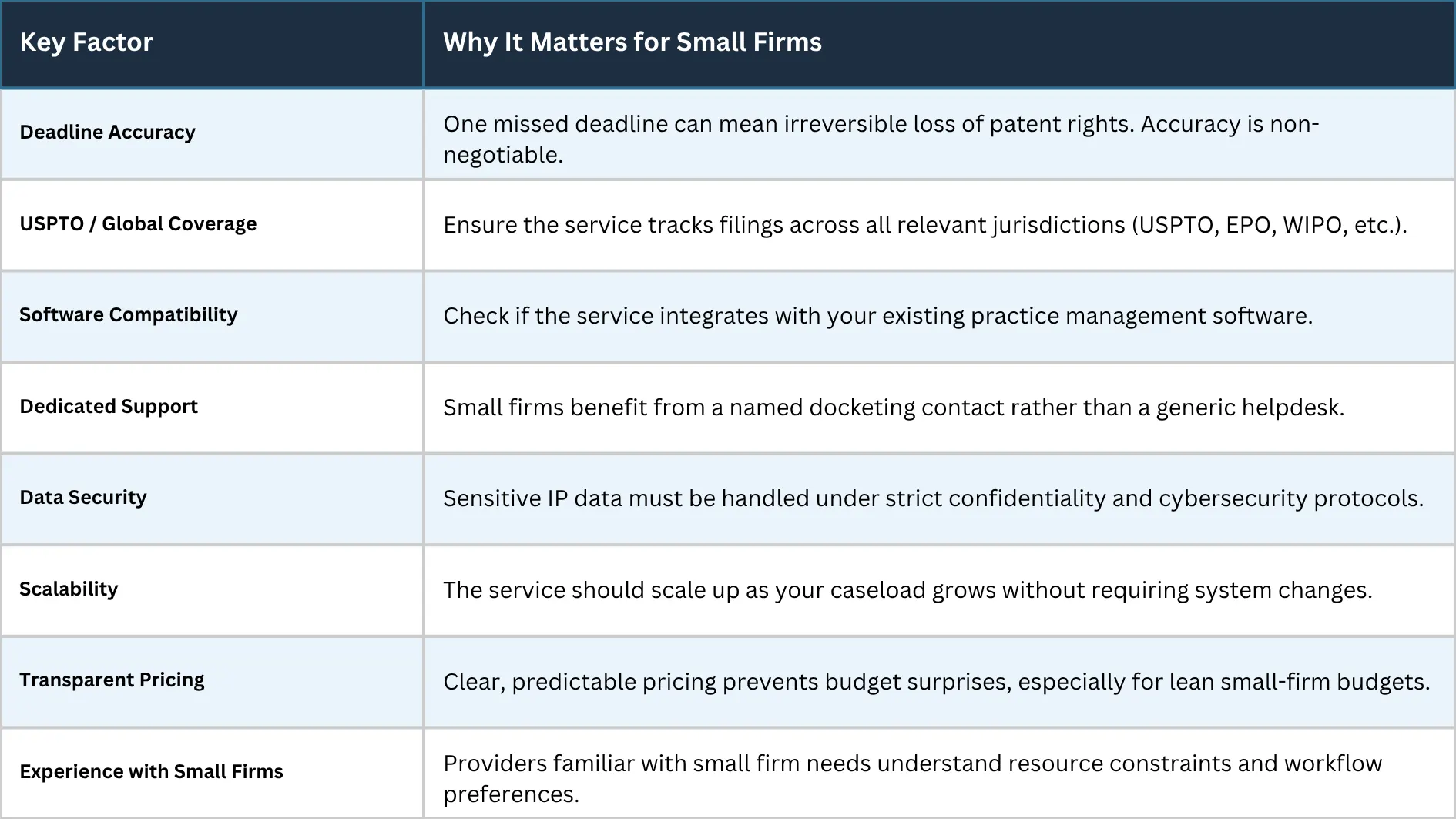
For a deeper dive into best practices, Teak IP’s IP docketing best practices guide covers the complete spectrum of considerations.
How to Set Up Patent Docketing for Your Small Firm: Step-by-Step
Whether you choose a fully outsourced service or a software-supported in-house model, the following steps will help you establish a reliable docketing system:
- Audit your current docket: Review all active matters, identify gaps in deadline tracking, and document your current workflow.
- Define your scope: List all jurisdictions you file in (USPTO, EPO, WIPO, national offices) to ensure your chosen service covers all necessary territories.
- Shortlist providers: Based on the factors in the table above, create a shortlist of two to three providers or platforms.
- Request demos or trial periods: Evaluate each provider’s user interface, responsiveness, and accuracy before making a commitment.
- Conduct a data migration review: If transitioning from an existing system, plan how active docket data will be transferred and verified.
- Establish quality control protocols: Even with an outsourced provider, implement a secondary review process for high-stakes deadlines.
- Train your team: Ensure that all attorneys and support staff understand how to read docket reports and escalate potential issues.
- Monitor performance regularly: Set quarterly reviews to assess error rates, turnaround times, and staff satisfaction with the docketing service.
You can also consult Teak IP’s legal docketing workflow guide for IP professionals for step-by-step workflow design tips.

Common Patent Docketing Mistakes Small Firms Must Avoid
Even experienced attorneys can fall into docketing traps that put client rights at risk. Here are the most critical mistakes to avoid:
1. Relying Solely on Manual Calendaring
Using Outlook reminders or paper calendars as your primary docketing tool is a significant malpractice risk. These systems lack redundancy, do not account for jurisdictional rule variations, and are vulnerable to human error.
2. Failing to Account for Jurisdictional Differences
Deadlines differ significantly between the USPTO, EPO, JPO, and CNIPA. A docketing system or service that does not accommodate multi-jurisdictional rules will inevitably generate errors for internationally active firms.
3. Ignoring Response Period Extensions
Many small firm attorneys are unaware that certain offices allow or require specific procedures to extend response periods. A docketing service should flag these options proactively.
4. Underestimating Maintenance Fee Schedules
Maintenance fees vary widely by country and patent age. Failing to track annuities on foreign counterpart patents is a common source of inadvertent lapse.
For an in-depth examination of intellectual property docketing requirements, see the intellectual property docketing guide from Teak IP Services.
5. Not Having a Backup or Redundancy System
A single point of failure in your docketing workflow is dangerous. Best practice requires at least two layers of deadline reminders: an initial notice well in advance (typically 90 days), a follow-up reminder (30 days), and a final alert (7-14 days before the deadline).
6. Choosing a Provider Not Suited to Small Firm Needs
Selecting an enterprise-focused provider because of brand recognition, without considering fit, can result in poor service, excessive costs, and lack of personalized support. Small firms should prioritize providers with demonstrated experience serving boutique and solo practices.
Expert Tips for Maximizing the Value of Your Patent Docketing Service
Getting the most out of your patent docketing service requires more than just subscribing to a platform or hiring a vendor. Here are field-tested recommendations:
- Insist on a named docketing contact: Having a specific person responsible for your docket creates accountability and consistency.
- Request monthly docket audit reports: Regular reports highlight upcoming deadlines and allow attorneys to review pending actions in advance.
- Integrate docketing with your practice management system: Eliminating data silos reduces manual re-entry and the associated error risk.
- Build in buffer time: Schedule internal reviews at least two weeks before every hard deadline.
- Document your docketing policies in writing: A written docketing policy manual ensures consistency even when key staff members are absent.
- Leverage technology for annuity management: For global portfolios, automated annuity payment services from providers such as Dennemeyer or CPA Global can reduce administrative burden.
- Review malpractice insurance requirements: Some professional liability insurers offer premium reductions for firms using certified docketing solutions. Check with your carrier.
For guidance specifically applicable to larger or growing firms, see patent and trademark docketing for large firms for scalability planning insights.
Why Outsourced Patent Docketing is Ideal for Small Firms
For most small patent law firms, outsourced patent docketing delivers a compelling combination of accuracy, cost-efficiency, and scalability that in-house solutions simply cannot match at the same price point. Here is why:
Cost Savings
Hiring a full-time, trained docketing specialist typically costs between USD 55,000 and USD 85,000 annually, including salary, benefits, and training. In contrast, outsourced services offer predictable, subscription-based pricing that scales with your caseload.
Access to Specialized Expertise
Professional docketing services employ specialists who work exclusively on IP deadline management. Their deep expertise in jurisdictional rules, procedural nuances, and rule changes ensures a level of accuracy that generalist staff cannot reliably provide.
Scalability Without Overhead
As your firm grows, outsourced docketing scales with you without requiring new hires, onboarding periods, or system upgrades. This flexibility is especially valuable for firms experiencing rapid caseload growth.
Reduced Malpractice Exposure
By placing deadline tracking in the hands of dedicated professionals, small firms significantly reduce the risk of errors that could lead to malpractice claims. Many firms report that switching to outsourced docketing reduced internal administrative stress and improved attorney focus on billable work.
According to the American Bar Association, malpractice claims related to deadline and calendar management represent one of the most common categories of legal malpractice incidents. Proper docketing is, therefore, a direct risk mitigation tool.
Choosing the Best Patent Docketing Service for Your Small Firm
Selecting the best patent docketing services for small firms is one of the most consequential operational decisions you will make as a patent attorney. Your clients rely on you to protect their intellectual property, and your ability to meet every deadline without fail is the foundation of that trust.
The right docketing solution will reduce your malpractice risk, free up attorney bandwidth for billable work, and provide the peace of mind that comes from knowing every deadline is tracked by trained professionals. For most small firms, outsourced docketing provides the optimal combination of accuracy, cost-efficiency, and flexibility.
Teak IP Services is specifically built to serve the needs of small and boutique IP law firms. With experienced docketers, flexible service models, and a deep understanding of USPTO, EPO, and PCT procedures, Teak IP delivers enterprise-level accuracy at a price point that makes sense for growing practices.
Ready to upgrade your docketing? Contact Teak IP Services today for a consultation, or explore the full blog and resources library for more expert guidance.
Authoritative External Resources
The following official and authoritative resources provide further context on patent deadlines and IP procedures referenced in this article:
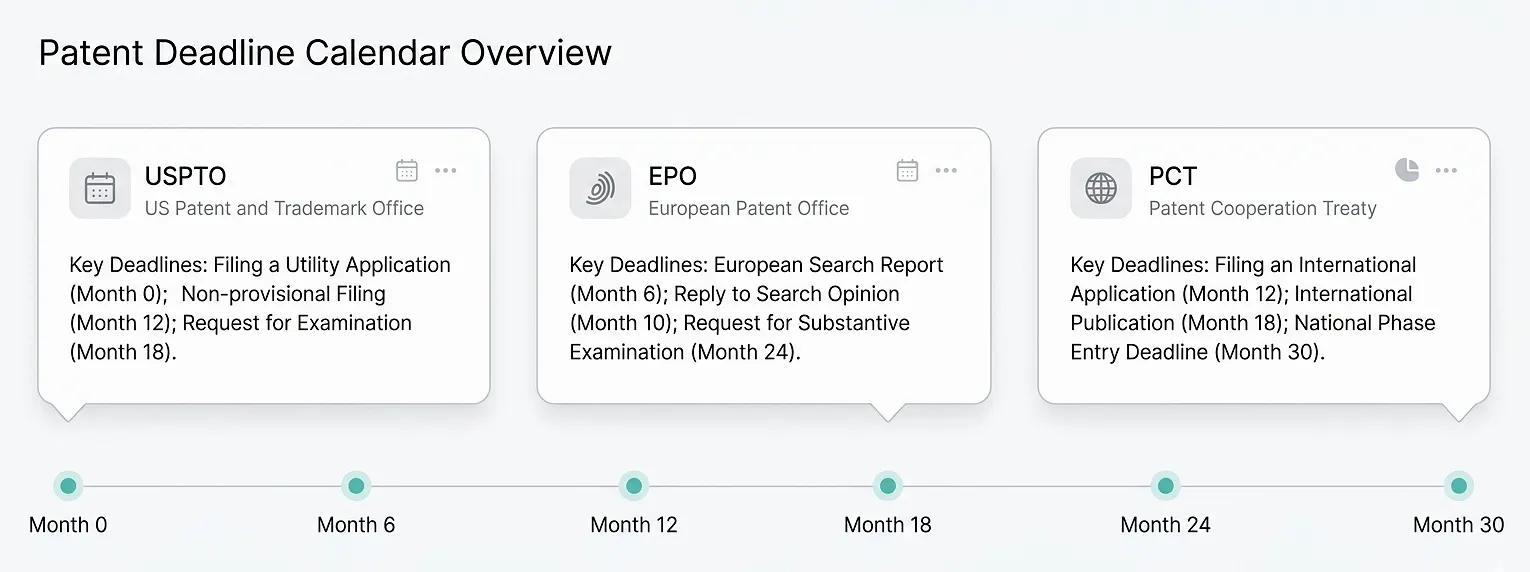
1. USPTO Patent Process Overview: United States Patent and Trademark Office – Patents – Official guidance on the U.S. patent filing process, deadlines, and fees.
2. EPO Guide to Procedures: European Patent Office – Filing a European Patent Application – Official EPO resource on application procedures and deadline rules.
3. WIPO PCT Resources: WIPO – Patent Cooperation Treaty – Comprehensive official resource on PCT international filing timelines, national phase entry, and docketing requirements.
FAQ: Best Patent Docketing Services for Small Firms
Q1: What are the best patent docketing services for small firms?
The best patent docketing services for small firms combine accuracy, affordability, and personalized support. Teak IP Services is specifically designed for small and boutique IP practices. Other notable providers include MaxVal Group for mid-range budgets, and CPA Global (Clarivate) for firms with international portfolios and larger budgets. The right choice depends on your firm’s size, jurisdictional scope, and budget.
Q2: How much does outsourced patent docketing cost for a small firm?
Outsourced patent docketing services for small firms typically range from a few hundred to a few thousand dollars per month, depending on caseload volume, jurisdictions covered, and the level of service. This is significantly less expensive than hiring a full-time in-house docketing specialist.
Q3: Can a solo patent attorney use a professional docketing service?
Yes; in fact, solo practitioners stand to benefit the most from professional docketing services. With no administrative staff to provide backup, a solo attorney relying on manual calendaring faces substantial malpractice risk. Outsourced docketing provides redundancy and professional oversight at a cost-effective price.
Q4: What is the difference between patent docketing software and a docketing service?
Patent docketing software is a technology platform that the firm’s staff uses to track and manage deadlines. A patent docketing service involves outsourcing that function to trained docketing professionals who manage the system on your behalf. Many small firms find the service model preferable because it requires no in-house training, system maintenance, or dedicated staff time.
Q5: How do I switch patent docketing providers without losing data?
Switching providers requires a structured data migration plan. First, export all active docket entries from your current system in a compatible format. Then, work with your new provider to import, verify, and reconcile the data before going live. Most reputable docketing services offer onboarding support to facilitate this transition.
Q6: Is outsourced patent docketing secure?
Reputable patent docketing services maintain strict data confidentiality protocols, including encrypted data transmission, non-disclosure agreements, and role-based access controls. Before engaging any provider, request their data security policy and confirm compliance with applicable professional responsibility rules in your jurisdiction.
Q7: How does patent docketing differ for international filings?
International filings, particularly under the PCT system, involve complex multi-stage deadline structures: international filing, ISR/WO, Chapter II, and national phase entry deadlines, each governed by different rules in different jurisdictions. A professional docketing service with multi-jurisdictional expertise is essential for managing these deadlines reliably.

