
IDS preparation checklist USPTO: If you’re navigating the U.S. patent prosecution process, one of the most critical – and often underestimated – obligations you’ll face is filing an Information Disclosure Statement (IDS). Missing a prior art reference, submitting incomplete forms, or failing to meet USPTO deadlines can compromise the enforceability of your patent and expose you to serious legal risk.

Whether you’re a patent practitioner, in-house IP counsel, or an inventor managing your own application, having a thorough IDS preparation checklist for USPTO filings is non-negotiable.
This guide walks you through everything you need before filing – from gathering the right references to understanding timing rules, fees, and compliance requirements – so you can file with confidence.
What is an IDS and Why Does It Matter?
An Information Disclosure Statement (IDS) is a formal submission to the USPTO in which applicants disclose all information known to be “material to patentability” of the invention being claimed. It is governed by 37 C.F.R. § 1.56, which establishes the duty of candor and good faith owed to the USPTO.
Why the IDS is Not Optional
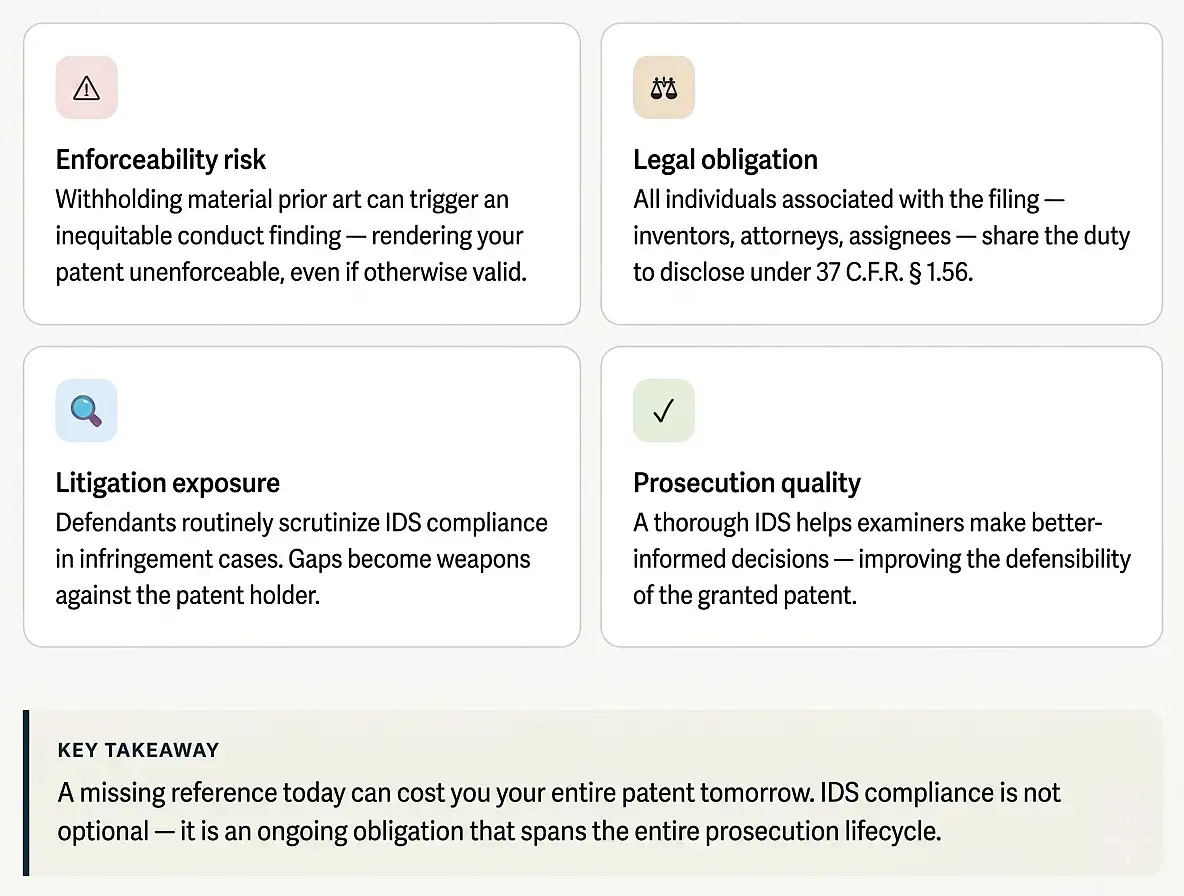
- Legal obligation: Every individual associated with the filing – inventors, attorneys, and assignees – has a duty to disclose known material prior art.
- Enforceability risk: Failure to disclose material information can result in a finding of inequitable conduct, rendering the patent unenforceable – even if valid.
- Litigation exposure: Courts and defendants in infringement cases routinely investigate IDS compliance. Gaps can be weaponized against patent holders.
- Prosecution integrity: A proper IDS helps examiners make well-informed decisions, improving the overall quality and defensibility of the granted patent.
Bottom Line: A missing reference today can cost you your entire patent tomorrow.
The IDS Preparation Checklist: Step-by-Step
Use this comprehensive IDS preparation checklist to ensure your USPTO filing is complete, compliant, and submitted on time.
SECTION 1: Identify All Material Prior Art References
The foundation of every IDS is a thorough prior art search and collection process. You must disclose all prior art that is “material to patentability” – meaning it could affect whether the claims are granted.
What to collect:
- U.S. Patents – Search USPTO patent databases (Patents.Google.com, USPTO Patent Full-Text Database)
- U.S. Patent Application Publications – Including pre-grant publications (PGPubs)
- Foreign Patents and Patent Publications – EPO, JPO, WIPO/PCT, CNIPA, KIPO, and others
- Non-Patent Literature (NPL) – Journal articles, conference papers, technical manuals, white papers, datasheets, product catalogs, standards documents
- References cited in related applications – Co-pending domestic applications, PCT national phase entries, continuation/divisional/CIP applications
- References cited by foreign patent offices – Search reports from EPO, JPO, KIPO, CNIPA received during prosecution of corresponding foreign cases
- References cited by co-inventors or internal R&D teams – Lab notebooks, technical disclosures, product development documentation
- References from litigation or IPR/PGR proceedings – Any invalidity contentions received in related matters
- References from third-party submissions – Pre-issuance submissions under 37 C.F.R. § 1.290
Pro Tips:
- Cast a wide net. It is far better to over-disclose than under-disclose.
- Set up a tracking system (spreadsheet or IP management software) to log every reference from every source throughout prosecution.
- Monitor foreign prosecution files regularly and synchronize IDS submissions accordingly.
SECTION 2: Gather the Correct Reference Documents
Once you’ve identified material references, you must obtain and organize the actual documents.
For each reference, confirm you have:
- Full copy of the document (patent, publication, or article)
- English translation (required for non-English documents – at minimum, a concise explanation of relevance is required; full translations are best practice)
- Accurate bibliographic data:
- Author(s) / Inventor(s)
- Title of publication or patent number
- Publication date / issue date / filing date
- Journal name, volume, issue, and page numbers (for NPL)
- Country of origin and patent office (for foreign documents)
- Application or patent number (for foreign patents)
Common pitfalls to avoid:
- Submitting references with illegible or incomplete bibliographic data
- Failing to include translations for foreign-language references
- Relying on abstracts or summaries instead of full documents
- Using outdated or superseded versions of standards documents
SECTION 3: Complete the Correct USPTO Forms
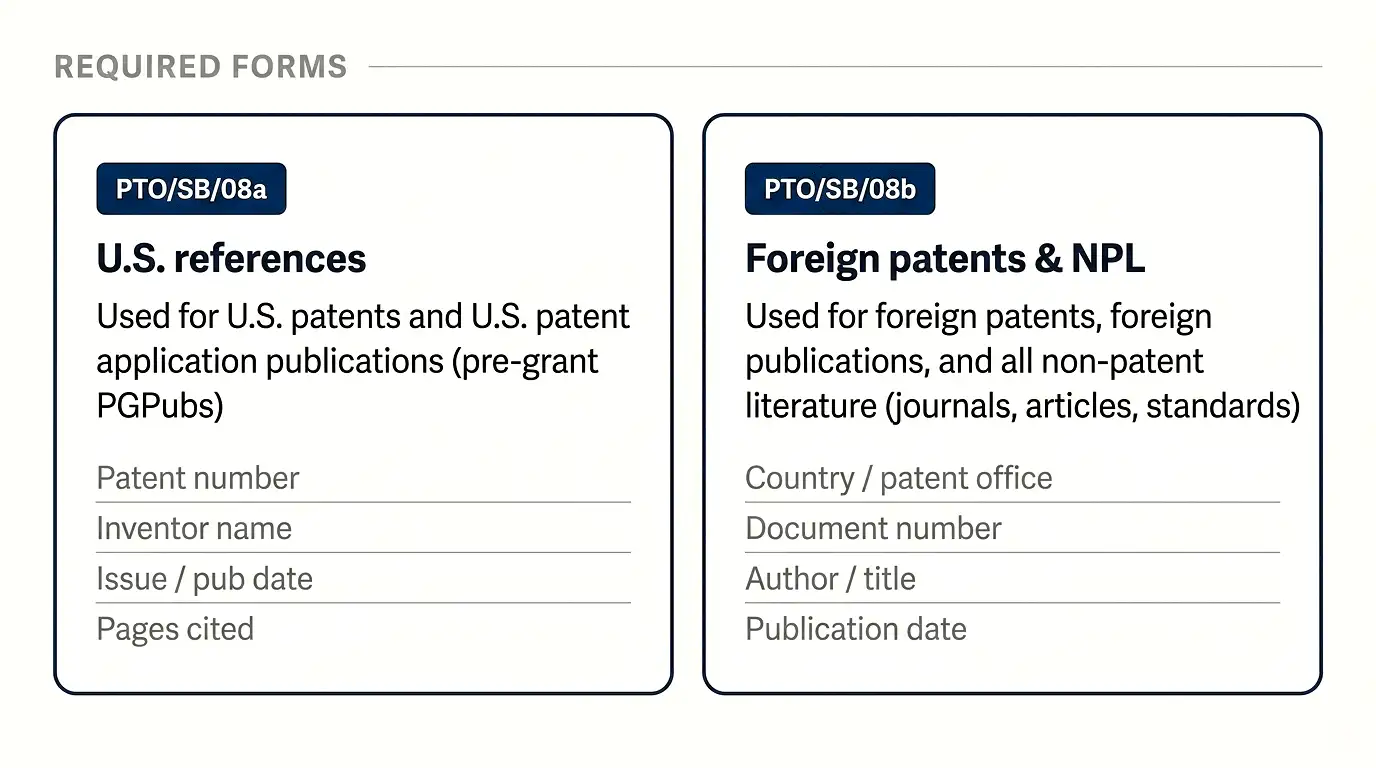
The USPTO requires specific forms for IDS submissions. Submitting the wrong form or an incomplete one will delay processing and may require resubmission.
Required Forms:
| Form | Use Case |
|---|---|
| PTO/SB/08a | For U.S. Patents and U.S. Patent Application Publications |
| PTO/SB/08b | For Foreign Patents and Non-Patent Literature |
| PTO-892 | Examiner-generated form; not used by applicants directly |
For each form, confirm:
- Application number is correct and matches the pending application
- All columns are filled accurately (document number, name, date, pages, etc.)
- References are listed individually – do not group multiple references in one row
- The form is signed by the practitioner of record (or applicant if pro se)
- Date of submission is accurate
Note: USPTO forms are updated periodically. Always download the most current version from USPTO.gov before preparing your IDS.
SECTION 4: Understand and Apply the Correct Timing Rules
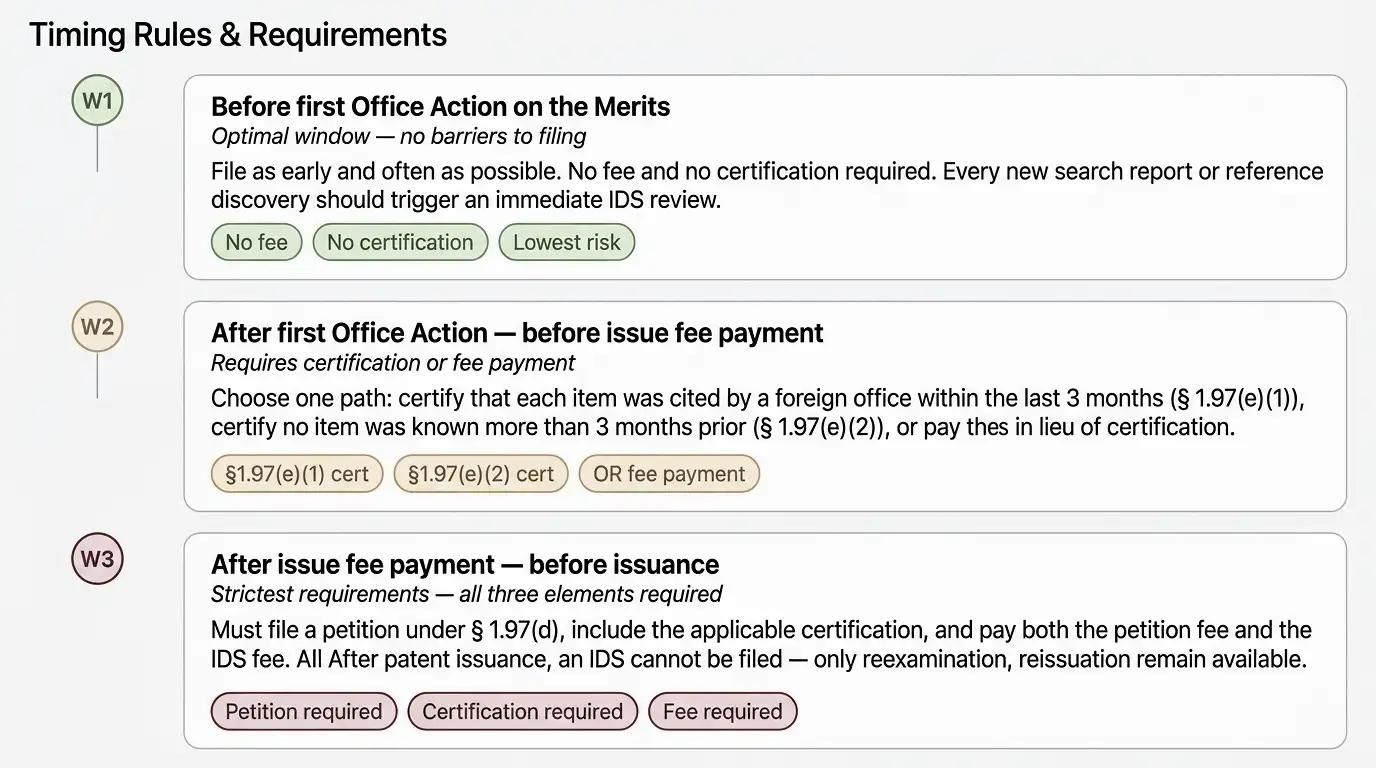
Timing is everything with IDS filings. The USPTO has strict rules governing when an IDS must be filed and what fee or certification is required depending on when it is submitted. Missing a window can require additional certifications or fees – or result in non-compliance.
The Three IDS Filing Windows:
Window 1: Before the First Office Action on the Merits (No Fee, No Certification)
- IDS filed before the mailing date of the first Office Action on the Merits (FOAM)
- No fee required
- No certification required
- This is the optimal window – file early and often
Checklist for Window 1:
- Confirm no first Office Action has been mailed yet
- Submit IDS promptly upon receiving foreign search reports or discovering material references
Window 2: After First Office Action, Before Payment of Issue Fee
An IDS filed after the first FOAM but before the date the issue fee is paid requires one of the following:
A Option – Certification under 37 C.F.R. § 1.97(e)(1):
- Each item was first cited in a communication from a foreign patent office or other party less than three months before the IDS is filed
- Certification statement signed by the practitioner or applicant
B Option – Certification under 37 C.F.R. § 1.97(e)(2):
- No item was known to any individual with a duty to disclose more than three months before the IDS was filed
- Certification statement signed
C Option – Fee payment (no certification needed):
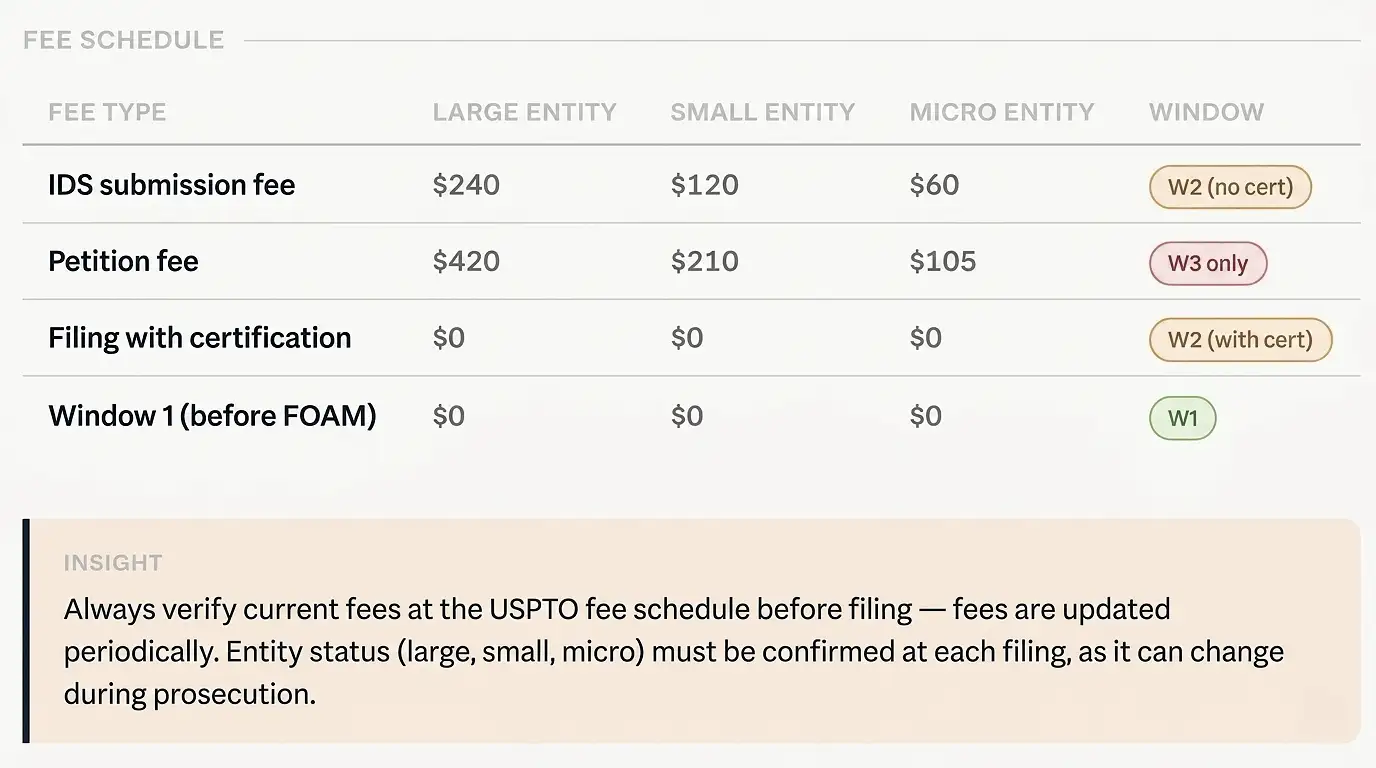
- Pay the required IDS fee (currently $240 for large entities; $120 for small entities; $60 for micro entities — verify current fee schedule at USPTO.gov)
Checklist for Window 2:
- Determine which option applies (certification or fee)
- Prepare the appropriate certification statement if applicable
- Calculate and include the correct fee if not certifying
- Confirm issue fee has not yet been paid
Window 3: After Payment of Issue Fee (Strictest Requirements)
An IDS filed after the issue fee is paid but before patent issuance requires all of the following:
- A petition under 37 C.F.R. § 1.97(d) (currently $420 for large entities)
- The applicable certification under § 1.97(e)
- The IDS fee if certification cannot be made
Critical Note: After the patent issues, an IDS cannot be filed in the application. Post-grant options include reexamination, reissue, or supplemental examination under 35 U.S.C. § 257.
Summary Timing Table:
SECTION 5: Calculate and Include the Correct Fees
Fee errors are one of the most common reasons for IDS processing delays.
Current IDS-Related Fees (verify at USPTO Fee Schedule):
Fee checklist:
- Confirmed entity status (large, small, or micro)
- Verified current fee amounts from USPTO fee schedule (fees change periodically)
- Included correct fee with submission or confirmed fee payment via USPTO deposit account
- Fee payment method documented (credit card, deposit account, EFT)
SECTION 6: Review Continuity and Related Application Obligations
IDS obligations do not exist in a vacuum. If you have a family of related applications, each application must independently satisfy its IDS obligations.
Related application review checklist:
- Identify all related U.S. applications (continuations, divisionals, CIPs, RCEs)
- Identify all corresponding foreign applications and PCT applications
- Cross-check references cited in each application against all other pending applications
- Upon receiving any Office Action or search report in any related case, evaluate and file an IDS in all pending related U.S. applications where the references may be material
- Track IDS obligations across the entire patent family in IP management software
Best Practice: Establish a written protocol for immediately routing any new Office Action, search report, or third-party citation to the responsible attorney for cross-application IDS review.
SECTION 7: Conduct a Pre-Submission Quality Review
Before hitting submit, run a final quality check. This is your last line of defense against compliance errors.
Final QC Checklist:
Document Completeness:
- Every reference listed on the form is accompanied by a copy of the document
- All non-English references include a translation or concise explanation
- No reference copies are missing pages or illegible
Form Accuracy:
- Correct forms used (SB/08a and/or SB/08b as applicable)
- All bibliographic data is accurate and complete
- No duplicate entries across forms
- Application number matches the pending application
Timing and Compliance:
- Confirmed the applicable filing window
- Correct certification or fee included as required
- Submission filed via correct USPTO filing method (EFS-Web / Patent Center)
Signatures:
- Form signed by the attorney of record or registered practitioner
- Certification statement signed (if applicable)
- Power of Attorney in place (if newly engaged practitioner)
USPTO Electronic Filing:
- All documents uploaded correctly in Patent Center
- File sizes within USPTO limits
- Confirmation receipt obtained and saved
SECTION 8: Establish an Ongoing IDS Monitoring Protocol
IDS compliance isn’t a one-time event – it’s an ongoing obligation throughout the entire prosecution lifecycle.
Set up a monitoring system that includes:
- Calendar alerts for all key prosecution milestones (Office Actions, issue fee deadlines, examiner interviews)
- Foreign prosecution monitoring – instruct foreign counsel to send all search reports and Office Actions promptly
- Litigation monitoring – if the patent family is involved in IPR, PGR, or district court litigation, route invalidity contentions immediately to prosecution counsel
- New prior art alerts – set up Google Scholar alerts, Derwent Innovation alerts, or similar for the relevant technology area
- Internal R&D coordination – establish a protocol for inventors to flag new publications, competitor products, or relevant third-party disclosures to IP counsel
- Docketing system entries – ensure every pending application has an active IDS docket entry that is reviewed at each prosecution milestone
Also, Read: How IDS Management Can Protect Your Patent from Invalidity Challenges
Common IDS Mistakes to Avoid (IDS preparation checklist USPTO)
Even experienced practitioners make IDS errors. Here are the most frequent pitfalls – and how to sidestep them:
| Common Mistake | How to Avoid It |
|---|---|
| Failing to disclose references found during foreign prosecution | Establish a systematic foreign prosecution reporting workflow |
| Submitting references without copies | Always attach copies – the USPTO requires them |
| Missing the certification window and incurring avoidable fees | Monitor prosecution dockets closely and file IDS proactively |
| Not updating IDS after RCE filing | Treat each RCE as a fresh application – re-evaluate all known references |
| Overlooking NPL (non-patent literature) | Expand prior art searches to technical databases (IEEE, PubMed, ACM, etc.) |
| Submitting illegible or incomplete documents | Quality-check every attachment before submission |
| Relying on memory instead of documentation | Maintain a written, timestamped prior art log throughout prosecution |
| Failing to cascade IDS filings across the patent family | Use a centralized IP management platform with cross-application linking |
Also, Read: Outsource IDS Filing: Why Law Firms Prefer It and the True Cost of DIY Filing
IDS After Reexamination or RCE: Special Considerations
After an RCE (Request for Continued Examination)
Filing an RCE reopens prosecution and resets certain IDS timing windows. After an RCE:
- The IDS obligation restarts – treat the post-RCE phase as a new Window 1 until the next FOAM
- Re-evaluate all previously known references that were not submitted
- Submit any newly discovered or received references immediately
During Reexamination
- In ex parte reexamination, the duty of disclosure continues throughout the proceeding
- In inter partes review (IPR) or post-grant review (PGR), different rules apply – consult with litigation counsel
- References raised in reexamination may need to be cross-filed in related pending applications
Also, Read: IDS vs. Prior Art Disclosure: Key Points for Patent Owners
IDS and Global Patent Portfolio Management
For applicants with international patent families, global coordination is essential.
International IDS Coordination Checklist:
- Maintain a master reference log accessible to both U.S. and foreign counsel
- Upon receipt of any international search report (ISR) or written opinion from a PCT authority, immediately assess whether an IDS is required in pending U.S. applications
- Upon receipt of any European, Japanese, Korean, or Chinese Office Action or search report, route to U.S. prosecution counsel within 1–2 weeks
- Include references cited in EPO examination reports – EPO examiners are known for thorough prior art searches
- Track national phase entries and ensure IDS filings are synchronized across all U.S. counterpart applications
Also, Read: How to Prepare an IDS: A Step-by-Step Guide for Patent Applicants
Quick-Reference IDS Preparation Summary
Here’s a condensed version of the full checklist for day-to-day use:
Before You File – The Essential IDS Checklist
Prior Art Collection:
- Search U.S. patents, publications, foreign patents, and NPL
- Collect all references cited in related domestic and foreign applications
- Gather references from litigation, IPR/PGR, and third-party submissions
Document Preparation:
- Obtain full copies of all references
- Prepare English translations for non-English documents
- Verify all bibliographic data is complete and accurate
Forms:
- Complete PTO/SB/08a for U.S. references
- Complete PTO/SB/08b for foreign patents and NPL
- Sign all forms appropriately
Timing:
- Determine applicable filing window (Window 1, 2, or 3)
- Attach certification or fee as required by window
Fees:
- Confirm entity status
- Verify current fee amounts
- Include correct payment method
Quality Review:
- All copies attached and legible
- No duplicate entries
- Confirmation receipt saved after Patent Center submission
Ongoing Monitoring:
- Docket reminders set for prosecution milestones
- Foreign prosecution reporting workflow established
- Cross-application IDS protocol in place
Also, Read: IDS Filing Deadlines: How to Avoid Costly USPTO Penalties
How Teak IP Services Can Help
Navigating IDS compliance requires precision, consistency, and deep familiarity with USPTO rules and procedures. At Teak IP Services, our team of experienced patent professionals provides end-to-end IDS support, including:
- Comprehensive prior art identification and tracking across domestic and international patent families
- IDS preparation and filing using correct USPTO forms, fees, and certifications
- Foreign prosecution coordination to ensure timely U.S. IDS disclosures
- RCE and continuation application IDS management
- IDS audit and compliance review for existing patent portfolios
Whether you’re managing a single application or a complex global patent family, Teak IP Services brings the thoroughness and expertise your IDS compliance demands.
Also, Read: What is an Information Disclosure Statement (IDS) and Why Does It Matter for Your Patent?
IDS preparation checklist USPTO: Frequently Asked Questions (FAQ)
Q: What happens if I forget to disclose a material reference in my IDS?
A: Failure to disclose material prior art can result in a finding of inequitable conduct, which can render the patent unenforceable – even if the patent would otherwise be valid. It is crucial to disclose all known material references promptly.
Q: Do I need to submit every reference I’ve ever seen, even if it’s not relevant?
A: No. The duty of disclosure applies to references that are “material to patentability” of the claims. However, when in doubt, it is generally better to disclose than not. Over-disclosure carries far less risk than under-disclosure.
Q: Can I file an IDS after my patent has been granted?
A: Not in the original application. After grant, you may consider filing a Request for Supplemental Examination under 35 U.S.C. § 257, a reissue application, or an ex parte reexamination request to address newly discovered prior art.
Q: Is there a limit to how many references I can include in an IDS?
A: There is no hard limit, but the USPTO may require a concise explanation of the relevance of each reference when a large number are submitted. If submitting more than a substantial number of references, consult with your patent practitioner about best practices for organizing and presenting the list.
Q: Do continuation applications need their own IDS?
A: Yes. Each continuation, divisional, or CIP application is a separate application with its own independent IDS obligation. References disclosed in the parent application are not automatically carried forward.
Q: What is the difference between an IDS and a prior art statement?
A: An IDS is a formal USPTO submission disclosing prior art. A “prior art statement” is a more general term that may be used in various contexts (e.g., in declarations). For USPTO purposes, the IDS is the official mechanism for satisfying your duty of candor obligations.
IDS preparation checklist USPTO
The IDS is not merely administrative paperwork – it is a cornerstone of patent prosecution integrity and a legal obligation that can determine the long-term enforceability of your patent. An airtight IDS preparation checklist for USPTO filings protects your intellectual property, strengthens your patent’s defensibility, and keeps you on the right side of the duty of candor.
By following the step-by-step checklist outlined in this guide – from identifying all material references and completing the correct forms, to understanding filing windows and establishing an ongoing monitoring protocol – you’ll be well-positioned to navigate IDS compliance with confidence.
At Teak IP Services, we make IDS preparation systematic, thorough, and stress-free. Reach out to our team to learn how we can support your patent prosecution workflow from first disclosure through grant and beyond.

