
IDS management patent validity: You’ve invested months – sometimes years – into developing a breakthrough invention. You’ve filed your patent application, navigated the USPTO examination process, and finally received your grant letter. Your patent is secured, right?

Not necessarily.
One of the most underestimated threats to patent validity isn’t a competitor’s legal challenge or a flaw in your claims – it’s a documentation failure that happens before the patent even issues. Specifically, it’s the failure to properly manage your Information Disclosure Statement (IDS).
Improper or incomplete IDS management can leave your patent vulnerable to invalidity challenges – even years after it has been granted. In today’s intensely competitive patent litigation environment, this is a risk no patent holder can afford to take.
In this article, we’ll break down exactly what IDS management is, why it’s critical to patent validity, and how a structured, professional approach to IDS management can serve as a powerful shield against invalidity challenges.
What is an IDS? A Quick Refresher
An Information Disclosure Statement (IDS) is a formal document filed with the United States Patent and Trademark Office (USPTO) by patent applicants. It discloses all information known to be material to the patentability of the invention – including prior art, technical literature, related patents, and foreign filings.
Under 37 C.F.R. § 1.56, every individual associated with the filing of a patent application – inventors, attorneys, and agents -has a duty of candor and good faith toward the USPTO. This duty requires them to disclose all information they are aware of that is material to patentability.
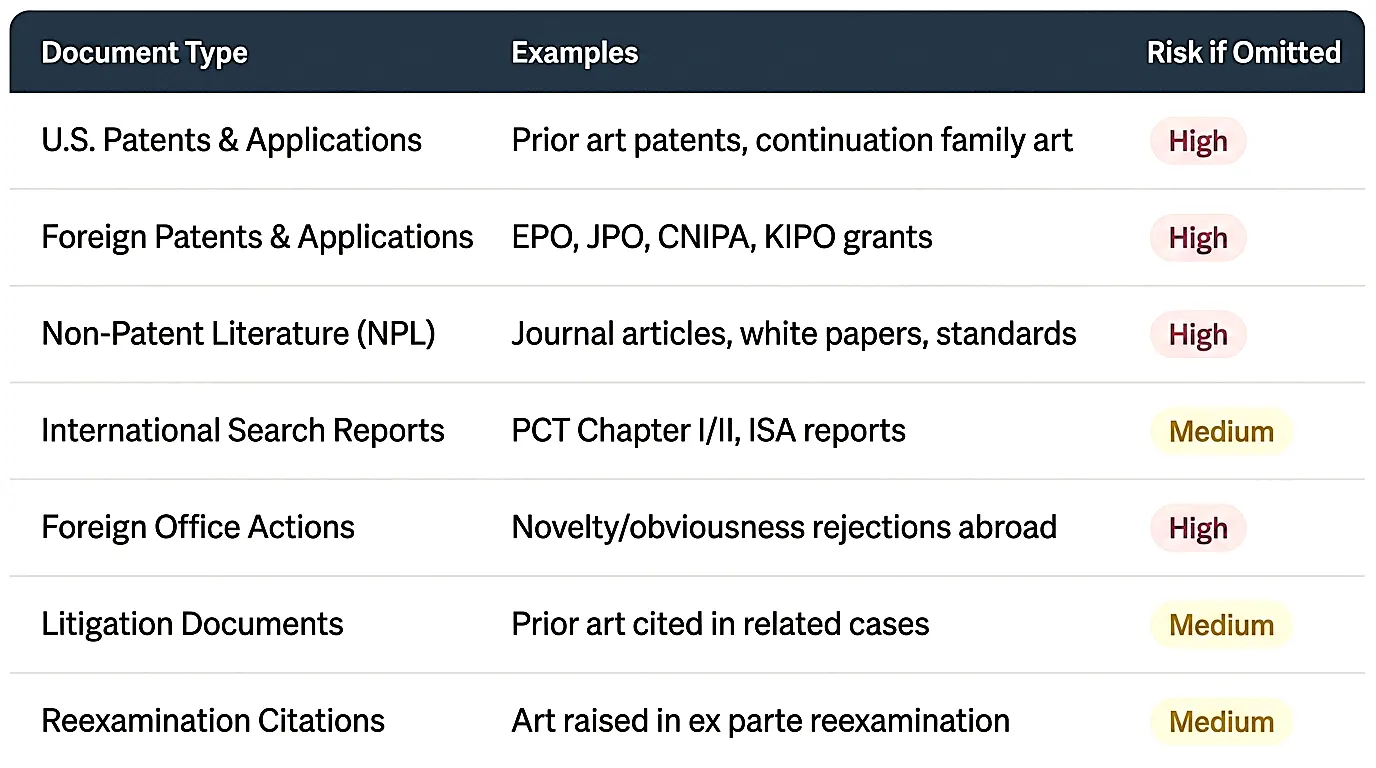
Key documents typically disclosed in an IDS include:
- Patents and patent applications (U.S. and foreign)
- Scientific journals and technical publications
- Non-patent literature (NPL)
- Related litigation documents
- International Search Reports from PCT applications
- Office actions from foreign counterpart applications
This sounds straightforward – but in practice, managing IDS disclosures across complex patent portfolios, international filings, and long prosecution timelines is anything but simple.
Also, Read: Outsource IDS Filing: Why Law Firms Prefer It and the True Cost of DIY Filing
Why IDS Management is Directly Tied to Patent Validity
The Doctrine of Inequitable Conduct
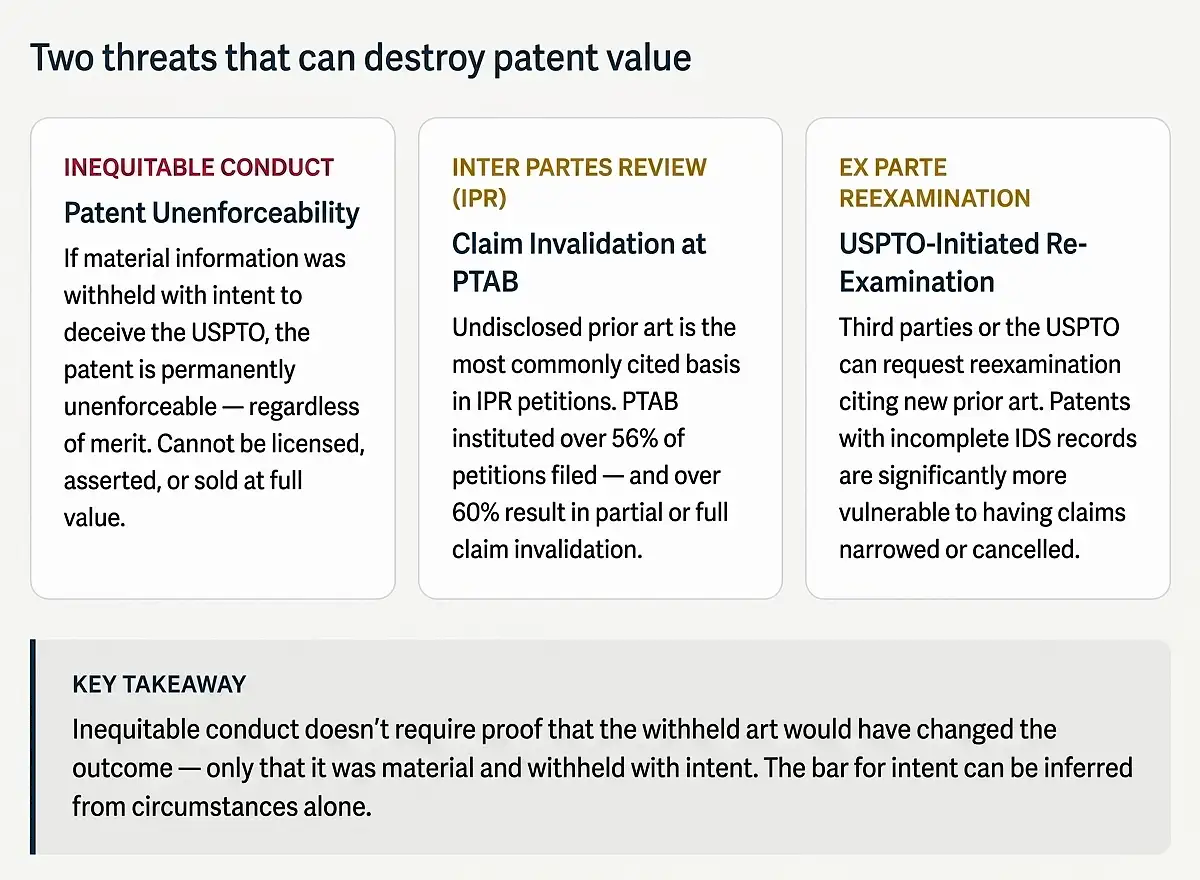
The single biggest legal threat arising from poor IDS management is the doctrine of inequitable conduct. If a court finds that a patent applicant or their representative withheld material information from the USPTO – with intent to deceive – the patent can be rendered unenforceable.
This is not a theoretical concern. The Federal Circuit has repeatedly upheld findings of inequitable conduct in cases where critical prior art was not disclosed. A patent found unenforceable due to inequitable conduct cannot be asserted, licensed, or sold at fair value – it is essentially worthless.
Key Point: Inequitable conduct does not require proof that the withheld reference would have prevented patent grant. It only requires that the reference was material and was withheld with intent to deceive.
Inter Partes Review (IPR) and Validity Attacks
Even without an inequitable conduct finding, poor IDS management can expose your patent to Inter Partes Review (IPR) proceedings at the USPTO’s Patent Trial and Appeal Board (PTAB). IPR petitioners routinely cite prior art that was not disclosed during prosecution as evidence that the claims lack novelty or are obvious.
When a patent holder cannot demonstrate that the examiner considered certain prior art during prosecution, the path toward invalidation becomes considerably smoother for challengers.
Statistics that should concern every patent holder:
- Over 60% of patents challenged in IPR proceedings have at least some claims invalidated.
- Prior art that was publicly available but not cited during prosecution is among the most commonly used tools in invalidity challenges.
- PTAB instituted IPR trials in approximately 56% of petitions filed in recent years.
Effective IDS management ensures that material prior art is considered during examination – making it far harder for challengers to raise it later as a basis for invalidity.
Also, Read: IDS vs. Prior Art Disclosure: Key Points for Patent Owners
The Core Challenges of IDS Management (IDS management patent validity)
Understanding why IDS management is difficult helps explain why even sophisticated patent filers sometimes get it wrong.
1. Volume and Complexity of Prior Art
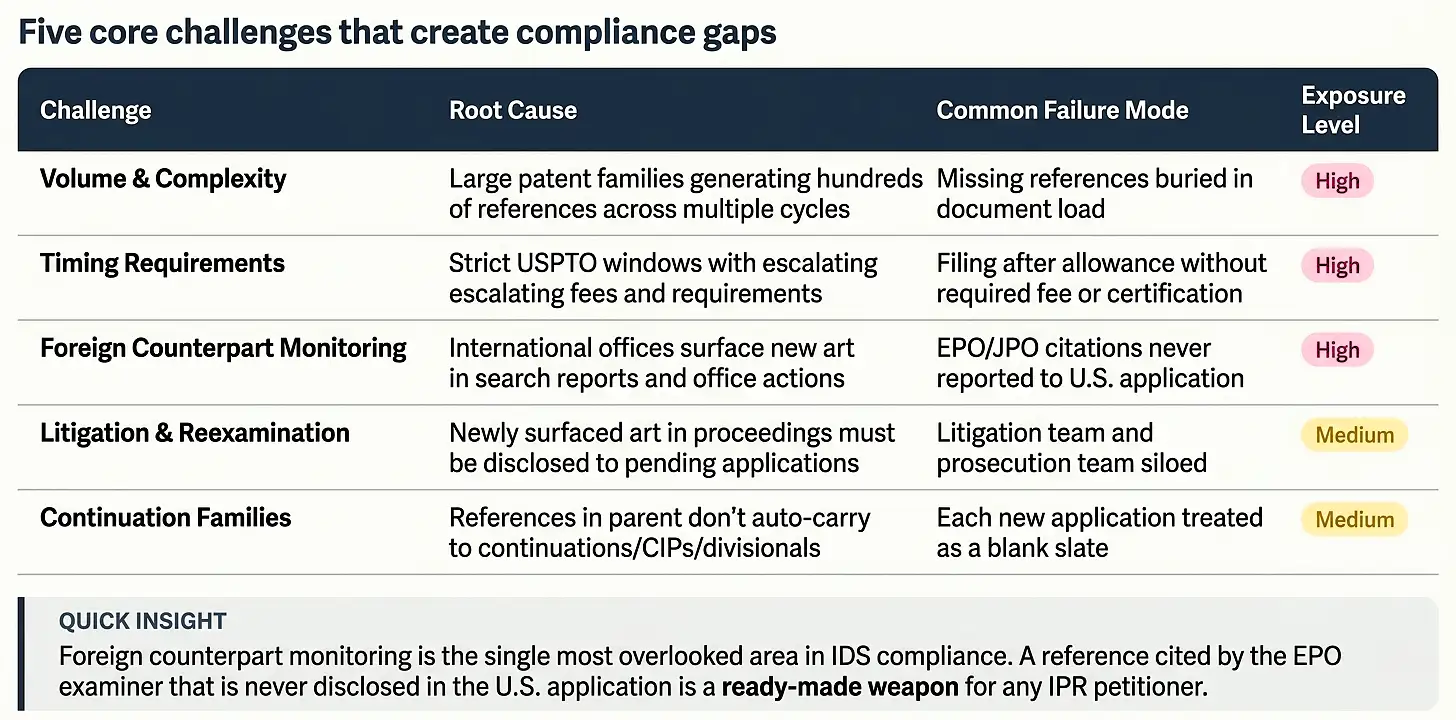
A single patent family can generate hundreds of references across multiple prosecution cycles, related applications, and international counterparts. Manually tracking, formatting, and filing all of this information is time-consuming and error-prone.
2. Timing Requirements (IDS management patent validity)
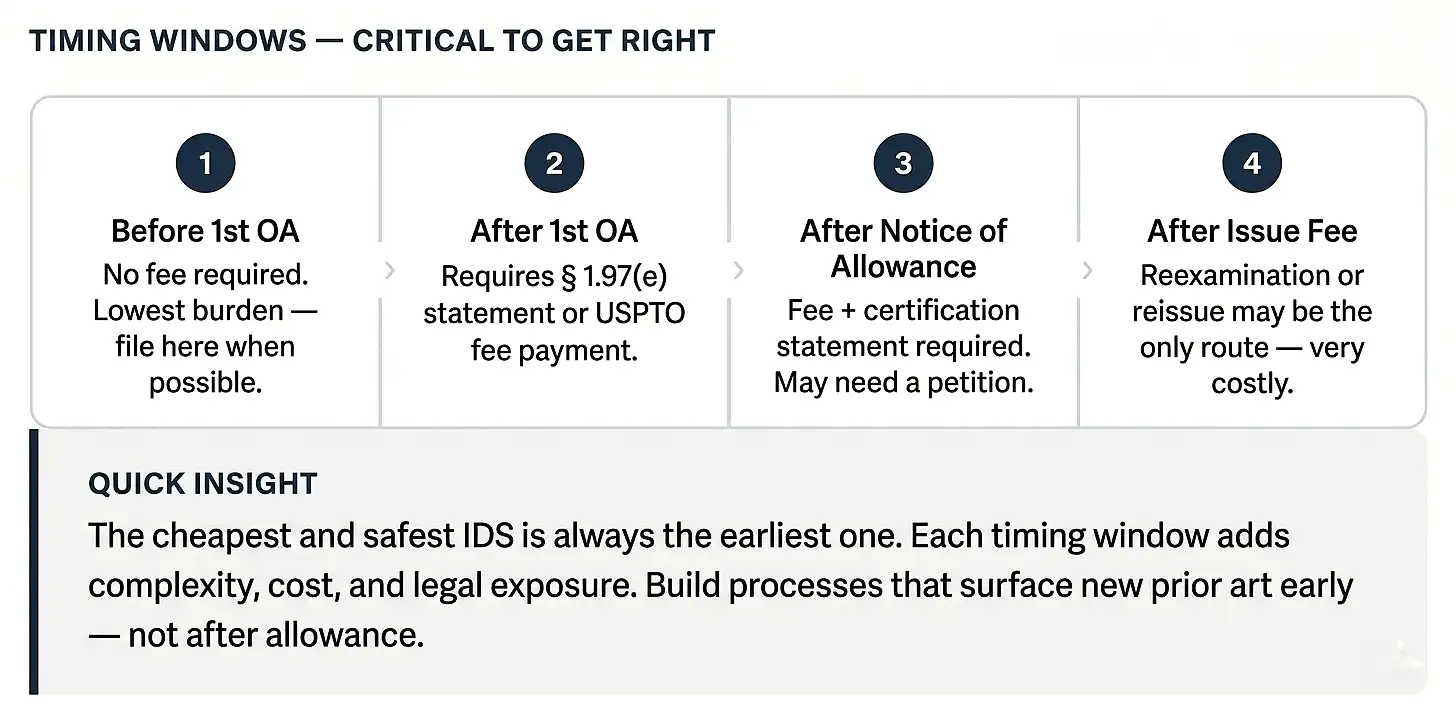
The USPTO has strict rules about when IDS references must be submitted:
- Before first Office Action: No fee required.
- After first Office Action but before a Notice of Allowance: Requires a statement under 37 C.F.R. § 1.97(e) or a fee.
- After Notice of Allowance: Requires both a fee and a statement, and must be accompanied by a petition in some circumstances.
Missing these windows – or failing to submit supplemental IDS filings when new references come to light – can create serious compliance gaps.
3. Foreign Counterpart Monitoring
When a patent family has international counterparts – PCT applications, European patents, Chinese national phase entries – each of those proceedings can surface new prior art through foreign search reports, opposition proceedings, or office actions. This information must be tracked and disclosed in U.S. applications as well, if it is material.
4. Related Litigation and Re-examination Proceedings
Prior art identified in litigation or reexamination proceedings can become material to pending related applications and must be disclosed. Failure to do so is a common source of inequitable conduct allegations.
5. Continuation and Divisional Applications
Large patent families with continuations, continuations-in-part (CIPs), and divisionals each require their own IDS filings. References disclosed in a parent application do not automatically carry over – each application must be managed independently.
Also, Read: How to Prepare an IDS: A Step-by-Step Guide for Patent Applicants
How Professional IDS Management Protects Your Patent
Comprehensive Prior Art Tracking
A professional IDS management approach involves systematic tracking of all material references across the life of a patent application and its related family members. This includes:
- Monitoring foreign counterpart prosecution and capturing search reports
- Tracking citations from related U.S. applications
- Identifying and logging NPL references cited in office actions globally
- Centralizing reference databases to avoid duplication or omission
Timely and Accurate Filings
Professional IDS management ensures that all disclosures are made within the applicable USPTO time windows – avoiding the need for costly petitions or the risk of non-disclosure. This includes:
- Preparing properly formatted IDS forms (PTO/SB/08a, 08b)
- Filing supplemental IDS submissions as new material comes to light
- Tracking the status of each application to anticipate critical timing milestones
Foreign Reference Review and Integration
International counterpart monitoring is one of the most frequently overlooked areas of IDS compliance. Proper IDS management incorporates:
- Automated retrieval of international search reports (from EPO, JPO, KIPO, CNIPA, and others)
- Review of PCT Chapter I and Chapter II reports
- Translation and evaluation of foreign office actions for material prior art
Litigation-Ready Documentation
In the event your patent is challenged – whether through litigation, IPR, or ex parte reexamination – professional IDS management leaves you with a clean, complete prosecution record. This documentation:
- Demonstrates the examiner’s consideration of all material prior art
- Supports a defense against inequitable conduct allegations
- Reduces the evidentiary footprint available to invalidity challengers
- Provides a defensible record of good-faith compliance with the duty of candor
Quality Control and Review Protocols
Professional IDS management incorporates rigorous quality checks to ensure:
- No references are inadvertently omitted
- Cited references are accurately identified (correct patent numbers, publication dates)
- Claim-by-claim materiality assessments are documented where appropriate
- Multiple review layers are applied before submission
Also, Read: IDS Filing Deadlines: How to Avoid Costly USPTO Penalties
IDS Management Best Practices: A Checklist for Patent Holders
Whether you manage your portfolio in-house or work with an IP services partner, these best practices form the foundation of strong IDS compliance:
Before Filing:
- Conduct a thorough prior art search before application filing
- Document all search results and references considered
- Identify related applications in the same family that may require coordinated disclosure
During Prosecution:
- Submit IDS with initial filing or within 3 months of filing (to avoid fees)
- Monitor all foreign counterpart office actions for new prior art citations
- Track litigation proceedings and reexaminations for newly surfaced references
- Review competitor patent grants and publications for potentially material references
- File supplemental IDS submissions promptly when new material is identified
After Allowance:
- Review for any undisclosed material references before issue fee payment
- File any necessary after-allowance IDS with the required fee and certification
- Maintain records of all submissions for litigation readiness
For Portfolio Management:
- Maintain a centralized database of all references cited across a patent family
- Establish protocols for continuation and divisional applications
- Conduct periodic portfolio audits to identify IDS compliance gaps
Also, Read: What is an Information Disclosure Statement (IDS) and Why Does It Matter for Your Patent?
Common IDS Mistakes That Lead to Invalidity Challenges
Even well-intentioned patent filers make mistakes that become vulnerabilities later. Here are the most common IDS management errors to avoid:
1. Failing to Disclose Known Prior Art The most obvious – and most consequential – error. Any reference known to an inventor or attorney that is material to patentability must be disclosed.
2. Disclosing References Without Review Simply “dumping” hundreds of references into an IDS without considering their materiality can be just as problematic. It may bury truly material references or signal a lack of good faith in the disclosure process.
3. Missing Supplemental Filing Windows New prior art can come to light at any time during prosecution. Failing to file supplemental IDS submissions in a timely manner – especially after receiving foreign search reports – is a common and costly error.
4. Failing to Track International Counterparts Many U.S. patent holders don’t have systematic processes in place to monitor and incorporate prior art from foreign counterpart proceedings. This gap is routinely exploited in invalidity challenges.
5. Inadequate Record-Keeping Even if all the right references were disclosed, poor documentation makes it difficult to prove compliance later. A clean, well-organized prosecution history is a critical asset in any validity dispute.
Also, Read: USPTO Rule 56: Duty of Disclosure Explained for Patent Practitioners
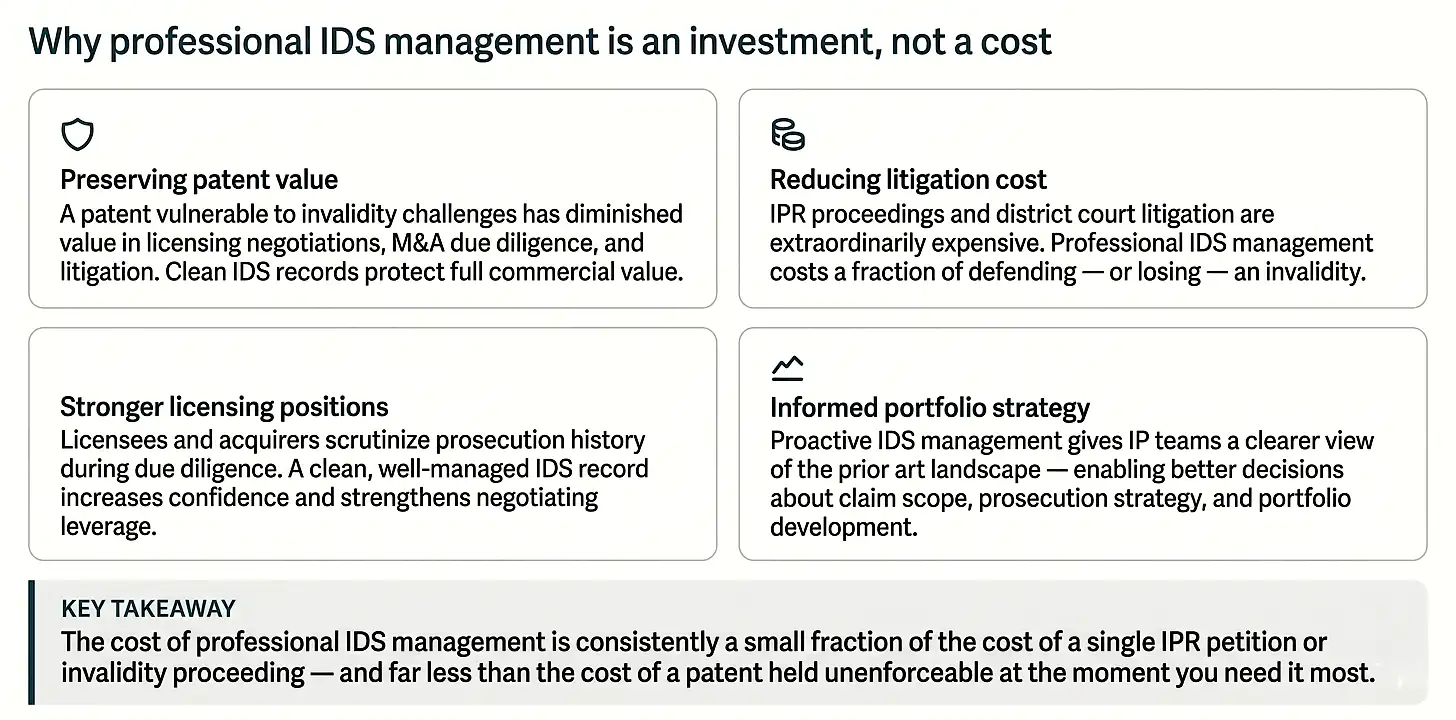
The Business Case for Professional IDS Management
Beyond legal compliance, there is a compelling business case for investing in professional IDS management:
Protecting Patent Value A patent that is vulnerable to invalidity challenges has diminished value – in licensing negotiations, in M&A transactions, and in litigation. Professional IDS management helps preserve and protect the full commercial value of your IP assets.
Reducing Litigation Risk IPR proceedings and district court litigation are extraordinarily expensive. The cost of professional IDS management is a fraction of the cost of defending an invalidity challenge – or losing one.
Strengthening Licensing Positions When licensees or potential acquirers conduct due diligence on your patent portfolio, they will scrutinize the prosecution history. A clean, well-managed IDS record strengthens your position and increases confidence in your portfolio.
Supporting Portfolio Strategy Proactive IDS management gives IP teams and executives a clearer picture of the prior art landscape across their portfolio – enabling better decisions about prosecution strategy, claim scope, and portfolio development.
How Teak IP Approaches IDS Management
At Teak IP Services, IDS management is not an afterthought – it is a core component of how we protect our clients’ patent portfolios.
Our dedicated IDS management team provides:
- End-to-end IDS preparation and filing across all stages of USPTO prosecution
- Foreign counterpart monitoring with integration of international search reports and office action citations
- Supplemental IDS tracking and filing to ensure ongoing compliance throughout prosecution
- Portfolio-level IDS audits to identify and remediate compliance gaps in existing patent families
- Litigation support including prosecution history review and expert analysis of IDS compliance
We work as a seamless extension of your IP team – combining deep USPTO procedural knowledge with rigorous quality control to ensure that every patent we touch is built on a defensible foundation.
IDS management patent validity: Don’t Let IDS Gaps Become Your Patent’s Weakness
Patent invalidity challenges are more aggressive, more sophisticated, and more common than ever before. Competitors, patent challengers, and IPR petitioners are highly skilled at finding the weak points in a patent’s prosecution history – and incomplete or inaccurate IDS management is one of the most exploitable.
The good news: This is a risk that is almost entirely preventable with the right processes, expertise, and professional support.
Proper IDS management ensures that your patent examiner considered all material prior art – making it dramatically harder for challengers to raise it as a basis for invalidity later. It demonstrates your good-faith compliance with the duty of candor, protecting against inequitable conduct allegations. And it creates the litigation-ready documentation you need if your patent is ever challenged.
Your patent represents years of innovation and significant investment. Don’t let poor IDS management become the vulnerability that unravels it.

