
Cross-Citing Foreign References IDS, In the increasingly complex landscape of international patent prosecution, managing information disclosure across multiple jurisdictions presents unique challenges. When organizations develop patent applications simultaneously in the United States, Europe, Japan, and other jurisdictions, they must carefully navigate the disclosure requirements of each system. Organizations managing international patent families can reduce the complexity and compliance risk of this process by leveraging dedicated IDS preparation and filing services that systematically handle cross-jurisdiction reference tracking and submission.

Cross-citing foreign references in Information Disclosure Statements (IDS) has become essential for achieving maximum efficiency while maintaining compliance. This practice involves systematically referencing prior art discovered during prosecution in one jurisdiction when filing corresponding applications in another.
Organizations managing international patent families often struggle with:
- Timing discrepancies across jurisdictions
- Language and translation requirements
- Different materiality standards
- Incomplete references and documentation
What is an Information Disclosure Statement?
An Information Disclosure Statement (IDS) is a formal document submitted to patent offices that lists all known references and information that may be material to patentability. It serves as a mechanism of transparency and good faith in the patent examination process.
Primary Functions of an IDS
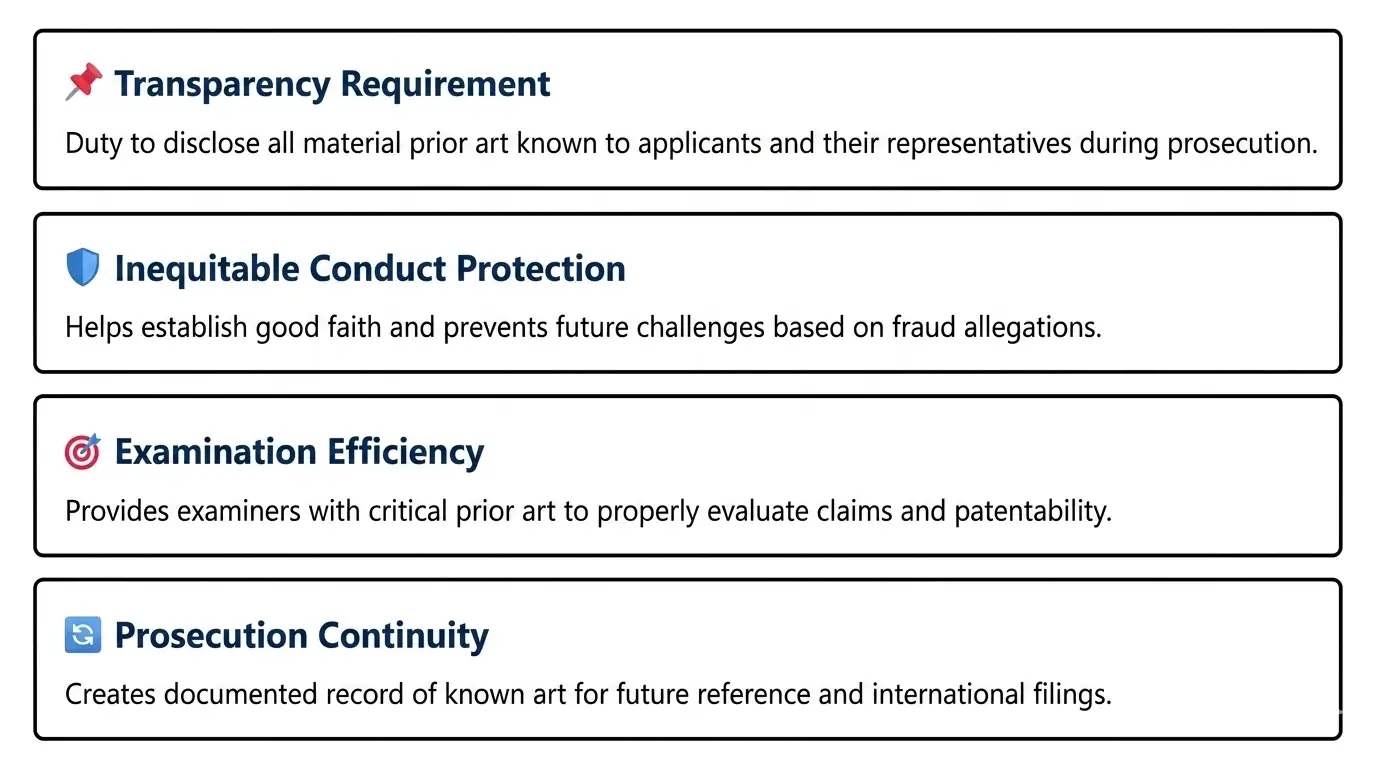
IDS Timing and Applicability
In the United States, an IDS must be filed before the earliest of:
- Payment of the issue fee
- First office action on the merits (though earlier filing is preferable)
- Abandonment of the application
Also, Read: Outsource IDS Filing: Why Law Firms Prefer It and the True Cost of DIY Filing
Understanding Cross-Citing in IDS (Cross-Citing Foreign References IDS)
Cross-citing refers to the practice of citing the same reference document in Information Disclosure Statements filed across multiple patent offices in different jurisdictions. When your organization discovers relevant prior art during examination in one country, you systematically include that reference when filing applications in other countries.
The Cross-Citing Process
| Step | Action | Key Consideration |
|---|---|---|
| 1. Discovery | Identify references during prosecution in jurisdiction A | Document source, date, and relevance |
| 2. Evaluation | Assess materiality and applicability to claims | Consider jurisdiction-specific materiality standards |
| 3. Documentation | Prepare complete reference information | Include proper citations and English translations if necessary |
| 4. Cross-Citation | Include in IDS for jurisdiction B, C, D, etc. | Maintain consistent formatting and referencing |
| 5. Tracking | Document cross-cited references in centralized system | Create audit trail for compliance verification |
Core Principle
Cross-citing ensures that examiners in every jurisdiction have access to the same material prior art, creating consistency across your patent family and preventing unfair prosecution advantages in specific regions.
Also, Read: IDS vs. Prior Art Disclosure: Key Points for Patent Owners
Why Cross-Citing Matters for International Patent Families
1. Consistency Across Jurisdictions
When managing a patent family across the US, Europe, Japan, China, and other jurisdictions, ensuring that examiners everywhere have access to the same prior art creates fair and predictable examination. This prevents situations where:
- Weak claims are allowed in one jurisdiction due to examiner ignorance of key prior art
- Claims are rejected in another jurisdiction for the same prior art
- Validity challenges later reveal inconsistent claim scope
2. Prevents Future Invalidity Challenges
Comprehensive cross-citing documented in IDSs creates a strong defense against post-grant challenges such as:
| 🛡️ Protection Against Inter Partes Review (IPR): Petitioners cannot claim references were withheld Opposition Proceedings: European Patent Office will note prior disclosure Invalidity Litigation: Courts recognize complete disclosure history Inequitable Conduct Allegations: Demonstrates good faith transparency |
3. Enhances Patent Family Strategy
Understanding how references affect claims enables strategic decisions about:
- Claim amendments across jurisdictions
- Whether to pursue or abandon applications in specific regions
- Scope of continuation applications
- Assertion and licensing strategies
4. Ensures Compliance with Duty of Candor
Different jurisdictions have varying interpretations of the duty to disclose material prior art:
| Jurisdiction | Disclosure Requirement | Materiality Standard |
|---|---|---|
| United States (USPTO) | Mandatory IDS filing | Patent Office Guidance Section 106.17 |
| Europe (EPO) | Best efforts disclosure | General knowledge in the art |
| Japan (JPO) | Recommended but discretionary | Broadly construed materiality |
| China (CNIPA) | Duty of good faith | Prior art accessible in China |
Best Practices for Cross-Citing Foreign References in IDS
1. Establish a Centralized Reference Management System
| 🗂️ Implementation Strategy Create a master database tracking all discovered references Document source jurisdiction, discovery date, and initial assessment Maintain translation status and quality assurance records Track which applications have included each reference in their IDS Use unique reference identifiers for consistency across jurisdictions |
Why This Matters: A centralized system prevents accidental omissions and ensures no reference is overlooked across your global portfolio.
2. Implement Rigorous Translation Protocols
Foreign language references require professional translation for acceptance in English-language patent offices.
- Quality Standards: Use certified translators with patent law expertise
- Certification Requirements: Many offices require translator declarations
- Format Consistency: Maintain uniform formatting for all translated documents
- Version Control: Track original language version alongside translation
Translation Best Practice Template:
Document ID: [Patent Publication Number]
Original Language: [Language]
Translation Language: English
Translator: [Name, Credentials]
Date Translated: [Date]
Declaration of Accuracy: [Translator Certification]
3. Develop a Materiality Assessment Framework
Different jurisdictions apply different materiality standards. Your assessment should consider:
| 📊 Claim-by-Claim Analysis Evaluate each reference’s relationship to specific claim limitations and potential obviousness combinations. |
| 🔍 Scope Assessment Determine whether the reference is directly anticipatory, creates an obviousness combination, or merely relevant background art. |
| ⚖️ Jurisdiction Alignment Apply the most stringent materiality standard (typically USPTO) to ensure compliance everywhere. |
| 📅 Temporal Relevance Confirm the reference qualifies as prior art under each jurisdiction’s filing date definitions. |
4. Create Standardized IDS Forms and Templates
Develop jurisdiction-specific IDS templates that account for local requirements:
- USPTO Form SB/1A: Create filled-in templates with your standard reference format
- EPO Form 1038 EPC: Pre-populate common sections for European filings
- JPO Submissions: Prepare Japanese language versions with certified translations
- CNIPA Requirements: Format for Chinese examination procedures
5. Implement a Timeline Management System
Coordinate IDS filing across jurisdictions to maximize strategic benefit:
- Early Filing Strategy: Submit IDS before first office action to prevent examiner-initiated search
- Sequential Filing Coordination: Time foreign IDS filings to benefit from prosecution history in primary jurisdiction
- Continuation Application Tracking: Ensure prior disclosures are carried forward to new applications
- Deadline Monitoring: Track jurisdiction-specific deadlines to maintain compliance
Pro Tip: Use Prosecution History as Intelligence
Develop a process to review office action rejections in primary jurisdictions (typically US first) and proactively include cited references in subsequent foreign IDS filings before examiners independently discover them.
6. Establish Clear Attribution and Documentation
For each cross-cited reference, document:
- Original source and discovery jurisdiction
- Date when reference was first identified
- Person or process that identified it
- Initial materiality assessment
- All jurisdictions where it has been cited in IDS
- Any prosecution impact (rejections, amendments, allowances)
7. Maintain Communication With Local Counsel
Coordinate with patent counsel in each jurisdiction to ensure:
- Local filing requirements are met (e.g., Chinese counsel may advise on CNIPA-specific standards)
- References are properly evaluated under local examination practices
- Timing of IDS filings aligns with local prosecution strategy
- Language and formatting meet local office specifications
Also, Read: How to Prepare an IDS: A Step-by-Step Guide for Patent Applicants
USPTO Guidelines & Requirements for Cross-Cited References
Relevant USPTO Rules and Procedures
The USPTO provides specific guidance on IDS submissions through multiple sources:
37 CFR § 1.98 – Information Disclosure Statement
Key Regulatory Requirements:
- Form Requirements: Must use official Form SB/1A or equivalent
- Content Requirements: Complete bibliographic data for each reference
- Certification: Requires signature by applicant, attorney, or authorized agent
- Completeness: Must provide sufficient information for examiner to locate reference
- Fee: May require IDS submission fee depending on number of references
Patent Office Guidelines for Examination of Patent Applications
The Patent Office publishes detailed guidelines (MPEP 609 et seq.) regarding:
- Materiality Determination: Section 106.17(a)(1) – “A reference is material to patentability when it is more than peripherally related to the claimed invention”
- Foreign Language References: Must provide English language version or certified translation
- Incomplete References: Sufficient information must be provided to support examination
- Copies of References: Physical copies or electronic versions must be readily available
Materiality Factors (USPTO)
A reference is presumed material if it:
- Discloses the same general type of invention
- Relates to the same problem solved by applicant
- Discloses the same unexpected results
- Shows awareness of features similar to those of applicant’s invention
- Is cited by applicant in any patent application
- Is from the field of applicant’s invention
- Is known or available to applicant
Requirements for Foreign Language References
When cross-citing references discovered in non-English jurisdictions:
| Requirement | Specification |
|---|---|
| Translation Provision | Complete English translation or certified translation declaration |
| Original Language Copy | Recommended to provide alongside translation for verification |
| Certification | Translator declaration of accuracy (even if not formally required) |
| Availability Verification | Confirm reference is publicly available (published patent, issued publication) |
Duty of Candor and Rule 56(a)
Critical for Cross-Citing: 37 CFR § 1.56 imposes a duty of candor and good faith on inventors, applicants, and their representatives. This means:
- All known references material to patentability must be disclosed
- Withholding material references can result in inequitable conduct
- Inequitable conduct can render the patent unenforceable
- Cross-citing foreign references demonstrates compliance with this duty
Important: Timing of IDS Filings
While IDS can be filed after the first office action, best practice is to file before the first action on the merits. This prevents the examiner from independently discovering the reference and placing greater weight on it. For cross-cited references discovered during foreign prosecution, promptly include them in US applications to demonstrate proactive disclosure.
Also, Read: What is an Information Disclosure Statement (IDS) and Why Does It Matter for Your Patent?
Common Challenges in Cross-Citing & Solutions (Cross-Citing Foreign References IDS)
Challenge 1: Language and Translation Issues
Problem: Non-English references discovered in foreign jurisdictions require translation, creating delays and potential accuracy concerns.
Solutions:
- Establish relationships with certified patent translators in key languages (German, French, Japanese, Chinese)
- Create reference translation templates to standardize format and reduce turnaround time
- Use professional translation management services that handle certification automatically
- Build translation costs into your patent budget from the outset
Challenge 2: Timing Misalignment Across Jurisdictions
Problem: Office actions arrive at different times in different jurisdictions, making simultaneous cross-citation difficult.
Solutions:
- Develop a prosecution timeline showing expected action dates in each jurisdiction
- Maintain a “watch list” of references discovered early to include in subsequent foreign IDS filings
- Implement a quarterly review process to identify references that should be cross-cited before critical deadlines
- Consider filing early IDS submissions in secondary jurisdictions before office actions occur
Challenge 3: Varying Materiality Standards
Problem: What is “material” to the USPTO may differ from EPO or JPO standards, creating uncertainty about whether to cross-cite.
Solutions:
- Apply the most stringent materiality standard (usually USPTO) as your disclosure threshold
- When in doubt, include the reference – over-disclosure is preferable to under-disclosure
- Work with experienced foreign counsel to understand jurisdiction-specific materiality interpretations
- Document your materiality assessment reasoning for each cross-cited reference
Challenge 4: Incomplete or Hard-to-Locate References
Problem: Some prior art may be difficult to fully document or locate in searchable databases.
Solutions:
- Provide detailed identification information (publication number, date, inventor/author, title)
- For non-patent literature, include complete journal citations or conference details
- Attach copies or explain where the reference can be located
- Request examiner’s feedback if information appears incomplete
Challenge 5: Managing Domestic vs. Foreign Counsel Coordination
Problem: Lack of communication between US patent counsel and foreign local counsel leads to inconsistent IDS filings.
Solutions:
- Establish a centralized reference database accessible to all counsel
- Create written protocols for when and how to cross-cite references
- Schedule quarterly calls with international counsel to discuss recent office actions and discovered references
- Use a unified docket system with automatic alerts for IDS-relevant milestones
Best Practice: Automated Alerts
Implement a system that alerts counsel when:
- A reference is cited by an examiner in any jurisdiction
- Similar claims are examined in multiple jurisdictions
- IDS filing deadlines are approaching
- Translations of foreign references are completed
International Perspectives: Cross-Citing Practices Across Major Offices
United States (USPTO)
🇺🇸 IDS Status: Mandatory
Requirements: Form SB/1A required; must include all known material references. Materiality Standard: 37 CFR 1.56 and MPEP 609. Foreign Reference Treatment: English translation required or certified translation declaration. Best Practice: File before first office action to demonstrate good faith and prevent weight enhancement by examiner discovery.
European Patent Office (EPO)
🇪🇺 IDS Status: Discretionary but Recommended
Requirements: Form 1038 EPC if submitting; examiner will conduct own search regardless. Materiality Standard: Broad interpretation – anything relevant to the art. Foreign Reference Treatment: English translation required; non-patent literature must be clearly identified. Best Practice: Submit IDS early to demonstrate applicant awareness of prior art and demonstrate good faith; particularly valuable for combating examiner rejections based on references you’ve already identified.
Japan Patent Office (JPO)
🇯🇵 IDS Status: Discretionary
Requirements: Submission optional but favorable for prosecution. Japanese translations recommended. Materiality Standard: Broader than USPTO – includes general field references. Foreign Reference Treatment: Japanese translations strongly recommended. Best Practice: Submit translated IDS to facilitate examiner’s review and demonstrate applicant cooperation; particularly important for technical fields.
China National IP Administration (CNIPA)
🇨🇳 IDS Status: Duty of Good Faith
Requirements: Discretionary but reflects good faith. Chinese language IDS preferred. Materiality Standard: Prior art accessible in China; may differ from US standard. Foreign Reference Treatment: Chinese translation essential; must be formatted per CNIPA specifications. Best Practice: Submit IDS in Chinese to demonstrate respect for local procedures; particularly valuable for demonstrating transparency in examination.
Comparative IDS Practices Table
| Office | Required? | Form Used | Translation Needed? | Effect on Examination |
|---|---|---|---|---|
| USPTO | Yes, Mandatory | SB/1A | Yes, English | High impact – limits examiner rejection bases |
| EPO | No, Discretionary | 1038 EPC | Yes, English | Moderate – demonstrates good faith |
| JPO | No, Discretionary | Applicant submission | Recommended (Japanese) | Moderate – facilitates communication |
| CNIPA | No, Discretionary | Applicant submission | Yes, Chinese | Moderate – shows transparency |
Practical Implementation Checklist (Cross-Citing Foreign References IDS)
Pre-Prosecution Planning
☐ Establish Reference Management System
Set up centralized database or tracking system for all discovered references with fields for: source jurisdiction, discovery date, language, translated status, materiality assessment, and cross-citation history.
☐ Develop IDS Protocol Document
Create written procedures document outlining: who is responsible for identifying references, decision criteria for cross-citing, review and approval process, translation requirements, and deadline management.
☐ Assemble Translation Resources
Identify and contract with certified patent translators in all relevant language pairs (German, French, Japanese, Chinese, Spanish, etc.) before the prosecution begins.
☐ Create IDS Templates
Prepare pre-formatted IDS documents for each jurisdiction (USPTO SB/1A, EPO 1038, JPO submission format, CNIPA requirements) with standardized reference entry formats.
During Active Prosecution
☐ Monitor All Office Actions Across Jurisdictions
Review examiner rejections in all jurisdictions within 5-7 days of receipt. Identify any references cited that you haven’t yet cross-cited to other family members.
☐ Assess New References for Cross-Citation
For each examiner-cited reference, evaluate whether it meets materiality threshold and plan cross-citation to other pending applications.
☐ Initiate Translation if Necessary
For non-English references, immediately request professional translation. Plan for 1-2 week turnaround time.
☐ Prepare Supplementary IDS Filings
Draft IDS submissions for each jurisdiction that includes newly discovered references. Ensure complete bibliographic information and translations are attached.
☐ Coordinate With Local Counsel
Before filing IDS in foreign jurisdictions, confirm with local counsel that timing and content comply with local requirements.
Post-Filing Documentation
☐ Maintain Complete Filing Records
Document: reference ID, source jurisdiction, date discovered, all jurisdictions where cross-cited, filing dates, any translations, and examiner responses.
☐ Track Examiner Treatment of Cross-Cited References
Monitor whether examiners acknowledge receipt of IDS and whether they cite the cross-referenced materials in subsequent office actions.
☐ Create Compliance Certification
At prosecution conclusion, prepare summary statement certifying that all known material references have been disclosed in all relevant jurisdictions.
☐ Maintain for Post-Grant Proceedings
Archive complete IDS history for reference if post-grant challenges (IPR, opposition) are later filed.
Key Takeaways (Cross-Citing Foreign References IDS)
Cross-citing foreign references in Information Disclosure Statements represents a critical best practice for organizations managing international patent families. By systematically ensuring that examiners in every jurisdiction have access to the same material prior art, you achieve multiple strategic objectives simultaneously.
🎯 Key Takeaways
- Establish Centralized Systems: Implement a reference management database that tracks discovery, translation status, and cross-citation history across all jurisdictions.
- Apply Stringent Materiality Standards: When in doubt, include references – use the strictest standard (typically USPTO) to ensure compliance everywhere.
- Invest in Translation Quality: Use certified patent translators and maintain clear version control between original language references and English translations.
- Create Standardized Procedures: Develop written protocols that all team members and counsel follow consistently across the organization.
- Coordinate International Counsel: Maintain regular communication with local counsel in each jurisdiction regarding IDS timing and content.
- File Early, File Often: Submit IDS before first office action when possible to demonstrate good faith and prevent examiner weight enhancement.
- Document Everything: Maintain complete records of all reference discoveries, assessments, translations, and cross-citations for compliance verification and post-grant proceedings.
Immediate Action Items
To begin implementing best practices for cross-citing foreign references:
- Week 1: Review your current patent family and identify all pending applications and their prosecution status
- Week 2: Compile all references that have been cited or discovered to date and assess cross-citation completeness
- Week 3: Establish a centralized reference tracking system with fields for all relevant metadata
- Week 4: Develop standardized IDS procedures document and templates for each jurisdiction
- Ongoing: Implement weekly monitoring of office actions to identify new references for cross-citation
💼 Strategic Value
By implementing rigorous cross-citing practices, you transform your patent family from a collection of individual applications into a coordinated strategic asset that presents consistent claim scope and prior art analysis across all jurisdictions. This demonstrates sophisticated patent prosecution, reduces vulnerability to post-grant challenges, and maximizes the commercial value of your intellectual property portfolio.
Continuing Education
Patent office procedures and guidelines evolve constantly. Stay current by:
- Subscribing to USPTO guidance updates and MPEP revisions
- Following EPO, JPO, and CNIPA examination guideline changes
- Participating in CLE courses on international patent prosecution
- Networking with other practitioners managing large patent families
Ready to Optimize Your International Patent Family Management?
At Teak IP Services, we specialize in coordinated international patent prosecution and reference management strategies that maximize your portfolio’s value while ensuring complete compliance across all jurisdictions. Schedule a Consultation
Our Services: Read IDS Preparation & Filing Services Information

