
IDS prior art disclosure patent requirements are among the most important obligations for anyone involved in the U.S. patent prosecution process. If you own a patent or are currently navigating this process, two critical duties should be on your radar: the Information Disclosure Statement (IDS) and prior art disclosure. While these terms are sometimes used interchangeably in casual conversation, they represent distinct legal concepts with significant practical differences – and confusing them can put your patent at serious risk.
Whether you’re a start-up founder filing your first patent application, an IP manager at a mid-sized company, or a seasoned inventor expanding your portfolio, understanding the difference between IDS and prior art disclosure is non-negotiable. Getting it wrong could result in an unenforceable patent, invalidity findings during litigation, or costly legal battles down the road. Patent owners who want to ensure their disclosure obligations are met correctly can rely on our IDS preparation and filing services to handle both the IDS and prior art disclosure requirements with thoroughness and compliance in mind.

In this guide, Teak IP breaks down everything patent owners need to know – from definitions and duties to best practices and common pitfalls.
What is an Information Disclosure Statement (IDS)?
An Information Disclosure Statement (IDS) is a formal document submitted to the United States Patent and Trademark Office (USPTO) during the patent application process. It is used to disclose all known relevant prior art to the patent examiner reviewing your application.
Key Facts About IDS:
- Governed by: 37 C.F.R. § 1.56 and USPTO rules
- Purpose: To inform the USPTO of all material information relevant to the patentability of the claimed invention
- Who submits it: Applicants, inventors, attorneys, and agents involved in the patent prosecution
- When to file: During the pendency of the patent application – ideally early, but there are specific timing rules
- What it includes:
- Patents (U.S. and foreign)
- Published patent applications
- Journal articles and technical papers
- Any other printed publications
- Any other information material to patentability
💡 Teak IP Tip: The IDS is not just a formality. It is a legal obligation under the duty of candor and good faith toward the USPTO. Failure to disclose known material information can lead to a finding of inequitable conduct, which may render your patent unenforceable.
Also Read : Outsource IDS Filing: Why Law Firms Prefer It and the True Cost of DIY Filing
What Is Prior Art Disclosure? (IDS prior art disclosure patent)
Prior art refers to any evidence that an invention is already known or publicly available before the filing date of a patent application. Prior art disclosure, broadly speaking, is the act of revealing, citing, or referencing this existing knowledge in the context of patent prosecution or proceedings.
Common Forms of Prior Art Include:
- Patents and patent applications – domestic or foreign
- Academic publications and research papers
- Product manuals, datasheets, and catalogs
- Public demonstrations or use of the invention
- Online content, websites, and databases
- Oral presentations or conference talks
- The inventor’s own prior public disclosures
Prior art disclosure can happen in multiple contexts:
- Through an IDS filing – the most structured and formal method during U.S. patent prosecution
- During inter partes review (IPR) or post-grant proceedings
- In litigation – when parties challenge patent validity
- Via statutory disclosure – such as the one-year grace period under 35 U.S.C. § 102(b)(1)
Also, Read: IDS Filing Deadlines: How to Avoid Costly USPTO Penalties
IDS vs. Prior Art Disclosure: The Core Differences (IDS prior art disclosure patent)
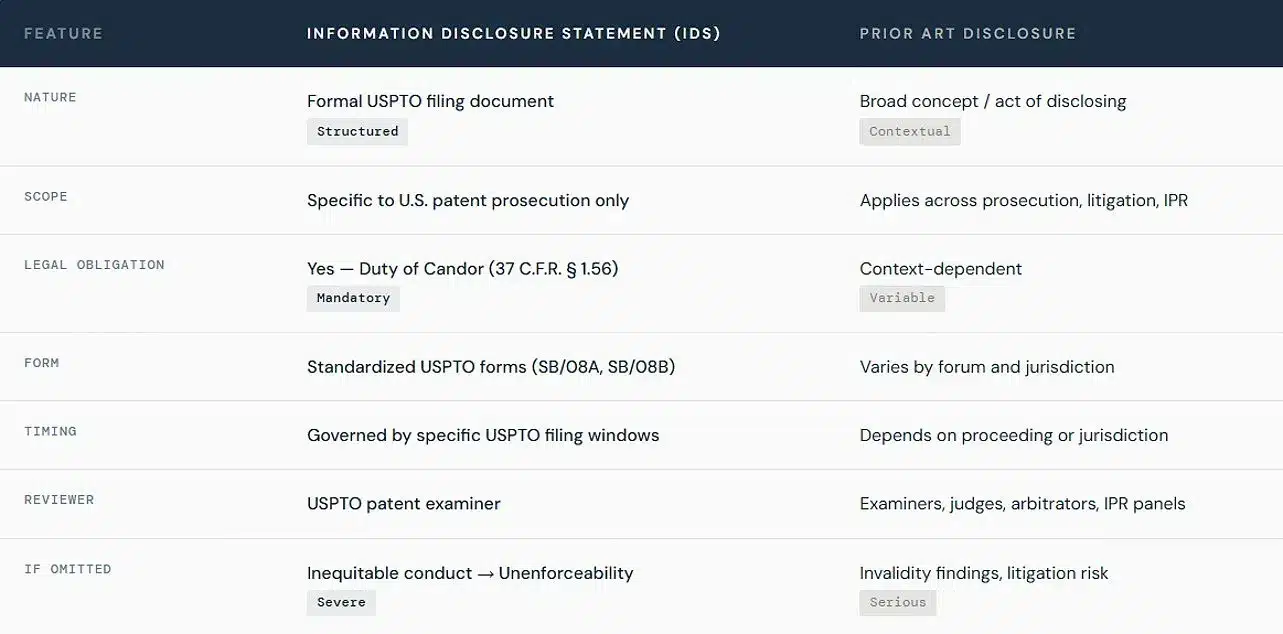
The Bottom Line:
Every IDS involves prior art disclosure – but not all prior art disclosure takes the form of an IDS. An IDS is the formal mechanism within U.S. patent prosecution for fulfilling your prior art disclosure obligations.
Also, Read: USPTO Rule 56: Duty of Disclosure Explained for Patent Practitioners
The Duty of Disclosure: A Legal Deep Dive
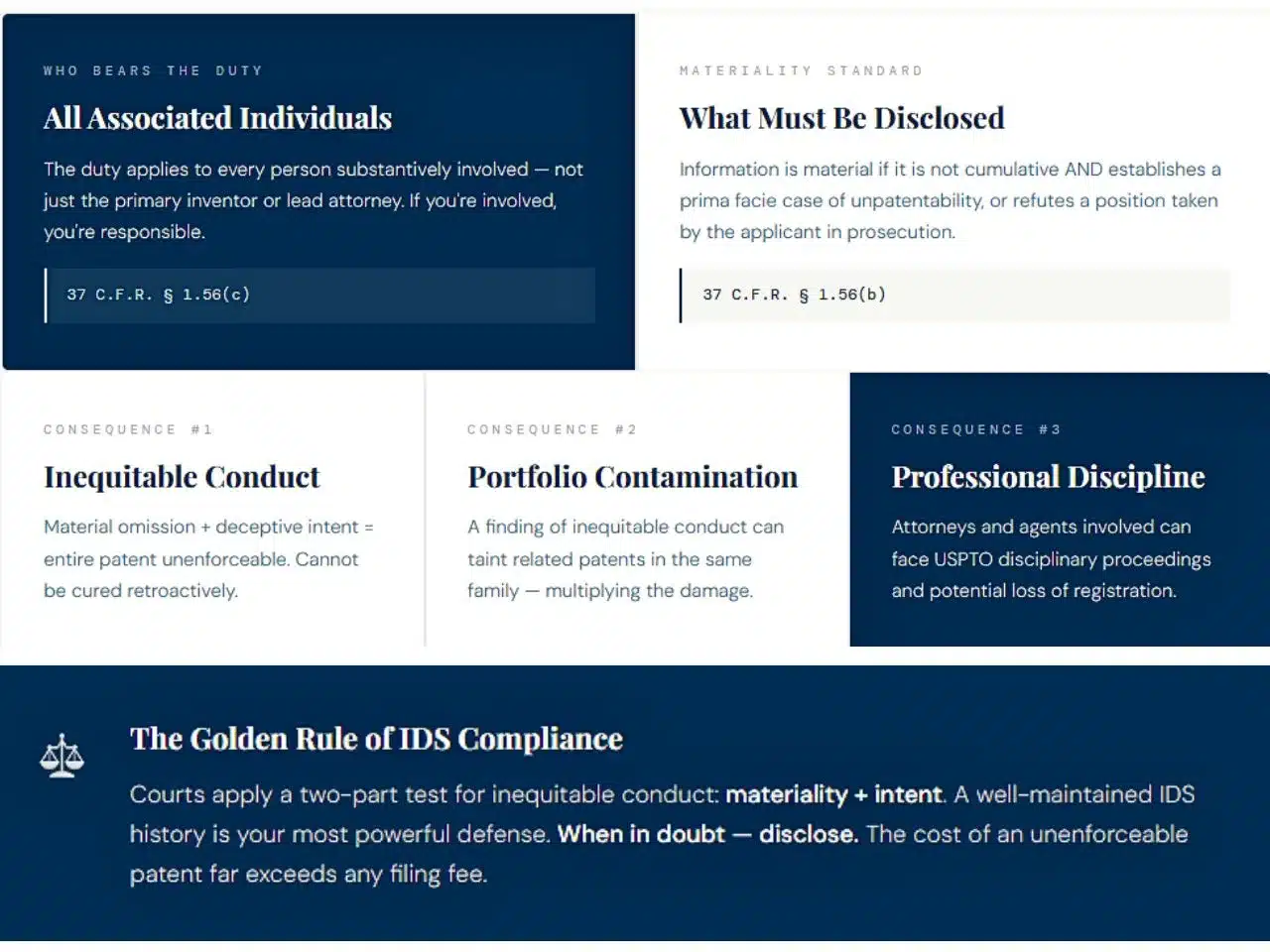
Under 37 C.F.R. § 1.56, all individuals associated with the filing and prosecution of a patent application have a duty of candor and good faith toward the USPTO. This includes:
- The inventor(s)
- Each attorney or agent
- Any other person substantively involved in the preparation or prosecution of the application
What Must Be Disclosed?
The rule is straightforward: any information material to patentability must be disclosed. Information is considered material if:
- It is not cumulative to information already of record
- It establishes (by itself or in combination with other information) a prima facie case of unpatentability
- It refutes or is inconsistent with a position the applicant has taken in opposing an argument of unpatentability or in asserting patentability
What Happens If You Don’t Disclose?
Failure to meet the duty of disclosure can result in a finding of inequitable conduct, which:
- Renders the entire patent unenforceable (not just invalid)
- Cannot be cured after the fact
- Can taint related patents in the same family
- May expose attorneys to professional discipline
⚠️ Critical Warning: Courts apply a high standard when evaluating inequitable conduct. Even well-intentioned omissions can be scrutinized if they involve highly material references. When in doubt – disclose.
When to File an IDS: Timing Rules You Must Know
The USPTO has strict timing requirements for IDS submissions, and filing late can result in additional fees or, worse, non-consideration of the cited references.
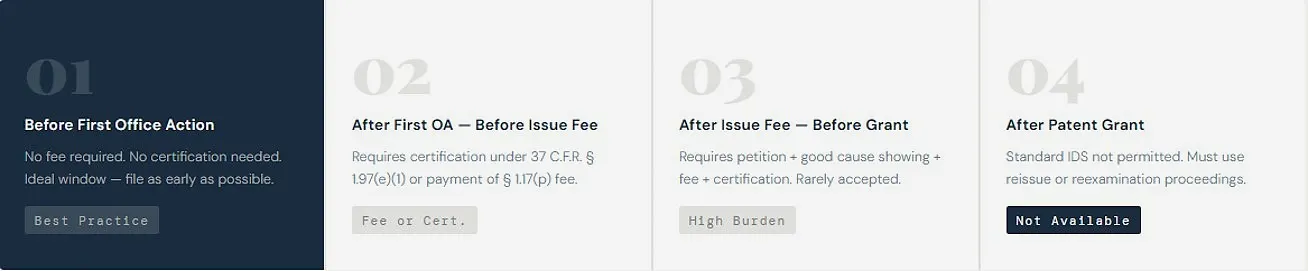
IDS Timing Windows:
1. Before First Office Action
- Can be filed without a fee or certification statement
- Best practice: File your initial IDS as early as possible
2. After First Office Action but Before Payment of Issue Fee
- Must be accompanied by:
- A certification under 37 C.F.R. § 1.97(e)(1): no item cited was known more than 3 months before filing, OR
- A fee as set by 37 C.F.R. § 1.17(p)
3. After Payment of Issue Fee (Before Patent Grant)
- Requires a petition and showing of good cause
- Must include a fee and certification
- Much harder to get accepted
4. After Patent Grant
- Cannot file a standard IDS
- Must use reissue or reexamination proceedings
- Significantly more expensive and time-consuming
Pro Tips on Timing:
- Monitor prosecution continuously – new prior art can surface at any point
- Search foreign patent databases – especially after receiving foreign office actions in related cases
- Watch your competitors’ publications – product launches and research papers can constitute material prior art
- Set reminders around issue fee payment – this is often when critical deadlines are missed
Also, Read: What is an Information Disclosure Statement (IDS) and Why Does It Matter for Your Patent?
Types of Information to Include in Your IDS
A well-prepared IDS is comprehensive but focused on material information. Here’s what to consider including:
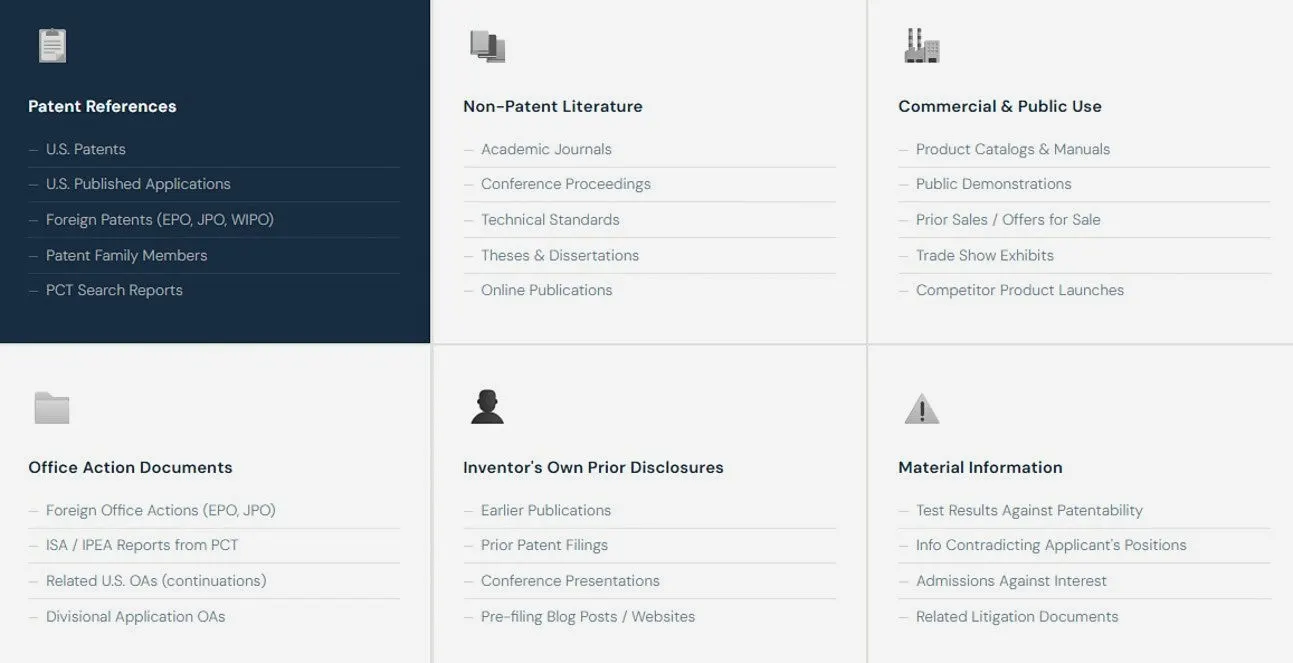
Patent References:
- U.S. patents and published applications
- Foreign patents (EPO, WIPO, JPO, CNIPA, etc.)
- Patent family members in related applications
Non-Patent Literature (NPL):
- Academic journals and peer-reviewed papers
- Conference proceedings
- Technical standards and specifications
- Product catalogs, brochures, and user manuals
- Online publications (properly archived/dated)
- Theses and dissertations
Office Actions from Related Cases:
- Foreign office actions and search reports (EPO, JPO, etc.)
- U.S. office actions on related applications (continuations, divisionals)
- ISA/IPEA reports from PCT proceedings
Other Material Information:
- Test results contradicting patentability arguments
- Prior sales, offers for sale, or public use of the invention
- Prior inventor disclosures or publications
Best Practice from Teak IP: Maintain a running prior art log from day one of your invention disclosure. Document every reference encountered during R&D, literature reviews, or competitive analysis. This proactive approach significantly reduces the risk of inadvertent non-disclosure.
Also, Read: How to Prepare an IDS: A Step-by-Step Guide for Patent Applicants
Common Mistakes Patent Owners Make
1. Thinking “I Don’t Know of Any Prior Art” Means No IDS Is Needed
Even if you haven’t searched, you still have an obligation to disclose what you do know. Moreover, conducting a reasonable prior art search is considered best practice.
2. Ignoring Foreign Office Actions
If you have co-pending foreign applications, the search reports and office actions issued by foreign patent offices often contain material references. These must be submitted to the USPTO in an IDS.
3. Disclosing Too Late
Waiting until just before issue fee payment – or worse, after – dramatically increases cost and complexity. Early, proactive disclosure is always better.
4. Over-Relying on Your Attorney to Identify Everything
While your patent attorney carries legal responsibility, inventors and technical experts often have unique knowledge of the prior art landscape. Collaboration is essential.
5. Failing to Update the IDS During Prosecution
Patent prosecution can take years. New publications, competitor patents, and office actions in related cases must be monitored and disclosed throughout the entire pendency of your application.
6. Misunderstanding the “Cumulative” Exception
Some applicants cite references they believe are “cumulative” and therefore exempt from disclosure. This is a dangerous practice – the determination of cumulativeness should be made carefully with legal counsel, not as a shortcut.
7. Not Disclosing Inventor’s Own Prior Publications
The inventor’s own published work, presentations, or earlier patent applications can constitute prior art. Many inventors overlook this, especially under the AIA’s § 102 framework.
IDS in the Post-AIA Era: What Changed?
The America Invents Act (AIA), effective March 16, 2013, significantly changed the U.S. patent landscape, shifting the system from first-to-invent to first-inventor-to-file. While the duty of disclosure under 37 C.F.R. § 1.56 remains substantively unchanged, several nuances now apply:
Key AIA Considerations for IDS:
- Prior art is now date-of-filing sensitive – what counts as prior art under § 102 depends on your effective filing date
- Grace period disclosures – an inventor’s own disclosure within 12 months before filing may serve as prior art protection, but must be properly documented
- AIA § 102(b)(1)(A) and (B) create specific safe harbors, but these do not eliminate the duty to disclose known material information
- Third-party pre-issuance submissions (37 C.F.R. § 1.290) now allow members of the public to submit prior art with explanations directly to the USPTO, making thorough IDS filing even more critical
Prior Art Disclosure in Post-Grant Proceedings
Beyond prosecution, prior art disclosure becomes critical in post-grant USPTO proceedings and patent litigation. Here’s how IDS-related issues play out in these contexts:
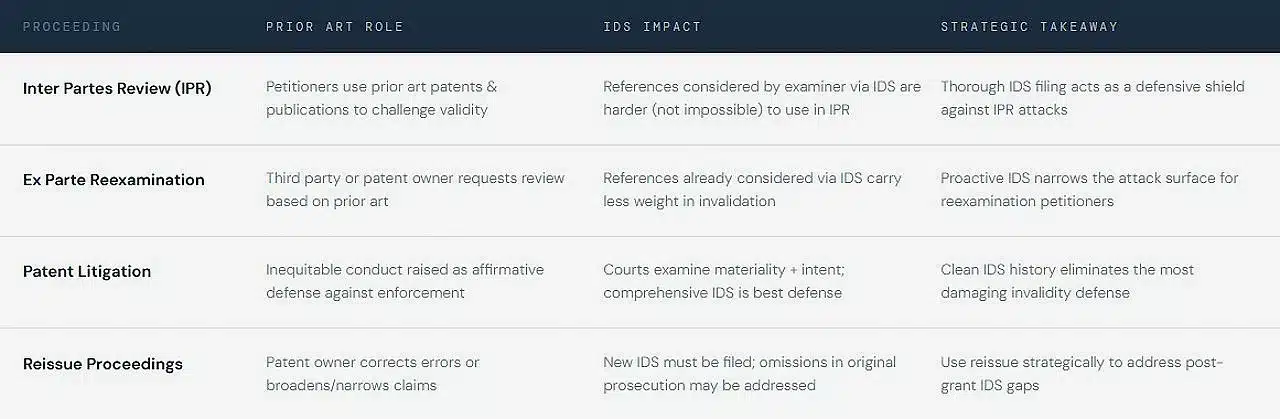
Inter Partes Review (IPR):
- Petitioners rely heavily on prior art patents and publications
- If a reference was previously disclosed in an IDS and considered by the examiner, it is harder (but not impossible) to use in IPR
- Thorough IDS filings can act as a defensive shield against IPR attacks
Ex Parte Reexamination:
- A third party or the patent owner can request reexamination based on prior art
- References already considered via IDS carry less weight in invalidating claims
Patent Litigation:
- Inequitable conduct defenses are asserted when opponents claim material information was withheld
- Courts look at materiality + intent – both must be proven
- A comprehensive, proactive IDS history is your best defense
Best Practices for Managing IDS and Prior Art Disclosure
1. Build a Prior Art Watch System Set up alerts on Google Patents, Espacenet, Lens.org, and relevant academic databases. Monitor your technology space continuously.
2. Implement an IDS Policy in Your Organization For companies with active patent portfolios, formalize an IDS protocol that includes:
- Inventor questionnaires at application filing
- Regular check-ins during prosecution
- Coordination between IP and R&D teams
- Review of foreign office actions before IDS deadlines
3. Work with a Qualified Patent Professional IDS compliance requires nuanced legal judgment. Partner with a registered patent attorney or agent – like the professionals at Teak IP – who understand the technical and legal dimensions of your invention space.
4. Document Your Search and Decision-Making Process Keep records of what was searched, what was found, and why certain references were or were not included. This documentation can be invaluable if your patent is ever challenged.
5. Don’t Skip the IDS for Cost Reasons While there are fees involved in late IDS filings, the cost of an unenforceable patent – or protracted litigation over inequitable conduct – far outweighs any filing fee savings.
6. Disclose Widely, Cite Strategically When in doubt, disclose. However, work with your attorney to provide the examiner with focused explanations of relevance so the IDS serves as both a compliance tool and a prosecution strategy asset.
How Teak IP Can Help (IDS prior art disclosure patent)
At Teak IP Services, we provide comprehensive patent prosecution and IP management support designed to protect your inventions at every stage of the process – from initial filing through post-grant proceedings.
Our services include:
- IDS preparation and filing – timely, thorough, and strategically prepared
- Prior art searches – domestic and international, across patents and non-patent literature
- Patent prosecution management – monitoring office actions and deadlines across jurisdictions
- Foreign filing coordination – ensuring seamless information flow between USPTO and international prosecution
- Portfolio audits – reviewing existing patents for potential IDS gaps or inequitable conduct risks
- Post-grant strategy – IPR, reexamination, and reissue guidance
Whether you’re a solo inventor or an enterprise IP team, Teak IP has the expertise to keep your patent portfolio strong, compliant, and defensible.
Frequently Asked Questions (FAQs)
Q: Is filing an IDS mandatory for every patent application? A: While there is no rule that requires filing an IDS if you are unaware of any material prior art, the duty of disclosure is mandatory. If you are aware of material information, you must disclose it – typically via an IDS.
Q: Can I file an IDS after the patent is granted? A: Standard IDS filings are not permitted post-grant. You would need to pursue reissue or reexamination proceedings, which are more costly and complex.
Q: What happens if I accidentally leave out a reference? A: Accidental omissions without deceptive intent generally do not constitute inequitable conduct. However, if the omitted reference is highly material, it can still complicate enforcement. Consult a patent attorney promptly if you discover an omission.
Q: Does an IDS need to be filed for continuation applications? A: Yes. Each continuing application has its own prosecution history, and material prior art – including references from the parent application – should be disclosed in each continuation where relevant.
Q: How many references can I include in a single IDS? A: There is no technical limit, but the USPTO charges fees when more than 50 references are included in a single application’s total IDS submissions. Quality and relevance should guide what you include.
Q: Do I need to translate foreign references before submitting them? A: You must provide a copy of foreign language references. A concise explanation or translation of the relevant portions is helpful but not always strictly required – consult your patent counsel for specifics.
Also, Read: Why Law Firms Outsource IDS Filing Services: The True Cost of DIY Filing
Conclusion: IDS prior art disclosure patent
The difference between an IDS and prior art disclosure may seem subtle, but in the world of patent law, the distinction has enormous practical consequences. An IDS is the formal, legally required mechanism for fulfilling your prior art disclosure obligations during U.S. patent prosecution. Failing to use it properly – or at all – can strip your patent of its enforceability and expose you to costly legal challenges.
The golden rule is simple: when in doubt, disclose. Work closely with a qualified patent professional, build proactive processes into your IP management workflow, and treat the IDS not as a bureaucratic formality but as a powerful tool for building a strong, defensible patent.
At Teak IP Services, we are committed to helping inventors and businesses navigate the complexities of patent prosecution with confidence and clarity. Reach out to our team today to learn how we can support your IDS compliance and broader patent strategy.
Ready to strengthen your patent portfolio with expert IDS management?
Our Services: Trusted IDS Preparation & Filing Services

