
PCT for Utility Models highlights how utility models represent a distinct form of intellectual property protection that sits between standard patents and designs, offering faster and more cost-effective protection for functional innovations. Also referred to as “petty patents” or “innovation patents” in some jurisdictions, utility models provide inventors with a streamlined path to securing their technological advancements without the extensive examination and lengthy prosecution timelines associated with traditional patents.

Inventors seeking to navigate the intersection of utility models and the PCT framework can work with our PCT application filing services to identify the most cost-effective route and ensure proper designation across all relevant jurisdictions.
Definition and Core Characteristics
A utility model is an intellectual property right that protects the functional aspects of a product’s shape, structure, or configuration. Unlike design patents that focus primarily on ornamental features, utility models protect the technical and functional innovations that make a product work more efficiently or effectively. The key distinguishing feature is their emphasis on practical utility and functional improvement rather than aesthetic appeal.
Utility models typically cover:
- Structural improvements: New configurations in mechanical devices, tools, and equipment
- Functional enhancements: Innovations that improve product performance or efficiency
- Technical features: Specific arrangements of components that provide technical advantages
- Manufacturing innovations: Novel production methods and processes (in some jurisdictions)
- Device modifications: Alterations to existing products that enhance their functionality
Advantages of Utility Model Protection
The strategic value of pursuing utility model protection has made it increasingly popular among innovators and small enterprises. Key advantages include:
Speed to Market
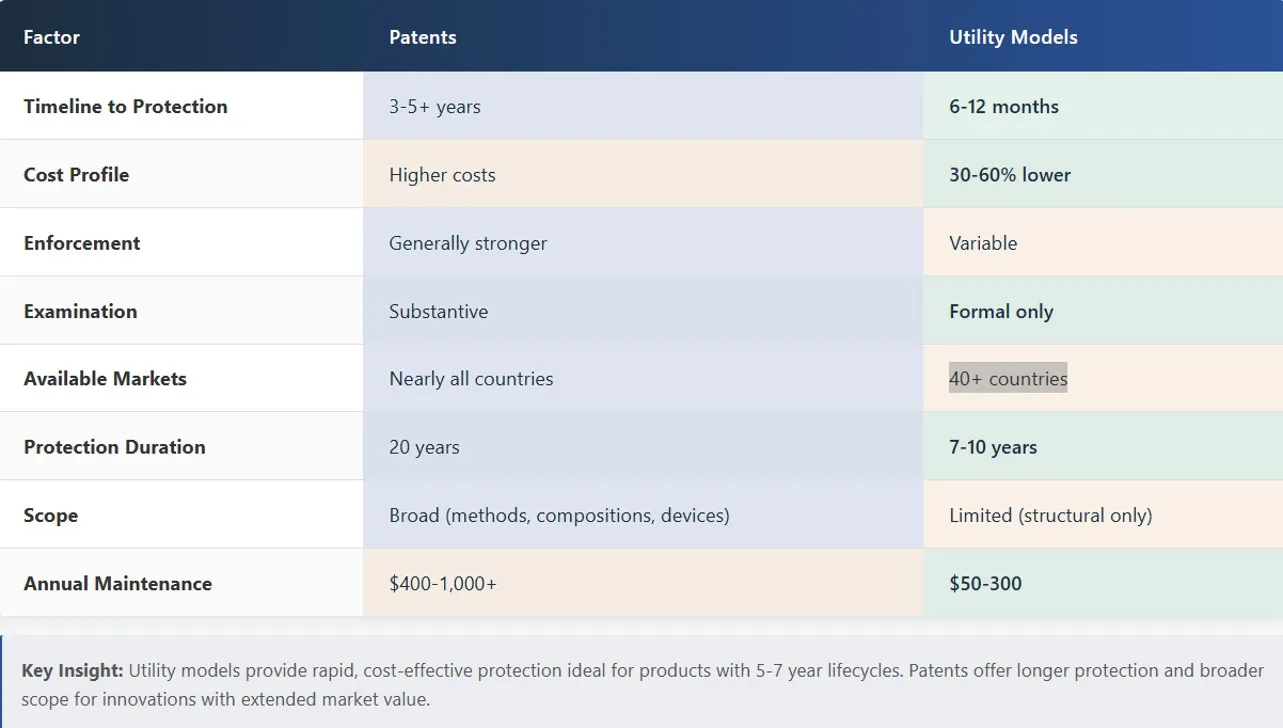
Utility models typically receive approval within 6-12 months compared to 3-5 years for standard patents. This rapid protection is invaluable for time-sensitive innovations in fast-moving technology sectors.
Lower Costs
Filing and maintenance fees are significantly reduced, often 40-60% lower than standard patent prosecution. This cost advantage makes utility models particularly attractive for SMEs and startups with limited IP budgets.
Simplified Examination
Most jurisdictions offering utility model protection employ a formal examination only approach, rather than substantive examination. This means examiners verify compliance with formalities but typically do not conduct exhaustive prior art searches, accelerating the approval process.
Extended Protection Period
While shorter than standard patents, utility models typically provide 7-10 years of protection, offering a substantial window for commercialization and market capture.
Limitations and Considerations
Despite their advantages, utility models come with important limitations that must be considered during strategy formulation:
- Limited International Recognition: Not all countries recognize utility model protection; availability varies significantly by jurisdiction
- Shorter Protection Term: Generally shorter than standard patents (7-10 years vs. 20 years)
- Narrower Scope: Cannot protect methods or processes in most jurisdictions, limiting applicability to structural innovations
- Weaker Enforcement: Some jurisdictions view utility models as less enforceable than standard patents in litigation
- Limited Prior Art Consideration: Reduced examination rigor may result in challenges to validity if contested
2. PCT and Utility Model Protection (PCT for Utility Models)
The Patent Cooperation Treaty (PCT) mechanism provides a powerful framework for extending utility model protection internationally, addressing a critical gap in global IP strategy. Understanding how the PCT system operates specifically for utility models is essential for any applicant seeking efficient international protection.
PCT Framework for Utility Models
The PCT, administered by the World Intellectual Property Organization (WIPO), enables applicants to file a single international application that can be used to seek protection in multiple countries simultaneously. This system represents a paradigm shift from the traditional approach of filing individual applications in each target country, significantly reducing administrative complexity and initial filing costs.
When pursuing patenting under PCT for utility models, applicants must navigate a unique landscape where:
- The international phase operates uniformly for all applicants regardless of the type of protection ultimately sought
- The national/regional phase allows applicants to specify whether they want patent or utility model protection in each designated country
- Some countries treat utility models as a distinct designation option, while others allow applicants to request conversion from patent to utility model applications
- Timing and procedural requirements for national phase entry may differ between patent and utility model tracks
International Phase Considerations for Utility Models
During the international phase, PCT applicants benefit from a single comprehensive search and preliminary examination conducted by an International Searching Authority (ISA) and International Preliminary Examining Authority (IPEA). This provides valuable information about the patentability and utility of the claimed invention before significant national-level expenses are incurred.
Key aspects of the international phase:
International Search Report (ISR)
- Identifies relevant prior art across global databases
- Applies novelty and inventive step standards
- Provides objective assessment of patentability potential
- Enables informed decision-making for national phase entry
- Available to the public 18 months after filing date
International Preliminary Examination Report (IPER)
- More detailed analysis of inventive step and non-obviousness
- Optional but highly recommended for utility model applicants
- Provides international opinion on patentability standards
- Strengthens position in national phase examinations
- Creates persuasive authority for examining offices
National Phase Entry for Utility Models (PCT for Utility Models)
The critical juncture in the PCT process occurs at the national phase entry, typically 30 months from the priority date. At this point, applicants must decide which countries to pursue and what type of protection to seek in each jurisdiction. For utility models, this requires sophisticated strategic analysis:
Patents vs PCT Utility Models Comparison
PCT Strategies for Utility Model Applicants
Sophisticated applicants employ multiple strategic approaches when utilizing the PCT system for utility models:
Strategy 1: Dual Track Filing
File a single PCT application while designating key markets for utility model protection and secondary markets for patent protection. This hybrid approach maximizes coverage while optimizing costs by pursuing expedited protection in high-priority markets and maintaining broader protection options in others.
Strategy 2: Rapid Utility Model Acquisition
Prioritize quick market entry and competitive advantage by pursuing utility model protection in key markets (6-12 months), deferring decisions on patent protection until market performance data becomes available. This approach conserves capital while maintaining protection during critical early commercialization phases.
Strategy 3: Conversion and Continuation
File initial PCT application as patent, obtain international search results, then convert to utility model in select jurisdictions where this option is available and advantageous. This approach maximizes flexibility and allows benefit of international examination regardless of ultimate designation choice.
3. Countries Offering Utility Model Registration
The availability and characteristics of utility model protection vary substantially across global jurisdictions. Understanding which countries offer utility model protection and the specific requirements in each is fundamental to effective PCT utility model strategy.
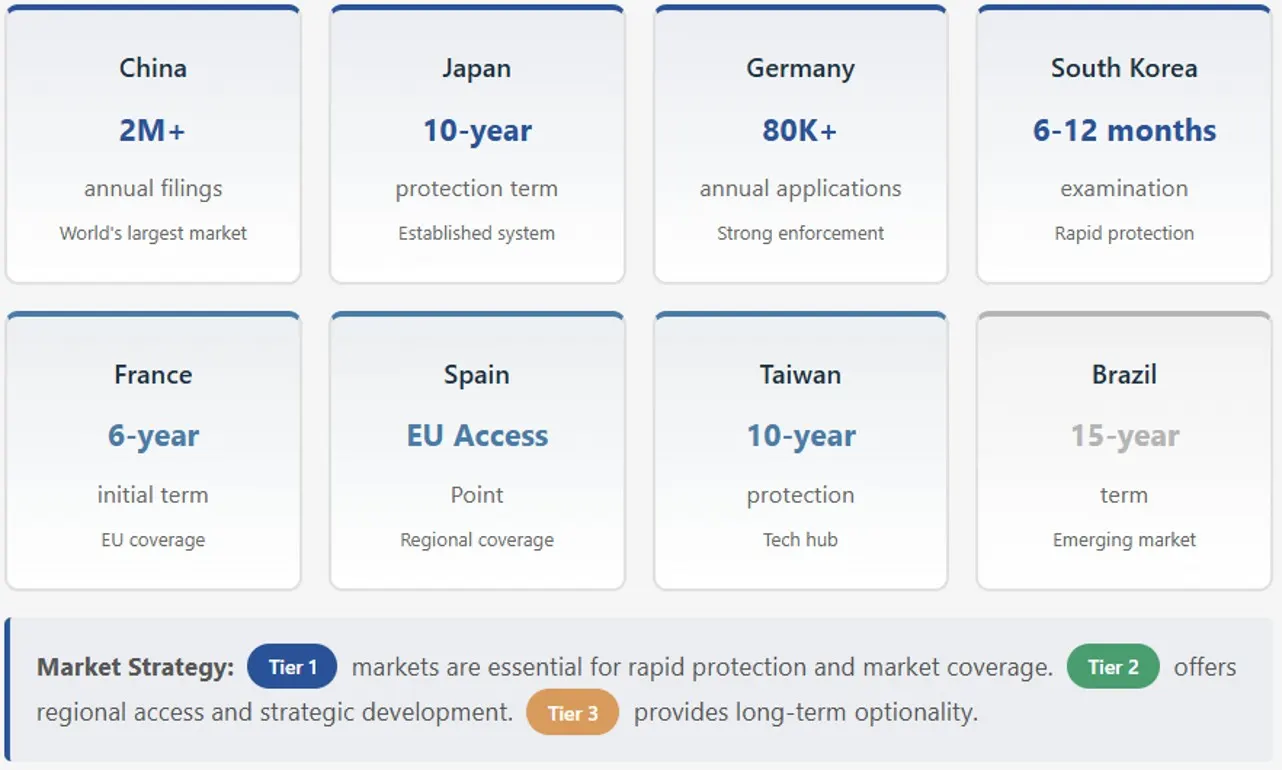
Global PCT Utility Model Market Landscape (PCT for Utility Models)
Major Markets with Utility Model Systems
While not all nations recognize utility models, the major economic powers and technology hubs increasingly offer this protection mechanism:
Asian Markets (Strong Utility Model Systems)
- China: One of the world’s largest and most active utility model markets; over 2 million utility model applications filed annually; government actively promotes utility model protection through subsidies and incentives
- Japan: Well-established system offering 10-year protection; rapid examination (9-18 months); widely used for consumer electronics and mechanical innovations
- South Korea: Progressive utility model system with 10-year terms; examination typically completed in 6-12 months; increasingly popular among technology manufacturers
- Taiwan: Offers utility model protection for 10 years; streamlined examination process; popular among semiconductor and electronics manufacturers
- India: Recently expanded utility model system; 6-year initial term with potential 2-year extensions; increasingly utilized by Indian technology companies
European Markets
- Germany: Robust utility model (Gebrauchsmuster) system; 10-year protection; considered highly enforceable; ~80,000 applications annually
- France: Utility model (certificat d’utilité) system; 6-year initial term with potential renewal; examination typically 6-9 months
- Spain, Italy, Netherlands: All offer utility model protection; typically 6-10 year terms; generally lower filing costs than patent protection
- Poland, Czech Republic: Central European markets with developing utility model systems; increasingly attractive for manufacturers targeting EU expansion
Other Active Markets
- Australia: Innovation patent system (essentially a utility model equivalent); 8-year term; examination-free system with lower costs
- Brazil: Utility model (modelo de utilidade) system; 15-year term; relatively underutilized despite attractive protection period
- Mexico: Utility model protection available; 10-year term; growing importance in North American trade context
- Russia and CIS nations: Active utility model systems; streamlined examination; critical for Eastern European and Central Asian expansion
Key Jurisdictions Lacking Utility Model Systems
Importantly, certain major markets do not offer utility model protection, affecting strategy planning:
- United States: No utility model system; relies exclusively on patents and design patents; strategic implications for North American applicants
- Canada: No utility model protection; applicants must choose between patents and design patents
- United Kingdom: No utility model system (though this may change post-Brexit); uses patents and designs exclusively
Variations in Protection Parameters
Protection Duration
6-year systems: France, Portugal provide shorter terms but lower ongoing maintenance costs. 10-year systems: Germany, Japan, South Korea, China offer more substantial protection windows aligned with typical product lifecycles. 15-year systems: Brazil provides extended terms exceeding most patent systems.
Examination Approach
Formal examination only: Most systems examine compliance with filing requirements but not substantive patentability; this accelerates processing but may result in validity challenges. Substantive examination: Some jurisdictions (Japan, Germany) conduct more thorough reviews, offering stronger protection at cost of longer timelines.
Scope Limitations
Most utility model systems exclude methods and processes, protecting only structural configurations. Some jurisdictions (China, Japan) allow broader scope including certain process innovations. Software and business methods are rarely protectable under utility model systems.
4. Country Designation Strategy Under PCT for Utility Models
The process of strategically selecting which countries to designate for utility model protection is among the most critical decisions in international IP strategy. This requires balancing commercial objectives, competitive landscapes, and financial constraints.
Strategic Designation Decision Framework
When pursuing patenting under PCT, applicants must conduct comprehensive market analysis across multiple dimensions:
Primary Market Considerations
- Current Revenue Generation: Designate countries representing existing sales revenue and market presence
- Strategic Expansion Markets: Include jurisdictions targeted for commercialization within 3-5 year horizon
- Manufacturing Locations: Protect in countries where products are manufactured to prevent competitive infringement
- Competitor Geographic Focus: Designate markets where primary competitors operate to establish blocking positions
- Supply Chain Nodes: Protect in key supply chain jurisdictions to prevent circumvention through component procurement
Intellectual Property Landscape Assessment
- Existing Patent Coverage: Identify markets where patent protection has already been obtained to avoid duplication
- Competitive Patent Activity: Analyze competitor patent filings to identify unprotected markets requiring rapid coverage
- Design Registration Status: Determine whether design registration provides sufficient protection, eliminating need for utility model in certain jurisdictions
- Trade Secret Viability: Assess markets where protection by trade secret is feasible and cost-effective alternative
Geographic Clustering for Efficiency
Sophisticated applicants employ geographic clustering strategies that balance comprehensive protection with cost management:
1st Tier: Core Markets (Mandatory Designation)
- Home country/primary market (typically mandatory for PCT filing)
- Largest export markets (typically top 2-4 markets by revenue)
- Countries with strong utility model systems and enforceability
- Markets with high competitor activity
2nd Tier: Regional Markets (Strategic Designation)
- Secondary export markets representing 5-20% of projected revenue
- Regional hubs serving as market entry points (e.g., Germany for EU, Singapore for ASEAN)
- Markets with developing but active utility model systems
- Markets with rapid economic growth and increasing market potential
3rd Tier: Exploratory Markets (Selective Designation)
- Emerging markets with long-term strategic importance
- Markets selected based on trade agreement benefits (e.g., EU harmonization)
- Markets where low filing fees justify inclusion for flexibility
- Markets requiring market study before major investment
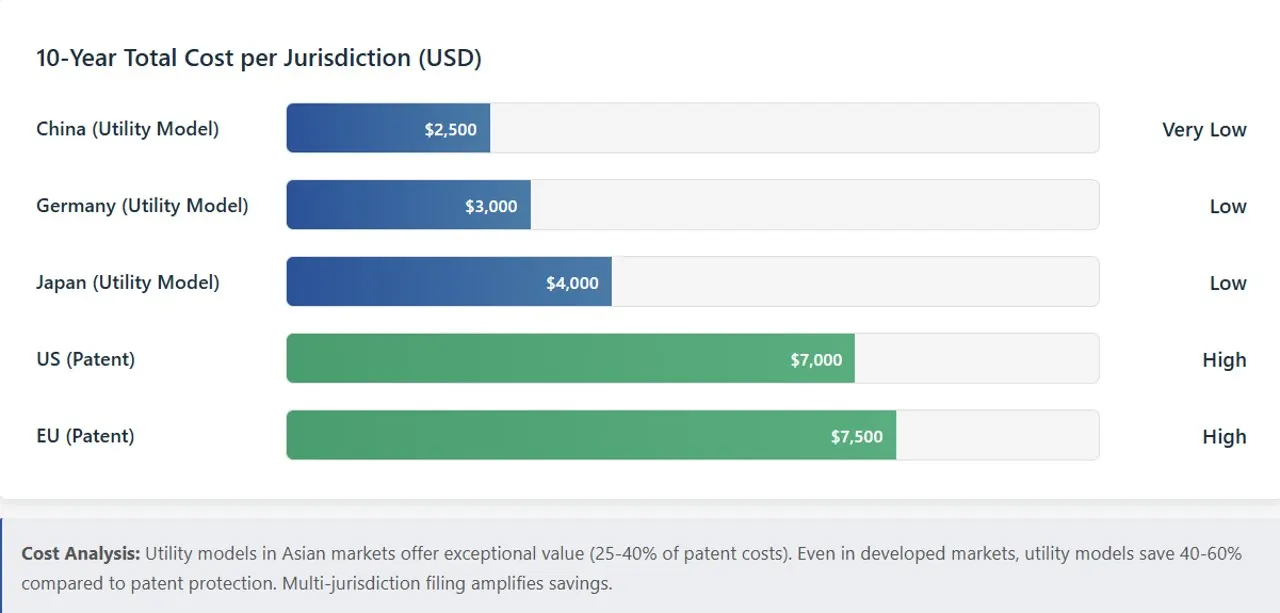
Cost Optimization Strategies
Designation decisions must account for substantial cost variations across jurisdictions and filing types:
Timing and Sequence Decisions
Beyond which countries to designate, the sequence and timing of designation carries strategic implications:
Simultaneous Designation Strategy
Designate all target countries in the initial PCT application filing, securing priority date benefit across all jurisdictions. This approach simplifies administration but requires early commitment of resources and comprehensive market analysis.
Phased Designation Strategy
Begin with Tier 1 core markets in initial PCT filing, then make subsequent designations through divisional applications or extensions where available. This approach provides flexibility for market assessment but requires careful attention to procedural deadlines.
Contingent Designation Strategy
File PCT application without initial designations, then designate countries at 30-month national phase entry deadline after assessing market performance and competitive landscape. This maximizes information available for decision-making but requires aggressive action near deadline.
Also, Read: ePCT Filing Guide using Online PCT Application System
5. Differences Between Patents and Utility Models
Understanding the fundamental distinctions between patent and utility model protection is essential for applicants making strategic IP decisions. These differences affect not only protection scope and enforceability but also cost, timeline, and long-term IP portfolio strategy.
Comprehensive Comparison Framework
| Characteristic | Patents | Utility Models |
|---|---|---|
| Scope of Protection | Methods, processes, compositions, devices, systems; broad coverage of technical innovation | Primarily structural features and configurations; limited to shape/structure/arrangement |
| Examination Type | Substantive: novelty, non-obviousness, industrial applicability assessed thoroughly | Formal: primarily compliance with procedural requirements; limited prior art review |
| Prosecution Timeline | 3-5+ years typical (US, EU); can exceed 10 years in complex cases | 6-12 months typical; many jurisdictions have 18-month targets |
| Protection Duration | 20 years from filing date (standard); 25+ years with extensions | 7-10 years typical; up to 15 years in select jurisdictions |
| Filing Costs | $2,000-5,000+ per jurisdiction for professional filing | $500-1,500 per jurisdiction; 40-60% lower typical |
| Maintenance Costs | $400-1,000+ annually per jurisdiction | $50-300 annually per jurisdiction |
| Total 10-Year Cost | $5,000-15,000+ per jurisdiction | $2,000-5,000 per jurisdiction |
| Enforceability | Generally strong; well-established legal framework; extensive case law | Variable by jurisdiction; sometimes weaker in litigation; limited precedent |
| Prior Art Impact | Comprehensive prior art search conducted; rejection if novelty not demonstrated | Limited prior art review; protection may be granted despite existing similar disclosures |
| Geographic Availability | Available in virtually all countries worldwide | Limited to 60+ countries; significant gaps in major markets |
| International PCT System | Full integration; all PCT members accept patent applications | Partial integration; available as optional designation in PCT-eligible countries only |
| Claim Structure | Broad, dependent, and independent claims; flexible scope definition | Typically single claim format; narrower scope definition |
| Amendment Flexibility | Amendments possible during prosecution with disclosed matter restrictions | Limited amendment opportunities; strict formal requirements in most systems |
Scope and Subject Matter Distinctions
One of the most critical distinctions between patents and utility models concerns what can be protected:
Patent Coverage Includes
- Manufacturing and production processes
- Chemical compositions and formulations
- Biological and biotechnological innovations
- Software and computer-implemented inventions (in many jurisdictions)
- Business methods (limited availability)
- Mechanical and structural innovations
- System integration and combination patents
Utility Model Coverage Limited To
- Physical structures and configurations
- Mechanical arrangements and assemblies
- Device modifications and improvements
- Tool and equipment innovations
- Product design enhancements
Typically Excluded from Utility Models
- Methods and processes
- Chemical compositions
- Biological inventions
- Software and algorithms
- Abstract ideas and principles
- Purely aesthetic design features
Examination and Prosecution Differences
The examination process represents a fundamental divergence between patent and utility model systems:
Patent Examination
Depth: Comprehensive prior art searches conducted across global databases; examiner may issue multiple rounds of rejections requiring detailed responses. Standards: Applicant must prove novelty (not previously disclosed), non-obviousness (non-obvious to person skilled in art), and industrial applicability. Timeline: Multiple office actions over years; applicant has opportunities to amend claims and provide evidence of patentability. Outcomes: Granted patents possess strong validity presumptions due to examination rigor.
Utility Model Examination
Depth: Formal examination focuses on procedural compliance; prior art search often limited or nonexistent. Standards: May require only novelty over immediately prior disclosures; non-obviousness often not assessed. Timeline: Rapid processing with few office actions; examination completed in 6-12 months. Outcomes: Granted utility models may face validity challenges if prior art emerges; protection can be revoked in litigation.
Cost and Financial Considerations
The significant cost differential between patent and utility model protection drives much strategic decision-making:
Utility Model Cost Advantages
- Initial Filing: 50-60% lower professional fees compared to patent prosecution
- Annual Maintenance: Substantially lower renewal fees; often no renewal requirement after initial grant
- Total 10-Year Cost: 60-70% cost reduction compared to patent protection in same jurisdiction
- Multiple Jurisdiction Advantage: Cost savings multiply significantly in multi-country filings
- Resource Allocation: Capital saved on utility model filings can be reinvested in additional markets or patent prosecution in key jurisdictions
Patent Cost Justification
- Market Leadership: Justified for breakthrough innovations with significant market potential
- Enforceability Premium: Stronger enforcement position justifies higher costs in high-value markets
- Litigation Prevention: Robust patents deter potential infringers more effectively
- Long-Term Value: 20-year terms justify higher annual costs for products with extended commercial lives
- Licensing Potential: Strong patents enable valuable licensing arrangements offsetting investment
Enforcement and Validity Considerations
The enforceability landscape differs substantially between protection types, affecting real-world value:
Patents possess significant enforceability advantages: Granted after rigorous examination, they carry presumption of validity; infringers bear burden of proving invalidity; well-established case law provides enforcement guidance; courts take patent infringement seriously with substantial damages available. Utility models face enforceability challenges in many jurisdictions: Limited examination creates vulnerability to validity challenges; enforcement costs can be high relative to protection scope; precedent varies significantly by jurisdiction; some countries treat utility models as secondary IP protection requiring enhanced proof of validity; damages may be limited compared to patent infringement awards.
Also, Read: PCT National Phase Deadlines: Complete Timeline Guide
6. Strategic PCT for Utility Models: Application and Filing Decisions
Developing an effective PCT strategy for utility model protection requires sophisticated analysis of multiple variables and alignment with broader business objectives. Successful applicants employ systematic approaches to maximize protection scope while optimizing financial investment.
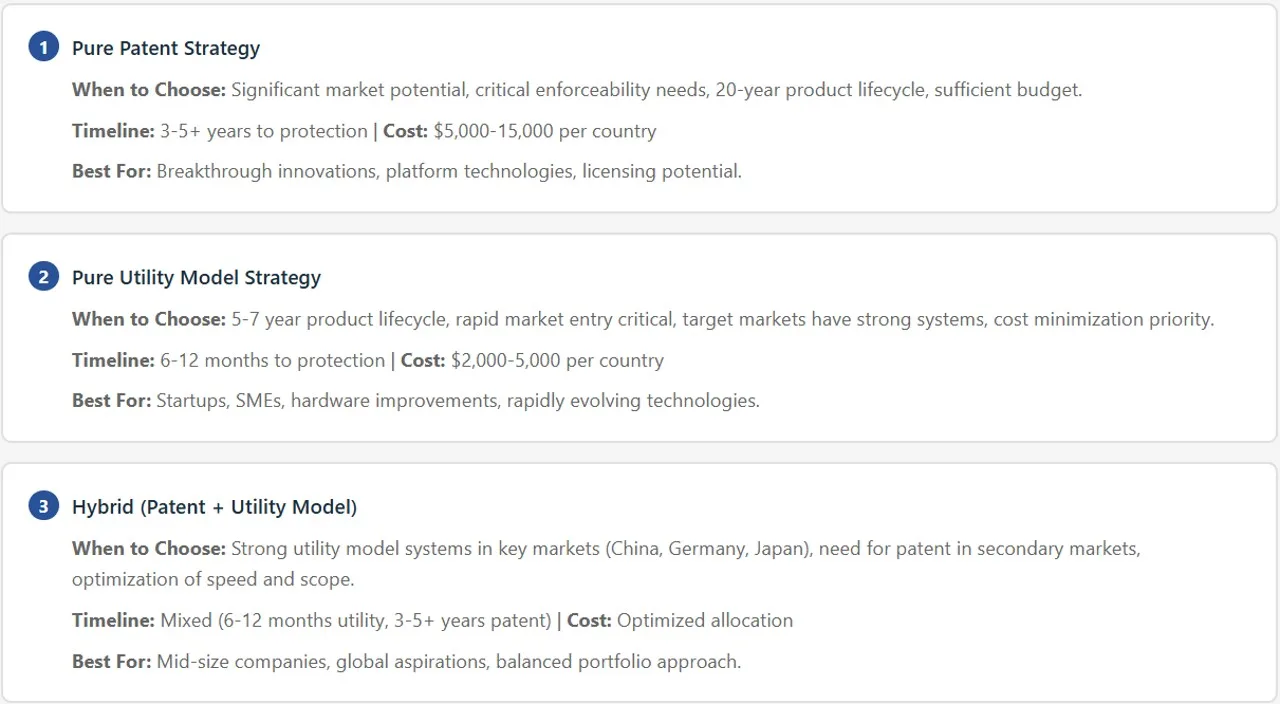
PCT Strategy Decision Framework (PCT for Utility Models)
Pre-Filing Assessment Framework
Before initiating PCT filing, applicants must conduct comprehensive strategic assessment:
1st Step: Invention Classification Analysis
- Determine whether innovation qualifies for utility model protection in target jurisdictions
- Identify whether innovation involves process/method (typically excluded from utility models)
- Assess structural/functional components eligible for protection
- Document technical advantages and functional improvements
- Evaluate whether innovation also qualifies for patent protection
2nd Step: Market and Competitive Landscape Review
- Identify primary target markets and commercialization timeline
- Research competitor patent and utility model filings in target markets
- Assess existing design patent or design registration opportunities
- Evaluate trade secret protection viability
- Determine market exclusivity value and licensing potential
3rd Step: Jurisdiction Eligibility and Suitability Assessment
- Identify which target markets offer utility model protection
- Research examination standards and enforceability track record in each jurisdiction
- Evaluate prosecution timeline and cost structure in candidate jurisdictions
- Assess market size and competitive activity in utility model systems
- Determine filing fee structures and maintenance cost implications
PCT for Utility Models: Application Strategy Decisions
Once pre-filing analysis is complete, applicants must make critical strategic decisions:
Decision 1: Patent vs. Utility Model vs. Hybrid Approach
Pure Patent Strategy
Appropriate When: Innovation has significant market potential; patent enforceability in key markets is critical; 20-year protection term provides substantial value; applicant can justify higher costs. Filing Approach: File standard PCT patent application designating all target countries for patent prosecution. Advantages: Comprehensive protection; strong enforcement capability; global recognition. Disadvantages: Higher costs; longer timelines; comprehensive prior art examination reduces flexibility.
Pure Utility Model Strategy
Appropriate When: Product lifecycle is 5-7 years; rapid market entry is critical; target markets have strong utility model systems; cost minimization is priority. Filing Approach: File PCT application with designation restricted to countries offering utility model protection; request utility model protection specifically in each designated country. Advantages: Rapid protection (6-12 months); significantly lower costs; faster market coverage decision-making. Disadvantages: Limited geographic availability; shorter protection terms; potentially weaker enforcement in litigation.
Hybrid (Patent + Utility Model) Strategy
Appropriate When: Key markets with strong utility model systems (China, Germany, Japan) offer faster protection; secondary markets require patent protection; applicant seeks optimal balance of speed and scope. Filing Approach: File single PCT application; designate key markets for utility model protection and secondary markets for patent protection; coordinate prosecution strategies. Advantages: Fast market coverage in priority jurisdictions; patent protection in major markets; optimized cost allocation; flexibility for market evolution. Disadvantages: Complex administration; coordinate dual prosecutions; inconsistent protection across markets.
Decision 2: Filing Timing and Priority Claim Strategy
- Early Priority Filing: File provisional or priority application immediately upon invention disclosure to secure priority date before any public disclosure
- Grace Period Utilization: File PCT application within 12-month grace period following inventor’s own disclosure where applicable
- Provisional Priority: File provisional application to establish early priority date, then file definitive application within 12 months
- Multiple Priority Claims: Maintain multiple priority relationships for different invention aspects filed at different times
Decision 3: Search and Examination Route Selection
- ISA/IPEA Route: Utilize International Searching Authority and International Preliminary Examination Authority in PCT system to obtain sophisticated international opinion
- Search Strategy: Select experienced ISA capable of thorough utility model search across relevant databases
- Examination Request Decision: Request international preliminary examination (optional) to strengthen position in utility model prosecution
- Appeal and Response Strategy: Plan responses to international reports with information strengthening utility model validity positions
National Phase Entry Strategy
The 30-month national phase entry point represents the critical juncture for utility model strategy implementation:
Information Assembly for National Phase Decisions
- Market performance data: actual sales, market share, customer adoption rates
- Competitive intelligence: competitor product launches, patent filings, market position changes
- Technology evolution: product development status, next-generation innovations in pipeline
- Financial performance: profitability, revenue growth, return on IP investment
- International Search Results and International Preliminary Examination Reports providing patentability assessment
National Phase Designation Decision Process
- Confirmed Designation Markets: Proceed with utility model protection in Tier 1 core markets where products are actively commercialized
- Selective Designation Markets: Designate Tier 2 markets based on competitive presence and market growth potential
- Market Entry Timing: Evaluate whether rapid protection is still necessary or if market entry timeline has shifted
- Cost Optimization: Reassess cost-benefit of each designation given market performance data
- Conversion Decisions: Where permitted, convert from patent to utility model or vice versa based on prosecution trajectory and cost considerations
Post-Grant Portfolio Management
Utility model strategy extends beyond grant into active portfolio management:
Maintenance and Renewal Strategy
- Evaluate active commercialization in each protected jurisdiction; abandon protection in markets with discontinued sales
- Monitor marketplace for design-arounds and next-generation competitor products
- Plan for product evolution and next-generation utility model filings for improved versions
- Track maintenance fee escalations and ROI calculations for continued renewal
- Prepare for potential validity challenges in jurisdictions with enforcement activity
Enforcement and Defense Preparation
- Monitor competitor products for potential infringement
- Document licensing opportunities and technology transfer potential
- Prepare enforcement strategy should infringement be detected
- Develop freedom-to-operate analysis for own product improvements
- Strengthen documentation of technical advantages supporting validity positions
Evolution to Patent Protection
- Evaluate timing for filing continuation or follow-on patents based on improved product versions
- Assess strategic value of converting utility models to patents where conversion mechanisms exist
- Plan for transition from utility model to patent protection as products mature and market value increases
Also, Read: National Phase Entry Patent Filing Process, Deadline and Strategy
7. Academic PCT Filing for Utility Models
Academic institutions and research organizations face unique challenges and opportunities when pursuing patenting under PCT for innovations emerging from research activities. Understanding these specialized considerations is essential for university technology transfer offices and research administrators.
Research Innovation and IP Protection Landscape
Academic research produces innovations ranging from fundamental discoveries to practical applications, with varying IP protection potential:
Research Innovations Suitable for Utility Model Protection
- Instrumental and Equipment Innovations: Improvements to laboratory apparatus, measurement devices, testing equipment; often benefit from rapid utility model protection
- Process Equipment Modifications: Novel configurations of production equipment developed through research; frequently protect technical enhancements through utility models
- Device Architecture Innovations: Structural improvements to experimental or analytical devices; ideal utility model candidates
- Component Configuration Enhancements: Novel arrangements of existing components achieving performance improvements; protectable under utility model systems
- Materials Processing Improvements: Physical improvements to existing materials handling and processing equipment
Innovations Developed Through Research Requiring Patent Protection
- New chemical compositions and formulations developed through research
- Novel processes and methods for manufacturing or analysis
- Biotechnological innovations and genetic engineering applications
- Software algorithms and computational methods developed in research
- Fundamental discoveries with broad application potential
Research Publication and Prior Art Considerations
A fundamental challenge for academic institutions is balancing research publication objectives with IP protection requirements. This consideration substantially affects utility model strategy:
Critical Issue: Most patent and utility model systems require confidentiality of the invention prior to filing. Once an invention is published, disclosed at conferences, or made publicly available in any form, it may be deemed prior art, destroying patentability or utility model eligibility in many jurisdictions.
Grace Periods and Publication Timing
Certain jurisdictions offer “grace periods” allowing applicants to file patent applications within 12 months of inventor’s own public disclosure. However: Not all countries recognize grace periods; grace period terms vary by jurisdiction; utility model systems typically provide no grace periods. Strategy: File PCT application BEFORE planning any conference presentations or journal publications; consult IP counsel before disclosures; ensure all researchers understand confidentiality requirements.
University Technology Transfer and IP Strategy
Most academic institutions have formal technology transfer offices managing commercialization of research innovations. Utility model strategy should align with technology transfer objectives:
Licensing and Commercialization Pathways
- Startup Company Formation: Researchers may establish startups to commercialize innovations; utility models provide rapid, cost-effective protection enabling startup positioning
- Industry Partnerships: Joint research with industry partners may produce innovations suitable for utility model protection; partnership agreements must clarify IP ownership
- Spin-Off Companies: Established academic spin-offs benefit from rapid utility model protection enabling early market entry
- License to Industry: Utility model protection enables licensing arrangements with established companies for market entry and commercialization
Cost and Funding Considerations
Academic institutions often face budget constraints affecting IP strategy:
Cost Reduction Strategies
- Utility Model Focus: Prioritize utility model protection in cost-sensitive situations where rapid protection is more valuable than extended terms
- Selective Designation: Designate only high-probability commercialization markets rather than attempting comprehensive global protection
- Staged Filings: File provisional applications and assess commercialization potential before incurring significant national phase costs
- External Funding: Seek grants from government innovation programs that subsidize IP filing costs (many countries offer research institution IP subsidies)
- Industry Cost-Sharing: Negotiate partner companies to bear IP filing costs for jointly developed innovations
Government Incentive Programs
Many governments offer substantial incentives for academic institutions to file patents and utility models:
- EU Research Institutions: Horizon Europe and national programs provide IP filing subsidies and support
- China: Extensive subsidies for utility model filings by academic institutions and research organizations
- South Korea: Government programs subsidize patent and utility model filings by university researchers
- India: National innovation missions offer IP filing support for academic research
- Taiwan: Research institution IP programs provide grants and subsidies
Multi-University Collaboration and IP Ownership
When research involves multiple institutions, IP ownership and filing strategy becomes more complex:
- Joint Inventorship: Clearly document which researchers from which institutions made inventive contributions; affects patent ownership and filing authority
- Ownership Agreements: Execute inter-institutional agreements clarifying IP ownership percentages and filing decision authority before research commences
- Filing Authority: Designate which institution controls filing decisions and cost obligations; typically the institution with largest ownership stake
- Revenue Sharing: Establish mechanisms for sharing license revenues or commercialization proceeds among institutions
Faculty Inventor Retention and Patent Incentive Programs
Academic institutions often provide financial incentives to researcher-inventors for productive research leading to patents or utility models:
- Filing Milestone Payments: Bonuses upon successful filing of patent or utility model applications
- Grant Milestone Payments: Additional compensation when patents or utility models are successfully obtained
- License Revenue Sharing: Percentage of license revenues or royalties shared with inventor-faculty members
- Equity Allocation: Equity positions in startup companies commercializing academic research
Also, Read: PCT Filing Costs and Fees: Complete Breakdown
8. PCT in Research Methodology Context
Understanding patenting under PCT in research methodology contexts is increasingly important as research tools, experimental methods, and analytical procedures become valuable IP assets. This section addresses how PCT systems accommodate research-related innovations and methodological developments.
Research Methodology as Patentable Subject Matter
While processes and methods are central to research, their patentability under patent systems is substantial, though utility model systems provide limited protection:
Patentable Methodological Innovations
- Analytical Methods: Novel approaches to measuring, testing, or analyzing materials or phenomena; widely patentable in most jurisdictions
- Experimental Procedures: Streamlined or improved procedures for conducting research or laboratory work; patent-eligible in most systems
- Quality Control Methods: Systematic approaches to ensuring product or process quality; generally patentable
- Diagnostic Methods: Procedures for identifying conditions or properties; increasingly patentable (though some restrictions apply)
- Data Analysis Algorithms: Computational approaches to analyzing research data; patentable in many jurisdictions
Utility Model Limitations for Methodological Innovations
Most utility model systems explicitly exclude methods and processes from protection scope. This represents a significant gap: while the equipment implementing a methodology may be protectable as a utility model, the methodology itself cannot be protected through utility models in most jurisdictions. Researchers must employ patents, trade secrets, or other protection mechanisms for methodology innovations.
Equipment and Instrumentation Innovations
Many research methodologies involve specialized equipment or instrumentation. These devices are often excellent utility model candidates:
Research Equipment Suitable for Utility Model Protection
- Sample Preparation Devices: Equipment for preparing research samples; often improve efficiency or reduce contamination through novel structural configurations
- Analytical Apparatus: Measurement devices with improved component arrangements; frequently protectable through utility models
- Reaction Vessels and Chambers: Containers and chambers with novel configurations improving reaction conditions or safety
- Separation Equipment: Centrifuges, chromatography apparatus, or electrophoresis equipment with structural improvements
- Data Acquisition Systems: Sensor systems and data collection apparatus with improved configurations
Research Publication and Patent Strategy Integration
A fundamental tension exists between research publication objectives (advancing scientific knowledge) and patent/utility model protection objectives (maintaining confidentiality):
The Publication Dilemma
Challenge: Researchers want to publish discoveries and methodologies promptly; patents and utility models require confidentiality before filing. Solution: File patent or utility model application BEFORE publication; utility models enable faster protection (6-12 months) than patents (3-5+ years), allowing research publication sooner after protection is obtained. Timing Strategy: File PCT application, allow international search and examination to proceed, then publish research after utility model grants or substantial international examination creates publication barriers for competitors.
Trade Secret vs. Patent Strategy for Methodology
For research methodologies, applicants must evaluate patent/utility model protection against trade secret protection:
Trade Secret vs Patent Strategy For Methodology (PCT for Utility Models)

Integrating Research Methodology and Equipment Protection
Sophisticated IP strategy often combines protection mechanisms for research innovations:
Integrated Protection Strategy
Equipment Protection: File utility model application for novel research equipment or apparatus; obtain rapid protection (6-12 months). Methodology Protection: Maintain proprietary methodology as trade secret within research group; use in equipment implementations. Publication Strategy: Publish research methodologies after equipment utility model is obtained; competitors can employ methodology but cannot use your equipment implementation. Licensing Approach: License methodology implementations through equipment; maintain competitive advantage despite research publication.
International Research Collaboration and IP Management
When research involves international collaboration, IP strategy becomes more complex:
- Collaborative Research Agreements: Establish clear IP ownership and publication rights before research commences
- Conflicting Objectives: Resolve tensions between academic institutions’ publication desires and industry partners’ confidentiality requirements
- Patent Rights Division: Determine which institutions control patent filing decisions and cost obligations
- Publication Delays: Implement reasonable publication delays (typically 30-90 days) allowing patent and utility model filings before public disclosure
- Geographic Filing Strategy: Coordinate PCT utility model filings across all collaborating institutions’ home countries and target commercialization markets
Also, Read: Comprehensive PCT Guide: Mastering International Patent Applications
9. University Technology Transfer and PCT
University technology transfer offices serve as stewards of academic research innovations, balancing research publication objectives, inventor rights, and institutional financial sustainability. Utility model protection through PCT mechanisms represents an increasingly important tool in modern technology transfer strategy.
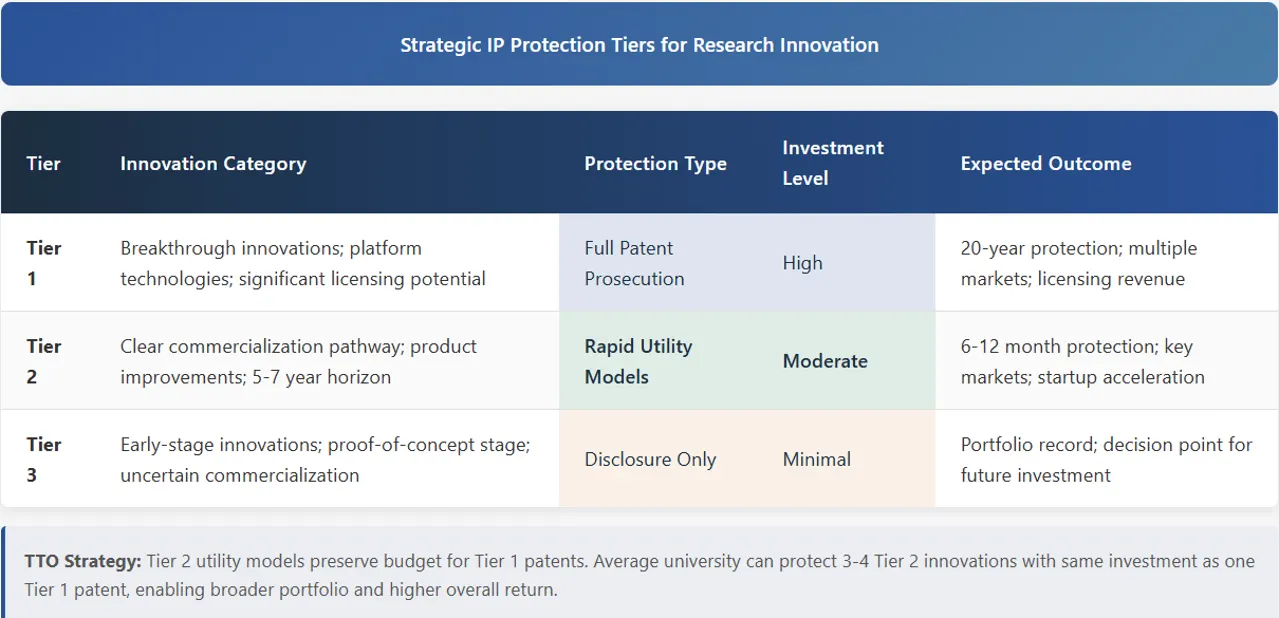
University IP Portfolio Tiering Strategy (PCT for Utility Models)
University Technology Transfer Office Functions
Modern university technology transfer offices manage multifaceted functions related to academic research commercialization:
Core TTO Responsibilities
- Invention Disclosure Processing: Receive disclosures from researchers describing innovations; evaluate commercialization and IP protection potential
- Patentability Assessment: Conduct preliminary patentability analysis to determine whether seeking IP protection is justified
- Prior Art Investigation: Identify existing patents, publications, or products that may impact protection viability
- IP Filing Strategy: Determine optimal protection mechanism (patent, utility model, trademark, trade secret) for each innovation
- Prosecution Management: Coordinate with patent/IP counsel; monitor prosecution timelines and costs
- Licensing and Commercialization: Identify potential industry partners; negotiate technology licenses and commercialization agreements
- Startup Support: Assist researcher-inventors in forming startup companies to commercialize innovations
- Revenue Management: Collect and distribute license revenues and royalties according to institutional policies
Utility Model Advantages in University Technology Transfer
University TTOs increasingly recognize utility models as valuable tools in their IP strategy portfolio:
Strategic Benefits of Utility Model Focus
Rapid Time-to-Commercialization
Utility models grant protection in 6-12 months compared to 3-5+ years for patents. This acceleration enables faster licensing discussions with industry partners, startup funding presentations, and market entry. Early protection status strengthens negotiating positions and reduces uncertainty for commercialization partners.
Cost Management and Budget Efficiency
Utility model filing and maintenance costs are 40-60% lower than patent prosecution. Given university budget constraints, this cost efficiency allows TTOs to protect more innovations with limited budgets. Preserved resources can be allocated to patent protection of highest-value innovations.
Commercialization Decision Support
Rapid utility model protection enables universities to make commercialization decisions based on actual market interest rather than hypothetical future potential. By the time utility model grants, market feedback clarifies whether continued patent investment is justified.
Startup Company Positioning
Early-stage startups benefit substantially from rapid utility model protection, which strengthens funding presentations to angel investors and venture capitalists, supports IP valuations for equity fundraising, and demonstrates management commitment to IP strategy.
University IP Portfolio Strategy
Leading universities employ strategic, tiered approaches to IP protection reflecting innovation value and commercialization potential:
1st Tier: High-Value Innovations (Patent Protection)
- Breakthrough innovations with significant market potential
- Inventions with platform technology applications across multiple markets
- Innovations with substantial licensing revenue potential
- Inventions enabling significant startup company valuations
- Strategy: Full patent prosecution across major markets; significant investment justified
2nd Tier: Moderate-Value Innovations (Utility Model Protection)
- Innovations with clear commercialization pathway and industry interest
- Improvements and enhancements to existing products or processes
- Innovations with 5-7 year commercialization horizon
- Technologies protectable through utility models in major markets
- Strategy: Rapid utility model protection in key markets; deferred patent decisions pending market performance
3rd Tier: Exploratory Innovations (Provisional/Disclosure-Only)
- Early-stage innovations with uncertain commercialization potential
- Technologies still in proof-of-concept stages
- Innovations requiring further development and validation
- Strategy: Record in university invention disclosure system; defer filing decisions pending further development
International Filing Strategy for University Research
Universities pursuing global commercialization employ strategic international filing approaches:
Geographic Prioritization Framework
- Home Country Filing: Always file in university’s home country; establishes priority date and strengthens IP portfolio
- Primary Commercial Markets: Designate countries representing existing commercialization partnerships or major potential markets (US, EU, Japan, China typically included)
- Emerging Market Opportunities: Consider strategic markets with high growth potential (India, Southeast Asia, Brazil)
- Cost-Benefit Analysis: Evaluate filing cost against commercialization probability in each jurisdiction
- Utility Model Market Focus: Prioritize jurisdictions with strong utility model systems (China, Germany, Japan) for rapid protection and cost efficiency
PCT Filing Advantages for Universities
- Single International Application: File once in home country; designates all desired countries simultaneously
- Deferred Cost Commitment: International phase fees are modest; major costs deferred to national phase entry at 30 months
- Market Assessment Period: 30-month window allows evaluation of actual commercialization interest before committing to national phase costs
- Flexible Designation: Modify country designations between international filing and national phase entry based on market developments
- International Opinion: Obtain objective international search and examination results strengthening national phase prosecution
Startup Company Support and IP Strategy
Many university innovations are commercialized through startup companies formed by researcher-inventors. University IP policies and protection strategies significantly impact startup viability:
University-Startup IP Relationships
- IP Licensing: University typically retains ownership; grants exclusive or non-exclusive license to startup for commercialization
- Equity Positions: Universities increasingly accept equity stakes in startup companies as partial payment for technology licenses
- Prosecution Cost Sharing: Startups typically fund additional national phase filings; universities maintain control of basic PCT application
- Revenue Sharing: License agreements specify how license fees and royalties are shared between university and researcher-inventors
- Follow-On IP: Policies clarify whether improvements and extensions developed by startup belong to startup or are shared with university
Utility Model Role in Startup Financing
- Investor Confidence: Rapid utility model protection strengthens startup investor presentations; demonstrates IP protection regardless of patent timeline
- Valuation Enhancement: Granted utility models increase startup technology valuations for equity fundraising
- Financing Documentation: Utility model grants provide concrete IP assets for collateral in equipment financing and lines of credit
- Customer Relationships: Customers gain confidence knowing technology is formally protected through utility models
Best Practices in University Technology Transfer
Leading universities employ systematic best practices in technology transfer involving utility models and PCT protection:
Invention Disclosure and Evaluation
- Establish inventor-friendly disclosure processes encouraging prompt reporting of innovations
- Conduct rapid preliminary evaluations determining IP protection appropriateness within 30-60 days
- Provide inventors with timely feedback on protection decisions and rationale
- Maintain transparent policies clarifying when protection is pursued vs. deferred
- Enable inventors to fund protection for innovations the university will not protect
Filing Strategy and Prosecution Management
- Establish clear criteria for patent vs. utility model vs. alternative protection decisions
- Employ experienced IP counsel familiar with both patent and utility model prosecution
- Maintain regular communication with researchers about filing timelines and IP strategy
- Implement cost control mechanisms for prosecution management
- Track prosecution timelines and ensure timely responses to office actions
Commercialization and Licensing Support
- Maintain active engagement with industry to identify licensing opportunities
- Develop clear licensing agreement templates balancing university and industry interests
- Provide startup company formation support including IP licensing mechanisms
- Implement inventor incentive programs encouraging IP development and commercialization participation
- Track commercialization outcomes and adjust strategies based on results
Also, Read: Why Choose PCT Filing? 5 Key Reasons
Conclusion: Strategic Use of PCT for Utility Models
The integration of utility model protection through the Patent Cooperation Treaty system represents a sophisticated approach to international IP strategy. As this comprehensive guide has demonstrated, PCT utility model protection provides distinct advantages in speed, cost efficiency, and market coverage for applicants willing to navigate the nuanced landscape of global utility model systems.
Key strategic principles emerge from the detailed analysis across academic, commercial, and research contexts:
- Systematic Evaluation: Determine invention classification and IP protection eligibility before proceeding with filing; utility models are not universally appropriate for all innovations
- Geographic Strategy: Identify target markets with both strong utility model systems and actual commercialization potential; focus resources on jurisdictions offering both protection and market opportunity
- Timing Optimization: Leverage utility models’ rapid prosecution timelines for competitive advantage; obtain protection rapidly in key markets while assessing long-term patent potential
- Cost Consciousness: Utilize utility model protection’s cost advantages to preserve capital for patent protection of highest-value innovations and expansion into additional markets
- Flexibility and Evolution: Recognize that utility model strategies should evolve as market conditions change, competitive landscape shifts, and commercialization opportunities emerge
For academic institutions and research organizations, utility model protection through PCT mechanisms enables rapid validation and commercialization of innovations. In the case of commercial enterprises, utility models provide expedited market protection supporting startup ventures and rapid product launches. For technology-intensive companies, strategically integrated patent and utility model portfolios maximize return on IP investment.
The future trajectory of utility model systems continues to evolve, with emerging markets increasingly recognizing utility model importance and established systems refining examination standards and enforcement mechanisms. Applicants who understand the strategic leverage points of utility model protection and implement sophisticated PCT strategies will capture disproportionate value from their innovation investments.
Taking Action: Next Steps for Applicants (PCT for Utility Models)
If your organization develops innovations potentially suitable for utility model protection, initiate discussion with qualified IP counsel regarding PCT strategy options. Conduct preliminary market and competitive analysis to identify target jurisdictions. Evaluate invention classification to confirm utility model eligibility. Establish timeline for filing before any public disclosure. Develop commercialization strategy clarifying which markets represent priority for rapid protection. Execute comprehensive filing strategy coordinating international phase timing with national designation decisions. Monitor market performance and adjust strategy as competitive landscape and commercial opportunities evolve.
Start your PCT patent filing journey today with careful planning, professional guidance, and a clear understanding of your commercial objectives.
Our Services Discover PCT Application Services.

