
PCT Filing Through USPTO and CIPO can help you navigate the complexities of USPTO and CIPO PCT filing with confidence. This comprehensive guide covers everything US and Canadian patent applicants need to know about international patent protection through the Patent Cooperation Treaty.” US and Canadian applicants who want expert support at every stage of this process can rely on our PCT application filing services to manage USPTO and CIPO PCT submissions accurately and on time.

PCT Filing Through USPTO and CIPO: Filing Through USPTO
The United States Patent and Trademark Office (USPTO) serves as a Receiving Office for the Patent Cooperation Treaty, enabling US-based inventors and applicants to file international patent applications efficiently. PCT USPTO filing represents a critical step for companies and inventors seeking patent protection across multiple countries without filing separate applications in each jurisdiction.
When you file a PCT USPTO application, you’re initiating a centralized process that simplifies international patent protection. Rather than navigating individual patent offices in each target country, the PCT USPTO system allows a single international application to establish priority dates across WIPO (World Intellectual Property Organization) member states.
The PCT Application Process at USPTO
The process begins with filing a PCT application at the USPTO as your Receiving Office. This application must include:
- A request form (PCT Form)
- A description of your invention
- Claims defining the scope of patent protection
- Drawings (if applicable)
- Abstract of the disclosure
- Appropriate fees
Key Point: Filing a PCT USPTO application doesn’t require you to hire an agent or attorney in other countries. The international application establishes your filing date across all designated member states simultaneously.
The USPTO assigns a Receiving Office number and conducts a completeness check to ensure your application meets PCT requirements. Applicants can track their application status through the PCT SAFE portal, the official electronic filing system for PCT USPTO applications.
Also, Read: National Phase Entry Patent Filing Process, Deadline and Strategy
USPTO as a Receiving Office: Advantages
Choosing the USPTO as your Receiving Office offers numerous strategic and procedural advantages for US applicants and international companies with US operations.
Primary Advantages of USPTO Filing
1. Streamlined Domestic Integration: Filing your PCT at USPTO keeps your patent portfolio centralized. You can manage your domestic US patent application and international filings through the same office, reducing administrative complexity. The filing date at the USPTO serves as your international priority date, eliminating the need for separate priority claims.
2. Familiar Processing and Examination Standards: As a US applicant, you’re already familiar with USPTO examination procedures and requirements. Filing your PCT application through USPTO means following established processes you understand, reducing the learning curve for international filing.
3. Cost Efficiency for US Entities: US applicants filing through USPTO as a Receiving Office often benefit from competitive fee structures. The USPTO offers reasonable application fees, and consolidating domestic and international filings reduces overall patent prosecution costs.
4. Potential for Accelerated Processing: The PCT SAFE system at the USPTO provides electronic filing with faster processing times. Additionally, US applicants may qualify for fee reductions as a small entity or micro-entity under USPTO guidelines.
5. Access to a Comprehensive Patent Information System: The USPTO maintains extensive prior art databases and examination resources. Filing your PCT USPTO application gives you access to high-quality examiner feedback that can strengthen your international application before it reaches national offices.
Advantage Highlight: The USPTO examines your PCT application during the International Preliminary Examination (IPE) phase if requested. This pre-examination by a US examiner often provides valuable insights for refining your claims before they enter national phase proceedings in target countries.
Also, Read: ePCT Filing Guide using Online PCT Application System Guide
PCT Filing Through USPTO and CIPO: Filing Through CIPO (Canada)
The Canadian Intellectual Property Office (CIPO) also operates as a Receiving Office for the Patent Cooperation Treaty. CIPO PCT filing provides Canadian applicants and companies operating in Canada with a home-office filing option for international patent protection.
Why Canadian Applicants Choose CIPO for PCT Filing
1. Domestic Filing Priority: CIPO PCT filing allows Canadian inventors and companies to establish their patent priority date at their home office. This approach ensures your invention is documented and protected in the Canadian patent system while launching international protection.
2. Integrated Canadian Patent Strategy: Filing through CIPO as your Receiving Office keeps all Canadian-related patent matters in one jurisdiction. This is particularly valuable for Canadian companies focusing on domestic protection with international expansion options.
3. Bilingual Support: CIPO operates in both English and French, accommodating the bilingual nature of Canadian business. CIPO PCT applications can be filed in either official language, reducing translation requirements and associated costs for Francophone applicants.
4. Streamlined Application Process: CIPO PCT filing follows the same international PCT procedures but with CIPO-specific requirements and communication protocols. CIPO examiners provide completeness checks and examination services aligned with Canadian patent law understanding.
CIPO’s Role in the PCT Process
When filing through CIPO, the office conducts an International Preliminary Examination if your application enters that phase. This examination by CIPO examiners evaluates patentability based on Canadian and international standards, providing early guidance on your invention’s patentability in various jurisdictions.
CIPO PCT Advantage: CIPO PCT filing is particularly advantageous for Canadian biotechnology, pharmaceutical, and technology companies seeking international protection while maintaining strong home-country IP management.
Also, Read: PCT Filing Costs and Fees: Complete Breakdown
Required Forms and Documentation (US)
Filing a PCT application through USPTO requires specific forms and documentation to meet both USPTO and WIPO requirements. Understanding these requirements ensures your PCT USPTO application avoids delays and formal defects.
Essential PCT Forms and Documents
1. Request Form (Form PCT/RO/101 or Electronic Equivalent): This is the primary form for PCT USPTO filing. It includes:
- Applicant identification and contact information
- Inventor information (for the United States, required even when a company is the applicant)
- Title of the invention
- Designation of contracting states for international protection
- Priority claim information (if applicable)
- Declaration of inventorship and authority to file
2. Description of the Invention: Your specification must enable a person skilled in the art to make and use your invention. For PCT USPTO applications, the description should:
- Clearly describe the technical field
- State the background and prior art
- Explain the problem your invention solves
- Describe the invention in clear, concise language
- Include working examples or embodiments
- Describe the drawings (if applicable)
3. Claims: Your claims define the scope of patent protection. PCT application claims at the USPTO must:
- Be numbered sequentially
- Include at least one independent claim
- Follow proper legal language and structure
- Be fully supported by the specification
- Not exceed a reasonable scope relative to disclosure
4. Drawings (if applicable): For most inventions, drawings are essential. PCT USPTO requires:
- Clear, numbered figures
- Reference numerals corresponding to description
- Professional drafting standards
- Proper labeling and identification
5. Abstract: A brief summary (typically 150 words for PCT applications) of your invention:
- Concisely describes the technical field
- States the problem addressed
- Explains the solution or innovative aspect
- Describes primary advantages
6. Declaration of Inventorship (Declaration and Power of Attorney): For PCT USPTO applications, this document:
- Confirms inventorship
- Establishes authority to file
- May appoint a representative or patent agent
- Must be signed or electronically submitted
Documentation Requirement: All documents for PCT USPTO filing must be in English or properly translated into English. Electronic filing through the USPTO requires conversion to PDF format with proper specifications.
Additional Supporting Documentation
Sequence Listings (if applicable): Biotechnology and pharmaceutical PCT applications at USPTO containing nucleotide or amino acid sequences require standardized sequence listings in XML format using the ST.25 standard.
Fee Payment Documentation: PCT USPTO applications require payment calculations and submission proof. Electronic filing through PCT SAFE allows direct fee payment during submission.
Also, Read: Comprehensive PCT Guide: Mastering International Patent Applications
Required Forms and Documentation (Canada)
CIPO PCT filing requires documentation adapted to Canadian requirements while maintaining full PCT compliance. The process involves forms and documents specific to CIPO procedures.
Key Forms for CIPO PCT Applications
1. Request Form (CIPO-Specific PCT/RO/101): Similar to the USPTO form but submitted through CIPO:
- Applicant and inventor information (both individual and corporate applicants)
- Resident agent information (sometimes required for Canadian filings)
- Title and designation information
- Priority claims and references
2. Specification and Claims: CIPO PCT applications require:
- English or French language specifications
- Claims in the same language as the specification
- Technical descriptions meeting Canadian patent law standards
- Claims that properly support the disclosure
3. Drawings: CIPO requires:
- Professional-quality drawings meeting CIPO standards
- Clear numbering and reference identification
- Consistency with the written description
4. Abstract: CIPO PCT abstracts must clearly summarize the invention in 150 words or less, written in clear, concise language.
5. Declaration of Inventorship and Authority: For CIPO PCT applications:
- Inventors must be identified
- Authority to file must be confirmed
- A Canadian address may be required for at least one applicant
- Electronic signatures are accepted
CIPO-Specific Requirement: CIPO PCT filing may require a Canadian resident agent if the applicant has no fixed address in Canada. This agent serves as the point of contact for CIPO communications regarding your PCT application through CIPO.
Bilingual Considerations
One significant advantage of CIPO PCT filing is the ability to file in French. For Francophone inventors and companies, this eliminates the need for English translation during the initial filing stage. However, international PCT processing typically requires English translation for WIPO publication and international phase proceedings.
Fee Structure: USPTO vs. WIPO Direct Filing
Understanding the fee structure for PCT applications is crucial for budgeting your international patent strategy. PCT USPTO filing and CIPO PCT filing involve different fee schedules compared to direct WIPO filing.
USPTO PCT Application Fees
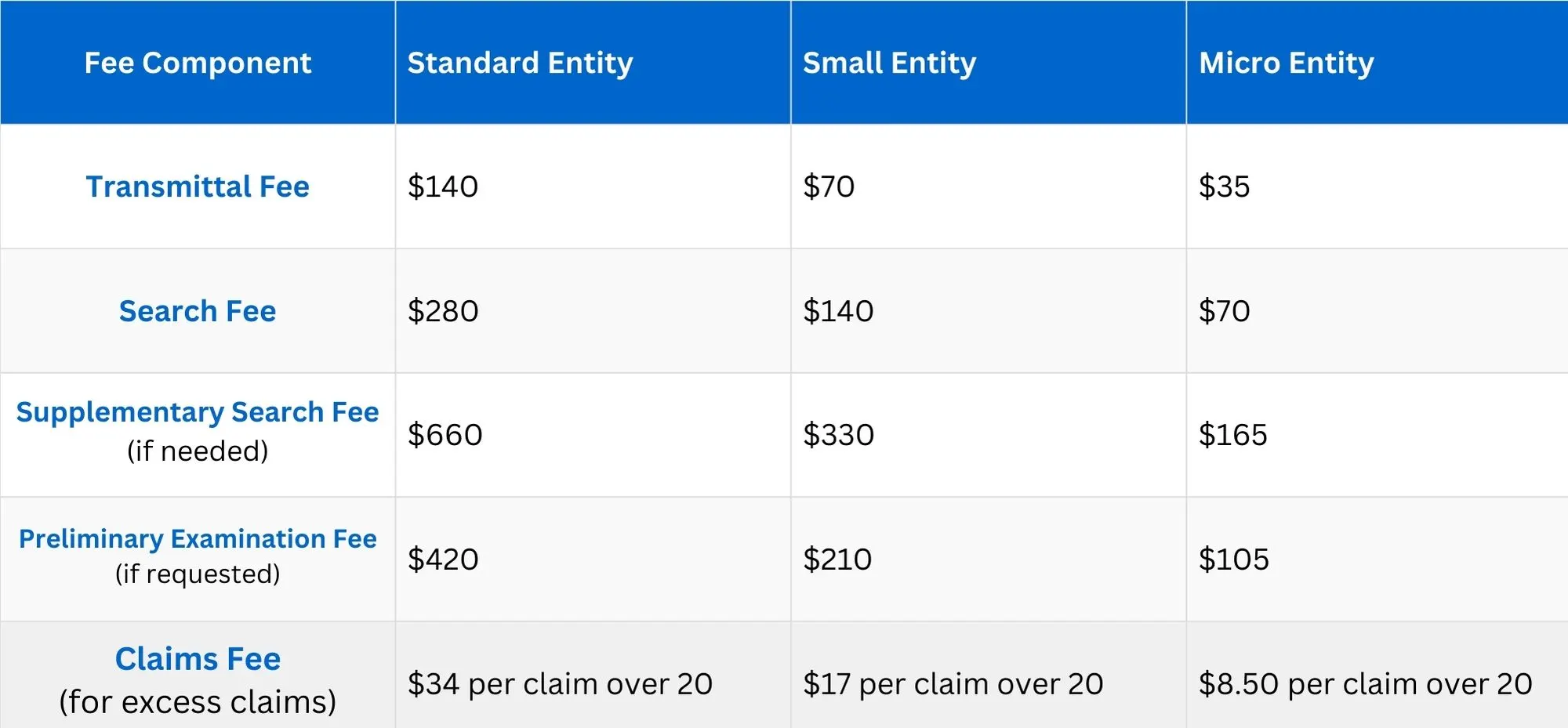
Fee Update Note: These fees are current as of 2025. Patent fees are subject to adjustment annually. Always verify current PCT USPTO fees on the official USPTO website before filing your application.
CIPO PCT Application Fees
CIPO PCT filing follows a different fee structure adapted for Canadian applicants:

Direct WIPO Filing vs. USPTO/CIPO Filing: PCT Filing Through USPTO and CIPO
When comparing PCT filing through USPTO versus direct WIPO filing, consider:
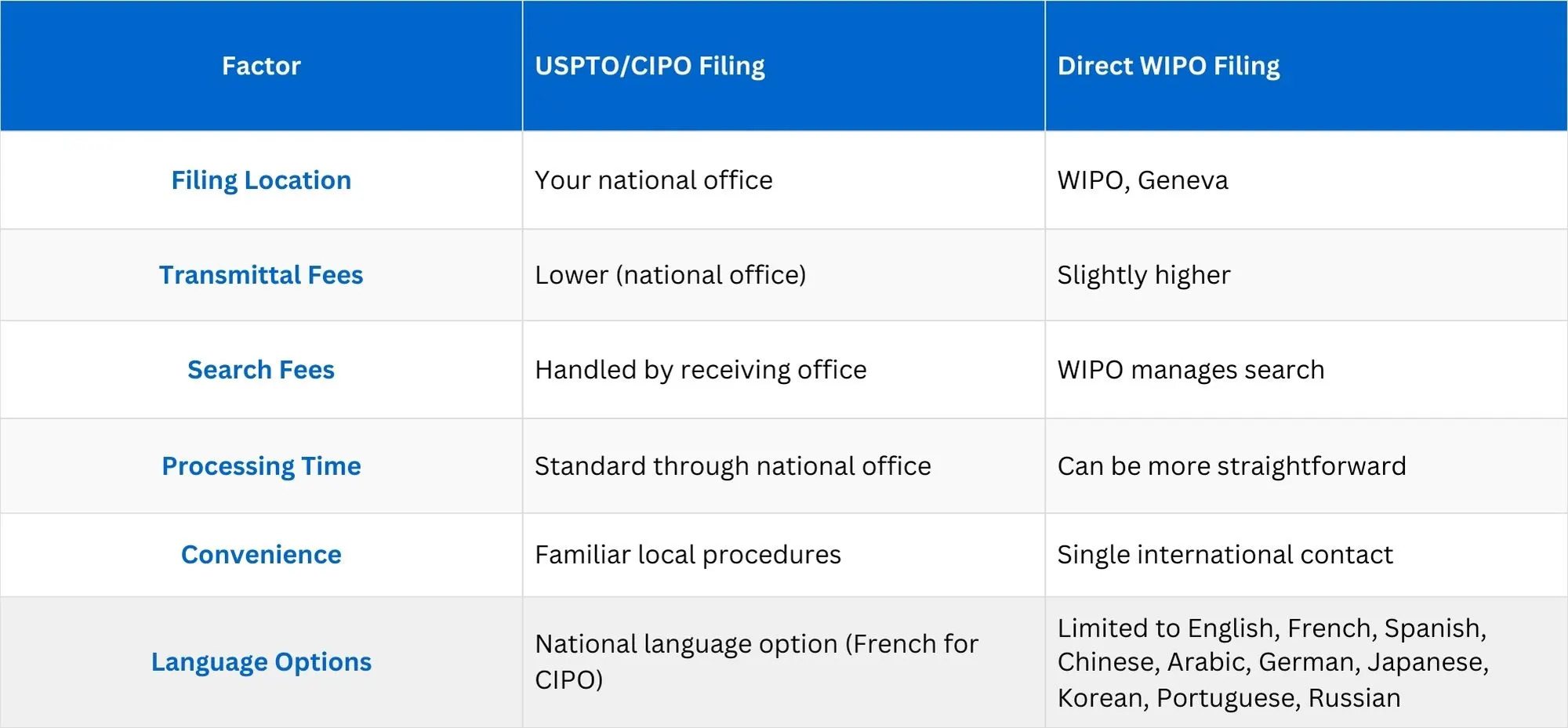
Cost Analysis: For most applicants, PCT filing through USPTO or CIPO offers competitive pricing compared to direct WIPO filing, especially when factoring in potential fee reductions for small entities.
Language Requirements for US and Canadian Filers
Filing language requirements vary notably between USPTO and CIPO PCT filings, influencing translation expenses and processing timelines.
Language Requirements for USPTO PCT Applications
Filing Language: All PCT applications through USPTO must be filed in English. This includes:
- The request form and all supporting documents
- The specification and claims
- The abstract
- All correspondence with the USPTO
Verification Language: Even if your original invention was conceived in another language, PCT USPTO requires English-language submissions. Any translated documents must be accompanied by certified translations or declarations of accuracy.
International Phase Language: While PCT applications filed at USPTO are processed in English, you can designate countries accepting other languages. The WIPO International Bureau will handle translation and publication in the designated international language for your application.
Language Requirements for CIPO PCT Applications
CIPO PCT filing offers significant linguistic flexibility:
Filing Language Options: CIPO accepts PCT applications in either English or French. This advantage is particularly valuable for:
- Francophone inventors in Quebec and other French-speaking regions
- Companies preferring French-language patent documentation
- Applicants seeking to reduce translation costs for initial filing
Processing Through CIPO: All communications between CIPO and the applicant can occur in English or French, as preferred. CIPO PCT applications maintain language consistency throughout the domestic phase.
International Phase Transition: When your CIPO PCT application enters the international phase, WIPO generally requires translation to English if your application is in French. This is a standard requirement for international patent processing.
Language Advantage for CIPO: CIPO PCT filing in French eliminates translation requirements during the early filing stage, potentially saving 6-12 weeks and reducing costs for French-speaking applicants.
USPTO ePCT Integration (PCT Filing Through USPTO and CIPO)
The USPTO ePCT system revolutionizes PCT USPTO filing by providing electronic submission, tracking, and management capabilities. Understanding how to leverage USPTO ePCT streamlines your entire international patent filing process.
What is USPTO ePCT?
ePCT is the official electronic filing and management platform for all PCT applications at USPTO. It integrates with the USPTO’s broader electronic filing infrastructure and provides:
- Real-time electronic filing of PCT applications through USPTO
- Instant confirmation of receipt and filing dates
- Secure transmission of documents
- Digital signature capability
- Integrated fee calculation and payment
- Application status tracking
Benefits of Using USPTO ePCT for PCT Filing
1. Immediate Filing Confirmation: When you submit your PCT application through USPTO ePCT, you receive instant confirmation of successful transmission. This eliminates uncertainty about whether your application was received and when your filing date is established.
2. Simplified Document Management: ePCT converts your documents to the required format automatically. You can upload specifications, claims, drawings, and other documents in standard formats, and ePCT handles the conversion to the proper filing standard.
3. Automatic Fee Calculation: PCT applications filed through ePCT include automatic fee calculation based on your application’s claims count, entity status, and designation selections. You can adjust these before final submission.
4. Secure Authentication: USPTO ePCT uses digital signatures and encryption to ensure your PCT USPTO filing is secure and legally binding. No wet signatures are required for electronic applications.
5. Real-Time Status Tracking: After filing your PCT application at USPTO, you can track its progress through every stage:
- Completeness examination by USPTO
- International searching phase
- Publication at WIPO
- Preliminary examination (if requested)
- National phase entry in target countries
ePCT Advantage: Applicants using USPTO ePCT for PCT filing report 30-40% faster processing times compared to paper-based submissions, particularly during the completeness check phase.
How to File Through USPTO ePCT
1st Step : Register for an ePCT Account Visit the USPTO ePCT portal and create an account. You’ll need:
- Valid email address
- User credentials
- Confirmation of legal authority to file
2nd Step : Prepare Your Documents Organize your PCT USPTO application materials:
- Specification in proper format (preferably PDF)
- Claims clearly delineated
- Abstract and technical field summary
- Drawings (if applicable) in proper size and format
- Declaration of inventorship
3rd Step : Complete the Request Form The ePCT interface guides you through completing the PCT/RO/101 form for PCT USPTO filing, with help text and validation at each step.
4th Step: Upload Documents Upload your specification, claims, drawings, and supporting documents through the ePCT platform. The system verifies document completeness and format.
5th Step : Review and Verify Before final submission, review your PCT application through ePCT:
- Verify all applicant and inventor information
- Confirm designated countries
- Check priority claims
- Review calculated fees
6th Step : Submit and Pay Fees Submit your PCT application through ePCT and arrange payment through the secure payment portal. Payment can be made immediately or deferred if permitted.
ePCT Features for Applicant Management
Application Monitoring: ePCT provides a dashboard showing all your PCT applications filed through USPTO, including:
- Filing dates and priority information
- Current examination status
- Office actions and correspondence
- Upcoming deadlines
- Publication status
Correspondence Management: All official communications regarding your PCT USPTO application are delivered through the ePCT portal, providing centralized access to important documents and notifications.
Also, Read: PCT National Phase Deadlines: Complete Timeline Guide
Receiving Office vs. International Bureau Filing
Understanding the distinction between Receiving Office filing (at USPTO or CIPO) and International Bureau filing (directly with WIPO) is crucial for optimizing your international patent strategy.
What is a Receiving Office?
A Receiving Office is a national or regional patent office authorized by WIPO to accept PCT applications. The USPTO and CIPO both operate as Receiving Offices. Their primary functions include:
- Receiving and validating PCT applications
- Conducting completeness checks
- Collecting and forwarding fees to WIPO
- Serving as the point of contact for applicants during the filing stage
- Assigning filing dates and application numbers
When you file a PCT application through USPTO or CIPO, you are working with your national Receiving Office.
What is the International Bureau (WIPO)?
The International Bureau is WIPO’s central administrative body that manages the PCT system globally. WIPO coordinates:
- International searching (assigning to International Searching Authorities)
- Publication of PCT applications (18 months from filing)
- Preliminary examination (if requested)
- Coordination of examination across member states
- Maintaining the official PCT record
The International Bureau receives information from Receiving Offices like USPTO and CIPO and coordinates the international phase of prosecution.
Filing at Receiving Office vs. Direct WIPO Filing

Strategic Decision: Choose PCT filing through USPTO if you’re a US applicant preferring to work with a familiar office. Choose CIPO if you’re Canadian or prefer French-language support. Consider direct WIPO filing only if you have a strong reason to bypass national offices.
Coordination Between Receiving Office and International Bureau
When you file your PCT application at USPTO or CIPO, the following process occurs:
- Receiving Office Validation: Your Receiving Office (USPTO or CIPO) validates that your PCT application meets minimum requirements and assigns a filing date.
- International Bureau Notification: Within specified timeframes, your Receiving Office forwards your application to the International Bureau.
- International Bureau Registration: WIPO registers your application in the international phase and assigns an international application number (typically beginning with WO).
- International Searching: WIPO coordinates with designated International Searching Authorities to conduct prior art searches.
- Publication: The International Bureau publishes your PCT application at 18 months from filing, regardless of whether Receiving Office or WIPO filing was used.
- Optional Preliminary Examination: If requested, WIPO coordinates preliminary examination through appropriate examiners.
- National Phase Entry: After the international phase, your application enters national phase proceedings in each designated country.
Security and Export Control Considerations (US Applicants)
US applicants filing PCT applications through USPTO must navigate critical security and export control requirements that don’t apply to Canadian applicants in the same way. These considerations are essential for compliance with US law and the international patent system.
Export Control Fundamentals for US Patent Applicants
The Core Issue: US law restricts the export of certain technical information, including patent applications in sensitive technology areas. PCT USPTO filings involving controlled technologies may trigger government review before international publication.
Key Regulations: US patent applicants must comply with:
- Export Administration Regulations (EAR): Enforced by the Commerce Department’s Bureau of Industry and Security, controlling technical information exports
- International Traffic in Arms Regulations (ITAR): Enforced by the State Department, controlling defense-related technologies
- USPTO Rules on Secrecy Orders: The USPTO can issue secrecy orders on patent applications involving national security technologies
Sensitive Technology Areas Requiring Review
Defense and Military Technologies: If your PCT application involves:
- Weapons systems or components
- Military encryption or communications
- Defense electronics or radar systems
- Aircraft, missile, or naval technologies
You must obtain approval from the State Department (ITAR) before filing your PCT USPTO application.
Dual-Use Technologies: Many commercial technologies have military applications. EAR controls apply to:
- Advanced semiconductors and electronics
- Cryptography and cybersecurity technologies
- Artificial intelligence and machine learning systems
- Advanced manufacturing processes
- Biotechnology and pharmaceuticals (certain areas)
- Quantum computing technologies
The Screening Process for PCT Applications
Initial Screening Requirement: When you file a PCT application at USPTO, you must indicate whether your invention is subject to export control restrictions. The USPTO request form includes a checkbox for disclosing foreign applications or export control concerns.
If Export Control is Triggered: The USPTO may issue a secrecy order on your PCT USPTO application, preventing:
- Publication of your application at 18 months (normal for PCT applications)
- Filing of PCT applications in foreign countries
- Disclosure to foreign nationals
- Communication of application details outside secure channels
Critical for US Applicants: Disclosing export control restrictions on your PCT application at USPTO is legally required. Failure to disclose can result in criminal penalties, even if the restriction seems burdensome.
Obtaining Approval for Controlled Technology PCT Filings
ITAR Approval Process (Defense-Related): For PCT applications involving ITAR-controlled technologies:
- Contact the State Department’s Directorate of Defense Trade Controls (DDTC)
- Provide technical details of your invention through a commodity jurisdiction (CJ) request
- Receive determination of whether technology is ITAR-controlled
- Obtain approval to file if permission is granted
- Proceed with PCT filing through USPTO with approval documentation
This process can take 30-90 days, so plan accordingly for your PCT filing timeline.
EAR Approval Process (Dual-Use): For commercial technologies with military potential:
- Determine if your technology is on the Commerce Control List (CCL)
- If listed, determine if your application requires a license
- Obtain any necessary export licenses before filing your PCT application
- File with all required authorizations
Impact on International Designations for PCT Applications
Country Restrictions: Even if you obtain approval to file your PCT application through USPTO, you may face restrictions on designating certain countries. Some countries are subject to comprehensive sanctions, and your PCT application cannot be published to those jurisdictions, even through the international PCT process.
Restricted Countries (Subject to Change): Your PCT USPTO filing typically cannot designate:
- North Korea
- Iran (for certain technologies)
- Syria (for certain technologies)
- Crimea region
- Other jurisdictions subject to comprehensive US sanctions
Before designating countries in your PCT application, verify current Office of Foreign Assets Control (OFAC) sanctions list to ensure compliance.
Navigating Export Control Without Overreporting
The Challenge: Many US applicants over-report export control concerns when filing PCT applications at USPTO, unnecessarily triggering reviews and delays.
Best Practice Guidance: When completing your PCT application form at the USPTO:
- Honestly evaluate whether your technology falls within EAR or ITAR categories
- Consult export control resources (Commerce Department’s CCL, State Department ITAR lists)
- When uncertain, seek guidance from an export control attorney rather than erring on the side of over-reporting
- Disclose actual restrictions, not speculative ones
- Provide clear, specific technical information in your PCT filing without including classified information
Export Control Best Practice: Work with an attorney experienced in both patent law and export controls when filing PCT applications involving potentially controlled technologies. The cost of consultation is minimal compared to the risks of non-compliance or unnecessary delays in your PCT USPTO filing.
Comparison with CIPO (Canadian Applicants)
CIPO PCT filing does not involve the same level of export control scrutiny as USPTO PCT applications. Canadian export controls exist but are generally less restrictive than US regulations. Canadian applicants with technologies that might face US restrictions can often file through CIPO first, establishing an earlier priority date before establishing a PCT application through USPTO.
Also, Read: Why Choose PCT Filing? 5 Key Reasons
Conclusion and Next Steps (PCT Filing Through USPTO and CIPO)
Filing PCT applications through USPTO or CIPO provides the most efficient path to international patent protection for US and Canadian applicants. Whether you choose PCT filing through the USPTO for convenience and cost efficiency or CIPO PCT filing for bilingual support and Canadian integration, the PCT system streamlines your international IP strategy.
Key Takeaways:
- PCT USPTO filing offers streamlined integration with US domestic patent prosecution
- CIPO PCT filing provides bilingual support and Canadian applicant convenience
- Electronic filing through ePCT accelerates PCT applications and improves tracking
- Fee reductions for small entities and micro-entities make PCT filing more accessible
- US applicants must navigate export control requirements when filing PCT applications in sensitive technology areas
Ready to File Your PCT Filing Though USPTO and CIPO Application ?
Our Services Check PCT Application Services.

